


'The Marshes are Dead': Iraqi Buffalo Herders Wander in Search of Water

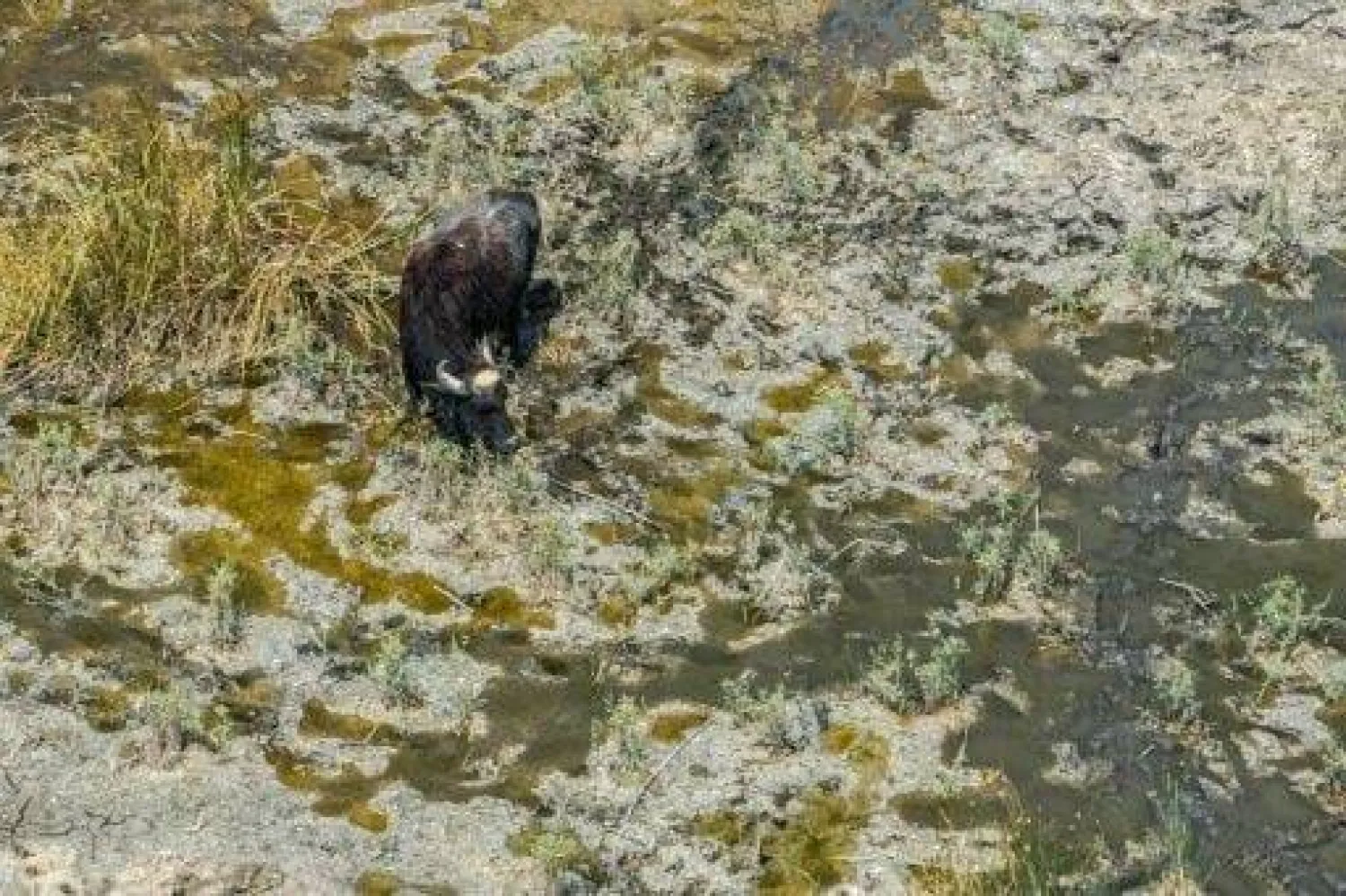
Years of drought have reduced southern Iraq's mythical marshes to a barren land. Asaad NIAZI / AFP
TT

'The Marshes are Dead': Iraqi Buffalo Herders Wander in Search of Water

Years of drought have reduced southern Iraq's mythical marshes to a barren land. Asaad NIAZI / AFP

Like his father, Iraqi buffalo herder Watheq Abbas grazes his animals in Iraq's southern wetlands, but with persistent drought shrinking marshland where they feed and decimating the herd, his millennia-old way of life is threatened.

"There's no more water, the marshes are dead," said 27-year-old Abbas, who has led his buffaloes to pasture in the marshland for the past 15 years.

"In the past, the drought would last one or two years, the water would return and the marshes would come back to life. Now we've gone without water for five years," the buffalo herder told AFP.

This year has been one of the driest since 1933, authorities have said, with summer temperatures topping 50C across Iraq, which is particularly vulnerable to the effects of climate change.

The UNESCO-listed swamplands in the country's south -- where tradition has it that the biblical Garden of Eden was located -- have sustained civilizations dating back to ancient Mesopotamia.

But the unrelenting dry spell has reduced the mythical waterways to a barren land of cracked earth, stripped of the slender reeds that once dominated the landscape.

Abbas and tens of thousands of Iraqis like him who rely on the marshes -- livestock herders, hunters and fishermen -- have watched helplessly as their source of livelihood evaporated.

At the Chibayish marshes, scarce water still fills some channels, which authorities have deepened so that animals like Abbas's 25 buffaloes could cool off.

For years, he and his herd have been on the move, heading wherever there was still water, in Chibayish or in the neighboring province of Missan.

'Battle for water'

But it has become an increasingly challenging feat. Last year, seven of his animals died.

Just recently Abbas lost another of his buffaloes which drank stagnant, brackish water that he said had "poisoned it".

The drought has been brought about by declining rainfall and soaring temperatures that increase evaporation.

But upstream dams built in Türkiye and in Iran have dramatically reduced the flow of the Tigris and Euphrates rivers in Iraq and exacerbated the effects of climate change.

With the Iraqi government forced to ration water supply to ensure the country's 46 million people have enough to drink and to meet agricultural needs, the marshes appear to be at the bottom of their priorities.

"There's a battle for water" in Iraq, said environmental activist Jassim al-Assadi, from the Nature Iraq NGO.

He was among a group of activists and engineers who two decades ago sought to re-flood 5,600 square kilometers (about 2,160 square miles) of marshland.

Today, only 800 square kilometers of the marshes are submerged, Assadi said, with many residents leaving the dried-up region.

The ecosystem of the marshes is also suffering irreversible damage, with turtles, otters and migratory birds among the victims.

"We used to have 48 species of fish but now only four remain, and from 140 species of wild birds we are now down to 22," said veterinarian Wissam al-Assadi.

'We have nothing else'

In collaboration with a French agriculture and veterinarian NGO, he helps treat the buffaloes, which in summer typically need be in the water for 14 hours a day and drink dozens of liters to avoid heat exhaustion.

But the reduced water flow means "the water does not renew, and salinity and pollution levels increase," the veterinarian explained.

"Animals that used to weigh 600 kilos (1,300 pounds) are now 400 or 300 kilos, their immune systems weaken and diseases multiply," he added.

The Mesopotamian water buffaloes now produce one-third of their usual output of milk, which is used to make cheese and geymar, a thick clotted cream that is a popular breakfast food in Iraq.

A UN report issued in July warned that "without urgent conservation measures", the buffalo population was "at risk of extinction".

Citing water scarcity as the cause, it said their numbers in the marshes have gone from 309,000 in 1974 to just 40,000 in 2000.

Towayeh Faraj, 50, who has lived in the hamlet of Hassja in Chibayish for the past two years, said he has been wandering the marshes for three decades to find water for his buffaloes.

"If the livestock is alive, so are we," he said.

"We have nothing else: no salary, no jobs, no state support."

He has 30 animals -- down from the 120 he began his career with, selling many off one-by-one to buy fodder for the remaining herd.

Faraj inherited the profession from his father, but the family tradition might end with him. His eldest of 16 children works for a Chinese oil company, and another is a minibus driver.



Macron’s ‘Top Gun’ Shades Charm Internet as Leaders Wrangle Over Greenland

 French President Emmanuel Macron, wearing sunglasses, speaks during a meeting on the institutional future of New Caledonia at the Elysee Palace in Paris, France, January 16, 2026. (Reuters)
French President Emmanuel Macron, wearing sunglasses, speaks during a meeting on the institutional future of New Caledonia at the Elysee Palace in Paris, France, January 16, 2026. (Reuters)
TT

Macron’s ‘Top Gun’ Shades Charm Internet as Leaders Wrangle Over Greenland

 French President Emmanuel Macron, wearing sunglasses, speaks during a meeting on the institutional future of New Caledonia at the Elysee Palace in Paris, France, January 16, 2026. (Reuters)
French President Emmanuel Macron, wearing sunglasses, speaks during a meeting on the institutional future of New Caledonia at the Elysee Palace in Paris, France, January 16, 2026. (Reuters)

French President Emmanuel Macron's aviator sunglasses have caught the eye, with social media users debating his choice of a "Top Gun" look as he criticized US President Donald Trump over Greenland during his speech in Davos.

As he spoke at the annual World Economic Forum in the Swiss mountain resort of Davos on Tuesday, the French president wore dark, reflective sunglasses.

Memes, comments and speculation over his appearance surged on social media, with some supporters praising him for his "Top Gun" look while opponents dismissed it as bombastic or speculated ‌about his ‌health.

Macron's office said the choice to ‌wear ⁠sunglasses during his ‌speech, which took place indoors, was to protect his eyes because of a burst blood vessel.

One meme, with the headline "Duel in Davos," was styled like a Top Gun parody, with Macron and Trump eyeballing each other, both wearing military-style flight suits, and Macron, looking very small next to Trump, sporting oversized aviator sunglasses.

References to the ⁠1986 movie starring Tom Cruise were ubiquitous.

"Trump: be careful ... Macron is here," one social ‌media user said on X, with a ‍picture of the French ‍president with the aviator glasses. "Could he not find some more sober ‍glasses?" another user asked.

Even Trump weighed in, mocking Macron for his glasses in his own Davos speech on Wednesday.

Meanwhile, some of Macron's colleagues had gotten in on the act, with European Affairs Minister Benjamin Haddad posting a version of the "Soyboy vs Yes Chad" meme with Chad donning aviators and draped in a French flag.

Italian ⁠group iVision Tech, which owns Henry Jullien, said the model worn by Macron was its Pacific S 01, with a price tag of 659 euros ($770) on its website. It said it sent Macron the sunglasses as a gift but that he had insisted on paying for them, and made sure they were made in France.

The Milan-listed stock was up almost 6% on Wednesday.

"The news this morning came as a surprise," the group's chief executive Stefano Fulchir said. "We were flooded with calls and requests on the ‌website ... The site crashed."


3 Authors Win $10,000 Prizes for Blending Science and Literature

This combination of images shows cover art for “Ancient Light” by Kimberly Blaeser, left, “Bog Queen” by Anna North, center, and “Forest Euphoria: The Abounding Queerness of Nature” by Patricia Ononiwu Kaishian. (University of Arizona Press/Bloomsbury Publishing/Spiegel & Grau via AP)
TT

3 Authors Win $10,000 Prizes for Blending Science and Literature

This combination of images shows cover art for “Ancient Light” by Kimberly Blaeser, left, “Bog Queen” by Anna North, center, and “Forest Euphoria: The Abounding Queerness of Nature” by Patricia Ononiwu Kaishian. (University of Arizona Press/Bloomsbury Publishing/Spiegel & Grau via AP)

Three authors who demonstrated how scientific research can be wedded to literary grace have been awarded $10,000 prizes.

On Wednesday, the National Book Foundation and the Alfred P. Sloan Foundation announced the winners of the fifth annual Science + Literature awards. The books include Kimberly Blaeser's poetry collection, “Ancient Light,” inspired in part by the environmental destruction of Indigenous communities; the novel “Bog Queen” by Anna North, the story of a forensic anthropologist and a 2000-year-old Celtic druid; and a work of nonfiction, Patricia Ononiwu Kaishian's “Forest Euphoria: The Abounding Queerness of Nature.”

“These gifted storytellers shine a scientific and poetic light on the beauties and terrors of nature and what they reveal to us about our deepest selves, our humanity, and our existence on this planet,” Doron Weber, vice president and program director at the Sloan Foundation, said in a statement, The AP news reported.

Ruth Dickey, executive director of the National Book Foundation, said in a statement that the new winners continue the awards' mission to highlight “diverse voices in science writing that ... enlighten, challenge, and engage readers everywhere.”

The Book Foundation presents the National Book Awards, one of the literary world's most prestigious events. The Sloan Foundation has a long history of supporting books that join science and the humanities, including Kai Bird's and Martin J. Sherwin’s Pulitzer Prize-winning “American Prometheus,” which director Christopher Nolan adapted into the Oscar-winning “Oppenheimer.”

“At a time when science is under attack, it has become more urgent to elevate books that bring together the art of literature with the wonders of science,” Daisy Hernández, this year's chair of the awards committee and a 2022 Science + Literature honoree, said in a statement.


Meteorologists Blame a Stretched Polar Vortex, Moisture, Lack of Sea Ice for Dangerous Winter Blast

Ice forms along the Lake Michigan shore as People walk their dogs on a beach, Tuesday, Jan. 20, 2026, in Chicago. (AP Photo/Kiichiro Sato)
TT

Meteorologists Blame a Stretched Polar Vortex, Moisture, Lack of Sea Ice for Dangerous Winter Blast

Ice forms along the Lake Michigan shore as People walk their dogs on a beach, Tuesday, Jan. 20, 2026, in Chicago. (AP Photo/Kiichiro Sato)

Warm Arctic waters and cold continental land are combining to stretch the dreaded polar vortex in a way that will send much of the United States a devastating dose of winter later this week with swaths of painful subzero temperatures, heavy snow and powerline-toppling ice.

Meteorologists said the eastern two-thirds of the nation is threatened with a winter storm that could rival the damage of a major hurricane and has some origins in an Arctic that is warming from climate change. They warn that the frigid weather is likely to stick around through the rest of January and into early February, meaning the snow and ice that accumulates will take a long time to melt.

Wednesday’s forecast has the storm stretching from New Mexico to New England, threatening at least 250 million people.

“I think people are underestimating just how bad it’s going to be,” said former National Oceanic and Atmospheric Administration chief scientist Ryan Maue, now a private meteorologist.

The polar vortex, a patch of bitter cold air that often stays penned up in northern Canada and Alaska, is being elongated by a wave in the upper atmosphere that goes back to a relatively ice-free part of the Arctic and snow-buried Siberia. As the bone-chilling temperatures sweep through the US, they'll meet with moisture from off California and the Gulf of Mexico to set up crippling ice and snow in many areas.

Origins of the system in a warming Arctic The origins of the system begin in the Arctic, where relatively warmer temperatures add energy to the polar vortex and help push its cold air south.

“The atmosphere is aligned perfectly that the pattern is locked into this warm Arctic, cold continent," Maue said. "And it’s not just here for us in North America, but the landmass of Eastern Europe to Siberia is also exceptionally cold. The whole hemisphere has gone into the deep freeze.”

As far back as October 2025, changes in the Arctic and low sea ice were setting up conditions for the kind of stretched polar vortex that brings severe winter weather to the US, said winter weather expert Judah Cohen, an MIT research scientist. Heavy Siberian snowfall added to the push-and-pull of weather that warps the shape of the normally mostly circular air pattern. Those conditions “kind of loaded the dice a bit'' for a stretching of the polar vortex, he said, The AP news reported.

Cohen co-authored a July 2025 study that found more stretched polar vortex events linked to severe winter weather bursts in the central and eastern US over the past decade. Cohen said part of the reason is that dramatically low sea ice in the Barents and Kara seas in the Arctic helps set up a pattern of waves that end up causing US cold bursts. A warmer Arctic is causing sea ice in that region to shrink faster than other places, studies have found.

Arctic sea ice is at a record low extent for this time of year, according to the National Snow and Ice Data Center.

Where the winter blast will strike The center of the stretched polar vortex will be somewhere above Duluth, Minnesota, by Friday morning, ushering in “long-lasting brutal cold,” Maue said. Temperatures in the North and Midwest will get about as cold as possible, even down to minus 25 or 30 degrees Fahrenheit (minus 32 to minus 34 degrees Celsius), Maue said. The average low temperature for the Lower 48 states will dance around 11 or 12 degrees (minus 12 to minus 11 degrees Celsius) on Saturday, Sunday and Monday, Maue said.

Two Great Lakes — Erie and Ontario — may freeze up, which would at least reduce the famed lake-effect snow a bit, Maue said.

National Weather Service meteorologist Zack Taylor of the national Weather Prediction Center said most areas east of the Rockies will be impacted by the bitter cold, snow or ice. Treacherous freezing rain could stretch from the southern plains through the mid-South and into the Carolinas, he said.

“We’re looking at the potential for impactful ice accumulation. So the kind of ice accumulation that could cause significant or widespread power outages or potentially significant tree damage,” he said.

And if you don't get ice, you could get “another significant swath of heavy snow,” Taylor said. He said it was too early to predict how many inches will fall, but “significant snowfall accumulations” could hit "the Ozarks region, Tennessee and Ohio valleys, the central Appalachians, and then into the mid-Atlantic, and perhaps into the portions of the northeast.”

Maue said in the mid-Atlantic around the nation's capital, there's a possibility that “you can get two blizzards on top of each other in the next 14 days.”