


Tropical Storm Leaves 3 Dead in Vietnam and Brings Heavy Rain to Parts of Southeast Asia 

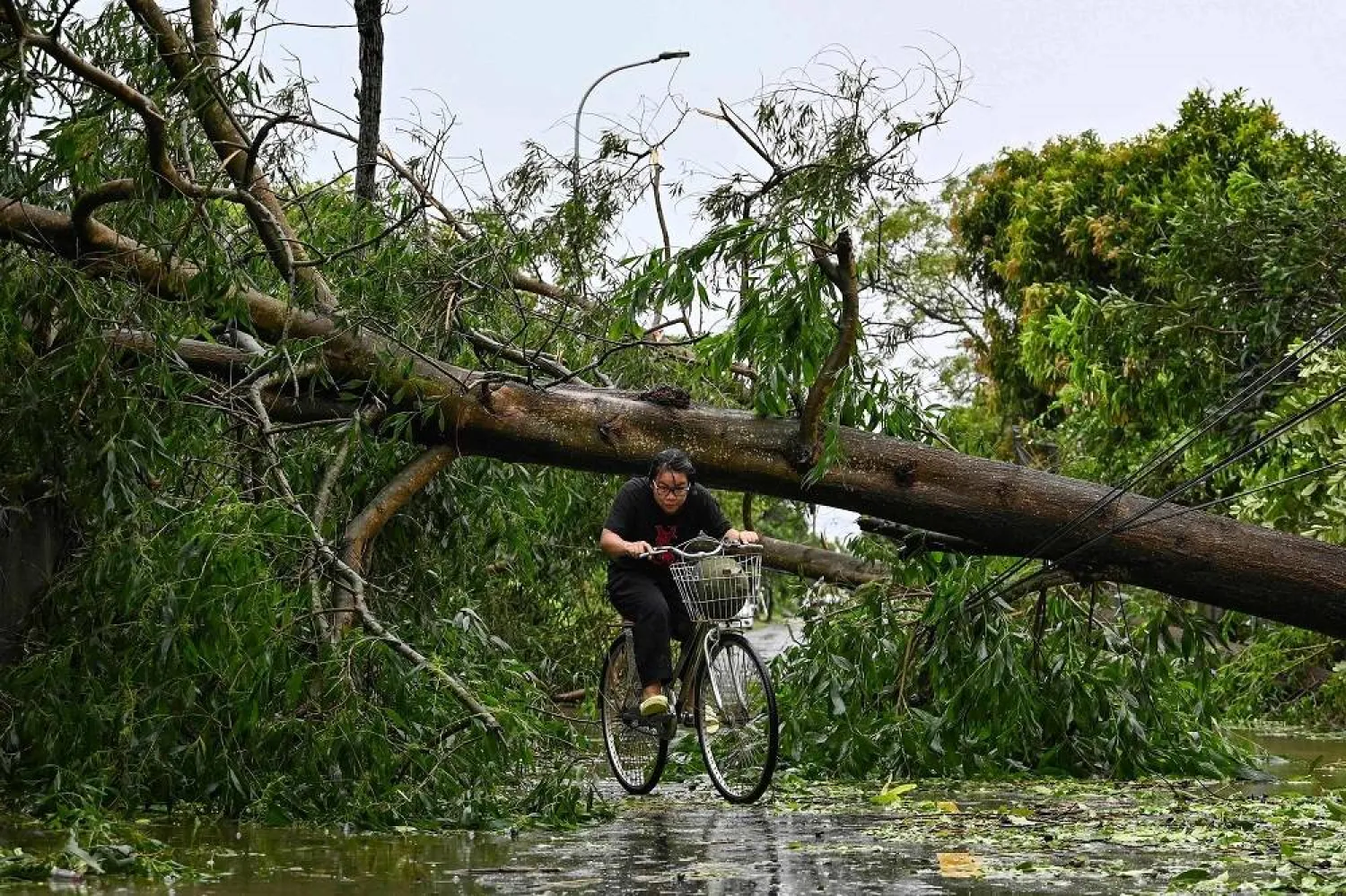
A woman rides her bicycle to make her way under a fallen tree blocking the road after Typhoon Kajiki passed through Nghe An province on August 26, 2025. (AFP)
TT

Tropical Storm Leaves 3 Dead in Vietnam and Brings Heavy Rain to Parts of Southeast Asia 

A woman rides her bicycle to make her way under a fallen tree blocking the road after Typhoon Kajiki passed through Nghe An province on August 26, 2025. (AFP)

Heavy rain fell Tuesday in parts of Southeast Asia after a tropical storm made landfall in Vietnam, causing at least three deaths, damage to homes and flooding in the capital and coastal areas.

State television network VTV said the remnants of Typhoon Kajiki were moving over Laos on Tuesday. Heavy rain also was forecast in Thailand and people were told to be vigilant about possible flooding into Wednesday.

Three people died, including a 90-year-old man whose house collapsed in the rain and a man who was electrocuted Friday while preparing his home for the storm, while 13 people were injured and thousands of houses were damaged in the country's central region, VTV reported.

The storm reportedly caused electricity outages in Nghe An province beginning Monday night.

In Hanoi on Tuesday, people tried to move motorbikes through deep water as cars and buses slowly moved along flooded streets.

“It’s flooding everywhere because it has been raining so much. I’m stuck here and can’t get to work,” said Nguyen Thu Quynh, an office worker who pushed her motorcycle out of a street flooded with knee-deep water.

Prior to the storm's landfall Monday afternoon, Vietnam's government planned to evacuate nearly 600,000 people in Thanh Hoa, Quang Tri, Hue and Danang provinces, where more than 152,000 homes were in high-risk areas. More than 16,500 soldiers and 107,000 paramilitary personnel were assisting with evacuations or were on standby for search and rescue, VTV reported.

Two airports in Thanh Hoa and Quang Tri provinces remained closed Tuesday after flights were halted Monday.

The national weather agency said Kajiki made landfall Monday afternoon in central Vietnam with maximum sustained winds of 117 kph (73 mph). The torrential rain triggered flash flood and landslide alerts. It hit during high tides that caused coastal flooding in Nghe An and Ha Tinh provinces.

Kajiki earlier brought winds and rain to China's southern Hainan Island.

In Thailand, the Meteorological Department warned of heavy rain nationwide Tuesday. Residents in foothills and low-lying areas near waterways were warned about possible flash floods and landslides.

Scientists published a 2024 study warning seas warmed by climate change will result in Southeast Asia’s cyclones forming closer to land, strengthening faster and lasting longer and raising risks for cities.



Netanyahu Says He Was Successfully Treated for Prostate Cancer

Israel’s Prime Minister Benjamin Netanyahu attends a ceremony commemorating Israel’s Remembrance Day for fallen soldiers, or Yom HaZikaron, at the Military Cemetery on Mount Herzl in Jerusalem April 21, 2026. (Reuters)
TT

Netanyahu Says He Was Successfully Treated for Prostate Cancer

Israel’s Prime Minister Benjamin Netanyahu attends a ceremony commemorating Israel’s Remembrance Day for fallen soldiers, or Yom HaZikaron, at the Military Cemetery on Mount Herzl in Jerusalem April 21, 2026. (Reuters)

Israeli Prime Minister Benjamin ‌Netanyahu said on Friday that he had received successful treatment for early-stage prostate cancer.

In a statement on X, as his annual medical report was released, Netanyahu, 76, said that during a routine checkup a “tiny spot” of less than a centimeter was found in his prostate and that further examination confirmed it was an early-stage malignant tumor with no spread or metastasis.

The PM had previously undergone surgery about a year and a half ago for an enlarged benign prostate.

Neither the recent medical report nor Netanyahu said when the treatment occurred, but the PM said he opted for immediate targeted treatment which successfully eliminated the issue.

Netanyahu said ‌that ⁠he had delayed the release of the medical report by two months to prevent Iran from spreading “false propaganda against Israel.”

The PM underwent surgery on his prostate in 2024 after he was diagnosed with a urinary tract infection resulting ⁠from a benign prostate enlargement. In 2023, he was fitted with a pacemaker.

Elections are due to be held in Israel by October.


US Envoys Heading to Pakistan for Uncertain Iran Talks

A view of a deserted road amid a high-level security lockdown due to anticipated US-Iran peace talks, in Islamabad, Pakistan, 25 April 2026. (EPA)
TT

US Envoys Heading to Pakistan for Uncertain Iran Talks

A view of a deserted road amid a high-level security lockdown due to anticipated US-Iran peace talks, in Islamabad, Pakistan, 25 April 2026. (EPA)

US envoys headed to the Pakistani capital Saturday in a bid to kickstart a new round of peace negotiations with Iran amid a fragile ceasefire, though the prospect of direct talks remained uncertain.

The White House said emissaries Steve Witkoff and Jared Kushner would engage in an "in-person conversation" with Iranian representatives, but Iranian state media said that direct negotiations were not in the cards.

Iran's foreign minister arrived in Islamabad on Friday.

Despite President Donald Trump's announcement on Thursday of a three-week ceasefire extension in Lebanon, Israeli strikes in the south of the country killed six people on Friday, the Lebanese health ministry said.

While Trump expressed confidence at the prospect of a lasting peace in Lebanon, sealing a deal to end the wider Middle East war is a thornier proposition, even as urgency mounts to reopen the Strait of Hormuz, a vital conduit for the world's oil and liquefied natural gas (LNG).

White House Press Secretary Karoline Leavitt said Witkoff and Kushner would head to Pakistan on Saturday "to engage in talks... with representatives from the Iranian delegation".

"The Iranians reached out, as the president called on them to do, and asked for this in-person conversation," Leavitt said, adding that the talks would "hopefully move the ball forward towards a deal".

Leavitt said Vice President JD Vance, who led a first round of negotiations in Islamabad two weeks ago that concluded without a deal, would not be joining for the time being, but was on "standby to fly to Pakistan if necessary".

It remained unclear late Friday whether the Iranian side would meet directly with the US envoys.

Iranian state television said Foreign Minister Abbas Araghchi has no plans to meet with the Americans, and Islamabad would serve as a bridge to "convey" Iranian proposals to end the conflict.

Pakistan's foreign ministry said Araghchi had arrived in Islamabad to discuss "ongoing efforts for regional peace and stability" with Pakistani officials, without directly referencing talks with Witkoff and Kushner.

An Iranian spokesman said Araghchi would visit Oman and Russia after the Pakistan stop to discuss efforts to end the war launched against Iran by Israel and the United States on February 28.

- EU says opening Hormuz 'vital' -

Since the last round of talks, efforts to bring the two sides back to the table have hit an impasse, with Iran refusing to participate as long as a US naval blockade on its ports remained in place.

Iran has imposed a de facto blockade of its own on the Strait of Hormuz, allowing only a trickle of ships to pass through the vital waterway, throwing global energy markets into turmoil.

Oil prices slid on Friday amid hopes that fresh peace talks would see an end to Tehran's disruption of trade through the strait.

European Council President Antonio Costa said Friday that the strait "must immediately reopen without restrictions and without tolling".

"This is vital for the entire world," Costa said.

Major Wall Street indices closed at fresh records on Friday as markets cheered the latest batch of earnings reports and US and Iranian officials headed to Pakistan.

The United States continued meanwhile to build up its forces in the Middle East with the arrival of its third aircraft carrier in the region, the USS George H.W. Bush.

- 'Destroyed' -

Trump spoke in glowing terms on Thursday of peace prospects for Lebanon after meeting with Israeli and Lebanese envoys, voicing hope for a three-way meeting with the Lebanese and Israeli leaders.

The two countries have been officially at war for decades and until last week had not met so directly since 1993.

Mohammed Raad, the head of Hezbollah's parliamentary bloc, urged the Lebanese government to withdraw from direct talks with Israel and warned that a lasting peace deal of the kind sought by Trump "will in no way enjoy Lebanese national consensus".

Israeli Prime Minister Benjamin Netanyahu, who has vowed to destroy the Iran-backed movement, said: "We have started a process to reach a historic peace between Israel and Lebanon, and it's clear to us that Hezbollah is trying to sabotage this."

In south Lebanon's Tyre, Mohamad Ali Hijazi was searching a mountain of rubble for mementos of family members killed in an Israeli airstrike minutes before the ceasefire took hold.

"I'm trying to find my mother's hairbrush...and a bottle of perfume that she loves," said Hijazi, 48 -- some of the last things he sent her from France, where he has long lived with his wife and two daughters.

"My life has been destroyed. I haven't slept for five days," he told AFP, repeatedly fighting back tears.


Merz Floats Sanctions Relief for Iran Peace Deal, Other EU Leaders Cautious

 Germany's Chancellor Friedrich Merz speaks during a press conference after taking part in an informal meeting of the European Council in Nicosia on April 24, 2026. (AFP)
Germany's Chancellor Friedrich Merz speaks during a press conference after taking part in an informal meeting of the European Council in Nicosia on April 24, 2026. (AFP)
TT

Merz Floats Sanctions Relief for Iran Peace Deal, Other EU Leaders Cautious

 Germany's Chancellor Friedrich Merz speaks during a press conference after taking part in an informal meeting of the European Council in Nicosia on April 24, 2026. (AFP)
Germany's Chancellor Friedrich Merz speaks during a press conference after taking part in an informal meeting of the European Council in Nicosia on April 24, 2026. (AFP)

German Chancellor Friedrich Merz suggested on Friday that the European Union could ease sanctions on Tehran as part of a comprehensive deal that would end the Iran war, but other EU leaders struck a more cautious note.

The 27-nation EU has imposed sanctions on Iran for years, including travel bans and asset freezes for senior officials and entities, in response to human rights violations, nuclear activities and military support for Russia.

US officials have suggested a ‌comprehensive deal covering Iran's ‌nuclear and missile programs and the ‌re-opening ⁠of the Strait of ⁠Hormuz could bring a lasting end to the US-Israeli war with Tehran, beyond the current ceasefire.

After an EU summit in Cyprus, Merz said the bloc could gradually ease sanctions on Iran in the event that a comprehensive agreement was reached.

European leaders have been largely sidelined in the current Middle ⁠East conflict but some European officials see ‌the bloc's sanctions as a possible ‌way for the EU to be involved in a diplomatic solution.

"The ‌easing of sanctions can be part of a process," ‌Merz told reporters after the Nicosia summit.

"No one has objected to that," he said of the summit deliberations. "It is, so to speak, part of the contribution we can make to advance this ‌process and, hopefully, lead to a permanent ceasefire."

But European Council President Antonio Costa, the chair ⁠of the summit, ⁠told a press conference after the end of the meeting: "It is too early to talk about relieving any kind of sanctions."

European Commission President Ursula von der Leyen said sanctions relief could only come after clear evidence of fundamental changes of course from Iran.

"We believe that sanctions relief should be conditional on verification of de-escalation, particularly on progress on the international effort to contain its nuclear threat, and on a change to the repression of its own people," she told the same press conference.