


James Cameron on Two Decades of Making ‘Avatar’ and the Future He Sees for Movies 

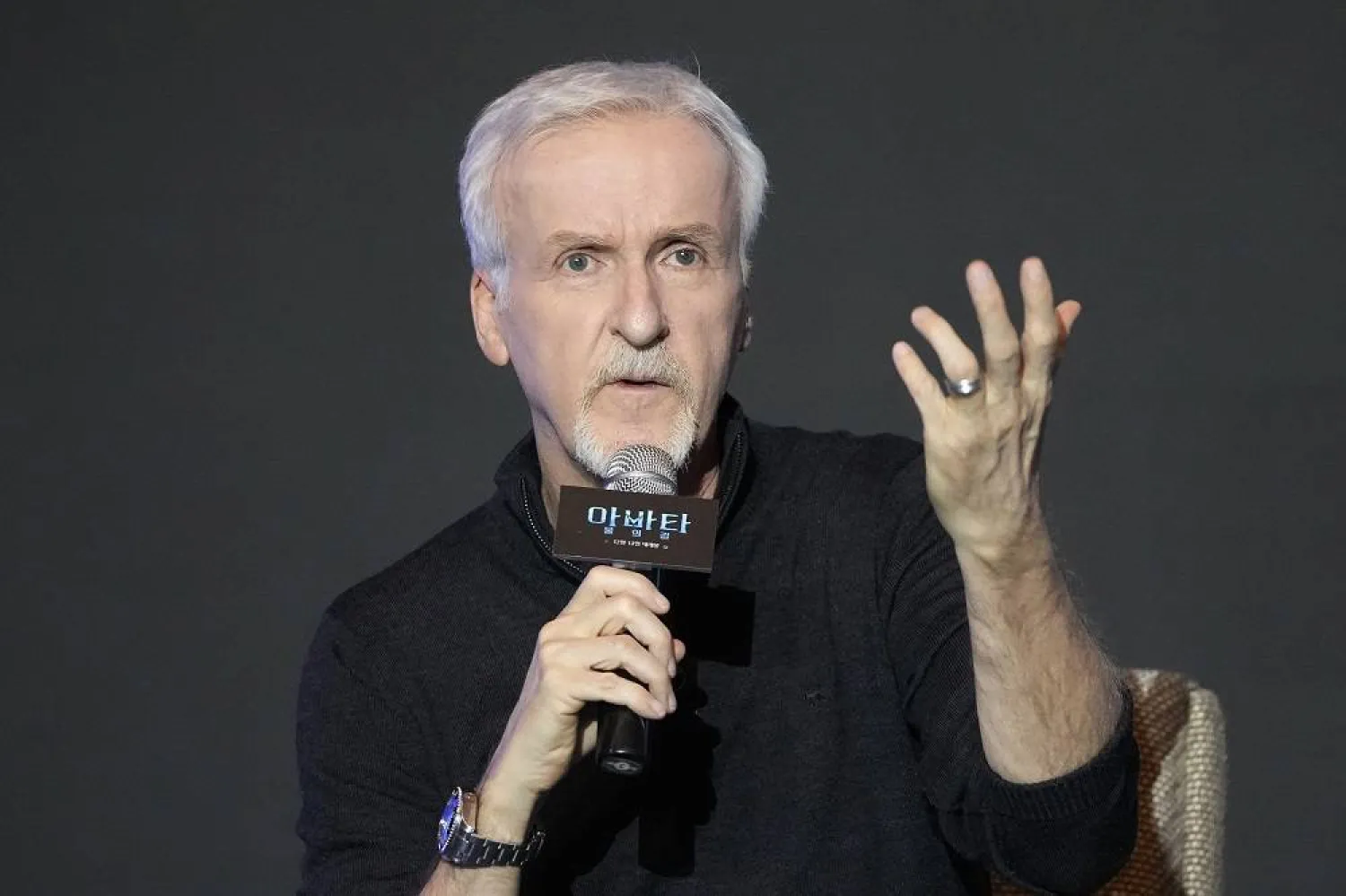
Director James Cameron speaks during the news conference to promote his latest movie "Avatar: The Way of Water" in Seoul, South Korea, on Dec. 9, 2022. (AP)
TT

James Cameron on Two Decades of Making ‘Avatar’ and the Future He Sees for Movies 

Director James Cameron speaks during the news conference to promote his latest movie "Avatar: The Way of Water" in Seoul, South Korea, on Dec. 9, 2022. (AP)

James Cameron recently turned 71 as he brought his third "Avatar" film, "Fire and Ash," to the finish line.

Cameron first began developing "Avatar" more than 30 years ago. He started working on the first film in earnest 20 years ago. Production on "Fire and Ash," which ran concurrently with 2022's "The Way of Water," got underway eight years ago.

By any measure, "Avatar" is one of the largest undertakings ever by a filmmaker. It's maybe the only project that could make "Titanic" look like a modest one-off. Cameron has dedicated a huge chunk of his life to it. Now, as he prepares to unveil the latest chapter of his Na'vi opus on Dec. 19, Cameron is approaching what he calls a crossroads.

"As you get older you start to think of time in a slightly different way," Cameron says from his 5,000-acre organic farm in New Zealand. "It’s not an infinite resource."

Two more "Avatar" films are already written and have release dates, in 2029 and 2031. Right now, though, Cameron is focused on completing "Fire and Ash," which is almost guaranteed to be the biggest movie of the fall. To get "Avatar" — a franchise already worth $5.2 billion in worldwide tickets sales — back in the minds of moviegoers, "The Way of Water" will also be rereleased Oct. 3.

"As I told the brass at Disney, we’re right at the glide slope to land right on time for delivery," Cameron says. "The first film was a nightmare. Movie two was hectic. But here, I keep having to pinch myself because it’s all going well. The film is strong."

There may be no filmmaker more at the nexus of past and future blockbuster making than Cameron. "Avatar: Fire and Ash" will arrive as Hollywood is reconciling itself to a new theatrical normal. In a movie industry of shrinking ambition, "Avatar," an original spectacle that once was the wave of the future, is already beginning to look like an endangered species.

In a recent interview, Cameron reflected on his history with "Avatar" and what's next for him, including a planned adaptation of Charles Pellegrino's "Ghosts of Hiroshima." For Cameron, most of his work is likely to touch on one of what he calls "the big three": Nuclear weapons, machine super intelligence and climate change.

"Avatar," a family saga that grows more complicated and darker in "Fire and Ash," relates to the latter. The films are environmental parables, set in a verdant faraway world. Sustainability, community, connection to nature — these are some of the pillars of Cameron's life right now, in the movies and outside them.

"I’m just a humble movie farmer," he says, smiling, "who’s also a farmer farmer."

AP: When you decided to embark on "Avatar," was it more likely that if you didn't, you'd spend your time mostly away from movies, doing deep sea exploration and other things?

CAMERON: It was sort of: Do the "Avatar" saga or follow my interests more. I knew that "Avatar" would be all-consuming, and it has been. When I set down that path, a reasonable projection was eight to 10 years to get it all written and do movie two and movie three together and get them out. But it’s actually turned out to be more than that. It was a major commitment and decision to make for me as a life choice.

But the "Avatar" movies reach people and they reach people with positive messaging. Not just positive about the environment but positive from the standpoint of humanity, empathy, spirituality, our connection to each other. And they’re beautiful. There’s a kind of magnetic draw into the film. It almost feels like it’s being pulled out of the audience’s dreams and subconscious state.

AP: "Avatar" began as a dream, didn't it?

CAMERON: I was 19. I was in college and I had a very vivid dream of a bioluminescent forest with glowing moss that reacted to your feet and these little spinning lizards that floated around. It’s all in the movie, by the way. The reason it’s in the movie is because I got up and painted it. That later became the inspiration, just a few years later, for a science-fiction script. I said, "Hey I got this idea for a planet where everything glows at night." We wrote that in and it never went away.

Years after that, when I was the CEO of Digital Domain, I wanted to push Digital Domain to be able to create CG worlds, CG humanoid creatures using performance capture. I just threw the kitchen sink into the treatment called "Avatar." So it came from almost a Machiavellian reason. I was trying to drive a business model for the development of CG. Of course, the answer I got from my technical team was: "We are not ready to make this film. We may not be ready for years." But it still served that inspirational purpose, which was: Well, how do we get ready?

AP: "Ghosts of Hiroshima" would be your first non-"Avatar" feature as director since "Titanic" in 1997. What do you think when you hear that?

CAMERON: It’s interesting. As I said earlier, "Avatar" has been all-consuming. In the process, we’ve developed many new technologies. I enjoy the day-to-day process with a team. I’ve surrounded myself with really intelligent, really creative people who enjoy the process of the world building. We enjoy leveling up in our working process. It’s a long, steady state thing where I’m not having to create a new startup, build a team and then disband that team — the way the movies cycled for me back in the ’80s and ’90s. Now, I’m at a kind of a crossroads where I have to decide if I want to keep doing this.

Four and five are written. If we’re as successful as we might potentially be, I’m sure the films will continue. The question for me will be: Do I direct them both? Do I direct one of them? At what point do I pass the baton? How pervasive do I want it to be in my life?

AP: When do you think you’ll decide?

CAMERON: I’m not going to make any decisions about that until probably Q2 of next year, when the dust has settled. And there are also new technologies to consider. Generative AI is upon us. It’s going to transform the film business. Does that make our work flow easier? Can I make "Avatar" movies more quickly? That would be a big factor for me.

AP: You’ve said the movie industry needs to use technological advances to bring down budgets. Is that the way forward?

CAMERON: The theatrical business is dwindling. Hopefully it doesn’t continue to dwindle. Right now, it’s plateaued at about 30% down from 2019 levels. Let’s hope it doesn’t get cannibalized more. In fact, let’s hope we can bring some of that magic back. But the only way to keep that magic alive and strengthen it is to make the kinds of movies people feel they need to see in a movie theater. Unfortunately, those movies are not getting greenlit as much as they used to be because studios can’t afford them. Or they can only afford to take the risk on certain blue chip stocks, so it doesn’t allow new IP to get launched. It doesn’t allow new filmmakers to come into those genres.

I’d like to see the cost of VFX artists come down. VFX artists get scared and say, "Oh, I’m going to be out of a job." I’m like, "No, the way you’re going to be out of a job is if trends continue and we just don’t make these kinds of movies anymore." If you develop these tools or learn these tools, then your throughpoint will be quicker and that will bring the cost of productions down, and studios will be encouraged to make more and more of these types of films. To me, that’s a virtuous cycle that we need to manifest. We need to make that happen or I think theatrical might never return.

AP: I do sometimes feel watching movies like "Lawrence of Arabia" or "Titanic" that these are monuments of a bygone era.

CAMERON: I would love to think that we’ve been building a new monument for the last three or four years. And I think there will always be a market for the new monument builds. The streamers kind of cannibalized the theatrical market with the promise of a lot of money to attract top filmmakers and top casts, and then that money has all retrenched back. The budgets aren’t there. Everything is starting to look like it’s driving toward mediocrity. Everything starts to look to me like a typical network procedural, or at least that could be an end point within just a couple years.

Unfortunately, the economics of streaming expanded rapidly and then contracted rapidly. Now, we’re betwixt and between models. It’s cannibalized theatrical and, at the same time, it’s not delivering the budgets to do the kind of imaginative, phantasmagorical filmmaking.

AP: "Avatar" has basically unfolded as a family saga. It seems like in these films, what you're most interested is spirituality and human connection.

CAMERON: The "Avatar" films, and certainly the new one "Fire and Ash," do exactly the same thing. In a way, they cast us in a good light. The humans in the story are the bad guys. But really what it’s saying is that the attributes we value — our interpersonal and intercommunity connections, our spirituality, our empathy — in the movies they reside in the Na’vi. But of course, we as the audience take the Na’vi’s side. So they seem a kind of aspirational, better version of us. In a sense, it’s still empowering and reinforcing certain values and ethics and morals.

Now, it’s a little more challenging in movie three because we show Na’vi who have kind of fallen from grace and are adversarial with other Na’vi. I think one of the reasons "Avatar" has been successful in all markets around the world is because everybody is in a family or wishes they were in a family. They have their ties. They have their tribes. They have their connections. And that’s what these films are about. What would you risk everything for?

AP: Does that apply to "Ghosts of Hiroshima" as well? You've spoken about it like a tragedy of disconnection.

CAMERON: "Ghosts of Hiroshima" is about testing our empathy boundaries. Somebody needed to be empathetic to the fact that a nuclear weapon was going to be used against human beings. And I don’t want to go down the rabbit hole of should the bombs have been dropped, who was right, who was wrong. But I do want to remind people of what these weapons are capable of doing against targets. It’s unfathomable.

There were three bombs in 1945. One was used as a test and two against people. There are now 12,000 and they range in power from 100 to over 200 times the energy that was generated at either one of those two bombings. We’re in a very precarious world right now. And because of all the geopolitical challenges internationally — more nuclear powers, more saber rattling, unaccountable leadership in Russia and America right now — I think we’re in as precarious a situation as we were in the Cuban missile crisis era.



Rapper Lil Jon Confirms Death of His Son, Nathan Smith

Lil Jon performs at Gronk Beach music festival during Super Bowl week on Saturday, Feb. 11, 2023, at Talking Stick Resort in Scottsdale, Ariz. (AP)
TT

Rapper Lil Jon Confirms Death of His Son, Nathan Smith

Lil Jon performs at Gronk Beach music festival during Super Bowl week on Saturday, Feb. 11, 2023, at Talking Stick Resort in Scottsdale, Ariz. (AP)

American rapper Lil Jon said on Friday that his son, Nathan Smith, has died, the record producer confirmed in a joint statement with Smith’s mother.

"I am extremely heartbroken for the tragic loss of our son, Nathan Smith. His mother (Nicole Smith) and I are devastated,” the statement said.

Lil Jon described his son as ‌an “amazingly talented ‌young man” who was ‌a ⁠music producer, artist, ‌engineer, and a New York University graduate.

“Thank you for all of the prayers and support in trying to locate him over the last several days. Thank you to the entire Milton police department involved,” the “Snap ⁠Yo Fingers” rapper added.

A missing persons report was ‌filed on Tuesday for Smith ‍in Milton, Georgia, authorities ‍said in a post on the ‍Milton government website.

Police officials added that a broader search for Smith, also known by the stage name DJ Young Slade, led divers from the Cherokee County Fire Department to recover a body from a pond near ⁠his home on Friday.

"The individual is believed to be Nathan Smith, pending official confirmation by the Fulton County Medical Examiner’s Office,” the post continued.

While no foul play is suspected, the Milton Police Department Criminal Investigations Division will be investigating the events surrounding Smith’s death.

Lil Jon is a Grammy-winning rapper known for a string ‌of chart-topping hits and collaborations, including “Get Low,” “Turn Down for What” and “Shots.”


Keke Palmer Is a Fish Out of Water in Horror-Comedy Series Based on Cult Movie ‘The ’Burbs’

Keke Palmer and Jack Whitehall attend Premiere Event Of Peacock's "The 'Burbs" at Universal Studios Backlot on February 05, 2026 in Universal City, California. (Getty Images/AFP)
TT

Keke Palmer Is a Fish Out of Water in Horror-Comedy Series Based on Cult Movie ‘The ’Burbs’

Keke Palmer and Jack Whitehall attend Premiere Event Of Peacock's "The 'Burbs" at Universal Studios Backlot on February 05, 2026 in Universal City, California. (Getty Images/AFP)

The suburbs are anything but bland in the new Peacock series “The 'Burbs,” where strange things are going on. Like how jokes mix with the dread.

Inspired by the 1989 Tom Hanks-led movie of the same name, “The 'Burbs” follows a new mom as she navigates a foreign world of white picket fences and manicured lawns while also investigating a possible murder.

“It’s got the comedy, it has the drama, it's got the mystery, it's got the horror, the thrills, the suspense — all of it,” says Celeste Hughey, the creator, writer and executive producer. All eight episodes drop Friday.

Hanks is replaced by Keke Palmer, who plays a newlywed and new mom who moves into her husband's family home in fictional Hinkley Hills, where everyone is in everybody else's business. “Suburbia is a spectator sport,” she is told.

Across the street is an abandoned home, where a local teen disappeared decades ago. Palmer's Samira soon joins forces with a band of off-beat suburbanites to help solve the case, even if her own husband had some sort of role.

“I really wanted to focus on that fish-out-of-water feeling, centering Samira as a Black woman in a white suburb who is a new mom, a new wife — new everything — and trying to figure out where she belongs in the environment,” says Hughey.

The cast includes Jack Whitehall as Samira's husband and the trio of Julia Duffy, Mark Proksch and Paula Pell as her wine-swilling, investigating neighbors who form a sort of found family.

“The movie came out when I was quite young, but I remember seeing it as a kid and it being like this terrifying movie to me,” says Hughey. “But revisiting it as an adult, it's just like the most timely movie.”

The scripts crackle with witty humor, from references to Marie Kondo to “Baby Reindeer,” and jokes often improvised by the actors. Chocolate brownies are described as “the Beyoncé of desserts” and there’s a joke about how white ladies love salad.

“The ’Burbs” also touches on more serious issues over its eight episodes — microaggressions, racial profiling, bullying and childhood trauma — but takes a kooky, off-beat approach.

“I always look at things with a sense of humor,” says Hughey. “I think comedy is a way to be able to examine all these pretty heavy subjects, but in a way that’s accessible, in a way that is clarifying.”

Palmer says she grew up watching Norman Lear shows and admired his ability to both entertain and address social tensions — something she found in “The 'Burbs.”

“When I read this script for the first time, then as we started doing the show, it started to become clear that we had an opportunity to do the same thing,” Palmer says. “We can expose cliches, we can lean into things, which is one of the greatest tools of satire and comedy in itself, and horror as well, because horror can play as a good allegory for the issues in our life.”

Whitehall, who grew up in the London suburb of Putney, says he appreciates that the social commentary never feels that heavy handed between the comedy and horror: “It was great to sort of be able to play in both genres.”

There are multiple nods to the original movie, like picking the last name Fisher after the late actor Carrie Fisher, who appeared in the Hanks-led version, and naming a dog Darla after the name of the pup who starred in the 1989 version. Hanks, himself, appears in a blink-or-you’ll-miss-it image.

There’s a scene where Samira steps onto her neighbor’s grass and leaves suddenly swirl around her feet menacingly, an echo to the original. And there’s a moment when sardines and pretzels are served, a riff off a classic moment in the movie. The creators even asked original actor Wendy Schaal to return to play the town librarian.

“I really wanted to honor the original fans of the movie and make sure that they see that someone who respects the original material and loves the movie had it in their hands,” says Hughey. “I see the fans.”

Hughey said she wrote the series with Palmer's voice in mind, a piece of manifesting that turned out to actually work when she first met Palmer over a year later.

The music ranges from Bill Withers' “Lovely Day” to Steve Lacy's “Dark Red” to Doechii’s “Anxiety” and Big Pun's “I'm Not a Player.”

“Music is very much a part of my creative process and something that I wanted to stand out in the show as well,” says Hughey. “I got to pull in so many of my inspiration songs.”


Kurt Cobain's 'Nevermind' Guitar Up for Sale

Guitars are displayed during a press preview of The Jim Irsay Collection at Christie's Los Angeles in Beverly Hills, California, on February 5, 2026. (Photo by VALERIE MACON / AFP)
TT

Kurt Cobain's 'Nevermind' Guitar Up for Sale

Guitars are displayed during a press preview of The Jim Irsay Collection at Christie's Los Angeles in Beverly Hills, California, on February 5, 2026. (Photo by VALERIE MACON / AFP)

The guitar played by late rock legend Kurt Cobain on the anthemic grunge track "Smells Like Teen Spirit" is going under the hammer next month.


The 1966 Fender Mustang is among a treasure trove of instruments and musical memorabilia that also includes the logo-emblazoned drum that announced The Beatles to the United States when the Fab Four played "The Ed Sullivan Show" in 1964.


The Jim Irsay collection -- put together by the one-time owner of the Indianapolis Colts NFL team -- includes guitars played by musicians who defined the 20th century, including Pink Floyd's Dave Gilmour, The Grateful Dead's Jerry Garcia, as well as Eric Clapton, John Coltrane and Johnny Cash.


But at the center of the collection are handwritten lyrics for The Beatles' smash "Hey Jude" as well as guitars played by John Lennon, Paul McCartney and George Harrison.


"I think it's fair to say that this collection of Beatles instruments...is the most important assembled Beatles collection for somebody who wasn't a member of the band," Amelia Walker, the London-based head of private and iconic collections at Christie's, told AFP in Beverly Hills.


"There are five Beatles guitars in his collection, as well as Ringo Starr's first Ludwig drum kit (and) John Lennon's piano, on which he composed several songs from Sergeant Pepper."


Also included is "the drum skin from Ringo's second Ludwig kit, which is the vision which greeted 73 million Americans who tuned in to watch 'The Ed Sullivan Show' on the ninth of February 1964 when the Beatles broke America."


The drum kit is expected to fetch around $2 million, while the guitars could sell for around $1 million at the auction in New York, Christie's estimates.

Perhaps the most expensive item in the collection is Cobain's guitar, which experts say might sell for up to $5 million.

"It's a talismanic guitar for people of my generation... who lived through grunge," said Walker.

"(Smells Like Teen Spirit) was the anthem of that generation. That video is so iconic.

"We're incredibly proud and privileged to have that here."