


Tiny Carved Animals Found in Türkiye Tell Story of Prehistoric Myth Making

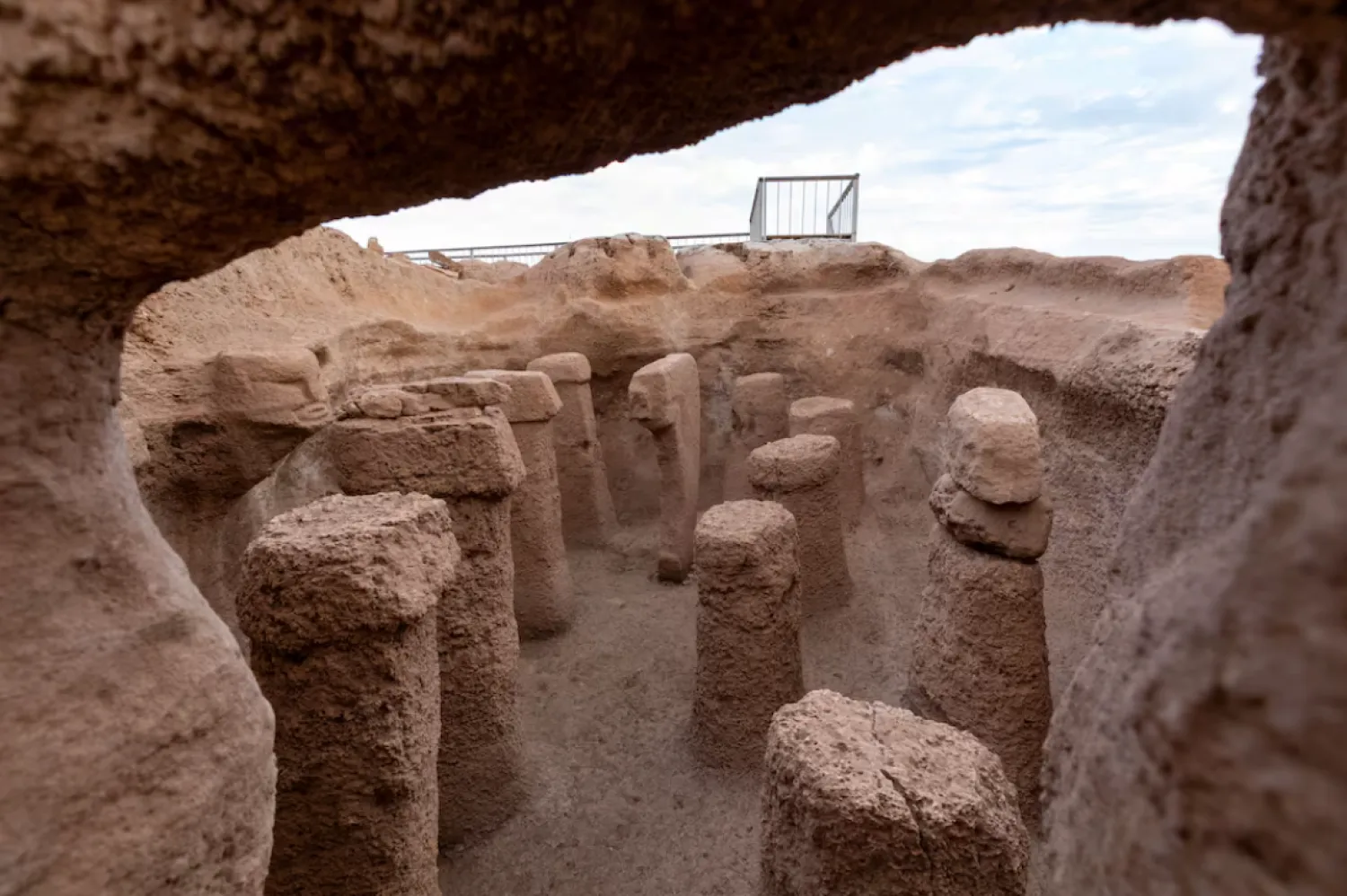
A view shows the archaeological site of Karahan Tepe, one of the world's oldest Neolithic settlements, is pictured in Sanliurfa, Türkiye, September 13, 2023. REUTERS/Tolga Ildun/File Photo
TT

Tiny Carved Animals Found in Türkiye Tell Story of Prehistoric Myth Making

A view shows the archaeological site of Karahan Tepe, one of the world's oldest Neolithic settlements, is pictured in Sanliurfa, Türkiye, September 13, 2023. REUTERS/Tolga Ildun/File Photo

A set of carved stone animals - a fox, a vulture and a wild boar - is shedding light on the way prehistoric people told stories after being unearthed by archaeologists in southeastern Türkiye.

Dating back some 11,500 years, the trio of figurines found at the Karahantepe archaeological site is the first known example of objects being arranged in a specific way to convey a narrative, archaeologists say.

"Telling a story undoubtedly brings storytellers to mind, and carving them into stone reveals the existence of artists. But it also proves that communities who know those stories share a common memory," Necmi Karul, head of the excavations at Karahantepe, one of the world's oldest Neolithic settlements, said, Reuters reported.

Unearthed late last year, the artefacts are now on display for the first time at the Presidential Complex in Türkiye's capital, Ankara, along with other items unearthed at Karahantepe, which dates back to 9,500 BC.

The set of animal figures - each one about 3.5 cm (1.38 inches) tall - was found in a small container, covered with a stone lid, and placed inside another, larger vessel. Each of the three figurines had its head placed into a limestone ring.

The intricacies of the arrangement reflect the figurines' use as part of a carefully prepared composition, Karul said, adding that previously only two-dimensional and often independent depictions had been found on immovable artefacts.

"With the Neolithic period and sedentism, we see a fundamental shift in narrative language," he said.

Sedentism, or living in one place for long periods, replaced millions of years of hunter-gatherer culture and gave rise to a new social order.

"These narratives must have been the social bonds that held this new order together," Karul said, describing the figurines as "one of the most important discoveries from a prehistoric perspective".

PREHISTORIC SUCCESS STORY

Karahantepe is one of the earliest settlements of the Neolithic period. Nearby Gobeklitepe, a UNESCO World Heritage Site, is believed to be the world's oldest.

Both sites are a part of a wider Neolithic research project called Tas Tepeler, or "Stone Hills", that includes various settlements dotted across the Turkish province of Sanliurfa and where excavations are ongoing.

Karahantepe covers 14 hectares (35 acres) but excavation work carried out there since 2019 has covered only a tiny fraction of the site, Karul said.

Pillars decorated with reliefs and a complex of circular communal buildings were also found there, with a human head carved into the bedrock on one of the walls.

Karul said he planned to seek different kinds of UNESCO recognition for the site as a way to increase global interest in his team's work.

"Modern people always place themselves at the pinnacle when compared to the past," he said. "Karahantepe shows us how successful people were in art and storytelling 11,000-12,000 years ago."



Saudi Arabia, Syria Underline Depth of their Cultural Ties

Syrian President al-Sharaa receives the Saudi minister of culture and the accompanying delegation at the Conference Palace in Damascus on Thursday. (SPA)
TT

Saudi Arabia, Syria Underline Depth of their Cultural Ties

Syrian President al-Sharaa receives the Saudi minister of culture and the accompanying delegation at the Conference Palace in Damascus on Thursday. (SPA)

Saudi Arabia and Syria underlined the strength of their cultural relationship during high-level meetings held in Damascus on Thursday, on the sidelines of the opening of the Damascus International Book Fair 2026, where the Kingdom is participating as guest of honor.

Syrian President Ahmad al-Sharaa received Saudi Minister of Culture Prince Badr bin Abdullah bin Farhan at the Conference Palace in the capital.

Earlier the same day, Prince Badr met with his Syrian counterpart, Minister of Culture Mohammad Yassin Saleh, during an official visit to attend the fair. T

he Saudi minister congratulated Syria on hosting the exhibition and expressed his wishes for continued prosperity, progress, and stability for the Syrian government and people.

Both meetings highlighted the depth of cultural relations between the two countries, the importance of expanding joint cultural cooperation across various fields, and the alignment of positions on issues of mutual interest in a way that serves both nations.

The Saudi delegation included senior officials and advisers, among them representatives from the Royal Court, the Ministry of Culture, and the King Abdulaziz Public Library, reflecting broad institutional engagement in the visit.

In the evening, Prince Badr attended the opening ceremony of the fair’s special session, held under the patronage and in the presence of al-Sharaa. The event drew wide official and cultural participation, including Arab ministers, political and intellectual figures, and a distinguished group of writers and cultural figures.

In a post on the X platform, Prince Badr thanked “our brothers in Syria for their generous hospitality and their efforts in organizing the Damascus International Book Fair.”

The minister also inaugurated the Kingdom’s pavilion at the fair in the presence of the Syrian minister of culture and the Qatari minister of culture.

Saudi Arabia’s guest-of-honor participation continues until Feb. 16 and reflects its growing prominence and leadership in the Arab and global cultural landscape.

This participation aligns with Saudi Vision 2030, which places culture at the heart of national development, viewing it as a space for dialogue, a bridge for civilizational communication, and a tool for strengthening ties among Arab peoples.

The Saudi Literature, Publishing and Translation Commission is leading the Kingdom’s participation, highlighting the development of the cultural sector and reaffirming the central role of books as carriers of knowledge and awareness.

The Saudi pavilion boasts a comprehensive cultural program featuring intellectual seminars, poetry evenings, a manuscript exhibition, traditional Saudi fashion displays, hospitality corners, archaeological replicas, and performing arts that express the depth of the Kingdom’s cultural heritage.

On the sidelines of the visit, Prince Badr, accompanied by Minister Saleh, toured the National Museum of Damascus, which houses rare artifacts spanning prehistoric eras, ancient Syrian civilizations, classical and Islamic periods, as well as traditional and modern art.


UNESCO Honors Al-Bisht Al-Hasawi as Thousands Flock to Al-Ahsa Festival

Visitors can explore interactive displays, participate in live workshops, and witness the meticulous process of tailoring this iconic symbol of prestige - SPA
TT

UNESCO Honors Al-Bisht Al-Hasawi as Thousands Flock to Al-Ahsa Festival

Visitors can explore interactive displays, participate in live workshops, and witness the meticulous process of tailoring this iconic symbol of prestige - SPA

The third edition of Al-Bisht Al-Hasawi Festival is drawing thousands of regional and international visitors to Ibrahim Palace in historic Al-Hofuf.

Organized by the Heritage Commission, this year’s festival celebrates the inscription of the Bisht on UNESCO’s Representative List of the Intangible Cultural Heritage of Humanity.

The event showcases Al-Ahsa’s centuries-old tradition of hand-weaving and gold embroidery, a craft passed down through generations of local families, SPA reported.

Visitors can explore interactive displays, participate in live workshops, and witness the meticulous process of tailoring this iconic symbol of prestige.

With UNESCO's participation and representatives from six countries, the festival has evolved into a global platform for cultural dialogue, cementing the Bisht’s status as a world-class cultural treasure.


Saudi, Syrian Culture Ministers Tour National Museum of Damascus

The ministers observed the museum’s extensive collections spanning prehistoric eras to modern art. SPA
TT

Saudi, Syrian Culture Ministers Tour National Museum of Damascus

The ministers observed the museum’s extensive collections spanning prehistoric eras to modern art. SPA

Saudi Minister of Culture Prince Badr bin Abdullah bin Farhan and his Syrian counterpart, Mohammed Yassin Saleh, have toured the National Museum of Damascus during the Kingdom’s participation as guest of honor at the 2026 Damascus International Book Fair.

The ministers observed on Thursday the museum’s extensive collections spanning prehistoric eras to modern art.

A particular focus was placed on the Arab-Islamic wing, featuring significant artifacts from the Umayyad period.

The Kingdom's participation as guest of honor at the 2026 Damascus International Book Fair, which runs until February 16, stems from the role culture plays within Saudi Vision 2030.