


Palestinian Factions Hand over Weapons from Beirut Camps, Says Official

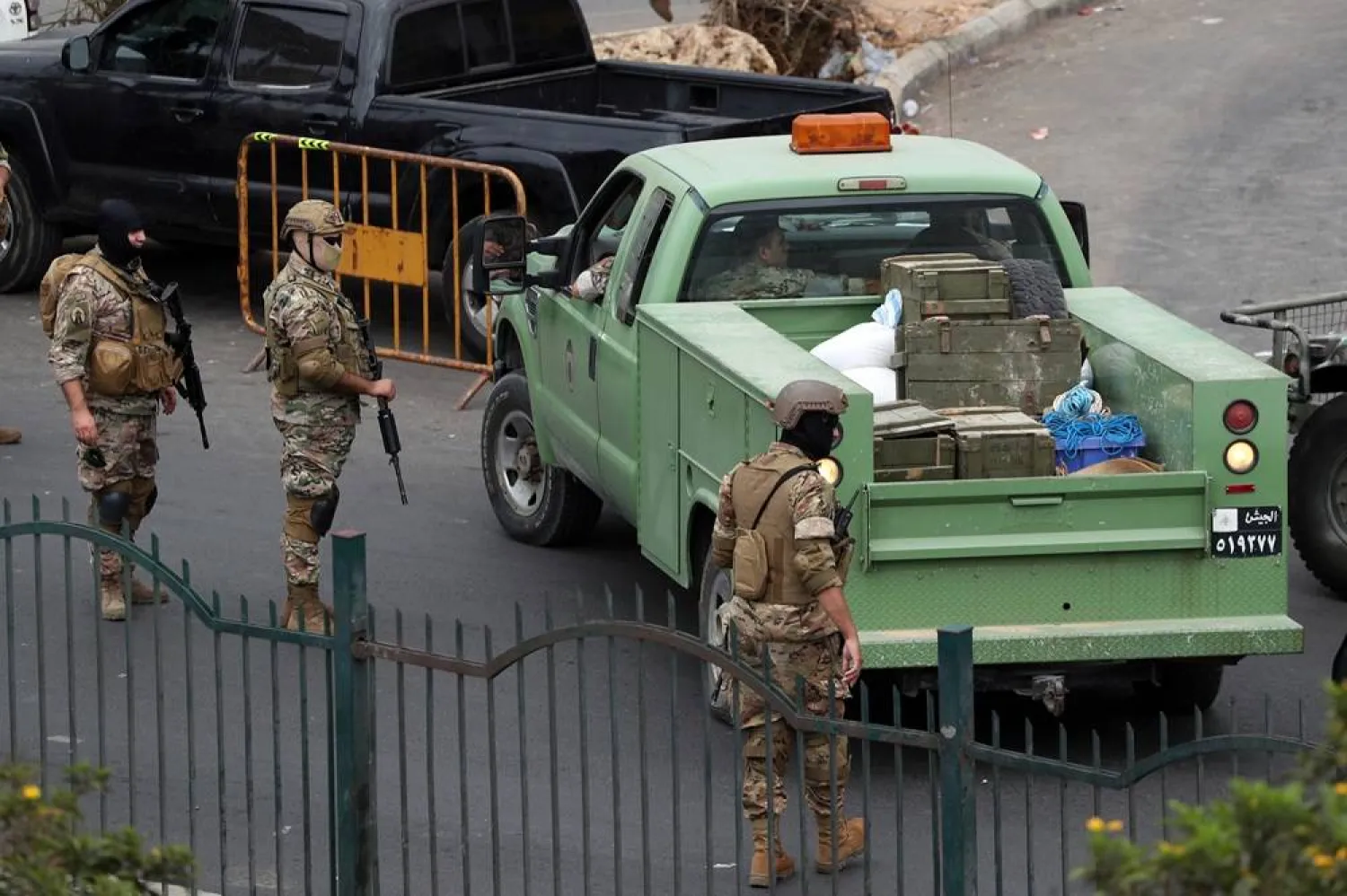
Lebanese army soldiers stand next to a truck carrying weapons at the Burj al-Barajneh Palestinian refugee camp in southern Beirut, Lebanon, 29 August 2025. (EPA)
TT

Palestinian Factions Hand over Weapons from Beirut Camps, Says Official

Lebanese army soldiers stand next to a truck carrying weapons at the Burj al-Barajneh Palestinian refugee camp in southern Beirut, Lebanon, 29 August 2025. (EPA)

Palestinian factions in several Beirut refugee camps surrendered their weapons to the Lebanese army on Friday, an official said, as the government disarms non-state groups.

Ramez Dimashkieh, chairman of the official Lebanese-Palestinian Dialogue Committee, told AFP that "the Palestine Liberation Organization handed over three truckloads of weapons to the Lebanese army", including rockets and heavy weapons.

One truckload came from the Mar Elias camp and Shatila camps, and two from the Burj al-Barajneh camp in Beirut and its suburbs, he said, adding that "this completes the process of handing over" PLO weapons from the Beirut camps.

At the entrance to the Burj al-Barajneh camp, AFP correspondents saw large wooden crates being moved to a nearby parking lot where soldiers inspected them before transporting them away, as troops deployed heavily to the area.

The official National News Agency had earlier reported the arrival of army vehicles in the camp "to receive a new batch of Palestinian weapons".

During a visit to Beirut in May, Palestinian President Mahmoud Abbas and Lebanese President Joseph Aoun agreed that weapons in Lebanon's Palestinian refugee camps would be handed over to the Lebanese authorities.

The implementation of the deal began last week as Abbas's Fatah movement surrendered weapons in Burj al-Barajneh camp.

Abbas's Fatah is the most prominent PLO faction. Palestinian armed groups Hamas and Islamic Jihad, which are allied to Lebanon's Hezbollah group, are not part of the organization.

Dimashkieh said Friday that "there are still other factions that have not surrendered their weapons but the process has started".

On Thursday, PLO factions handed over heavy weapons in south Lebanon's Rashidieh, Al-Bass and Burj al-Shemali camps, the Lebanese-Palestinian dialogue committee said.

The move to collect the Palestinian factions' weapons comes as the Lebanese army draws up a plan to disarm Hezbollah by the end of the year.

The plan, which is to be presented to the cabinet by the end of the month, was commissioned by the government under heavy US pressure and amid fears of expanded Israeli military action.

During a year of hostilities between Israel and Hezbollah that largely ended with a November ceasefire, Palestinian groups including Hamas claimed rocket fire towards Israel.

By longstanding convention, the Lebanese army stays out of the Palestinian camps and leaves Palestinian factions to handle security.



Iran Protest Death Toll Rises as Alarm Grows over Crackdown 'Massacre'

Protesters gather as vehicles burn, amid evolving anti-government unrest, in Tehran, Iran, in this screen grab obtained from a social media video released on January 9, 2026. Social Media/via REUTERS/File Photo
TT

Iran Protest Death Toll Rises as Alarm Grows over Crackdown 'Massacre'

Protesters gather as vehicles burn, amid evolving anti-government unrest, in Tehran, Iran, in this screen grab obtained from a social media video released on January 9, 2026. Social Media/via REUTERS/File Photo

At least 192 protesters have been killed in Iran's biggest movement against the Islamic republic in more than three years, a rights group said Sunday, as warnings grew that authorities were committing a "massacre" to quell the demonstrations.

The protests, initially sparked by anger over the rising cost of living, have now become a movement against the theocratic system in place in Iran since the 1979 revolution and have already lasted two weeks.

The mass rallies are one of the biggest challenges to the rule of supreme leader Ali Khamenei, 86, coming in the wake of Israel's 12-day war against the Islamic republic in June, which was backed by the United States.

Protests have swelled in recent days despite an internet blackout that has lasted more than 60 hours, according to monitor Netblocks, with activists warning the shutdown was limiting the flow of information and the actual toll risks being far higher.

"Since the start of the protests, Iran Human Rights has confirmed the killing of at least 192 protesters," the Norway-based non-governmental organization said, warning that the deaths "may be even more extensive than we currently imagine".

Videos of large demonstrations in the capital Tehran and other cities over the past three nights have filtered out despite the internet cut that has rendered impossible normal communication with the outside world via messaging apps or even phone lines.

Video verified by AFP showed large crowds taking to the streets in new protests on Saturday night in several Iranian cities including Tehran and Mashhad in the east, where images showed vehicles set on fire.

Several circulating videos, which have not been verified by AFP, allegedly showed relatives in a Tehran morgue identifying bodies of protesters killed in the crackdown.

The US-based Center for Human Rights in Iran (CHRI) said it had received "eyewitness accounts and credible reports indicating that hundreds of protesters have been killed across Iran during the current internet shutdown".

"A massacre is unfolding in Iran. The world must act now to prevent further loss of life," it said.

It said hospitals were "overwhelmed", blood supplies were running low and that many protesters had been shot in the eyes in a deliberate tactic.

- 'Significant arrests' -

The US-based Human Rights Activists News Agency said it had confirmed the deaths of 116 people in connection with the protests, including 37 members of the security forces or other officials.

State TV on Sunday broadcast images of funeral processions for security forces killed in recent days, as authorities condemned "riots" and "vandalism".

National police chief Ahmad-Reza Radan said authorities made "significant" arrests of protest figures on Saturday night, without giving details on the number or identities of those arrested, according to state TV.

Iran's security chief Ali Larijani drew a line between protests over economic hardship, which he called "completely understandable", and "riots", accusing them of actions "very similar to the methods of terrorist groups", Tasnim news agency reported.

Iran's President Masoud Pezeshkian said "rioters" must not distrupt Iranian society.

"The people (of Iran) should not allow rioters to disrupt society. The people should believe that we (the government) want to establish justice," he told state broadcaster IRIB.

In Tehran, an AFP journalist described a city in a state of near paralysis.

The price of meat has nearly doubled since the start of the protests, and while some shops are open, many others are not.

Those that do open must close at around 4:00 or 5:00 pm, when security forces deploy in force.

- 'Legitimate targets' -

Reza Pahlavi, the exiled son of the ousted shah, who has played a prominent role in calling for the protests, called for new actions later Sunday.

"Do not abandon the streets. My heart is with you. I know that I will soon be by your side," he said.

US President Donald Trump has spoken out in support of the protests and threatened military action against Iranian authorities "if they start killing people".

Israel's Foreign Minister Gideon Saar urged the European Union on Sunday to designate Iran's Revolutionary Guards Corps as a "terrorist organization" over the suspected violence against protesters.

He also said Israel supports the Iranian people's "struggle for freedom".

Iran's parliament speaker Mohammad Bagher Ghalibaf said Iran would hit back if the US launched military action.

"In the event of a military attack by the United States, both the occupied territory and centers of the US military and shipping will be our legitimate targets," he said in comments broadcast by state TV.

He was apparently also referring to Israel, which the Islamic republic does not recognize and considers occupied Palestinian territory.


Israeli Fire Kills Three People in Gaza, Tension Rises

Palestinians attend an anti-war protest and against Hamas in a rare show of public anger against the group that rules the territory, in Beit Lahiya, northern Gaza Strip, Wednesday, March 26, 2025. (AP)
TT

Israeli Fire Kills Three People in Gaza, Tension Rises

Palestinians attend an anti-war protest and against Hamas in a rare show of public anger against the group that rules the territory, in Beit Lahiya, northern Gaza Strip, Wednesday, March 26, 2025. (AP)

Israeli fire killed at least three Palestinians in two separate incidents across ​the enclave, local health authorities said, as tension rises over continued violence.

Medics said one Palestinian was killed in the Tuffah neighborhood in Gaza City, in an area under ‌Palestinian control, while ‌two others ‌were ⁠killed ​in ‌the town of Bani Suhaila east of Khan Younis, an area Israel still occupies, Reuters reported.

There was no comment from the Israeli military on the two incidents.

Fighting ⁠has largely abated since Israel and ‌Palestinian militant group Hamas ‍agreed to ‍a ceasefire in October, two ‍years into the war, but it has not stopped entirely. Israel and Hamas have traded blame over ​the violations of the deal.

A Hamas official told Reuters ⁠on Sunday that the group urged mediators to intervene to stop "daily Israeli killings that aim to derail the ceasefire deal."

More than 440 Palestinians, most of them civilians according to Gaza health officials, have been killed since the truce, ‌as well as three Israeli soldiers.


Iraq’s Sadr Accepts Defectors’ Return, Signals Force to Rivals

Sadrist movement leader Moqtada al-Sadr (Sadrist media)
TT

Iraq’s Sadr Accepts Defectors’ Return, Signals Force to Rivals

Sadrist movement leader Moqtada al-Sadr (Sadrist media)

Shiite cleric Moqtada al-Sadr, leader of the Shiite National Current, has offered what amounts to an amnesty to a group of former followers who had broken away from his movement and joined armed factions, most of which have strained relations with him.

The majority of leaders and fighters in the Shiite armed factions trace their origins to the religious authority of the late Mohammed Sadiq al-Sadr, the father of Moqtada al-Sadr.

Among them is Qais al-Khazali, secretary general of Asaib Ahl al-Haq, who had been one of al-Sadr’s aides before defecting in mid-June 2006, as did other faction leaders. Local and regional interventions, particularly by Iran, played a significant role in those defections, as part of broader efforts to weaken al-Sadr and his movement.

Al-Sadr’s remarks came in response to a question submitted by a “group from Baghdad” of his former followers, who asked him to reopen the door for their return to his movement.

“I am aware of your suffering, and I know your needs,” al-Sadr said. “I am absolutely certain that your affiliation with them is merely physical.”

“I know that your hearts are with us, and your minds are with us. You love the homeland as we love it, and you reject subservience as we reject it,” he added.

“Just as your hearts are with us, my heart is with you. I have not forgotten you in my prayers for success, guidance, and righteousness.”

“You are welcome whenever you wish. Whoever does not wish to return may remain among them, but not be one of them; that is my assumption of you.”

“Yes, my assumption is that you are still faithful to the covenant, the covenant of our father al-Sadr. You are welcome at any time and in any place. The door of the al-Sadr family is always open, as you have always known.”

The open invitation to the “repentant” came just days after the assassination of Hussein al-Alaq, a senior figure in the Sadrist movement and the Peace Brigades, in the southern city of Amarah.

Asaib Ahl al-Haq was accused of involvement in the killing, an allegation denied last week by its secretary general, Qais al-Khazali.

Southern provinces have witnessed rising tensions in recent days between the Sadrist movement and armed factions, particularly following the assassination.

The killing prompted al-Sadr to lift a decision freezing the activities of the Peace Brigades, the armed wing of his movement, in the southern provinces of Basra and Wasit.

On Friday, al-Sadr called for a unified Friday prayer in Amarah, attended by thousands of his supporters, in what appeared to be a direct response to the assassination. Maysan province, whose capital is Amarah, is considered one of the Sadrist movement’s main strongholds in southern Iraq.

The movement dominated the province’s local government for more than 15 years before al-Sadr decided to withdraw his bloc from parliament and refuse participation in the federal government and local administrations.

That move allowed forces from the Coordination Framework, led by Asaib Ahl al-Haq, to expand their influence in the province.

A senior Sadrist figure told Asharq Al-Awsat that al-Sadr’s recent moves “send clear warning messages to his rivals among the armed factions, some of which al-Sadr labels ‘insolent militias.’”

He said lifting the freeze on the Peace Brigades and holding the prayer were also intended as a show of force toward factions “that do not hesitate to commit crimes against Sadrist followers.”

While the Sadrist official played down the likelihood of armed clashes at this stage, he did not rule out the possibility in the future “if those groups continue targeting Sadrist leaders.”

He said the aggressive conduct of some factions cannot be separated from the fears surrounding them, particularly those linked to concerns over Iran’s regional role.

“They are seeking to undermine the strength of the Sadrist movement to prevent it from later filling any vacuum that regional developments may create,” he said.