Red Cross Head Says Mass Evacuation of Gaza City 'Impossible'

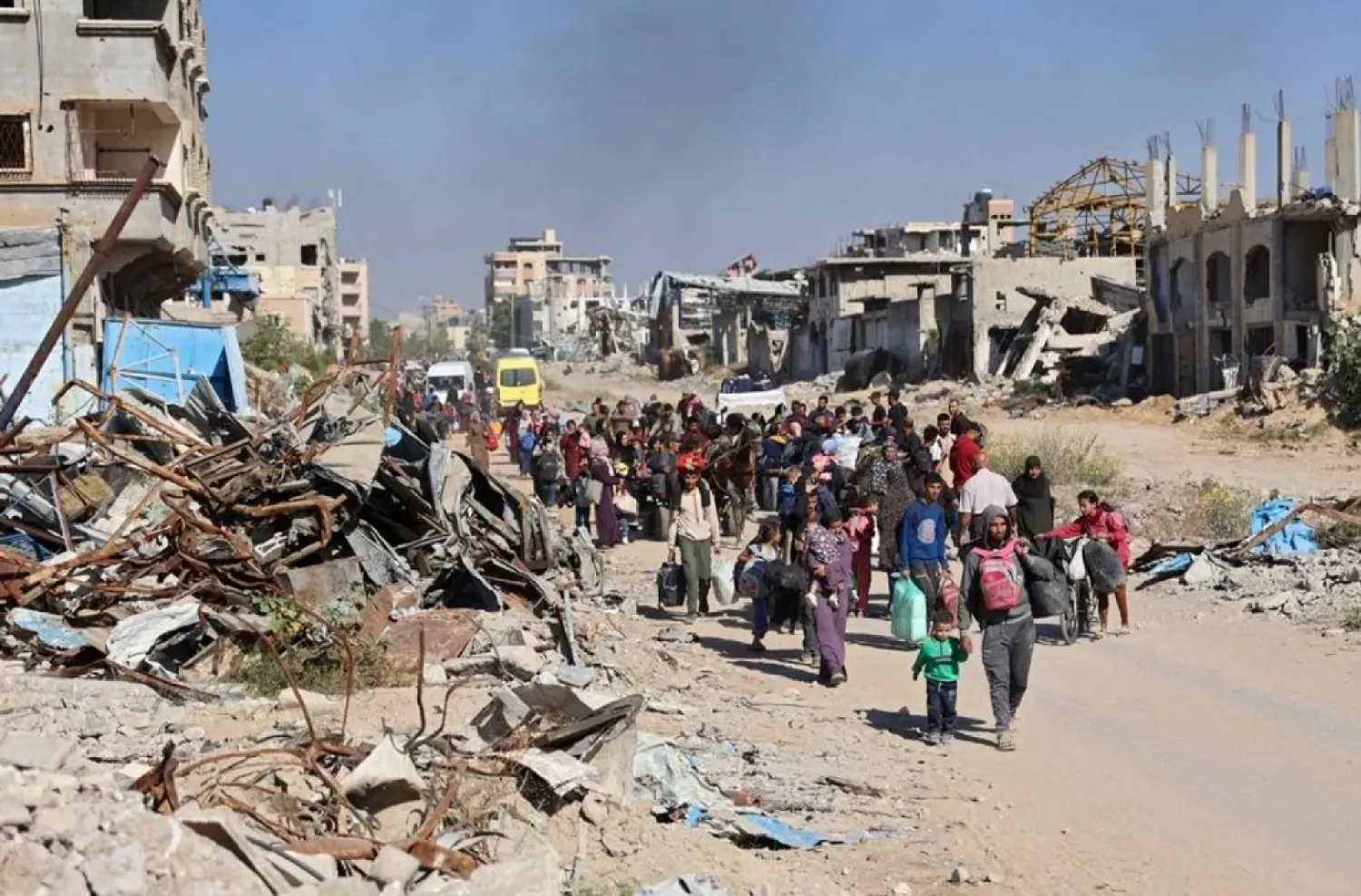
Displaced Palestinians fleeing Israeli military operations in Beit Lahia in the northern Gaza strip walk along the Salah al-Din main road in eastern Gaza City making their way to the city center, on October 22, 2024, amid the ongoing war in the Palestinian territory between Israel and Hamas. (AFP)
TT

Red Cross Head Says Mass Evacuation of Gaza City 'Impossible'

Displaced Palestinians fleeing Israeli military operations in Beit Lahia in the northern Gaza strip walk along the Salah al-Din main road in eastern Gaza City making their way to the city center, on October 22, 2024, amid the ongoing war in the Palestinian territory between Israel and Hamas. (AFP)

The head of the international Red Cross on Saturday denounced Israel's plans for a mass evacuation of Gaza City ahead of a military takeover, insisting there was no way it could be done safely.

"It is impossible that a mass evacuation of Gaza City could ever be done in a way that is safe and dignified under the current conditions," International Committee of the Red Cross president Mirjana Spoljaric said in a statement, AFP reported.

"Such an evacuation would trigger a massive population movement that no area in the Gaza Strip can absorb, given the widespread destruction of civilian infrastructure and the extreme shortages of food, water, shelter and medical care," she warned.

Her comments came after Israel's military on Friday declared Gaza City "a dangerous combat zone", as it prepared to conquer the occupied Palestinian territory's largest city after almost two years of war.

The Israeli military did not call for the population to evacuate immediately but the army's Arabic-language spokesman, Avichay Adraee, said on Wednesday that the city's evacuation was "inevitable".

Israel is under mounting pressure at home and abroad to end its devastating offensive in Gaza, where the vast majority of the population has been displaced at least once and the United Nations has declared a famine.

The UN estimates that nearly a million people currently live in Gaza governorate, which includes Gaza City and its surroundings in the north of the territory.

Any evacuation order "would be imposed on civilians who are already traumatised by months of fighting and terrified by what could come next", Spoljaric said.

"Many are unable to comply with evacuation orders because they are starving, sick, injured or suffering from physical disabilities," she pointed out, stressing that "all civilians are protected by international humanitarian law (IHL), whether they leave or stay behind, and must be allowed to return home".

Spoljaric highlighted that "IHL requires that when evacuation orders are issued, Israel must do everything to ensure that civilians have satisfactory conditions of shelter, hygiene, health, safety and nutrition, and that families are not separated".

"These conditions cannot currently be met in Gaza," she said.

"This makes any evacuation not only unfeasible but incomprehensible under the present circumstances."

The ICRC president reiterated the call for an immediate ceasefire, a mass-influx of aid and for Palestinian group Hamas to release its remaining Israeli hostages.

"Any further escalation of the conflict will only lead to more death, destruction and displacement," she said.


Al-Zaidi: Iraq Will Not Become a Platform to Harm Others

Iraqi Prime Minister Ali al-Zaidi delivers his speech at the event in Baghdad. (INA)
TT

Al-Zaidi: Iraq Will Not Become a Platform to Harm Others

Iraqi Prime Minister Ali al-Zaidi delivers his speech at the event in Baghdad. (INA)

Iraqi Prime Minister Ali al-Zaidi stressed on Monday that his government is forging ahead in building a “free” and “sovereign” Iraq, adding that international coalition forces will complete their withdrawal on September 30.

“Since assuming responsibility for the government, we have pledged to move toward building a fully sovereign Iraq in which the people enjoy all the foundations of respect, dignity and security, and whose citizens cooperate in protecting the country and safeguarding its wealth and the future of its generations,” he said during a speech at an event in Baghdad marking the Prophet Muhammed’s birthday.

Iraq will declare the completion of its sovereignty over its entire territory on September 30, he announced, reported Iraq’s state news agency INA.

Moreover, he said: “Iraq should not be a platform for harming others.”

“Our region has lived for decades amid ongoing tensions that have led to divisions in the approaches and governing visions of the countries of the Arab and Islamic world,” remarked al-Zaidi.

“Our government program included a clear approach to construction and reform, combating corruption and strengthening a productive working environment, alongside building security institutions operating under the framework of the Constitution.”

Earlier, al-Zaidi received in Baghdad Commander of German Forces Deployed Abroad Gunter Schneider.

The PM highlighted “the importance of transitioning toward multidimensional relations with the coalition countries.”

The meeting reviewed preparations for completing the withdrawal of coalition forces from Iraq.

Al-Zaidi commended Germany’s longstanding role in assisting Iraq in its fight against terrorism, particularly during the war on ISIS.


Sharaa Says Syria 'Shakes Off Dark Stain' with Removal from US Terror List

FILE PHOTO: US President Donald Trump shakes hands with Syrian President Ahmed al-Sharaa during a bilateral meeting alongside the NATO leaders summit at the Bestepe Presidential Compound in Ankara, Türkiye, July 8, 2026. REUTERS/Jonathan Ernst/File Photo
TT

Sharaa Says Syria 'Shakes Off Dark Stain' with Removal from US Terror List

FILE PHOTO: US President Donald Trump shakes hands with Syrian President Ahmed al-Sharaa during a bilateral meeting alongside the NATO leaders summit at the Bestepe Presidential Compound in Ankara, Türkiye, July 8, 2026. REUTERS/Jonathan Ernst/File Photo

Syrian President Ahmed al-Sharaa hailed early on Tuesday the United States' removal of his country from the state sponsors of terror list, a major sanctions relief step.

"Today, Syria shakes off a dark stain and tears away a painful chapter of its past to embark on a path of development, reconstruction and rebuilding," Sharaa said in a speech.

Washington's decision on Monday rescinded a decades-old designation that came with severe economic restrictions, marking another step in warming ties between the countries following the 2024 ouster of Bashar al-Assad.

The Treasury Department announced corresponding sanctions relief.

Sharaa expressed his "many thanks to the President of the United States of America, Donald Trump, and to all the friendly and supportive nations that stood by us.”

The US Department of State also revoked its designation of the al-Nusra Front -- latterly known as Hay'at Tahrir al-Sham (HTS) -- as a global terrorist organization.

The United States had initially announced in July its intent to delist Syria as a state sponsor of terrorism, a move seen as a vote of confidence in Sharaa.

Monday's move gave Syria's "a path to prosperity,” according to US Secretary of State Marco Rubio.

The action "eliminates the final major barriers for private sector investment in Syria and promotes Syria's economic recovery and reintegration into the global economy," he said in a statement.

Syrian Foreign Minister Assad al-Shaibani described Washington's delisting as a "historic milestone" and said it reflected "the new Syrian state's commitment to international peace and security.”

Finance Minister Mohammed Barnieh described the move as a "success for Syrian diplomacy," according to the official news agency SANA.

It "opens a major and long-awaited door to strengthening Syria's integration into the global economic and financial system, attracting investment and modern technologies, and supporting development opportunities.”


Lebanese Authorities Extend Residency of Iran’s Ambassador

 Iranian Ambassador to Syria Mohammad Reza Sheibani, shows his ink-stained finger as he votes in the first round of the Iranian presidential election on June 14, 2013 at the Iranian embassy in the Syrian capital, Damascus. (AFP)
Iranian Ambassador to Syria Mohammad Reza Sheibani, shows his ink-stained finger as he votes in the first round of the Iranian presidential election on June 14, 2013 at the Iranian embassy in the Syrian capital, Damascus. (AFP)
TT

Lebanese Authorities Extend Residency of Iran’s Ambassador

 Iranian Ambassador to Syria Mohammad Reza Sheibani, shows his ink-stained finger as he votes in the first round of the Iranian presidential election on June 14, 2013 at the Iranian embassy in the Syrian capital, Damascus. (AFP)
Iranian Ambassador to Syria Mohammad Reza Sheibani, shows his ink-stained finger as he votes in the first round of the Iranian presidential election on June 14, 2013 at the Iranian embassy in the Syrian capital, Damascus. (AFP)

Lebanese authorities extended on Monday the residency of former Iranian Ambassador Mohammad Reza Sheibani, who defied the country’s expulsion order earlier this year.

Now viewed as regular civilian, not a diplomat, the authorities extended his stay by six months.

A security source told Asharq Al-Awsat that General Security chief Hassan Choucair, within his legal capacity, proposed granting him residency.

He informed the concerned political authorities, meaning the president, prime minister and interior minister, before approving the residency.

Lebanese Foreign Ministry sources told Asharq Al-Awsat that the ministry was not informed of the intention to grant him residency.

They stressed that Foreign Minister Youssef Raggi’s position "is clear and not up for debate" that Iran must respect the expulsion order.

The ministry had in March withdrawn its approval of the ambassador's accreditation, giving him 72 hours to leave the country, drawing Hezbollah's condemnation.

The expulsion stemmed from what the Lebanese state described as Tehran's violation of diplomatic norms and established practices between the two countries.

It is "a measure against the ambassador for violating diplomatic protocol and his obligations as an appointed ambassador to Lebanon".

The ministry accused him of making statements "interfering in Lebanon's internal politics and evaluating the decisions taken by the government".

The government has accused Hezbollah of dragging Lebanon to war after it fired rockets at Israel on March 2 in wake of the killing of Iran's supreme leader Ali Khamenei at the beginning of the US-Israel war on Iran.

Hezbollah called the expulsion a "sin" and demanded the authorities "immediately reverse" the move.