


Britain's Energy Grid Bets on Flywheels to Keep the Lights On

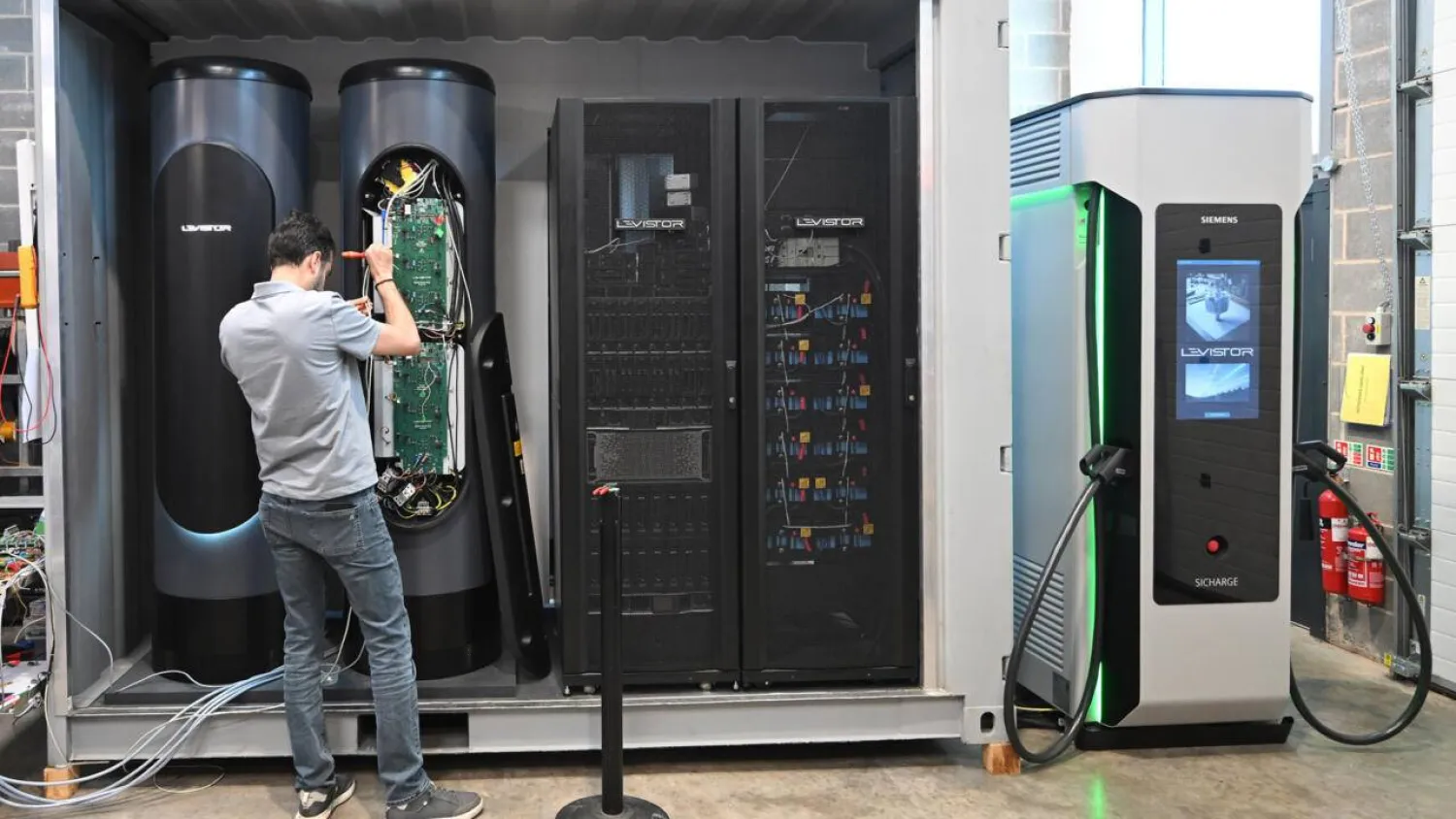
An engineer works on a flywheel energy storage system at Levistor's workshop in southwest London. Justin TALLIS / AFP
TT

Britain's Energy Grid Bets on Flywheels to Keep the Lights On

An engineer works on a flywheel energy storage system at Levistor's workshop in southwest London. Justin TALLIS / AFP

Britain's energy operator is betting on an age-old technology to future-proof its grid, as the power plants that traditionally helped stabilize it are closed and replaced by renewable energy systems.

Spinning metal devices known as flywheels have for centuries been used to provide inertia -- resistance to sudden changes in motion -- to various machines, from a potter's wheel to the steam engine.

Grid operators are now looking to the technology to add inertia to renewable-heavy electricity systems to prevent blackouts like the one that hit Spain and Portugal this year.

In an electricity grid, inertia is generally provided by large spinning generators found in coal-fired and gas power plants, helping maintain a steady frequency by smoothing fluctuations in supply and demand.

But renewable energy sources like solar and wind power don't add inertia to the grid, and usually cannot help with other issues, such as voltage control.

Flywheels can mimic the rotational inertia of power plant generators, spinning quicker or slower to respond to fluctuations.

Without rotating turbines, "the system is more prone to fluctuations than it would be otherwise", explained David Brayshaw, a professor of climate science at the University of Reading in England.

"As we get to ever higher levels of renewables, we're going to have to think about this more carefully," Brayshaw told AFP.

Flywheels and batteries

The Iberian Peninsula, which is powered by a high share of renewables, went dark on April 28 after its grid was unable to absorb a sudden surge in voltage and deviations in frequency.

Spain's government has since pointed fingers at conventional power plants for failing to control voltage levels.

It could serve as a wake-up call similar to a 2019 outage which plunged parts of Britain into darkness following a drop in grid frequency.

That blackout prompted UK energy operator NESO to launch what it called a "world-first" program to contract grid-stabilizing projects.

Flywheels and batteries can add synthetic inertia to the grid, but engineering professor Keith Pullen says steel flywheels can be more cost-effective and durable than lithium-ion batteries.

"I'm not saying that flywheels are the only technology, but they could be a very, very important one," said Pullen, a professor at City St George's, University of London and director of flywheel startup Levistor.

In the coming years, Pullen warned the grid will also become more unstable due to greater, but spikier demand.

With electric cars, heat pumps and energy-guzzling data centers being hooked onto the grid, "we will have more shock loads... which the flywheel smooths out".

Carbon-free inertia

Norwegian company Statkraft's "Greener Grid Park" in Liverpool was one of the projects contracted by NESO to keep the lights on.

Operational since 2023, it is a stone's throw from a former coal-fired power station site which loomed over the northern English city for most of the 20th century.

But now, instead of steam turbines, two giant flywheels weighing 40 tons (40,000 kilograms) each whirr at the Statkraft site, which supplies one percent of the inertia for the grid needed in England, Scotland and Wales.

Each flywheel is attached to a synchronous compensator, a spinning machine that further boosts inertia and provides voltage control services in the Liverpool region.

"We are providing that inertia without burning any fossil fuels, without creating any carbon emissions," said Guy Nicholson, Statkraft's zero-carbon grid solutions head.

According to NESO, 11 other similar synchronous compensator and flywheel projects were operational in Britain as of 2023, with several more contracted.

'Not fast enough'

The government is "working closely with our industry partners who are developing world-leading technology, including flywheels, static and synchronous compensators, as we overhaul the energy system", a Department for Energy Security and Net Zero spokesperson told AFP.

But, "we aren't building them fast enough to decarbonize the grid", warned Nicholson.

Britain aims to power the grid with clean energy 95 percent of the time by 2030, before completely switching to renewables in the next decade.

"At the moment... we can't even do it for one hour," said Nicholson.

Even when there is sufficient solar and wind energy being generated, "we still have to run gas turbines to keep the grid stable", he explained.

Still, Britain and neighboring Ireland seem to be ahead of the curve in procuring technology to stabilize renewable-heavy grids.

"In GB and Ireland, the system operators are leading by contracting these services," Nicholson said. "On the continent, there hasn't been the same drive for that."

“I think these things are driven by events. So, the Spanish blackout will drive change."


Former Flight Attendant Posed as Pilot, Received Hundreds of Free Flights, US Authorities Say

A United Airlines plane takes off from San Francisco International Airport on January 20, 2026 in San Francisco, California. (Getty Images/AFP)
TT

Former Flight Attendant Posed as Pilot, Received Hundreds of Free Flights, US Authorities Say

A United Airlines plane takes off from San Francisco International Airport on January 20, 2026 in San Francisco, California. (Getty Images/AFP)

A former flight attendant for a Canadian airline posed as a commercial pilot and as a current flight attendant to obtain hundreds of free flights from US airlines, authorities said.

Dallas Pokornik, 33, of Toronto, was arrested in Panama after being indicted on wire fraud charges in federal court in Hawaii last October. He pleaded not guilty Tuesday following his extradition.

According to court documents, Pokornik was a flight attendant for a Toronto-based airline from 2017 to 2019, then used fake employee identification from that carrier to obtain tickets reserved for pilots and flight attendants on three other airlines.

US prosecutors said Tuesday that Pokornik even requested to sit in an extra seat in the cockpit — the “jump seat” — typically reserved for off-duty pilots. It was not clear from court documents whether he ever actually rode in a plane’s cockpit, and the US Attorney’s Office declined to say.

The indictment did not identify the airlines except to say they are based in Honolulu, Chicago and Fort Worth, Texas. Representatives for Hawaiian Airlines, United Airlines and American Airlines — which are respectively based in those cities — didn’t immediately respond to emails from The Associated Press seeking comment.

Air Canada, which is based in Toronto, also did not respond to an email seeking comment.

The scheme lasted four years, the US prosecutors in Hawaii said.

A US magistrate judge on Tuesday ordered Pokornik to remain in custody. His federal defender declined to comment.

In 2023, an off-duty airline pilot riding in the cockpit of a Horizon Air flight said “I’m not OK” just before trying to cut the engines midflight. That pilot, Joseph Emerson, later told police he had been struggling with depression.

A federal judge sentenced him to time served last November.

The allegations against Pokornik are reminiscent of “Catch Me If You Can,” the movie starring Leonardo DiCaprio that tells the story of Frank Abagnale posing as a pilot to defraud an airline and obtain free flights.


Wave of Low Temperature Brings Rare Snowfall to Shanghai

A woman holding an umbrella rides a bicycle amid snowfall in Shanghai, China January 20, 2026. (Reuters)
TT

Wave of Low Temperature Brings Rare Snowfall to Shanghai

A woman holding an umbrella rides a bicycle amid snowfall in Shanghai, China January 20, 2026. (Reuters)

A wave of low temperature sweeping southern China brought rare snowfall to ​Shanghai on Tuesday, delighting residents of the financial hub as authorities warned that the frigid weather could last for at least three days.

The city, on China's east coast, last ‌experienced a heavy snowfall ‌in January ‌2018. ⁠And ​just ‌last week, Shanghai basked in unusually high temperatures of 20 degrees Celsius (68 degrees Fahrenheit), which local media said had caused some osmanthus trees to bloom.

"The weather seems rather ⁠strange this year," said 30-year-old resident Yu Xin.

"In ‌general, the temperature ‍fluctuations have ‍been quite significant, so some people ‍might feel a bit uncomfortable," she said.

Chinese state media said other areas experienced sharp temperature drops, including Jiangxi and ​Guizhou provinces, which sit south of China's Yangtze and Huai ⁠rivers. Guizhou province is expected to experience temperature drops of 10 to 14 degrees Celsius, the Zhejiang News reported.

Across China, authorities have also shut 241 sections of major roads in 12 provinces including Shanxi, Inner Mongolia and Heilongjiang due to snowfall and icy ‌roads, state broadcaster CCTV said.


Researchers Find Antarctic Penguin Breeding Is Heating up Sooner, and That’s a Problem

View of gentoo (Pygoscelis papua) penguins at the Paradise Bay in the Gerlache Strait -which separates the Palmer Archipelago from the Antarctic Peninsula, on January 20, 2024. (AFP)
TT

Researchers Find Antarctic Penguin Breeding Is Heating up Sooner, and That’s a Problem

View of gentoo (Pygoscelis papua) penguins at the Paradise Bay in the Gerlache Strait -which separates the Palmer Archipelago from the Antarctic Peninsula, on January 20, 2024. (AFP)

Warming temperatures are forcing Antarctic penguins to breed earlier and that's a big problem for two of the cute tuxedoed species that face extinction by the end of the century, a study said.

With temperatures in the breeding ground increasing 5.4 degrees Fahrenheit (3 degrees Celsius) from 2012 to 2022, three different penguin species are beginning their reproductive process about two weeks earlier than the decade before, according to a study in Tuesday's Journal of Animal Ecology. And that sets up potential food problems for young chicks.

“Penguins are changing the time at which they’re breeding at a record speed, faster than any other vertebrate,” said lead author Ignacio Juarez Martinez, a biologist at Oxford University in the United Kingdom. "And this is important because the time at which you breed needs to coincide with the time with most resources in the environment and this is mostly food for your chicks so they have enough to grow.''

For some perspective, scientists have studied changes in the life cycle of great tits, a European bird. They found a similar two-week change, but that took 75 years as opposed to just 10 years for these three penguin species, said study co-author Fiona Suttle, another Oxford biologist.

Researchers used remote control cameras to photograph penguins breeding in dozens of colonies from 2011 to 2021. They say it was the fastest shift in timing of life cycles for any backboned animals that they have seen. The three species are all brush-tailed, so named because their tails drag on the ice: the cartoon-eye Adelie, the black-striped chinstrap and the fast-swimming gentoo.

Suttle said climate change is creating winners and losers among these three penguin species and it happens at a time in the penguin life cycle where food and the competition for it are critical in survival.

The Adelie and chinstrap penguins are specialists, eating mainly krill. The gentoo have a more varied diet. They used to breed at different times, so there were no overlaps and no competition. But the gentoos' breeding has moved earlier faster than the other two species and now there's overlap. That's a problem because gentoos, which don't migrate as far as the other two species, are more aggressive in finding food and establishing nesting areas, Martinez and Suttle said.

Suttle said she has gone back in October and November to the same colony areas where she used to see Adelies in previous years only to find their nests replaced by gentoos. And the data backs up the changes her eyes saw, she said.

“Chinstraps are declining globally,” Martinez said. “Models show that they might get extinct before the end of the century at this rate. Adelies are doing very poorly in the Antarctic Peninsula and it’s very likely that they go extinct from the Antarctic Peninsula before the end of the century.”

Martinez theorized that the warming western Antarctic — the second-fasting heating place on Earth behind only the Arctic North Atlantic — means less sea ice. Less sea ice means more spores coming out earlier in the Antarctic spring and then “you have this incredible bloom of phytoplankton,” which is the basis of the food chain that eventually leads to penguins, he said. And it's happening earlier each year.

Not only do the chinstraps and Adelies have more competition for food from gentoos because of the warming and changes in plankton and krill, but the changes have brought more commercial fishing that comes earlier and that further shortens the supply for the penguins, Suttle said.

This shift in breeding timing “is an interesting signal of change and now it’s important to continuing observing these penguin populations to see if these changes have negative impacts on their populations,” said Michelle LaRue, a professor of Antarctic marine science at the University of Canterbury in New Zealand. She was not part of the Oxford study.

With millions of photos — taken every hour by 77 cameras for 10 years — scientists enlisted everyday people to help tag breeding activity using the Penguin Watch website.

“We’ve had over 9 million of our images annotated via Penguin Watch,” Suttle said. “A lot of that does come down to the fact that people just love penguins so much. They’re very cute. They’re on all the Christmas cards. People say, ‘Oh, they look like little waiters in tuxedos.’”

“The Adelies, I think their personality goes along with it as well,” Suttle said, saying there's “perhaps a kind of cheekiness about them — and this very cartoon-like eye that does look like it’s just been drawn on.”
