


Al-Sharaa’s Provincial Tour Reinforces Popular Support for His Rule in Syria

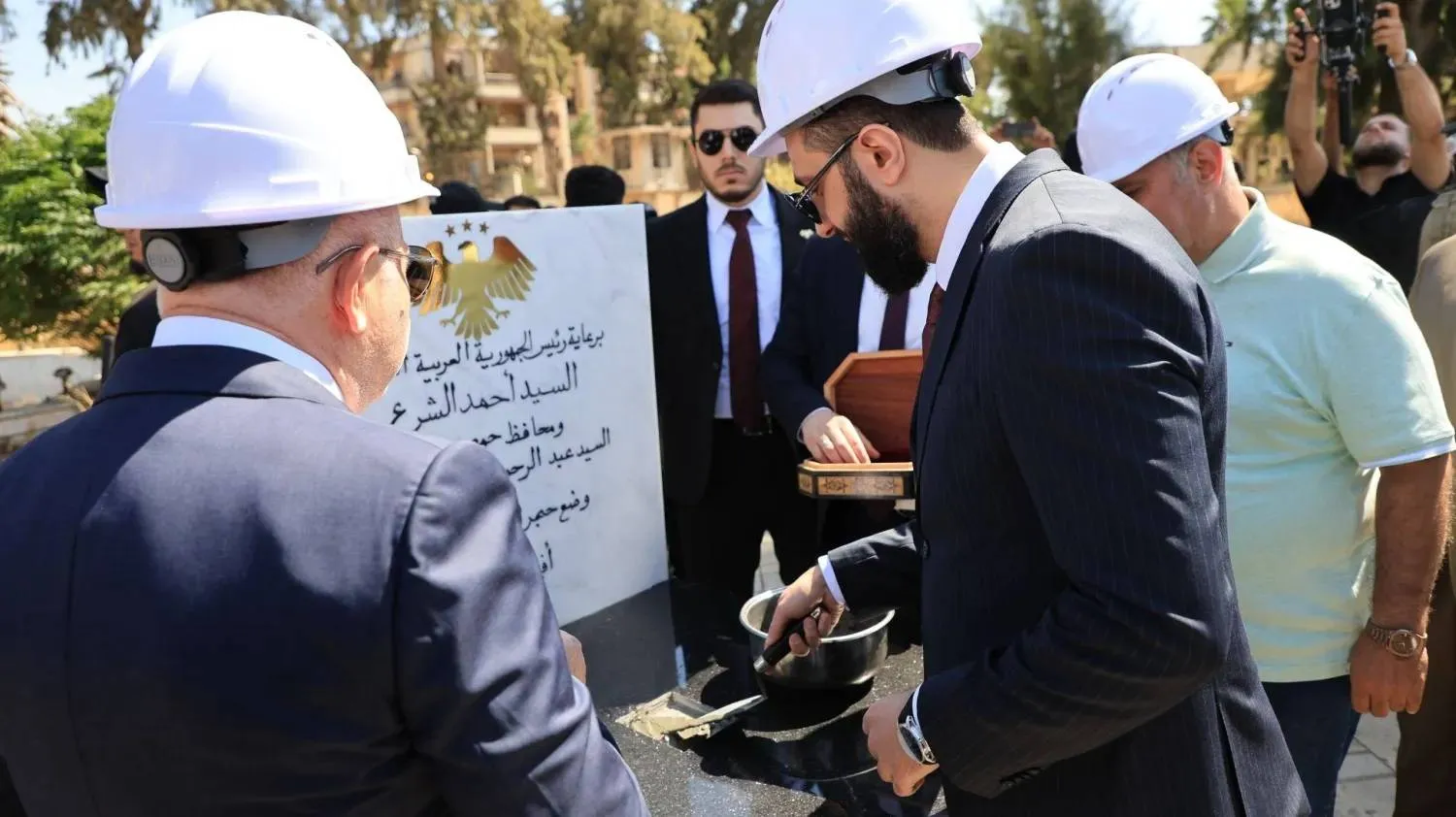
President Ahmed al-Sharaa lays the foundation stone for the Dar al-Salam project in Homs. (Syrian Presidency).
TT

Al-Sharaa’s Provincial Tour Reinforces Popular Support for His Rule in Syria

President Ahmed al-Sharaa lays the foundation stone for the Dar al-Salam project in Homs. (Syrian Presidency).

Syrian President Ahmed al-Sharaa made a surprise tour on Friday of three provinces - Homs, Hama, and Idlib - in what appeared to be a carefully timed bid to showcase his grassroots support.

In Hama, widely seen as the symbolic heart of his power base, thousands of people enthusiastically gathered to welcome him.

The scenes were interpreted as a direct rebuttal to recent media claims that the new leadership’s popularity has been eroding in the wake of July’s bloodshed in the southern Sweida province, where hundreds were killed, and amid mounting internal pressure, including calls for autonomy in parts of the country and the continued backdrop of Israeli strikes on Syria.

Government-aligned sources told Asharq Al-Awsat that al-Sharaa’s authority rests on “five core strongholds - Daraa, Deir Ezzor, Homs, Idlib, and Hama, the latter being the central pillar.”

They described these regions as socially cohesive and politically reliable, forming a solid backbone for the state.

Homs and Hama, they added, demonstrated especially strong support, while Idlib remained significant as the province where al-Sharaa had built his movement in the final years of the struggle against Bashar al-Assad.

The sources stressed that the president has shown interest in all Syrian provinces, particularly Damascus as the political capital and Aleppo as the country’s economic center. Yet they underscored that the five “pillars” remain the cornerstone of the new government’s power structure.

Al-Sharaa’s unannounced visits to Homs and Hama on Friday surprised many residents. In Idlib, locals said they expected him to wrap up his tour with a meeting there, after spending the day in several rural towns.

According to a presidential statement, al-Sharaa met with prominent figures and community leaders in Homs “to reaffirm the state’s commitment to direct engagement with citizens and to listening to their aspirations.”

He also laid the cornerstone for a series of “Dar al-Salam” projects, alongside Governor Abdulrahman al-Ama, marking what officials described as the beginning of a new stage in reconstruction and investment for the province.

Observers noted that by resuming his provincial tours - interrupted after unrest in the coastal region on March 6 - al-Sharaa aims to garner public resolve behind his project of building a “new Syria.”

His next stops are expected in Deir Ezzor in the east and Raqqa in the northeast, where Arab tribes have grown increasingly restive over the unresolved negotiations with the Syrian Democratic Forces (SDF).

The president’s outreach comes ahead of parliamentary elections scheduled for mid-September, and just weeks before his trip to New York for UN General Assembly meetings. The visits coincide with reports that Washington is seeking to push forward some form of agreement or security arrangement between Syria and Israel.



Drones from Iran Attack PM’s Office in Iraqi Kurdistan

The attacks happened with Two Hadid-110 type explosive-laden drones. Reuters file photo
TT

Drones from Iran Attack PM’s Office in Iraqi Kurdistan

The attacks happened with Two Hadid-110 type explosive-laden drones. Reuters file photo

Two drones launched from inside Iran attacked the office of the Kurdistan Regional Government's prime minister in ⁠Iraq and the home of the autonomous region's intelligence chief overnight, authorities said Monday.

"Two Hadid-110 type explosive-laden drones were launched from across the Iranian border toward the private office of the Kurdistan region prime minister and the residence of the Parastin Agency director," the regional Counter-Terrorism Directorate said.

“Fortunately, no casualties were reported,” it added.


King of Jordan to Visit China from August 18

Jordan's King Abdullah II ibn Al-Hussein speaks during a news conference in Berlin, Germany, March 15, 2022. REUTERS/Hannibal Hanschke
TT

King of Jordan to Visit China from August 18

Jordan's King Abdullah II ibn Al-Hussein speaks during a news conference in Berlin, Germany, March 15, 2022. REUTERS/Hannibal Hanschke

Jordan’s King Abdullah II will visit China from Tuesday for talks with Chinese President Xi Jinping, Beijing announced on Monday.

The trip, at the invitation of Xi, will take place from August 18 to 24, Beijing's foreign ministry said in a statement.

The leaders will "exchange views on bilateral relations and international and regional issues of common concern,” Chinese foreign ministry spokesman Lin Jian said.

"China is willing to work with Jordan to take this visit as an opportunity to jointly enhance political mutual trust, expand mutually beneficial cooperation... and make positive contributions to regional peace, stability and development," he added.

During his visit to China -- his ninth since he took the throne in 1999 -- the Jordanian king will also visit Shanghai and Shenzhen.

King Abdullah II's visit to China will map out the next decade of strategic cooperation with Xi, according to Chinese Ambassador to Amman Guo Wei.

Guo told the Jordan News Agency (Petra) that the upcoming summit marks a key milestone as Jordan and China approach the 50th anniversary of diplomatic relations next year.

Economic cooperation between Amman and Beijing expanded rapidly, according to the ambassador. China became Jordan’s top trading partner in 2025, with bilateral trade surging over 25 percent to exceed $6.7 billion. Jordan's exports to China jumped 80 percent in the first five months of this year alone, reaching nearly $300 million.

Chinese investments in Jordan now exceed $3 billion, supporting major sectors such as engineering, textiles, steel, ceramics, energy, logistics, and e-commerce, while employing thousands of Jordanians.

Beyond economic ties, cultural and educational exchanges continue to grow. Over 600 Jordanian students are currently learning Chinese across seven institutions, while around 500 Chinese students study in Jordan.

Chinese culture is also gaining strong traction across Jordan, with tea, culinary, and poetry events reaching local schools and communities.


Erdogan Plans Syria Visit, Reaffirms Türkiye’s Support for Stability

Turkish President Recep Tayyip Erdogan receives Syrian President Ahmed al-Sharaa during his first visit to Türkiye in February 2025. (Turkish Presidency)
TT

Erdogan Plans Syria Visit, Reaffirms Türkiye’s Support for Stability

Turkish President Recep Tayyip Erdogan receives Syrian President Ahmed al-Sharaa during his first visit to Türkiye in February 2025. (Turkish Presidency)

Turkish President Recep Tayyip Erdogan plans to visit Syria soon, reviving a trip initially scheduled for April but postponed after the outbreak of the Iran war in February.

Erdogan pledged that Türkiye would do everything possible to bolster stability in its neighbor, stressing that Syria “will not be alone,” according to excerpts from a television interview carried by Turkish media on Sunday.

He predicted that Syrian Kurds would play a role in peace and stability and pledged to strengthen Türkiye’s ties with Kurdish communities across the region.

Erdogan also cited parliament’s approval of legislation on “Strengthening National Solidarity and Social Integration,” known as the “framework law,” allowing members of the Kurdistan Workers’ Party (PKK) to return and reintegrate into Turkish society as part of the “Terror-Free Türkiye” process.

The Kurdish side calls the initiative the “Peace and Democratic Society Process,” centered on the PKK’s dissolution and disarmament, along with affiliated groups.

SDF integration

Erdogan’s remarks coincided with comments attributed by the pro-government Türkiye newspaper to Mahmoud Berkhedan, a Syrian Democratic Forces (SDF) commander in Ain al-Arab, or Kobani.

Berkhedan praised Erdogan and his ally, Nationalist Movement Party (MHP) leader Devlet Bahceli, for their role in Türkiye’s new peace process.

According to Berkhedan, 99% of outstanding issues over military integration with Damascus have been resolved, with some 10,000 to 12,000 members of the Kurdish People’s Protection Units (YPG), the main component of the SDF, integrated into the Syrian army.

He added that the YPG would be dissolved within days and the Autonomous Administration structure in northern and northeastern Syria would disappear.

“We have buried our weapons and are not demanding an independent state,” Berkhedan declared. “There is no turning back. We will participate side by side in building a new Syria within one army, one state, one flag and a shared homeland.”

Military integration is nearly complete, he added, though the status of the Women’s Protection Units (YPJ) and Turkish nationals serving in the Kurdish forces remains unresolved.

Syria trip

Turkish Ambassador to Damascus Nuh Yilmaz revealed Friday that Erdogan had been considering a visit around April 21, but the Iran war and closure of airspace prevented it.

The date had not been finalized before regional developments intervened, Yilmaz explained, but the trip remains planned and will be announced by the Turkish presidency once arrangements are complete.

He expects Erdogan to visit before the end of the year.

Erdogan last traveled to Damascus in January 2011, when he was Türkiye’s prime minister, about two months before the Syrian uprising and the subsequent rupture in diplomatic relations over Ankara’s opposition to the Assad government’s crackdown on protests.

Syrian President Ahmed al-Sharaa has made four visits to Türkiye since the fall of the Assad regime in December 2024, while exchanges between senior officials have increased and political, economic, security and defense ties have deepened.

Yilmaz noted that four strategic security threats along Türkiye’s border — human smuggling, drug trafficking, irregular migration and terrorism — had disappeared since the collapse of the regime.

Trade between the two countries has also risen 40% to $3.75 billion, with a medium-term target of $10 billion. Talks are continuing on a free-trade agreement, joint industrial zones and opening all crossings along the more than 900-kilometer border.

Türkiye’s foreign and interior ministries are also working on new visa arrangements to make it easier for Syrians who have returned home to visit Türkiye, according to Yilmaz.