

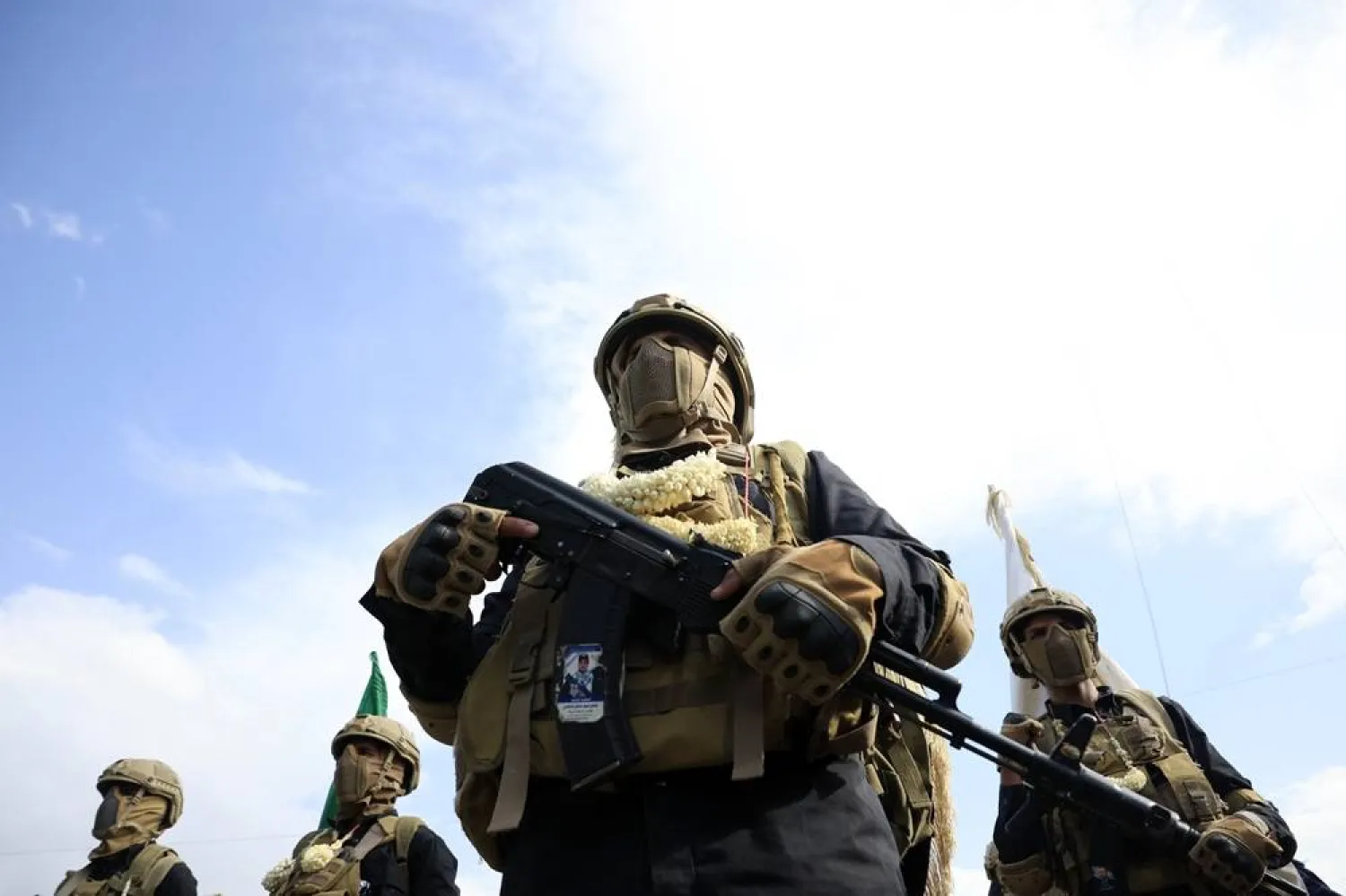

Houthis Raid UN Offices in Yemen and Detain at Least 11 Employees 

Houthi fighters participate in a protest against Israel in Sanaa, Yemen, 29 August 2025. (EPA)
TT

Houthis Raid UN Offices in Yemen and Detain at Least 11 Employees 

Houthi fighters participate in a protest against Israel in Sanaa, Yemen, 29 August 2025. (EPA)

The Iran-backed Houthis raided offices of the United Nations’ food, health and children's agencies in Yemen’s capital Sunday, detaining at least 11 UN employees, officials said. The militants tightened security across Sanaa after Israel killed their prime minister and several Cabinet members. 

Abeer Etefa, a spokesperson for the World Food Program, told The Associated Press that security forces raided the agencies’ offices in the Houthi-controlled capital Sunday morning. 

Also raided were offices of the World Health Organization and UNICEF, according to a UN official and a Houthi official, who spoke on condition of anonymity because they weren’t authorized to brief the media. The UN official said armed forces raided the offices and questioned employees in the parking lot. 

Ammar Ammar, a spokesperson for UNICEF, said a number of the agency's staffers were detained, and UNICEF was seeking additional information from the Houthis. 

Both Etefa and Ammar said their agencies were conducting “a comprehensive head count" of their employees in Sanaa and other Houthi-held areas. 

UN Secretary-General António Guterres in a statement late Sunday said at least 11 personnel had been detained. He condemned their detentions and the “forced entry into the premises of the World Food Program, the seizure of UN property and attempts to enter other UN premises in Sanaa.” 

Guterres called for the immediate and unconditional release of the personnel detained on Sunday as well as those detained in the past. 

The raids were the latest in a long-running Houthi crackdown against the UN and other international organizations working in Houthi-held areas in Yemen. 

They have detained dozens of UN staffers, as well as people associated with aid groups, civil society and the now-closed US Embassy in Sanaa. The UN suspended its operations in Saada in northern Yemen after the militants detained eight UN staffers in January. 

Sunday's raids followed the killing of the Houthi prime minister and several of his Cabinet members in an Israeli strike Thursday. It was a blow to the militants who have launched attacks on Israel and ships in the Red Sea in relation to the Israel-Hamas war in the Gaza Strip. 

Among the dead were Prime Minister Ahmed al-Rahawi, Foreign Minister Gamal Amer, Deputy Prime Minister and Minister of Local Development Mohammed al-Medani, Electricity Minister Ali Seif Hassan, Tourism Minister Ali al-Yafei and Information Minister Hashim Sharafuldin, according to two Houthi officials and the victims' families. 

Also killed was a powerful deputy interior minister, Abdel-Majed al-Murtada, the Houthi officials said. 

They were targeted during a “routine workshop held by the government to evaluate its activities and performance over the past year,” a Houthi statement said Saturday, two days after the strike. The Houthis said a funeral for all those killed is scheduled for Monday in Sabeen Square in central Sanaa. 

Defense Minister Mohamed Nasser al-Attefi survived the attack while Abdel-Karim al-Houthi, the interior minister and one of the most powerful figures in the militant group, didn’t attend the Thursday meeting, the Houthi officials said. 

UN envoy for Yemen Hans Grundberg expressed “great concern” over Israel’s recent strikes in the Houthi-controlled areas following Houthi attacks against Israel. 

“Yemen cannot afford to become a battleground for a broader geopolitical conflict,” he said in a statement. He called for de-escalation. 

Thursday’s strike came after the Houthis attacked Israel on Aug. 21 with a ballistic missile that its military described as the first cluster bomb the militants had launched at Israel since 2023. The missile, which the Houthis said was aimed at Ben Gurion Airport, prompted air raid sirens across central Israel and Jerusalem, forcing millions into shelters. 

The Houthis are likely to escalate their attacks on Israel and ships in the Red Sea, after they vowed in July to target merchant ships belonging to any company that does business with Israeli ports, regardless of nationality. 

“Our military approach of targeting the Israeli enemy, whether with missiles, drones or a naval blockade, is continuous, steady, and escalating,” Abdel Malik al-Houthi, the group’s secretive leader, said in a televised speech Sunday. 


Arab League Condemns Israeli Forces' Raid on UNRWA Headquarters

A general view shows the opening session of the meeting of Arab foreign ministers at the Arab League Headquarters (Reuters)
TT

Arab League Condemns Israeli Forces' Raid on UNRWA Headquarters

A general view shows the opening session of the meeting of Arab foreign ministers at the Arab League Headquarters (Reuters)

Secretary-General of the Arab League Ahmed Aboul Gheit strongly condemned the Israeli forces' raid on the headquarters of the United Nations Relief and Works Agency for Palestine Refugees (UNRWA) in East Jerusalem.

He described this attack as part of an ongoing campaign by the occupying forces to undermine the agency's role and eliminate its contribution to safeguarding the rights of Palestinian refugees, SPA reported.

In a statement issued Tuesday, Aboul Gheit disclosed that the justifications provided by the occupying forces for this illegal raid have no logical or legal basis.

The secretary-general urged the international community to intervene effectively and decisively to halt this Israeli campaign targeting the international agency, which provides essential health, education, and employment services to millions of Palestinian refugees across its five areas of operation.

He also referenced the important vote at the United Nations a few days ago, which extended UNRWA's mandate for an additional three years.


‘Shockingly High’ Number of Gaza Children Still Acutely Malnourished After Truce, UN Says 

Displaced Palestinian students attend class at a tent school in the Tal Al-Hawa neighborhood in Gaza City, Gaza Strip, 09 December 2025. (EPA)
TT

‘Shockingly High’ Number of Gaza Children Still Acutely Malnourished After Truce, UN Says 

Displaced Palestinian students attend class at a tent school in the Tal Al-Hawa neighborhood in Gaza City, Gaza Strip, 09 December 2025. (EPA)

Thousands of children have been admitted for treatment for acute malnutrition in Gaza since an October ceasefire that was supposed to enable a major increase in humanitarian aid, the UN children's agency said on Tuesday.

UNICEF, the biggest provider of malnutrition treatment in Gaza, said that 9,300 children were treated for severe acute malnutrition in October, when the first phase of an agreement to end the two-year Israel-Hamas war came into effect.

While this is down from a peak of over 14,000 in August, the number is still significantly higher than during a brief February-March ceasefire and indicates that aid flows remain insufficient, UNICEF spokesperson Tess Ingram told a Geneva press briefing by video link from Gaza.

"It's still a shockingly high number," she said. "The number of children admitted is five times higher than in February, so we need to see the numbers come down further."

Ingram described meeting underweight babies weighing less than 1 kilogram born in hospitals "their tiny chests heaving with the effort of staying alive."

UNICEF is able to import considerably more aid into the enclave than it was before the October 10 agreement, but obstacles remain, she said, citing delays and denials of cargoes at crossings, route closures and ongoing security challenges.

"We have seen some improvement, but we continue to call for all of the available crossings into the Gaza Strip to be open," she added.

There are not enough commercial supplies entering Gaza, she added, saying that meat was still prohibitively expensive at around $20 a kilogram.

"Most families can't access this, and that's why we're still seeing high rates of malnutrition," she said.

In August, a UN-backed hunger monitor determined that famine conditions were affecting about half a million people - or a quarter of Gaza's population.

Children were severely affected by hunger as the war progressed, with experts warning that the effects could cause lasting damage.


Sudan’s RSF Advances Could Trigger New Refugee Exodus, UNHCR Chief Warns 

Women displaced from el-Fasher stand in line to receive food aid at the newly established El-Afadh camp in al-Dabba, in Sudan's Northern State, Nov. 16, 2025. (AP)
TT

Sudan’s RSF Advances Could Trigger New Refugee Exodus, UNHCR Chief Warns 

Women displaced from el-Fasher stand in line to receive food aid at the newly established El-Afadh camp in al-Dabba, in Sudan's Northern State, Nov. 16, 2025. (AP)

Advances by paramilitary Rapid Support Forces in Sudan could trigger another exodus across the country's borders, UN High Commissioner for Refugees, Filippo Grandi, told Reuters.

The RSF took over Darfur's city of el-Fasher in late October in one of its biggest gains of the 2-1/2-year war with Sudan's army. This month, advances have continued eastward into the Kordofan region and they seized the country's biggest oil field.

Most of the estimated 40,000 people that the United Nations says have been displaced by the latest violence in Kordofan - a region comprised of three states in central and southern Sudan - have sought refuge within the country, Grandi said, but that could change if violence spreads to a large city like El Obeid.

"If that were to be - not necessarily taken - but engulfed by the war, I am pretty sure we would see more exodus," said Grandi in an interview from Port Sudan late on Monday.

"We have to remain...very alert in neighboring countries in case this happens," he said.

MILLIONS HOMELESS

Already, the war has uprooted nearly 12 million people, including 4.3 million who have fled across borders to Chad, South Sudan and elsewhere, in the world's biggest displacement crisis. However, some have returned to the capital Khartoum, which is now back in Sudanese army control.

Humanitarian workers lack resources to help those fleeing, many of whom have been raped, robbed or bereaved by the violence, said Grandi, who met with survivors who fled mass killings in el-Fasher.

"We are barely responding," said Grandi, referring to a Sudan response plan, which is just a third funded largely due to Western donor cuts. UNHCR lacks resources to relocate Sudanese refugees from an unstable area along Chad's border, he said.

FAMILIES TORN APART BY CONFLICT

Most of those who trekked hundreds of kilometers from el-Fasher and Kordofan to Sudan’s al-Dabba camp on the banks of the Nile north of Khartoum, which Grandi visited last week, are women and children. Their husbands and sons were killed or conscripted along the way.

Some mothers said they disguised their sons as girls to protect them from being abducted by fighters, Grandi said.

"Even fleeing is difficult because people are continuously stopped by the militias," he said.

Grandi began his UNHCR career in Khartoum in the 1980s, when Sudan sheltered refugees from other African wars. He is on his last trip as UNHCR chief before his term ends this month. A successor has yet to be named from over a dozen candidates.
