


Italy Exhibition Explores How Sound Helps Us to Savor Food

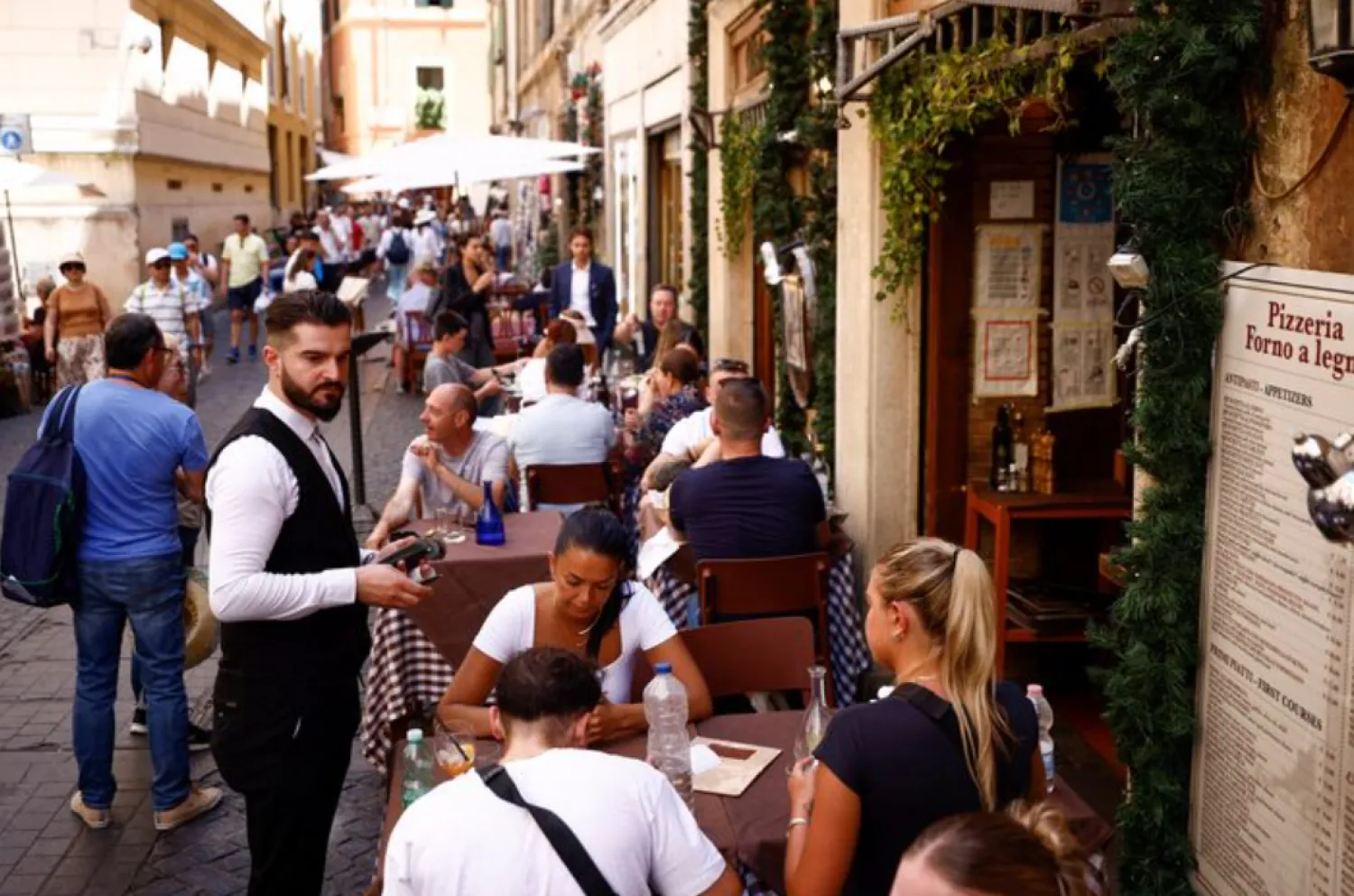
A waiter holds a point-of-sale (POS) device at a restaurant near the Pantheon, on the day the European Central Bank's rate-setting Governing Council holds an unscheduled meeting to discuss the recent sell-off in government bond market, in Rome, Italy, June 15, 2022. REUTERS/Guglielmo Mangiapane/File photo
TT

Italy Exhibition Explores How Sound Helps Us to Savor Food

A waiter holds a point-of-sale (POS) device at a restaurant near the Pantheon, on the day the European Central Bank's rate-setting Governing Council holds an unscheduled meeting to discuss the recent sell-off in government bond market, in Rome, Italy, June 15, 2022. REUTERS/Guglielmo Mangiapane/File photo

An exhibition in northern Italy is expanding traditional ideas about taste by exploring how sound influences the way people experience their food.

Hosted at the MUSE science museum in Trento, Food Sound examines how auditory cues – from the crunch of an apple to the sizzle of a pan – affect appetite, perception of flavor and emotional response, Reuters reported.

"If neuroscience has transformed fields from psychology to economics, it's also reshaping how we understand cooking and food," said Patrizia Famà, director of the museum's Office of Public Programmes.

Visitors are guided through mock-ups of trattorias and dining pods, learning how the brain processes sound and how acoustics can influence food choices.

One interactive display invites guests to select food based solely on sound.

"Food perception is the ultimate multi-sensory experience, engaging all five senses," said Massimiliano Zampini, a researcher at the University of Trento and a member of the exhibition's scientific committee.

Zampini and Charles Spence, an experimental psychologist at Britain's Oxford University, were among the first to study how sound – often overlooked in discussions of taste – affects flavour and emotional response.

In a landmark experiment in 2004, they found that potato chips were perceived as being both crisper and fresher when either the overall sound level was increased, or when just the high frequency sounds were selectively amplified.

The idea for the exhibition came to creator Vincenzo Guarnieri after overhearing children describe a visit to a potato chip factory.

"They said the fryers sounded like other children crying. That moment struck me, and I realized sound could be a powerful tool to raise awareness about food," Guarnieri said.

The food industry has taken notice of the research to try to attract consumers.

British food ingredients maker Tate & Lyle has identified "Hyper Crunch" as a rising trend, with consumers adding baked rice to salads and seeking out snacks that deliver a satisfying crunch.

In a report published in November, Tate & Lyle predicted that the trend would expand into sweet categories. It cited examples such as a chocolate bar with a kunefe filling, a traditional Middle Eastern dessert, and iced coffee served in chocolate-coated cups that crackle when squeezed.

Betti Nincioli, from Florence, said that she had already realised how much background music contributed to her sense of serenity and positive mood when she was picking up products from supermarket shelves or dining in restaurants.

"Now I am more aware of how a product's sound can make it seem like something else," she said after visiting the exhibition which is in a museum designed by Italian architect Renzo Piano.

The exhibition runs until Jan. 11, 2026.


Thousands of Authors Publish ‘Empty’ Book to Protest AI Using their Work

Thousands of authors published an “empty” book to protest AI (Shutterstock)
TT

Thousands of Authors Publish ‘Empty’ Book to Protest AI Using their Work

Thousands of authors published an “empty” book to protest AI (Shutterstock)

Thousands of authors including Kazuo Ishiguro, Philippa Gregory and Richard Osman have published an “empty” book to protest against AI firms using their work without permission.

About 10,000 writers have contributed to Don’t Steal This Book, in which the only content is a list of their names.

Copies of the work were distributed to attenders at the London book fair on Tuesday, a week before the UK government is due to issue an assessment on the economic cost of proposed changes in copyright law.

By March 18, ministers must deliver an economic impact assessment as well as a progress update on a consultation about the legal overhaul, against a backdrop of anger among creative professionals about how their work is being used by AI firms.

The organizer of the book, Ed Newton-Rex, a composer and campaigner for protecting artists’ copyright, said the AI industry was “built on stolen work ... taken without permission or payment.”

He added: “This is not a victimless crime – generative AI competes with the people whose work it is trained on, robbing them of their livelihoods. The government must protect the UK’s creatives, and refuse to legalize the theft of creative work by AI companies.”

Other authors who have contributed their names to the book include the Slow Horses author, Mick Herron; the author Marian Keyes; the historian David Olusoga; and Malorie Blackman, the writer of Noughts and Crosses.

“It is not in any way unreasonable to expect AI companies to pay for the use of authors’ books,” said Blackman.


Wildlife to Replace Humans on Next Series of UK Banknotes

Banknotes and coins that feature an image of Britain's King Charles III are pictured on display during a photocall for "The Future of Money" exhibition, at the Bank of England Museum, City of London, UK, Feb. 27, 2024. (AFP)
TT

Wildlife to Replace Humans on Next Series of UK Banknotes

Banknotes and coins that feature an image of Britain's King Charles III are pictured on display during a photocall for "The Future of Money" exhibition, at the Bank of England Museum, City of London, UK, Feb. 27, 2024. (AFP)

Images of ‌animals will feature on the next series of banknotes from the Bank of England, as the central bank shifts away from historical figures such as William Shakespeare, Winston Churchill and Jane Austen over the coming years.

"Nature is a great choice from a banknote authentication perspective and means we can showcase the UK's rich and varied wildlife on the next series of ‌banknotes," Victoria ‌Cleland, the BoE's chief cashier, said.

Bank ‌of ⁠England banknotes have ⁠featured monarchs since Queen Elizabeth first appeared on one in 1960, while Shakespeare was the first historic figure to appear in 1970.

King Charles' portrait will continue to appear on the next series of notes as well, the ⁠BoE said.

The BoE held a ‌consultation on a change ‌to the design of banknotes in July 2025, ‌inviting views from the public.

The theme of ‌nature was supported by 60% of the 44,000 responses, narrowly beating the category of "architecture and landmarks" on 56% and "notable historical figures" on 38%. Other categories included "arts, ‌culture and sport", "innovation" and "noteworthy milestones".

The new notes will feature wildlife native ⁠to ⁠the United Kingdom and will not include household pets, the BoE said. It plans to run a second consultation in the coming months asking for the public's views on specific animals to feature on the notes taken from a list created by British wildlife experts.

The BoE is not the only producer of banknotes in the United Kingdom. Notes are also produced by seven commercial banks in Scotland and Northern Ireland.


North Korea and China to Resume Passenger Train Service After Six-Year Gap

A North Korean flag flutters from a train believed to be carrying North Korean leader Kim Jong Un, as it arrives in Beijing, China, September 2, 2025. (Reuters)
TT

North Korea and China to Resume Passenger Train Service After Six-Year Gap

A North Korean flag flutters from a train believed to be carrying North Korean leader Kim Jong Un, as it arrives in Beijing, China, September 2, 2025. (Reuters)

South ‌Korea's Unification Ministry said on Tuesday that passenger train services between Pyongyang and Beijing are set to resume this week, marking the end of a six-year suspension caused by the COVID-19 pandemic.

The resumption restores a critical transport link between North Korea and its primary economic ally, after ‌years of ‌strict border closures that began ‌in ⁠early 2020.

China's state ⁠railway told the Yonhap News Agency that the Pyongyang–Beijing train will begin the round-trip service on March 12, operating four times a week.

Only the last two carriages will ⁠initially carry passengers, mainly diplomats or ‌others on ‌official business, with ticket sales to the general ‌public possible if seats are ‌available, Yonhap quoted a railway official as saying.

North Korea remains closed to most foreign tourism, with limited exceptions largely for ‌Russian tour groups under restricted arrangements, according to travel agencies organizing trips ⁠to ⁠the country.

Before the pandemic, Chinese visitors made up the largest share of foreign tourists to North Korea, the agencies said.

Tour organizers said on Monday that North Korea had cancelled next month's Pyongyang Marathon for unspecified reasons. The race is one of the few events that has been open to international participants in the isolated state.
