About 2,000 North Korean Troops Killed in Russia Deployment

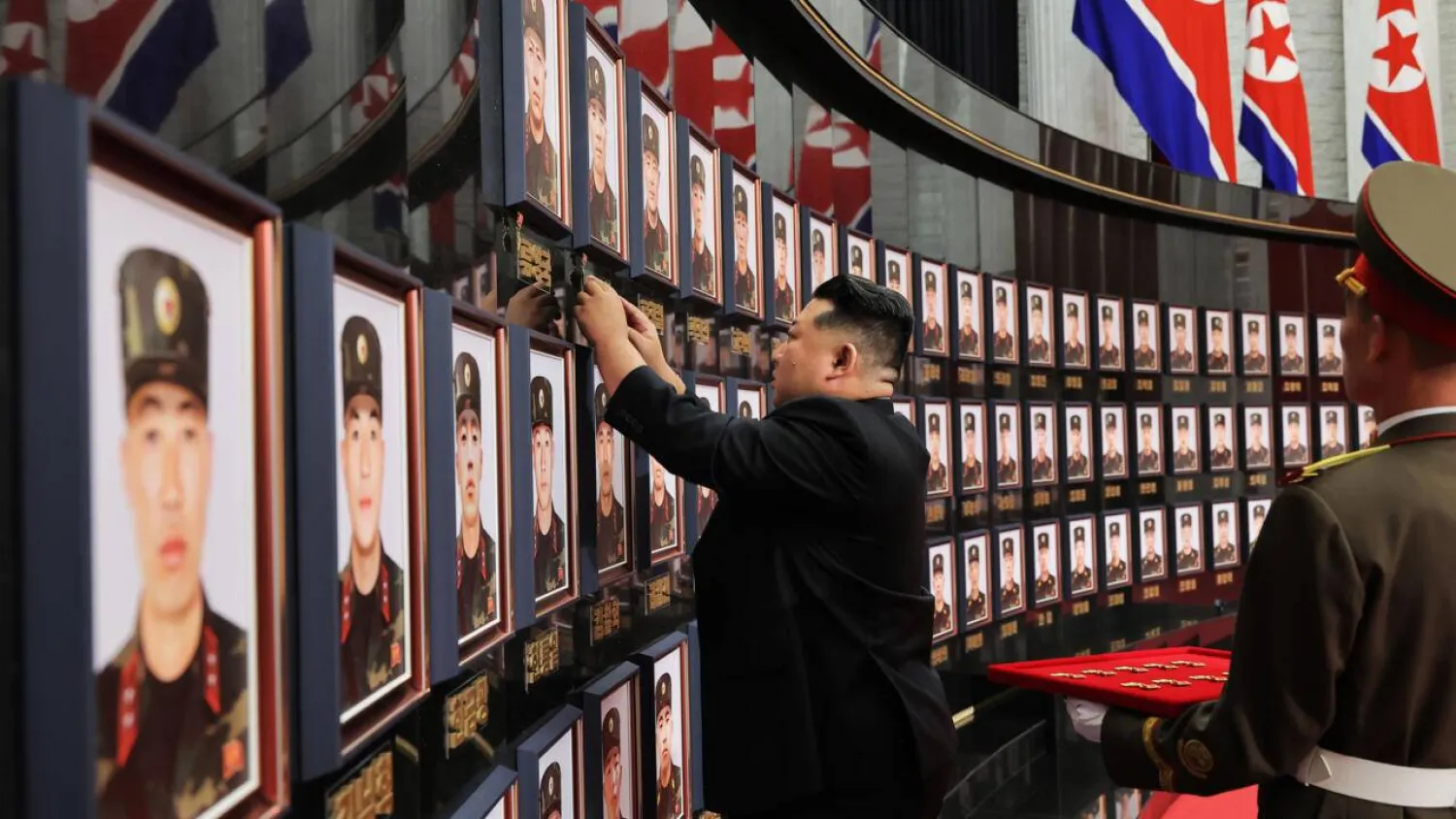
North Korean leader Kim Jong Un visits a memorial wall in Pyongyang in August for Korean People's Army's Overseas Operational Forces who took part in military operations for Russia. STR / KCNA VIA KNS/AFP/File
TT

About 2,000 North Korean Troops Killed in Russia Deployment

North Korean leader Kim Jong Un visits a memorial wall in Pyongyang in August for Korean People's Army's Overseas Operational Forces who took part in military operations for Russia. STR / KCNA VIA KNS/AFP/File

Around 2,000 North Korean soldiers deployed to help Russia fight Ukraine are estimated to have been killed, Seoul's spy agency said Tuesday, according to a lawmaker.

Seoul's National Intelligence Service said in April "the number of war dead was at least 600. But based on updated assessments, it now estimates the figure at around 2,000," lawmaker Lee Seong-kweun told reporters after a briefing from the spy agency.

South Korean and Western intelligence agencies have said the North sent more than 10,000 soldiers to Russia in 2024 -- primarily to the Kursk region -- along with artillery shells, missiles and long-range rocket systems, AFP said.

Lawmaker Lee said that the NIS believed that Pyongyang planned to deploy another 6,000 soldiers and engineers to Russia and that 1,000 had already arrived.

"It is assessed that out of the recent third deployment plan of 6,000 troops, around 1,000 combat engineers have arrived in Russia," MP Lee said.

Earlier this year, Moscow's Foreign Minister Sergei Lavrov said that the North would send builders and deminers to the Kursk region.

North Korea only confirmed it had deployed troops to support Russia's war in Ukraine in April and admitted that its soldiers had been killed in combat.

Since then, North Korean leader Kim Jong Un has met with the families of soldiers killed fighting for Russia against Ukraine and offered condolences for their "unbearable pain".

State media has run images of an emotional Kim embracing a returned soldier who appeared overwhelmed, burying his face in the leader's chest.

The leader was also seen kneeling before a portrait of a fallen soldier to pay his respects and placing medals and flowers beside images of the dead.

Russia and North Korea signed a military deal last year, including a mutual defense clause, during a rare visit by Russian President Vladimir Putin to North Korea.


US Helicopter Fired on Ship That Tried to Break Iran Ports Blockade

A vessel near the Strait of Hormuz, as seen from Musandam, Oman, August 10, 2026. (Reuters)
TT

US Helicopter Fired on Ship That Tried to Break Iran Ports Blockade

A vessel near the Strait of Hormuz, as seen from Musandam, Oman, August 10, 2026. (Reuters)

A US helicopter fired missiles on Tuesday into the engine room of a Panama-flagged cargo ship that attempted to break the American blockade of Iran's ports, the United States military said.

The US Navy MH-60 helicopter fired on and disabled the M/V Vela Nova "after the ship's civilian crew ignored repeated warnings from American forces," US Central Command (CENTCOM) said on X, adding that the vessel "is no longer transiting to Iran in violation of the US blockade."

It was the third time the United States, in a months-long war against Iran, has forcibly halted a vessel since reinstating the ports blockade on July 14.

CENTCOM said it has redirected 55 ships that tried to run the blockade and boarded two others as of Tuesday.

US forces previously blockaded Iranian ports from April 13 to June 18, during which they disabled nine ships and redirected more than 140, according to CENTCOM.

Iran has demanded that the United States end the ports blockade as part of its conditions to reopen the Strait of Hormuz, a key conduit for oil and gas shipments before the war that has seen traffic plummet due to Tehran's attacks on ships in the area.

US President Donald Trump repeated his frequent claim Tuesday that the United States has taken over the waterway.

"We have total control over the Hormuz Strait right now. They don't have control. We have total control. We own it," Trump told reporters.


Trump Says His Plane Faced ‘Greater Risk’ in Secret Flight Change

US President Donald Trump speaks to members of the media after disembarking Air Force One at Joint Base Andrews, Maryland, US, August 11, 2026. (Reuters)
TT

Trump Says His Plane Faced ‘Greater Risk’ in Secret Flight Change

US President Donald Trump speaks to members of the media after disembarking Air Force One at Joint Base Andrews, Maryland, US, August 11, 2026. (Reuters)

US President Donald Trump said on Wednesday he secretly switched planes in Türkiye last month at the direction of the US Secret Service, but that the plane he ultimately flew on was still more vulnerable than Air Force One.

Following a NATO summit in Ankara, Trump was transferred from Air Force One to a military plane via a catering truck in an extraordinary deception prompted by an Iranian assassination threat, US media reported.

The White ‌House did not ‌disclose the change and it remained a secret until ‌the ⁠Washington Post first ⁠reported it on Monday.

Some media commentators questioned whether the operation left Trump's aides and journalists traveling with him at risk aboard the plane presumed to be carrying the president.

"I think actually the plane that I flew on was at greater risk," Trump told reporters on Tuesday. "I think it was at greater risk because that would be the plane I think that they would be more likely to ⁠go for."

After a day of social media memes portraying ‌Trump as hiding out in the catering ‌truck, the image-conscious president, who often promotes memes of himself as a bold and courageous ‌leader, said he was following the direction of the Secret Service, the agency ‌that protects the president.

"Well, it's only up to Secret Service. I just follow what they'd like to do, so I go by Secret Service and the military," Trump said.

"I guess there was a threat out there. I didn't really ask too much about ‌it. I get a lot of threats," Trump said.

The White House said at the time that the ⁠president was flying aboard ⁠Air Force One from Türkiye to Britain. But moments after Trump boarded the plane, he left it in secret via the catering truck and boarded another aircraft for the flight to Britain, the Post said on Monday, quoting unnamed sources.

Trump had taken a newly renovated Qatari-donated jet to Ankara for the NATO summit but unexpectedly announced he would use an older Air Force One when departing the country, a move that prompted questions about the newer plane.

The trip to NATO was the first international travel for the new plane and took place as hostilities escalated with Iran, which borders Türkiye.


Groups Sue Trump Administration Over Its Targeting of International Criminal Court

An exterior view of the International Criminal Court in the Hague, Netherlands, March 31, 2021. (Reuters)
TT

Groups Sue Trump Administration Over Its Targeting of International Criminal Court

An exterior view of the International Criminal Court in the Hague, Netherlands, March 31, 2021. (Reuters)

Human Rights Watch and three other advocacy groups sued the Trump administration on Tuesday to challenge its campaign against the International Criminal Court, arguing that sanctions against ICC judges and prosecutors are undermining the ability to prosecute people responsible for humanity’s worst crimes.

The complaint — filed in the Southern District of New York — says that President Donald Trump's executive order last year targeting the Hague-based criminal court and the US sanctions issued against a UN human rights expert and three Palestinian rights groups represent a “blatantly illegal attack on international justice and should be struck down," according to a press release.

The lawsuit is the latest example of organizations pushing back on what they call the Trump administration’s efforts to undermine international law and prevent efforts to combat impunity by governments around the world.

“The fact that so many leading human rights and humanitarian organizations have come together to challenge Trump’s unlawful executive order demonstrates the widespread harm it is causing across civil society groups dedicated to bringing those responsible for grave crimes to justice,” said Andrew Loewenstein of Foley Hoag LLP, the lead counsel representing the plaintiffs.

The groups assert that the financial and legal penalties against the ICC have forced them to “curtail a wide range of human rights and legal work in violation of their First and Fifth Amendment rights under the US Constitution and under the Religious Freedom Restoration Act.”

Other organizations joining the lawsuit are the American Friends Service Committee, the Center for Constitutional Rights and the Open Society Institute. The State Department did not immediately respond to a request for comment.

Efforts to retain the global tribunal's power come as the ICC faces enormous pressure, both internally and from its more than 120 member states. Among those sanctioned by the US last year was Karim Khan, who was the ICC’s chief prosecutor until he was removed from the post last month, nearly two years after sexual misconduct allegations against him first emerged, as detailed in stories by The Associated Press.

The Trump administration had issued those sanctions against Khan and a dozen other ICC staff in retaliation for warrants the court has issued for top Israeli officials, including Prime Minister Benjamin Netanyahu, over the war in Gaza and investigations into US personnel in Afghanistan.

“The Trump administration seeks a get out of jail free card for whomever it chooses. And with this case, we say no,” Liz Evenson, international justice director at Human Rights Watch, said during a press conference Tuesday.

Last month, US Secretary of State Marco Rubio announced that the US was launching a “sweeping campaign to dismantle the threat posed by the International Criminal Court to US sovereignty.”

In a video message, Rubio said the US would pressure member states to withdraw from the institution, sanction organizations that work with the court and ban staff from traveling to the United States. Countries that “enjoy the benefits of the US security umbrella” will be called upon to reject the court’s jurisdiction over US citizens, he added.

Several countries, including US-allied Venezuela, announced they would withdraw from the court shortly after Rubio's statements and Khan's removal.