


Back to the Future: UK Eyes New Towns to Help Housing Crunch 

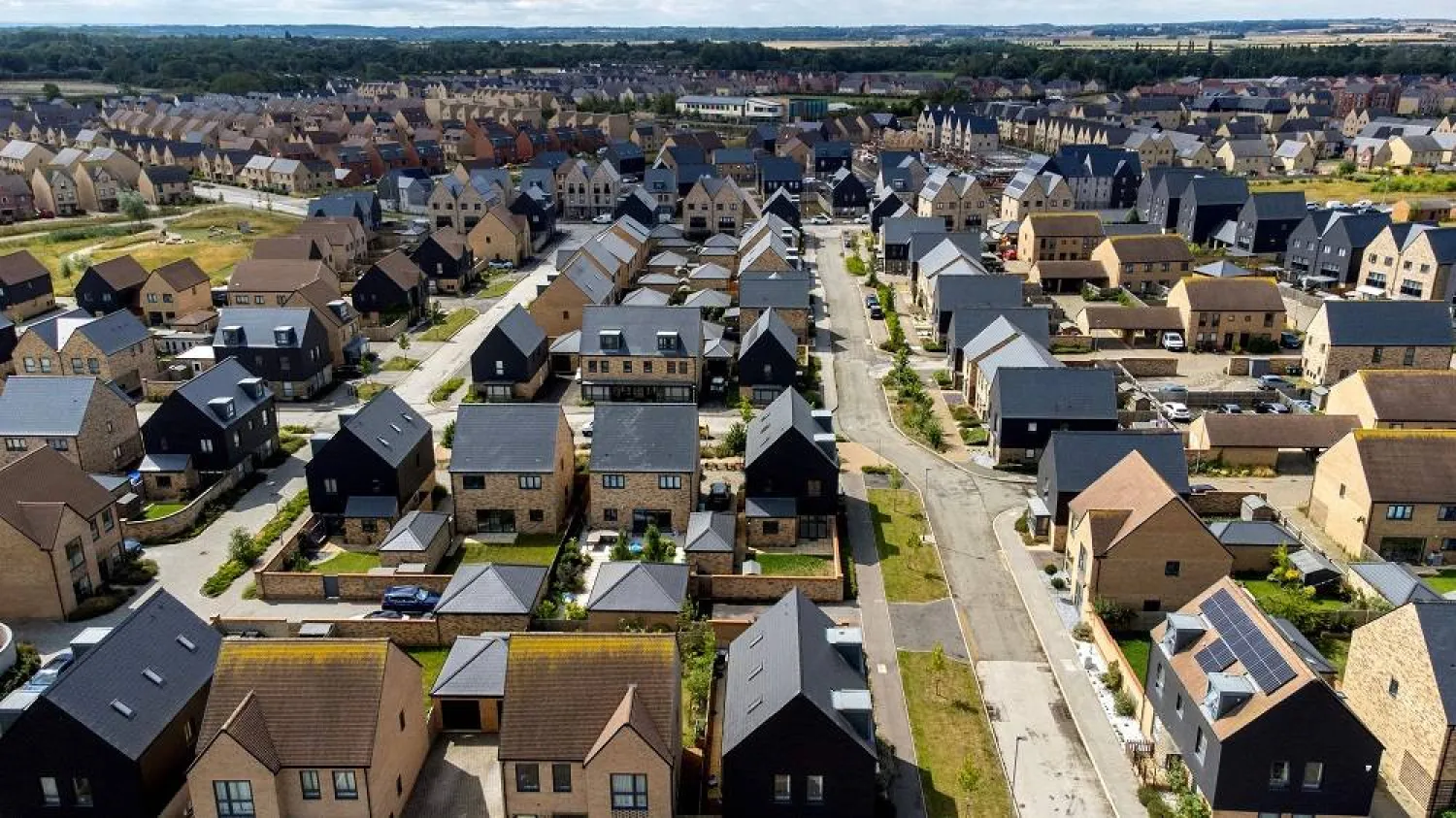
An aerial view shows newly built homes in the new town of Northstowe, eastern England on July 31, 2025. (AFP)
TT

Back to the Future: UK Eyes New Towns to Help Housing Crunch 

An aerial view shows newly built homes in the new town of Northstowe, eastern England on July 31, 2025. (AFP)

The UK's newest town Northstowe is gradually taking shape amid cranes and scaffolding, a possible blueprint for others as the government seeks to tackle a desperate housing shortage.

So far the town, which lies close to the affluent eastern city of Cambridge, has just 3,000 or so residents and next to no amenities.

But planners project that within the next two decades its population could swell to 30,000 people.

"I'm really excited about the future," said Jason Benedicic, who moved with his partner and young child to the town in 2020 because it offered more affordable space than the nearby historic university city.

"There is an amazing community, the people really make the place special," he said, adding there were regular events which brought everyone together as well as "great transport links" and "open spaces".

Labor Prime Minister Keir Starmer, elected in July last year, has pledged to build 1.5 million houses by 2029, as he tries to solve a chronic shortage of homes.

Most will be built by expanding existing urban developments, but the British leader has also vowed to start work on the UK's "next generation" of new towns.

The idea harks back to the late prime minister Clement Attlee's reforming Labor government of 1945-1951, which famously set up the National Health Service and welfare state.

Its new town project paved the way for the construction in the 1960s of arguably Britain's most famous new town -- the oft-derided Milton Keynes, just north of London.

When Milton Keynes -- now a city of more than 250,000 residents -- was built, car was king and the future of shopping was thought to be inside vast malls.

Now urban designers are more conscious about biodiversity and the battle against global warming, while buyers tend to prefer market towns, noted Katja Stille, of Northstowe planner Tibbalds.

"The world is very different from that time," she told AFP.

With its green spaces, cycle lanes, lakes and transport links, Northstowe, 12 miles (19 kilometers) northwest of Cambridge, calls itself a "healthy" new town with a "low-carbon community".

The site, on what used to be Royal Air Force barracks, welcomed its first residents in 2017 and some 1,600 homes are now occupied.

Once complete, the town will have 10,000 houses and eight schools.

It currently has no shops or doctor's surgery, but officials have announced plans for a "vibrant town center" on what is currently a field and a health facility.

"It would be nice to have a barber," said Benedicic, an IT consultant who became Northstowe's mayor earlier this year.

Stephen Brewer runs the town's Tap and Social cafe which opened in April 2024.

The 68-year-old feels "proud" to be one of the new community's pioneers but looks forward to the day his business has some competition.

"We're not fearful of that," he told AFP.

Britain has been gripped by a national housing crisis for several years, with supply failing to keep up with demand as people live longer and immigration soars.

With housing prices skyrocketing, home ownership is out of reach for many young people.

The charity Shelter England has estimated around 354,000 people are homeless across the country.

Starmer wants to deliver 300,000 homes a year during this parliament -- well above what has been achieved in recent years.

He has set about overhauling planning laws to make it easier for developers to override environmental regulations.

But there are questions over the availability of land, building materials, and workers with the necessary skills.

"It is an exciting but ambitious target and challenge," Tim Wray, group development director at Keepmoat, which is building 300 houses in Northstowe, told AFP.

A government task force is considering more than 100 sites across England for the next new towns, which could host 10,000 homes each. It is due to announce the locations this summer.

They will be "well-designed, beautiful communities with affordable housing, GP (doctor's) surgeries, schools and public transport," the government has promised.



No Trees, No Fans: Surviving Extreme Heat in India’s Salt Pans

A worker harvests salt at the Little Rann of Kutch (LRK) region of Gujarat on April 29, 2026. (AFP)
TT

No Trees, No Fans: Surviving Extreme Heat in India’s Salt Pans

A worker harvests salt at the Little Rann of Kutch (LRK) region of Gujarat on April 29, 2026. (AFP)

India faces challenging heatwaves each year, but few places endure conditions as searing as the country's western desert salt pans, where workers rely on simple techniques to survive almost unbearable temperatures.

Up to 50,000 workers in Gujarat spend eight months on the remote salt pans without electricity or healthcare, relying on a tanker to deliver drinking and washing water every 25 days.

They use shaded rest breaks, cloth-cooled water bottles and staggered hours to survive.

In Gujarat's Little Rann of Kutch summer temperatures routinely cross 45C, and can climb to 47-48C.

The same dry heat that makes life punishing also makes the desert ideal for salt production -- Gujarat produces roughly three-quarters of India's total salt output.

"We work in staggered timing... doing our work in early mornings and after sunset," said 42-year-old Babulal Narayan, who rakes the salt as brine water dries in shallow pools.

During the hottest hours, many retreat to makeshift huts -- frames of sticks draped with coarse homespun cloth, plastered with wild donkey dung.

"We sit here every two to three hours, so that we do not feel weak or dizzy," said 17-year-old salt worker Bhavna Rathore.

The dung blocks the sun and allows heat to escape, while the rough cloth allows some air to pass through, she explained.

The huts offer shelter in a landscape without trees or natural shade, and where the sun reflects harshly off the white salt crust.

- 'Heatwave' -

Kanchan Narayan, 44, uses a damp cloth-wrapped bottle hung on a string, cooling the drinking water inside via evaporation.

"The wind helps to cool the water," she said.

Poornima, a salt pan worker, sips black tea during the day -- saying the hot drink induces sweating in the dry weather to cool the body.

The salt is produced by pumping saline water from bore-wells into shallow pans, where the liquid evaporates under the sun and wind.

Workers rake the surface daily to ensure even crystallization. Over weeks, a thick crust of salt forms, which the workers break and stack into mounds.

The job has always involved enduring harsh conditions, but this year the India Meteorological Department (IMD) forecasts an "above-normal number of heatwave days" across several regions, including Gujarat.

Workers are exposed to the heat for longer than before.

Previously, they relied on expensive diesel pumps to bring the saline water to the surface. But a switch to solar has brought down costs and allowed families to operate the pans for longer.

That means work that used to end in March now continues into the hottest months.

- 'Fever' -

The consequences for workers can be deadly, with regular reports of fatigue, dizziness and nausea -- signs of heat stress, when the body's natural cooling systems are overwhelmed.

This can cause organ failure and even death.

Several studies have found high levels of dehydration, heat stress and even signs of kidney malfunction among these communities.

"I take a paracetamol whenever fever becomes high," said Kanchan, a rare worker wearing rubber boots -- to protect against prolonged exposure to brine, that can crack skin so deep it bleeds.

India has no fixed legal temperature at which work must stop.

Instead, it relies on IMD heatwave thresholds -- around 40C for alerts and 47C for "severe" conditions -- with local authorities imposing restrictions.

The desert conditions make the extreme heat marginally more survivable -- at low humidity, sweat evaporates more quickly off the skin, cooling the body.

But conditions are growing harder, with heatwaves intensifying and unseasonal storms also threatening livelihoods.

A sudden rainstorm can dissolve crystallized salt overnight -- forcing workers to restart the evaporation cycle.

"A big dust storm hit us last month, destroying salt worth 200,000 rupees ($2,100)," Narayan said.

He and five relatives made a profit of 250,000 rupees ($2,635) -- or $450 each for eight months of hard work.

But families say they have little alternative.

"What else will we do?" said 65-year-old worker Rasoda Rathore.

"We have no land to farm, no livestock to earn our livelihood from... this is all we know."


Saudi Arabia Elected to UN CSTD for 2027–2030 Term

File photo of the Saudi flag/AAWSAT
TT

Saudi Arabia Elected to UN CSTD for 2027–2030 Term

File photo of the Saudi flag/AAWSAT

Members of the United Nations Economic and Social Council (ECOSOC) elected the Kingdom of Saudi Arabia to the Commission on Science and Technology for Development (CSTD) for the 2027–2030 term, the Saudi Press Agency said on Sunday.

The election reinforces the Kingdom’s international presence and its leading role in shaping global trends and policies in science, technology, and innovation.

The Communications, Space and Technology Commission (CST) stated that the Kingdom’s election reflects its active contribution to discussions on global issues related to emerging technologies, data governance, artificial intelligence, and support for the Sustainable Development Goals.

The commission explained that the Kingdom’s membership will contribute to monitoring implementation of the outcomes of the World Summit on the Information Society (WSIS) and the Global Digital Compact (GDC), in addition to participating in developing relevant international recommendations to be submitted to the United Nations General Assembly for adoption.

It added that this achievement was realized in coordination with the Ministry of Foreign Affairs, reinforcing the Kingdom’s role as an active international partner within the United Nations system, particularly in the fields of communications, technology, and space.

The commission also noted that Saudi Arabia, represented by CST, chaired the 25th session of the CSTD in 2022, reflecting the Kingdom’s international standing and the global community’s confidence in its leadership in digital sectors.


Egypt Calls for Preserving Migration Routes for Birds

Migratory birds in Sinai. Asharq Al-Awsat
TT

Egypt Calls for Preserving Migration Routes for Birds

Migratory birds in Sinai. Asharq Al-Awsat

Egypt has reaffirmed the importance of protecting migratory birds as the country marked World Migratory Bird Day, holding activities under the slogan “Every bird counts... your observation matters” to raise environmental awareness.

Minister of Local Development and Environment Manal Awad said Egypt represents one of the world’s most important migration corridors due to its strategic geographic location linking Europe and Africa.

Millions of birds pass through the country annually during seasonal migration periods, she stated.

According to Awad, Egypt’s coastal areas and wetlands serve as vital resting and feeding stations for migratory birds. So, she stressed the importance of nature reserves in protecting these habitats and supporting biodiversity conservation.

She also highlighted several key sites for migratory birds, including the Zaranik, Ashtoum El-Gamil, and Burullus reserves along the Mediterranean coast, in addition to Ras Mohammed and the northern Red Sea islands.

Awad pointed to the winter migratory bird census project, implemented in cooperation with the Egyptian Environmental Affairs Agency (EEAA) and the Nature Conservation Egypt association, which provides scientific data on bird populations and species diversity.

The ministry said its conservation efforts include issuing annual hunting regulations and conducting campaigns to remove illegal bird-catching nets from protected areas.

Approximately 18 kilometers of illegal nets have been removed from the Ashtoum El-Gamil and Burullus reserves.