


Bulgarian Village Draws Chinese Tourists for Its Famed Yogurt

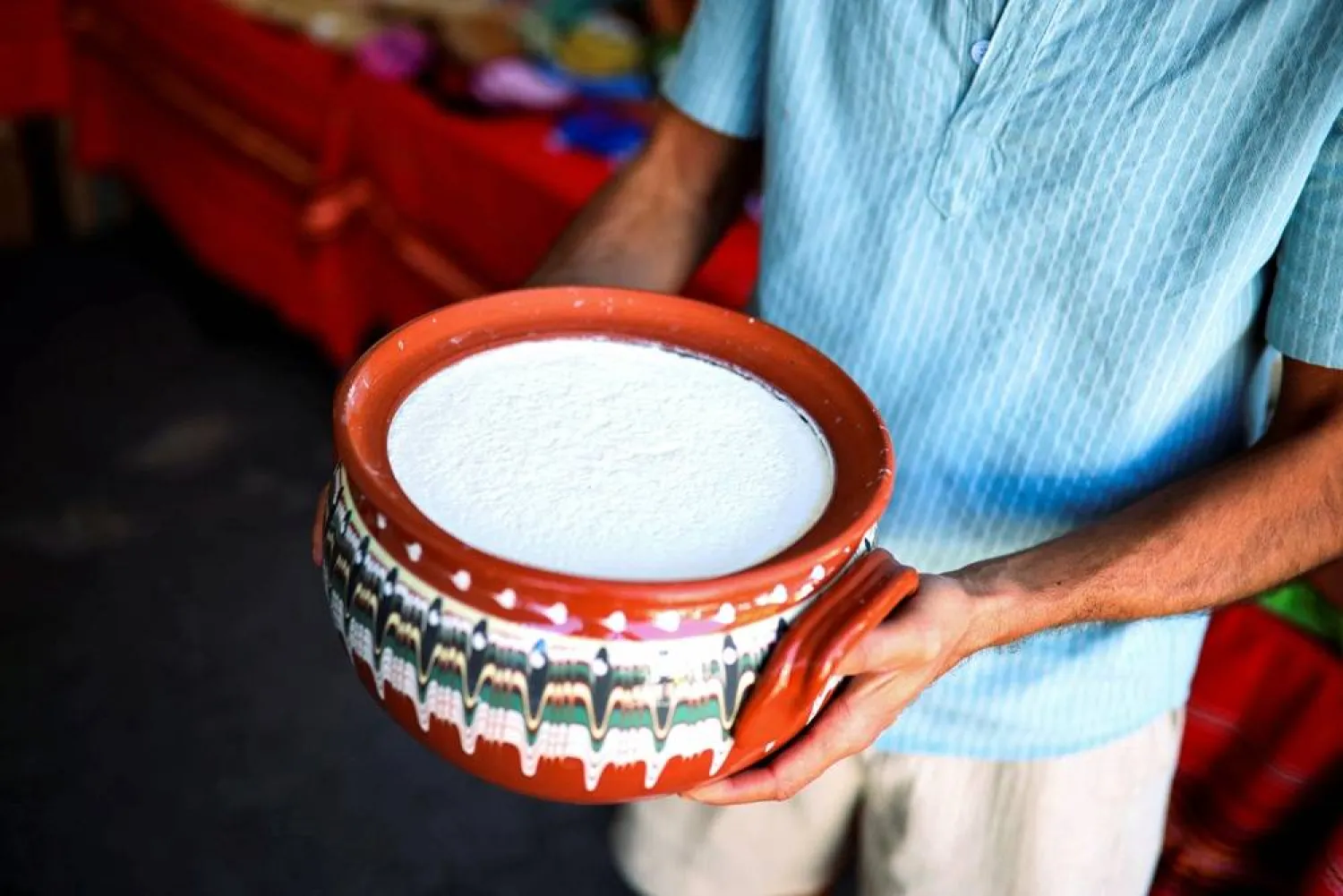
A local producer shows Bulgarian yogurt displayed during the Yogurt Festival in the village of Momchilovtsi, Bulgaria, August 30, 2025. (Reuters)
TT

Bulgarian Village Draws Chinese Tourists for Its Famed Yogurt

A local producer shows Bulgarian yogurt displayed during the Yogurt Festival in the village of Momchilovtsi, Bulgaria, August 30, 2025. (Reuters)

Every year, hundreds of Chinese tourists flock to the Bulgarian mountain village of Momchilovtsi for a festival celebrating the local yogurt, which is renowned for its health benefits and has become a hit among consumers in China.

The Chinese visitors mingle with locals in the village in the Rhodope Mountains near the Greek border. On a stage in the village square, singers and bagpipers in traditional embroidered costumes perform folk songs in the late summer sun.

Yogurt and cheese producers from the region, many of whom speak some Chinese, offer samples and products for sale.

"Bulgarian yogurt is very popular in China ... so we want to try the pure yogurt here," said Ge Lin, 37, a tourist from China.

Chinese tourists have been visiting Momchilovtsi since 2009, when a Chinese dairy company first imported the bacteria found in the local yogurt. The company's product, branded Mosilian, is now sold in most Chinese supermarkets.

In the early 20th century, Bulgarian microbiologist Stamen Grigorov and Russian zoologist Élie Metchnikoff found that consuming yogurt helped Bulgarian peasants to live longer.

Bulgarian yogurt contains Lactobacillus bulgaricus and other bacteria unique to the region, which boost health, immunity, and longevity, said Prof. Dr. Penka Petrova, director of the Institute of Microbiology at the Bulgarian Academy of Sciences.

"Bulgarian yogurt may be the world's first probiotic and has been used to treat various ailments. Each bacterial strain isolated from homemade yogurt has distinct properties," she said.

A number of recent scientific studies have found fermented dairy products from Bulgaria have beneficial health properties.

Dimitar Danchev, 37, a fourth-generation livestock breeder from the region, said local yogurt is made from both cows' and sheep's milk and its properties vary according to the season.

"In spring, when animals graze on fresh grass, the yogurt has specific characteristics, ... while in autumn, when the grass is drier, the milk is thicker."

Mitra Pareva, 95, said yogurt has been part of her daily diet for her whole life.

"Yogurt is good for me. The first foods on my table are bread and yogurt," she said.



Makkah Quran Museum Displays Rare ‘Blue Quran’ Manuscript

The Blue Quran is regarded as one of the rarest and most luxurious mushafs in Islamic civilization. (SPA)
TT

Makkah Quran Museum Displays Rare ‘Blue Quran’ Manuscript

The Blue Quran is regarded as one of the rarest and most luxurious mushafs in Islamic civilization. (SPA)

The Holy Quran Museum in the Hira Cultural District in Makkah is displaying a rare folio from the famed “Al-Muṣḥaf Al-Azraq” (Blue Quran), featuring verses from Surah Al-Baqarah, from the end of verse 37 to the beginning of verse 42, reported the Saudi Press Agency on Monday.

The exhibit highlights the richness of Islamic Quranic heritage and its ancient artistic legacy.

The Blue Quran is regarded as one of the rarest and most luxurious mushafs in Islamic civilization. It was written in pure gold ink in early Kufic script on a deep blue background, reflecting a distinctive artistic style that underscores early Muslims’ reverence for the Quranic text and their dedication to the aesthetics of its calligraphy.

Dating back to the 9th century, the manuscript holds exceptional historical and scholarly value. It stands as a testament to the development of Arabic calligraphy and illumination during the early Islamic period.

Surviving pages of the Blue Quran are extremely rare and are now dispersed among a limited number of museums and private collections worldwide.

The display forms part of the museum’s efforts to introduce visitors to the history of the mushaf and the artistic stages of its transcription, offering access to extraordinary examples of Quranic manuscripts.

The initiative aims to deepen cultural awareness and enrich the experience of visitors to the Hira Cultural District from within the Kingdom and abroad.

The Holy Quran Museum serves as a cultural and educational landmark, highlighting the history of the Quran and its journey since the revelation. It houses rare manuscripts and historic copies of the Quran, alongside interactive exhibits and modern technologies that reflect Muslims’ enduring devotion to the Quran throughout the centuries, in a location closely associated with the dawn of the Islamic message.


Riyadh Art Unveils Tuwaiq Sculpture 2026

The exhibition site on Tahlia Street was strategically chosen for its historical legacy of innovation to provide a conceptual framework for the works. SPA
TT

Riyadh Art Unveils Tuwaiq Sculpture 2026

The exhibition site on Tahlia Street was strategically chosen for its historical legacy of innovation to provide a conceptual framework for the works. SPA

The Royal Commission for Riyadh City, via its Riyadh Art program, has launched the Tuwaiq Sculpture 2026 exhibition on Prince Mohammed bin Abdulaziz Street (Tahlia).

Open to the public from February 9 to 22, the exhibition showcases 25 new artworks themed "Traces of What Will Be," exploring transformation and urban renewal.

The sculptures were crafted during a live phase from January 10 to February 5, during which artists from 18 countries used local stone and recycled metals, allowing the public to witness the creative process firsthand.

The exhibition site on Tahlia Street was strategically chosen for its historical legacy of innovation to provide a conceptual framework for the works.

Overseen by a panel of international experts, the exhibition serves as an interactive cultural platform featuring workshops and panel discussions to foster community engagement.

All 2026 pieces will join Riyadh Art's permanent collection, which has hosted over 170 artists since 2019 and already installed more than 60 sculptures across the city to integrate contemporary art into Riyadh's urban fabric.


Syrian Culture Minister Applauds Saudi Pavilion at Damascus Book Fair

The 2026 Damascus International Book Fair is held from February 6 to 16 - SPA
TT

Syrian Culture Minister Applauds Saudi Pavilion at Damascus Book Fair

The 2026 Damascus International Book Fair is held from February 6 to 16 - SPA

Syrian Minister of Culture Mohammed Yassin Saleh visited the Kingdom’s pavilion at the 2026 Damascus International Book Fair, held from February 6 to 16, where the Kingdom is serving as the Guest of Honor.

He commended the efforts of the Literature, Publishing and Translation Commission in showcasing the rich diversity of the Saudi cultural and literary scene. The pavilion features exhibitions of manuscripts, a Saudi fashion corner, and archaeological replicas, SPA reported.

The minister reviewed the commission's Tarjim translation initiative and Saudi literature comics.

This participation at the 2026 Damascus International Book Fair showcases Saudi creativity and fosters cultural dialogue, supporting Saudi Vision 2030’s goals of knowledge exchange and cultural leadership.