

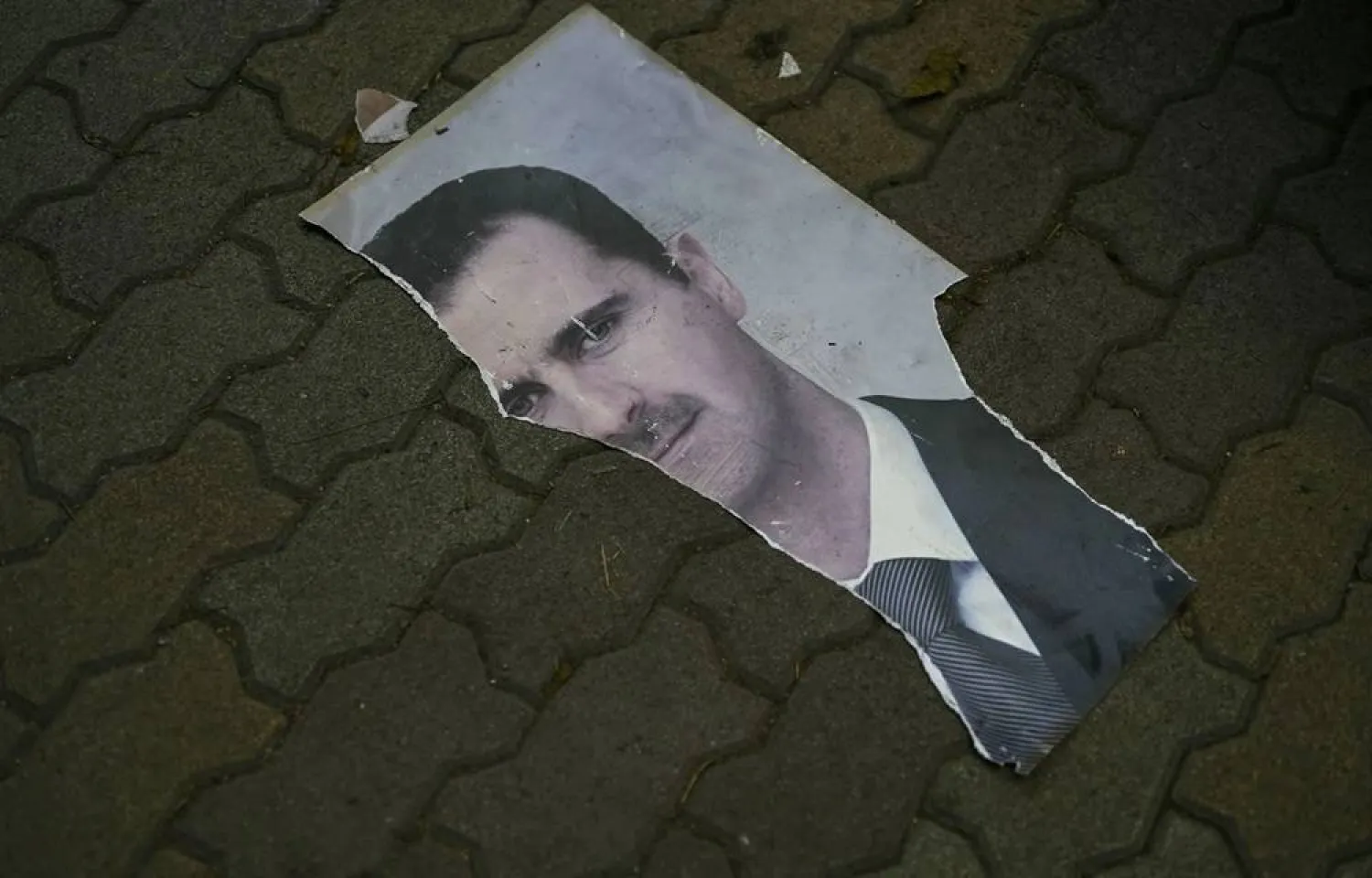

France Issues Arrest Warrant for Syria’s Assad over 2012 Journalist Killings

Assad escaped with his family to Russia after being ousted by opposition fighters at the end of 2024. (AFP)
TT

France Issues Arrest Warrant for Syria’s Assad over 2012 Journalist Killings

Assad escaped with his family to Russia after being ousted by opposition fighters at the end of 2024. (AFP)

French judicial authorities have issued arrest warrants for ousted Syrian president Bashar al-Assad and six other top former officials over the bombardment of an opposition-held city in 2012 that killed two journalists, lawyers said Tuesday.

Marie Colvin, 56, an American working for The Sunday Times of Britain, and French photographer Remi Ochlik, 28, were killed on February 22, 2012 by the explosion in the eastern city of Homs, which is being investigated by the French judiciary as a potential crime against humanity as well as a war crime.

British photographer Paul Conroy, French reporter Edith Bouvier and Syrian translator Wael Omar were wounded in the attack on the informal press center where they had been working.

Assad escaped with his family to Russia after being ousted by opposition fighters at the end of 2024 although his precise whereabouts have not been confirmed.

Other than Assad, the warrants notably target his brother Maher al-Assad who was the de facto head of the 4th Syrian armored division at the time, intelligence chief Ali Mamlouk, and then-army chief of staff Ali Ayoub.

"The issuing of the seven arrest warrants is a decisive step that paves the way for a trial in France for war crimes and crimes against humanity committed by Bashar al-Assad's regime," said Clemence Bectarte, lawyer for the Paris-based International Federation for Human Rights (FIDH) and Ochlik's parents.

The FIDH said the journalists had clandestinely entered the besieged city to "document the crimes committed by Bashar al-Assad's regime" and were victims of a "targeted bombing".

"The investigation clearly established that the attack on the informal press center was part of the Syrian regime's explicit intention to target foreign journalists in order to limit media coverage of its crimes and force them to leave the city and the country," said Mazen Darwish, lawyer and director of the Syrian Center for Media and Freedom of Expression (SCM).

Colvin was known for her fearless reporting and signature black eye patch which she wore after losing sight in one eye in an explosion during Sri Lanka's civil war. Her career was celebrated in a Golden Globe-nominated film, "A Private War".



Southern Yemen United in Welcoming Riyadh Conference

National Shield forces in Hadhramaut. (Reuters)
TT

Southern Yemen United in Welcoming Riyadh Conference

National Shield forces in Hadhramaut. (Reuters)

Parties in southern Yemen welcomed on Sunday Saudi Arabia’s call to hold a comprehensive conference on the issue of the South.

The conference will be held in Riyadh at an official request by Presidential Leadership Council (PLC) Chairman Dr. Rashad al-Alimi. The meeting will help shape the path of the southern issue, meeting the ambitions of southern and eastern Yemen governorates.

Local authorities in Hadhramaut, al-Mahra, Lahj, Shabwah and Socotra welcomed the conference, as did prominent political leaderships in the south. The Southern Transitional Council (STC) also notably welcomed the conference.

Saudi Arabia’s move to host the meeting was welcomed by Gulf and Arab countries and the international community over the weekend. It was viewed as a necessary step towards restoring dialogue in the South, overcoming efforts to eliminate the other and viewing the southern issue within a national and regional framework that would lead to a fair and sustainable solution.

Member of the PLC Dr. Abdullah al-Alimi expressed his deep appreciation for Saudi Arabia’s stance, calling all southern components, starting with the STC, to positively approach the conference and comprehensive dialogue that prioritizes the interests of the South above all else.

Serious dialogue is the only way to bridge divides, achieve rapprochement and unify southern ranks to serve security and stability, he stressed.

Shura Council Speaker Ahmed bin Dagher underlined the importance of the Riyadh conference, saying dialogue will help defuse strife.

The meeting will present realistic solutions to pending issues in the South, he added.

The STC welcomed Saudi Arabia’s call to hold the conference, saying it is in line with its policies that are based on dialogue.

It did place conditions, however, underscoring the “will of the people of the south” and demanding international guarantees, a clear timeframe, and popular referendum.

Observers said the conditions are an attempt by the STC to preserve its political position.

They noted that the very fact that it agreed to join the conference is an acknowledgment that the southern issue is greater than one party that is taking unilateral decisions.

The regional and international climate do not allow unilateral actions, they added.


Two Dead in Israeli Strike on South Lebanon

The wreckage of a car at the site after an Israeli strike on Al-Khiyam, in the Nabatieh governorate, southern Lebanon, 03 January 2026. (EPA)
TT

Two Dead in Israeli Strike on South Lebanon

The wreckage of a car at the site after an Israeli strike on Al-Khiyam, in the Nabatieh governorate, southern Lebanon, 03 January 2026. (EPA)

Lebanon said a strike in the south killed two Sunday while Israel said it had struck a Hezbollah operative, the latest raids as Beirut seeks to disarm the Iran-backed group.

Despite a year-old ceasefire between Israel and Hezbollah, Israel carries out regular strikes on Lebanon, usually saying it is targeting Hezbollah sites and operatives, and has maintained troops in five areas it deems strategic.

Lebanon's health ministry said two people were killed in an "Israeli enemy strike that targeted a vehicle" near the town of Jmaijmeh, around 10 kilometers (six miles) from the border.

An Israeli military statement said that "in response to Hezbollah's continued violations of the ceasefire understandings", it had struck an operative from the group in the area.

Under heavy US pressure and fears of expanded Israeli strikes, Beirut has committed to disarming Hezbollah, which was badly weakened after more than a year of hostilities with Israel including two months of open war that ended with the November 2024 ceasefire.

Lebanon's army was expected to complete the disarmament south of the Litani River -- about 30 kilometers from the border with Israel -- by the end of 2025, before tackling the rest of the country.

Lebanon's cabinet is to meet on Thursday to discuss the army's progress, while the ceasefire monitoring committee -- comprising Lebanon, Israel, the United States, France and UN peacekeepers -- is also set to meet this week.

On Sunday, Israel's Foreign Minister Gideon Saar acknowledged on X that the Lebanese government and army had made efforts to disarm Hezbollah but said "they are far from sufficient", citing "Hezbollah's efforts to rearm and rebuild, with Iranian support".

Israel has previously questioned the Lebanese military's effectiveness and has accused Hezbollah of rearming, while the group itself has rejected calls to surrender its weapons.

At least 350 people have been killed by Israeli fire in Lebanon since the ceasefire, according to an AFP tally of Lebanese health ministry reports.


Syrian Media Say Govt and Kurdish-Led SDF Meet on Military Merger without Progress

Syrian President Ahmed al-Sharaa signed a deal in Damascus last March with SDF commander Mazloum Abdi on integrating the force into state institutions (AP)
TT

Syrian Media Say Govt and Kurdish-Led SDF Meet on Military Merger without Progress

Syrian President Ahmed al-Sharaa signed a deal in Damascus last March with SDF commander Mazloum Abdi on integrating the force into state institutions (AP)

Syrian government officials held talks Sunday with the commander of the main Kurdish-led force in the country over plans to merge it with the national army, state media reported, adding that no “tangible results” had been achieved. 

The leadership in Damascus under interim President Ahmed al-Sharaa inked a deal in March with the Kurdish-led and US-backed Syrian Democratic Forces, which control much of the northeast. The SDF was to merge with the Syrian army by the end of 2025, but there have been disagreements on how it would happen. 

A major sticking point has been whether the SDF would remain a cohesive unit in the new army or whether it would be dissolved and its members individually absorbed. 

The SDF said in a statement Sunday that a delegation led by top commander Mazloum Abdi held talks with government officials in Damascus related to the military integration process. 

The SDF later said talks had ended, with details to be released later. The SDF has tens of thousands of fighters and is the main force to be absorbed into Syria's military. 

State TV said the meeting did not produce "tangible results” that would accelerate implementation of the agreement. It said the sides agreed to hold further meetings at a later date. 

The deal signed in March also would bring all border crossings with Iraq and Türkiye and airports and oil fields in the northeast under the central government’s control. Prisons holding about 9,000 suspected members of the ISIS group also are expected to come under government control. 

Türkiye has been opposed to the SDF joining the army as a single unit. Ankara considers the SDF a terrorist organization because of its association with the Kurdistan Workers’ Party, or PKK, which has waged a long-running insurgency in Türkiye, although a peace process is now underway. 

In late December, clashes broke out between security forces and SDF fighters in the northern city of Aleppo during a visit to Syria by Türkiye’s foreign minister. 

Sunday's meetings in Damascus came hours after three rockets struck a western neighborhood of the capital, causing some damage to a mosque and a telecommunications center without inflicting casualties, state media said. 

The state news agency called the rockets “random” without giving details on where they were fired from or who was behind it.