

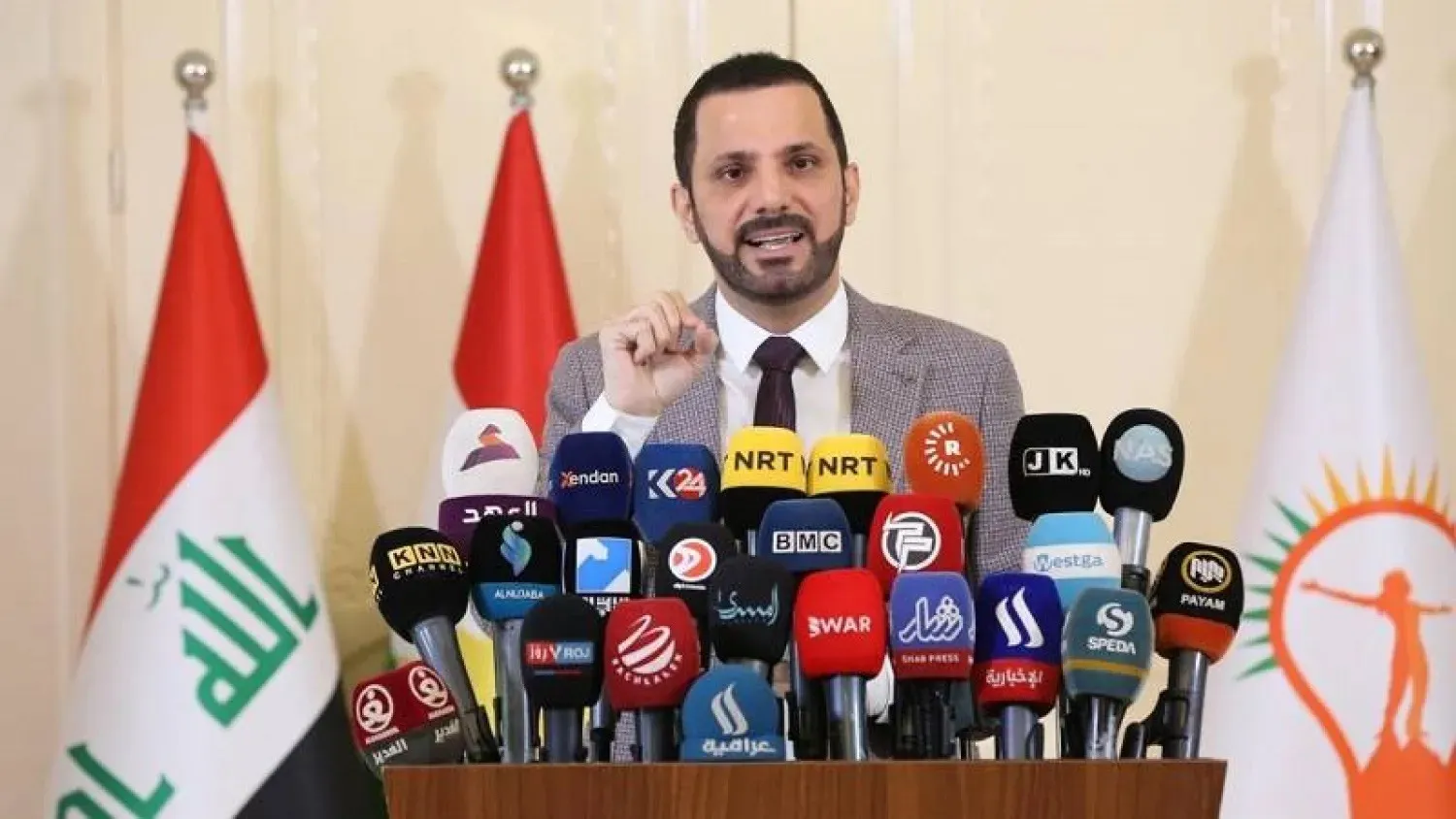

Opposition Party Leader in Iraqi Kurdistan Sentenced to Prison

New Generation Party leader Shaswar Abdulwahid (NRT Channel)
TT

Opposition Party Leader in Iraqi Kurdistan Sentenced to Prison

New Generation Party leader Shaswar Abdulwahid (NRT Channel)

A court in Iraqi Kurdistan’s Sulaymaniyah has sentenced Shaswar Abdulwahid, head of the opposition New Generation Movement, to five months in prison following a complaint filed by former regional lawmaker Shadi Nozad, Kurdish sources reported.

Abdulwahid was arrested on August 12 by security forces while staying in the “German Village” residential complex in Sulaymaniyah. He could face additional verdicts in other pending cases against him.

Tuesday’s ruling comes just days after clashes in Sulaymaniyah involving members of the family of late Iraqi President Jalal Talabani, which ended with the arrest of Lahur Sheikh Jangi, head of the People’s Front Party and cousin of Bafel Talabani, leader of the Patriotic Union of Kurdistan (PUK).

According to reports, the court based its decision on “evidence and documents” submitted in the case, brought under Article 431 of the Iraqi Penal Code.

The article criminalizes threats to commit a felony against a person or property, or to reveal information damaging to a person’s honor, when accompanied by a demand to act or refrain from acting. Convictions can carry sentences of up to seven years.

Abdulwahid’s defense team, however, argued that the charges are politically motivated, saying the timing reflects attempts to undermine the New Generation Movement.

Supporters claim the movement has increasingly become a political target after emerging as the third-largest force in Kurdistan behind the PUK and the Kurdistan Democratic Party (KDP), with nine seats in Iraq’s federal parliament and 15 in the Kurdish regional parliament.

Following the sentencing, Abdulwahid’s lawyers said in a statement that the hearing “was not legal” and demanded his immediate release.

They added that the New Generation Movement will continue its political activity and contest the upcoming parliamentary elections “whether its leader is inside or outside prison.”

In addition to the criminal cases, Abdulwahid faces financial troubles. The Kurdistan Regional Government’s Ministry of Finance and Economy announced Sunday that his company, Nalia, owes 92 billion Iraqi dinars (around $74 million).

The ministry said it would confiscate 60 of his properties, including land plots, hotels, cafes, and tourist cabins, to be sold at public auction.



Lebanon: Israeli Airstrikes, Artillery Fire Hit Ali al-Taher, Explosions Reported in South

15 August 2026, Lebanon, Nabatieh District: People are searching the rubble following an Israeli airstrike on a house in a tourist area of Ansar, southern Lebanon, before dawn, completely destroying the building and causing extensive damage to surrounding properties. Photo: Abdul Kader Al Bay/ZUMA Press Wire/dpa
TT

Lebanon: Israeli Airstrikes, Artillery Fire Hit Ali al-Taher, Explosions Reported in South

15 August 2026, Lebanon, Nabatieh District: People are searching the rubble following an Israeli airstrike on a house in a tourist area of Ansar, southern Lebanon, before dawn, completely destroying the building and causing extensive damage to surrounding properties. Photo: Abdul Kader Al Bay/ZUMA Press Wire/dpa

Israeli warplanes carried out a series of overnight airstrikes and artillery shelling on Ali al-Taher hill and the outskirts of al-Dabsha, while explosions were reported in Majdal Zoun and Mansouri in southern Lebanon, Lebanon’s state-run National News Agency reported on Thursday.

“Israeli warplanes carried out a series of overnight strikes on Ali al-Taher hill and the area around al-Dabsha, on the northern outskirts of Nabatieh al-Fawqa and Kefr Rumman”, said NNA. They were subject to intermittent artillery fire until dawn, added the agency.

In the southern city of Tyre, the Israeli forces carried out explosions, overnight and at dawn, in Majdal Zoun and Mansouri, alongside artillery shelling of the two towns.

Israel launched a war against Lebanon on March 2 after Hezbollah fired rockets at northern Israel. Israeli forces occupied several towns in southern Lebanon.

A ceasefire was announced on June 20, after which the frequency of Israeli strikes in southern Lebanon declined.


UK Summons Israeli Envoy over West Bank Settlement Project

An Israeli military vehicle patrols near to the settlers in front of the Palestinian houses in the village of Qusra, south of Nablus, in the occupied West Bank, on August 13, 2026. (Photo by Zain JAAFAR / AFP)
TT

UK Summons Israeli Envoy over West Bank Settlement Project

An Israeli military vehicle patrols near to the settlers in front of the Palestinian houses in the village of Qusra, south of Nablus, in the occupied West Bank, on August 13, 2026. (Photo by Zain JAAFAR / AFP)

Britain said on Wednesday it had summoned Israel's charge d'affaires and demanded a halt to a major West Bank settlement project after Israeli authorities opened bidding for more than 1,200 homes in the area.

The E1 plan, green-lit by Israel last year, has drawn international condemnation, with the UN secretary general saying at the time that it posed an "existential threat" to a contiguous Palestinian state.

The project would further separate east Jerusalem, occupied and annexed by Israel and predominantly inhabited by Palestinians, from the West Bank, said AFP.

British foreign minister Ed Miliband called the move "an unacceptable and destructive act" and said it would "endanger the viability of a two-state solution".

"The Israeli Government must halt E1 plans immediately, retract the tender and stop all settlement expansion," Miliband said in a statement.

Miliband said he delivered the message directly to his Israeli counterpart Gideon Saar and that Israel's charge d'affaires was summoned to the foreign ministry.

The British government also pledged to unveil "a comprehensive set of measures" in the coming weeks, including sanctions targeting people involved in the "illegal settlement expansion".

"Britain will not stand back and accept the destruction of the two state solution," Miliband said.

Israel approved the plans for the roughly 12-square-kilometer (five-square-mile) parcel of land known as E1 just east of Jerusalem, in August last year.

The plan seeks to build around 3,400 homes on the ultra-sensitive tract of land, which lies between Jerusalem and the Israeli settlement of Maale Adumim.

The latest tender covers more than 1,200 housing units, according to Israeli NGO Peace Now.

Peace Now said Israel's housing ministry published the tender on August 18 and immediately opened it for bids.

Submissions are due by October 19, one week before Israeli elections scheduled for October 27.

The group said the homes accounted for about one-third of the planned E1 development and accused the government of trying to advance construction commitments before the vote.

Israel heavily restricts the movement of West Bank Palestinians, who must obtain permits from authorities to travel through checkpoints to cross into east Jerusalem or Israel.

Last year, Britain and France were among 21 countries who condemned Israeli approval of the E1 project, calling it a violation of international law and urging Israel to reverse the decision.

Excluding east Jerusalem, the West Bank is home to around three million Palestinians, as well as about 500,000 Israeli settlers.


'Ray of Hope': Gaza Seed Bank Rebuilds after Wartime Destruction

Salem Muhanna, who manages the Al Qarara Seed Bank with support from the International Committee of the Red Cross (ICRC), prepares to stack a container with seeds at the bank, in Deir el-Balah, central Gaza Strip on August 11, 2026. (Photo by Bashar Taleb / AFP)
TT

'Ray of Hope': Gaza Seed Bank Rebuilds after Wartime Destruction

Salem Muhanna, who manages the Al Qarara Seed Bank with support from the International Committee of the Red Cross (ICRC), prepares to stack a container with seeds at the bank, in Deir el-Balah, central Gaza Strip on August 11, 2026. (Photo by Bashar Taleb / AFP)

From a small makeshift tent in the central Gaza Strip, a dedicated team works to carefully store and document some of the war-shattered territory's most precious commodities: local seeds.

Shelves of unassuming plastic tubs line the walls of the Al Qarara Seed Bank, each holding indigenous seeds seen as a way of reviving Gaza's devastated farming sector and preserving its agricultural heritage.

The seed bank in Deir el-Balah is rebuilding its stocks of Gaza's heirloom seeds that were destroyed during the Israel-Hamas war which erupted in October 2023, said AFP.

Unlike hybrid varieties often sold commercially, heirloom seeds can be saved and used year after year and are often better adapted to their local environment.

"During the war, they were what helped us survive," said Salem Muhanna, who manages the project which was founded in 2017 with support from the International Committee of the Red Cross (ICRC).

"Heirloom seeds give continuity. They provide 80 to 90 percent of the same yield repeatedly. That is why we relied on heirloom seeds," he told AFP.

The bank holds seeds for wheat and barley; leafy crops such as Swiss chard, spinach and parsley, as well as some vegetables like courgette and okra.

The war that erupted following Hamas's attack on Israel in October 2023 took an immensely heavy toll.

The fighting "completely destroyed the bank and led to the loss of many seed varieties," explained 27-year-old Hanadi Muhanna, Salem Muhanna's daughter who also manages the project.

"In addition, because we were repeatedly displaced, it was difficult to start over again," she added.

"Eventually we settled in Deir el-Balah and managed, thankfully, to establish a small tent. We created something simple using basic means".

A collection of large hessian sacks, plastic barrels, and smaller mismatched tubs now hold what remain of the stocks, each carefully labelled and protected from pests with plastic sheets.

- 'Safety valve' -

Like the rest of life in the coastal Palestinian territory, Gaza's agricultural sector was shattered by the conflict.

Despite a US-backed ceasefire since October 2025, bloodshed has continued, with the Israeli military continuing to target Palestinians it says are militants.

Israel says it now controls more than 60 percent of the Gaza Strip, up from about half when the ceasefire took effect, and has refused to start withdrawing until Hamas fully disarms.

Before the war, agriculture including crop production, herding and fishing, accounted for approximately 10 percent of Gaza's economy, according to the United Nations' Food and Agricultural Organization (FAO).

Just three percent of the cropland in Gaza remains accessible and undamaged, the FAO said Tuesday.

Tight Israeli controls on the entry of all goods into the territory has also compounded the woes of Gaza's farmers.

"There is no water, no fertilizer, no agricultural chemicals," Salem Muhanna told AFP. "Nothing is available".

Before the war, Gaza was self-sufficient in fresh vegetables and used to export one-third of its production to external markets, according to Osama Al-Mukhalalati, an economic security officer with the ICRC.

Now, at best, the agricultural output cannot provide more than 10 percent of Gaza's vegetable needs, he added.

The Al Qarara Seed Bank works on a lending system, with trusted farmers receiving seed and then returning it at the end of the season.

"During the war, we considered this project our main safeguard," said Suleiman Abu Shamas, a farmer from Deir el-Balah who was out inspecting a crop of waist-high chilli peppers.

"With agricultural supplies cut off and prevented from entering through the crossings, the only safeguard we had was to build a food basket based on heirloom seeds that already existed within Gaza."

For Al-Mukhalalati, the bank is not only a way of continuing food production on what agricultural land remains, but is a means of preserving Gaza's agricultural heritage for the future.

"We consider this project a ray of hope amid the complete darkness hanging over the agricultural sector," he said.