

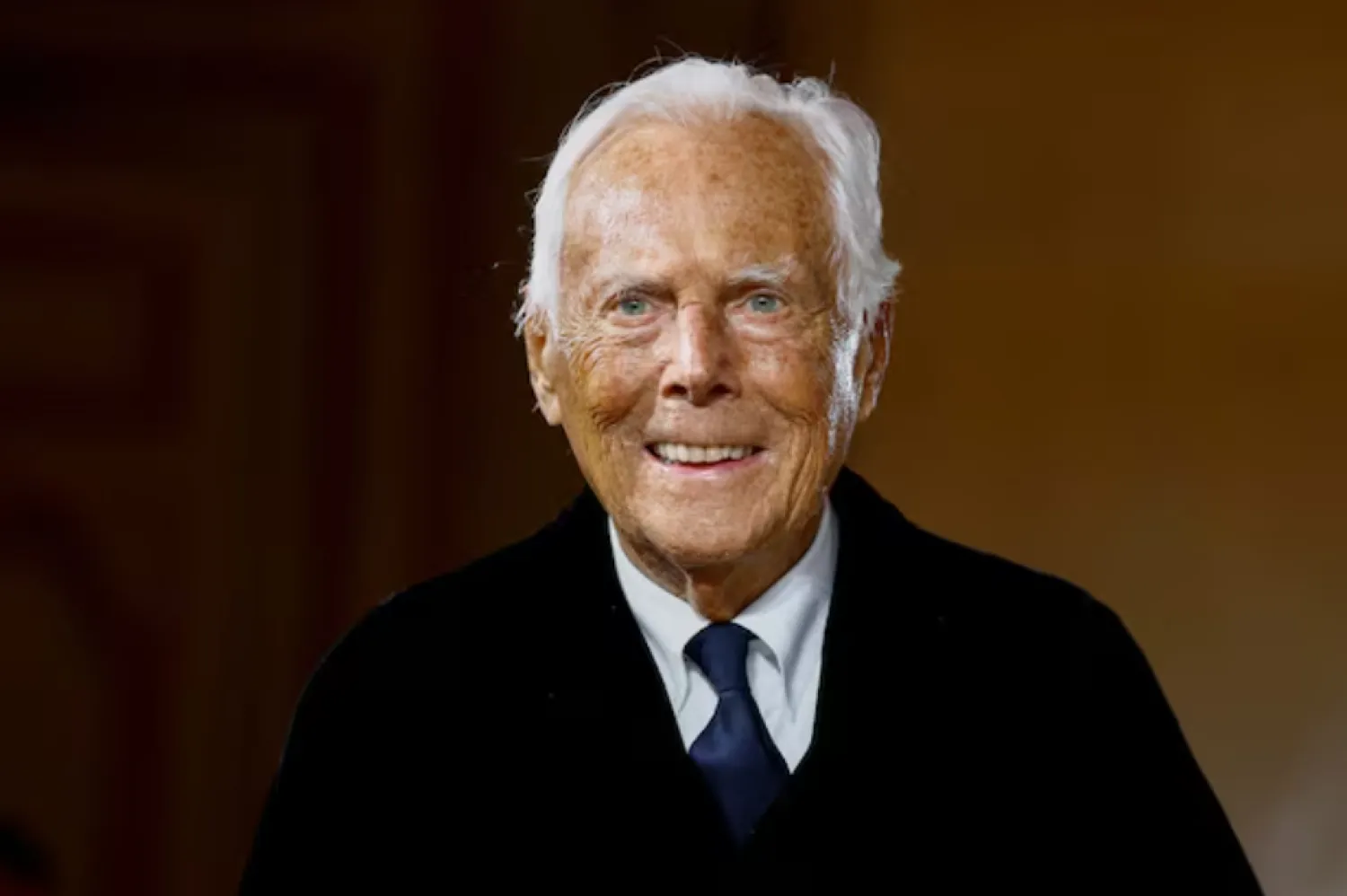

Fashion Designer Giorgio Armani Dead at 91

Designer Giorgio Armani appears at the end of his Haute Couture Spring/Summer 2025 collection show for Giorgio Armani Prive in Paris, France, January 28, 2025. REUTERS/Sarah Meyssonnier/File Photo
TT

Fashion Designer Giorgio Armani Dead at 91

Designer Giorgio Armani appears at the end of his Haute Couture Spring/Summer 2025 collection show for Giorgio Armani Prive in Paris, France, January 28, 2025. REUTERS/Sarah Meyssonnier/File Photo

Giorgio Armani, the Italian designer who turned the concept of understated elegance into a multibillion-dollar fashion empire, has died, his fashion house confirmed. He was 91.

Armani died at home, the fashion house said. Armani, one of the most recognizable names and faces in the global fashion industry, missed Milan Fashion Week in June 2025 for the first time during the previews of Spring-Summer 2026 menswear to recover from an undisclosed condition. He was planning a major event to celebrate 50 years of his signature Giorgio Armani fashion house during Milan Fashion Week this month.

Starting with an unlined jacket, a simple pair of pants and an urban palette, Armani put Italian ready-to-wear style on the international fashion map in the late 1970s, creating an instantly recognizable relaxed silhouette that has propelled the fashion house for half a century, The AP news reported.

From the executive office to the Hollywood screen, Armani dressed the rich and famous in classic tailored styles, fashioned in super-soft fabrics and muted tones. His handsome black tie outfits and glittering evening gowns often stole the show on award season red carpets.

At the time of his death, Armani had put together an empire worth over $10 billion, which along with clothing included accessories, home furnishings, perfumes, cosmetics, books, flowers and even chocolates, ranking him in the world’s top 200 billionaires, according to Forbes.

The designer also owned several bars, clubs, restaurants and his own basketball team EA7 Emporio Armani Milan, better known as Olympia Milano. Armani opened more than than 20 restaurants from Milan to Tokyo since 1998, and two hotels, one in Dubai in 2009 and another in Milan, in 2010.

Armani himself was the foundation of his style Armani style began with Giorgio Armani himself, from the penetrating blue eyes framed in a permanent tan and early-age shock of silver hair, to the trademark jeans and t-shirt work clothes and the minimalist decoration of his private homes.

Armani’s fashion vision was that of easygoing elegance where attention to detail made the difference.

“I design for real people. There is no virtue whatsoever in creating clothes and accessories that are not practical,” he liked to say when asked to identify his clientele.

In conversation, the designer’s disarming smile and exquisitely mild manners belied the tough businessman underneath, who was able to turn creative talent into a fashion empire worth over $10 billion. Never a merger nor a sale, Re Giorgio (King George) as the Italians call him, was always his own boss.

Born July 11, 1934, in Piacenza, a small town south of Milan, Armani dreamed of becoming a doctor before a part-time job as a window decorator in a Milan department store opened his eyes to the world of fashion.

In 1975, Armani and his partner Sergio Galeotti sold their Volkswagen for $10,000 to start up their own menswear ready-to-wear label. Womenswear followed a year later.

The symbol of his new style was the liningless sports jacket, which was launched in the late 1970s and became an instant success from Hollywood to Wall Street. The designer paired the jacket with a simple t-shirt, an item of clothing he termed “the alpha and omega of the fashion alphabet.”

The Armani suit soon became a must in the closet of the well-heeled man. And for women, the introduction of the pantsuit in the executive workroom was all but revolutionary. Dubbed the “power suit” with its shoulder-padded jacket and man-tailored trousers, it became the trademark of the rising class of businesswomen in the 1980s.

Over the years Armani would soften the look with delicate detailing, luxurious fabrics and brighter shades for his basic beige and gray palette. His insistence on pants and jackets led some critics to label his fashion “androgynous.”

Armani hits Hollywood The 1980 film classic “American Gigolo” launched both Armani and actor Richard Gere on their Hollywood careers. Dressed in Armani, Gere became America’s new favorite heart throb, and “Geeorgeeo” as they called him, the glam set’s most popular designer.

The Hollywood connection earned him wardrobe film credits in over 200 films, and in 2003 a place on Rodeo Drive’s “Walk of Fame.”

Oscar night always sparkled, with smart suiting for the men, and glittering gowns for the ladies. The 2009 best actor winner Sean Penn picked up his statue in a black-on-black Armani outfit, while best actress nominee Anne Hathaway walked the red carpet in a shimmering white strapless evening gown from Armani’s latest Prive couture collection.

Other longtime devotees included Jodie Foster, George Clooney, Sofia Loren and Brad Pitt. David and Victoria Beckham were the “face” of his 2009 underwear ad campaign.

So significant was the impact of Armani style, not only on how people dressed but how they approached fashion, that in 2000 New York’s Guggenheim museum presented a retrospective of Armani’s first 25 years in fashion.

“I love things that age well, things that don’t date and become living examples of the absolute best,” Armani said of his efforts.

Armani has gone well beyond fashion Today, the Armani empire has an army of more than 9,000 employees, with women comprising half of the executive suite, along with seven industrial hubs and over 600 stores worldwide, according to figures released in 2023. Along with clothes and accessories, the company produces perfumes, cosmetics and home furnishings, as well as selling its own candy, flowers and even books. The designer opened his fifth multi-brand store on New York’s fashionable Fifth Avenue in February 2009.

In the realm of fashion hobbies, Armani owned several bars, restaurants and clubs, as well as the basketball team. Recreation time was spent in getaways in Broni in the countryside near Milan, the isle of Pantelleria off Sicily and St. Tropez on the French Riviera. Each home bore the trademark of Armani design: bare walls, important pieces, few knickknacks.

Like many of his colleagues, Armani tried to give back some of the fame and fortune he amassed during the heyday of the “moda Milanese” which put Italian ready-to-wear at the center of the world’s fashion map at the turn of the millennium. Personally involved in several charity organizations devoted to children and a staunch supporter of the battle against AIDS, in 2002 Armani was named a U.N. goodwill ambassador for refugees.

Galeotti died in 1985. Armani had no children but was very close to his niece Roberta, daughter of his late brother Sergio. She abandoned a budding film career to become his director of public relations, and often represented her uncle, who wasn’t much of a party-goer, at social events. In later years she was a key go-between with the celebrity world.

In 2006, she orchestrated the top-billed wedding of actors Tom Cruise and Katie Holmes in a medieval castle outside Rome, while Uncle Giorgio designed the attire for both bride and groom.

Armani had indicated that as he considered succession he was looking toward his longtime head of menswear Leo Dell’Orco and his niece Silvana Armani, who fills the same role for womenswear.



Kering Names Former Prada Brand CEO as New Alexander McQueen Boss

The logo of French luxury group Kering is pictured on the day of the Kering General Assembly meeting at the company's headquarters in Paris, France, May 28. (Reuters)
TT

Kering Names Former Prada Brand CEO as New Alexander McQueen Boss

The logo of French luxury group Kering is pictured on the day of the Kering General Assembly meeting at the company's headquarters in Paris, France, May 28. (Reuters)

Kering has appointed former Prada brand CEO Gianfranco D'Attis as chief executive of struggling British luxury house Alexander McQueen, the French group said on Monday.

D'Attis will start on June 3, Kering ‌said, as ‌the British label grapples ‌with ⁠a slump in ⁠sales, which have triggered a restructuring and layoffs.

Job losses recently led to a strike at the group's Italian operations where McQueen is cutting almost ⁠a third of its roughly ‌180-strong workforce ‌as it seeks to break ‌even after revenue fell by around ‌60% over the past three years, unions have said. The brand also confirmed job cuts in ‌its UK office last year.

D'Attis previously ran the Prada brand ⁠and ⁠left the role last year.

"Alexander McQueen is entering a new phase focused on strengthening its distinctive positioning, supported by a leaner and more disciplined model built around focused collections, a rightsized retail network and a streamlined organization," Kering said in a statement.


Gap, American Eagle Fall as Weak Apparel Demand Signals Constrained Consumer Spending

A man walks past a Gap store on Oxford Street in London, Britain, July 1, 2021. (Reuters)
TT

Gap, American Eagle Fall as Weak Apparel Demand Signals Constrained Consumer Spending

A man walks past a Gap store on Oxford Street in London, Britain, July 1, 2021. (Reuters)

Shares of apparel makers Gap and American Eagle Outfitters dropped 15% and 10%, respectively, in premarket trade on Friday after weak annual forecasts, as consumers curb discretionary spending amid a tough macroeconomic climate.

Gap cut its annual sales forecast, while American Eagle maintained its full-year comparable sales and operating profit outlook but flagged a contraction in current-quarter gross margin, stoking worries about near-term demand.

US inflation posted its biggest increase ‌in three ‌years, while consumer sentiment hit a record low ‌in ⁠May, forcing households to ⁠tap savings and cut back on discretionary purchases such as clothes and accessories.

Both companies flagged weakness in certain women's seasonal categories, weighing on current-quarter results.

At Gap, which is undergoing a turnaround under CEO Richard Dickson, pressure centered on Old Navy, its largest banner, where seasonal women's apparel failed to connect ⁠with shoppers.

"Old Navy was the key swing ‌factor," BTIG analysts said in ‌a note.

"Weakness was concentrated in seasonal categories like dresses, where the assortment missed ‌on fashion and value, weighing on conversion despite solid traffic."

American ‌Eagle also came under pressure as strong demand at Aerie failed to offset weakness at its namesake brand, with women's bottoms hurt by changing fashion trends and a colder spring.

In a bid to ‌attract Gen Z shoppers and boost sales, the denim retailer, last month, unveiled a second ⁠campaign with "Euphoria" ⁠star Sydney Sweeney for its summer season denim shorts collection, a year after a viral and controversial ad featuring the actress fueled a stock rally.

Barclays noted heavy marketing spending is expected to recur in Q2 2026, but "bottoms including denim have since returned to underperformance".

It added American Eagle brand may struggle to lap its high-profile Sydney Sweeney and Travis Kelce campaigns and drive earnings growth in H2 2026.

Gap currently trades at 10.30 times its estimated earnings for the next 12 months, compared with 9.70 times for American Eagle and 7.43 times for Abercrombie & Fitch, according to LSEG data.


Clothing Rental Services Promise a Sustainable Alternative to Fast Fashion. Experts Say It Depends

A shopper browses for clothing at a Walmart store in Flagstaff, Arizona, US, October 19, 2022. (Reuters)
TT

Clothing Rental Services Promise a Sustainable Alternative to Fast Fashion. Experts Say It Depends

A shopper browses for clothing at a Walmart store in Flagstaff, Arizona, US, October 19, 2022. (Reuters)

For weddings, vacations or other special occasions, more consumers are turning to clothing rental services instead of buying something new.

These subscription-based services, often marketed as a sustainable alternative to fast fashion, ship straight to customers everything from everyday and workwear to dresses, handbags and formalwear. Then, the items are returned for someone else to use.

“I haven’t bought anything for a big occasion since 2019,” said Sasha Eck, a user of clothing rental services.

Along with giving her continuous and affordable access to newer, trendier clothes, she said renting formalwear made more sense than spending the equivalent of a month's rent on a dress she would only wear once. A recent survey from ThredUp suggests others face the same predicament, with the resale platform finding 87% of wedding guests said they had purchased at least one outfit they wore only once.

Clothing rental services appear to be an environmentally ethical alternative: One garment can be worn by multiple people instead of being tethered to a single closet. But fashion and logistics experts say the reality of rental subscriptions is more complicated, especially once shipping, returns and consumer habits are factored in.

The promise (and problem) of rental fashion

Kate Fletcher, a professor of sustainability, design and fashion systems at Manchester Metropolitan University, said rental services can sometimes encourage the same mindset that drives fast fashion.

“In theory, the embodied resources within that garment get a chance to be worked harder by having that many more people wear it. And so that’s the sort of compelling argument of it,” she said.

But Fletcher said many of those environmental benefits can be undermined by repeated shipping, returns and cleaning.

Aja Barber, a sustainability consultant and writer, said people often overlook the footprint of those processes.

“When you think about rental, you don’t think about the packaging that comes every time you get something from rental. You don’t think about the carbon footprint of shipping the item to you. And you certainly don’t think about the carbon footprint of dry cleaning,” said Barber.

Still, both experts said rental services can have advantages in certain situations.

“If you are someone who occasionally has to wear occasion-wear and you don’t want to buy a dress that you’re going to wear just once, I think it can be really impactful,” said Barber.

Fletcher pointed to older, more localized rental models, like with suit or gown rentals, where customers visited a shop, were fitted in person and later returned the item. She said those systems often had a very different environmental profile than modern, app-based rental services that rely on repeated shipping.

Why shipping matters

The rise of online shopping has heightened the environmental affect of “last mile delivery" — the final stage of transporting a package from a fulfillment center to a customer’s home. Transportation is already one of the largest contributors to greenhouse gas emissions, said Johanna Amaya, assistant professor of supply chain management at Pennsylvania State University.

“The more deliveries going to our homes, the more delivery that goes to our preferred location, the more that impact on the environment,” said Amaya.

Rental services can also create an added logistical challenge because the process involves two trips — one to deliver the clothing and another to return it.

Amaya said fast shipping can also make delivery systems less efficient because companies have less time to consolidate packages into fuller routes.

“The longer they can wait to consolidate more orders and use the capacity of the delivery vehicles, the better,” said Amaya.

She added that returning items to centralized locations, like parcel lockers or post offices, may be less environmentally impactful than home pickup services.

So what should consumers do?

Experts say renting can still be a better option in some situations, particularly for special occasion outfits that may otherwise only be worn once. But they also said consumers should think carefully about how often they are ordering, shipping and returning clothing.

Fletcher encouraged people to “look within a wardrobe and yourself before you look without and try and get a new piece.”

Amaya said consumers can reduce the environmental impact by avoiding rush shipping and choosing consolidated or pickup delivery options when possible.

And the broader sustainability challenge in fashion cannot be solved by a single service or product alone, Fletcher said.

For consumers trying to shop more sustainably overall, experts said some of the simple options may still be the most effective, like re-wearing clothing, repairing items, swapping with friends, buying secondhand or donating pieces so they continue to be used.

“The best thing we can do is engage with fashion as a practice. So, a lived experience of what it is to be dressed — full of capabilities of who I can be in the world — and not as something to buy,” Fletcher said. “Fashion as shopping, that sort of idea of it, is something that industry has encouraged us to believe is the only way of engaging with fashion. And fundamentally, that’s only going to lead to more climate impacts.”