
European Countries Near Russia Puzzled by US Plans to Cut Defense Funding

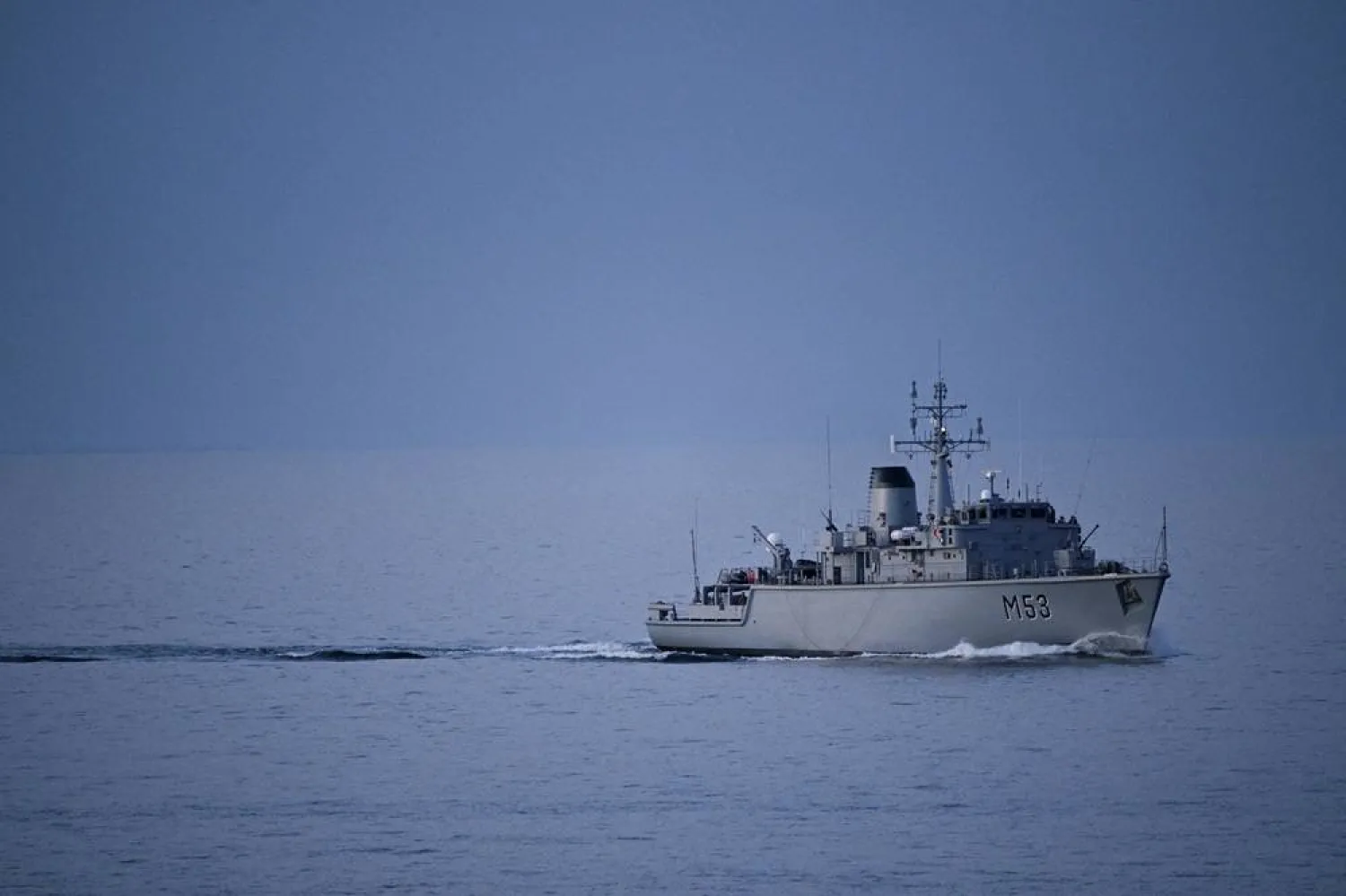
Lithuanian's minhunter Skalvis (M53) moves through the water, as seen from the German Navy supply tender Donau, during the multinational naval maneuver Northern Coasts, part of the Quadriga 2025 exercise led by the Bundeswehr and NATO partners to strengthen defense readiness under realistic conditions in the Baltic Sea, off the coast of Kiel, Germany September 2, 2025. (Reuters)
TT

European Countries Near Russia Puzzled by US Plans to Cut Defense Funding

Lithuanian's minhunter Skalvis (M53) moves through the water, as seen from the German Navy supply tender Donau, during the multinational naval maneuver Northern Coasts, part of the Quadriga 2025 exercise led by the Bundeswehr and NATO partners to strengthen defense readiness under realistic conditions in the Baltic Sea, off the coast of Kiel, Germany September 2, 2025. (Reuters)

Confusion emerged Friday over Trump administration plans to halt some security assistance funding to European countries along the border with Russia, with some Baltic defense leaders saying they have not received official notification.

Pentagon funding for programs that provide training and equipment to reinforce security would be cut, according to a person familiar with the discussions and a congressional aide, who spoke on condition of anonymity because they were not authorized to discuss the matter. It wasn't clear exactly how much money would be affected, though it could be hundreds of millions of dollars.

It includes funding under Section 333 and the Baltic Security Initiative, which helps finance weapons purchases by countries on NATO’s eastern flank, including of US systems, as well as ammunition, special forces training and intelligence support.

A White House official, who was not authorized to speak publicly so spoke on condition of anonymity, said the action has been coordinated with European countries and is part of President Donald Trump’s plan to ensure “Europe takes more responsibility for its own defense.”

The Trump administration has pushed NATO countries to step up their defense spending and slashed foreign assistance across the board. As Trump remakes the American approach to foreign policy, allies have tried to decipher often murky proposals, from tariffs to troop numbers. It was not clear whether US lawmakers would approve of some of the reductions, which were inconsistent with the Pentagon’s most recent allocations notified to Congress, the congressional aide said.

Baltic countries express confusion and concern

Former Lithuanian Foreign Minister Gabrielius Landsbergis said any cuts to American military support to the Baltic states — part of NATO's border with Russia — would “only weaken the credibility of NATO’s attempts at deterrence” as Moscow's war in Ukraine drags on.

Vaidotas Urbelis, Lithuania's Defense Ministry policy director, said there had been “discussions and certain indications” from the US but that the country had received no official information about any reduction in support and was talking to the Pentagon about “which programs will be continued and which may be postponed.”

Latvia's Defense Ministry also said it had not received any “official notification of concrete decisions” and said it would continue discussions on reaffirming the importance of the support.

The Estonian Defense Ministry said in a statement that it was clear the “current administration’s direction is to significantly cut foreign aid,” but added that US assistance increasingly makes up a smaller proportion of the country’s defense budget because Estonia has ramped up its own spending.

The three Baltic states, as well as Poland, are the NATO countries that spend the most on defense, promising to spend 5% of gross domestic product from 2026.

Members of Congress are also in the dark

Congressional offices also were waiting for details on what programs would be cut under the Pentagon’s proposal, but lawmakers from both political parties who have been supportive of US support to the region were alarmed.

Rep. Don Bacon, a Republican who is retiring next year, said on social media that it would be “a disastrous and shameful decision.”

“This Administration continues to be WEAK towards Putin and a WEAK leader of the Free World,” he added. “This will read as an ugly chapter in US history if the President does not reverse course.”

Sen. Jeanne Shaheen, the top Democrat on the Senate Foreign Relations Committee, said in a statement that “this is a misguided move that sends exactly the wrong signal as we try to force Putin to the negotiating table and deter Russian aggression.”

Sen. Dick Durbin, an Illinois Democrat, joined with Sen. Chuck Grassley, an Iowa Republican, to propose that Congress’ annual defense authorization bill include language to codify the Baltic Security Initiative, which established military cooperation between the US, Estonia, Latvia and Lithuania.

The Pentagon said it has reviewed foreign assistance programs under Trump's orders and that he has been "unequivocal in asserting that allies and partners must assume greater responsibility for funding their own security."

The plans to cut the security funds were first reported by the Financial Times.

Where the funding goes

That initiative allocated about $377 million from 2018 to 2024, Estonia’s Defense Ministry said. It helped fund Estonia's purchase of critical capabilities, including US-made HIMARS multiple-launch rocket systems.

Also affected is Section 333 funding from the Defense Department, which totaled nearly $1.6 billion to Europe from 2018 to 2022, according to the Government Accountability Office.

However, State Department funding to Latvia, Lithuania and Estonia is unaffected as of yet. It provides roughly $7 billion a year in military assistance to the Baltic states, almost $6 billion of which is foreign military financing used by those countries to purchase US-made munitions and other materiel, according to an official who spoke on condition of anonymity due to the sensitivity of the matter.

The Estonian Defense Ministry suggested that funding cuts would still have to be approved by Congress.

Congress previously included the Baltic Security Initiative in the budget even though the Pentagon “has never been a huge fan of it,” said Helga Kalm, deputy director at the International Centre for Defense and Security in Tallinn, Estonia.

“It's too soon” to know if the funding will be pulled or not, she said.

Because the Baltic nations now have ramped up their defense spending and cooperate extensively, “it wouldn't be the end of the world" if it were cut, Kalm said.

The move came as military drills to train US military personnel to rapidly deploy forces and prepare for operations on NATO’s eastern flank started Friday in Latvia, Lithuania, Estonia and Poland.

Trump’s ambassador to NATO had said earlier this year that the US would start discussions later in the year about reducing troops in Europe, but the proposal has not moved forward. Trump suggested Thursday that he could send “more” troops to Poland.


Top Trump Iran Negotiator Says Visits US Aircraft Carrier in Middle East

US Special Envoy Steve Witkoff delivers a press conference upon the signing of the declaration on deploying post-ceasefire force in Ukraine, during the so-called "Coalition of the Willing" summit, at the Elysee Palace in Paris, France, January 6, 2026. (Reuters)
TT

Top Trump Iran Negotiator Says Visits US Aircraft Carrier in Middle East

US Special Envoy Steve Witkoff delivers a press conference upon the signing of the declaration on deploying post-ceasefire force in Ukraine, during the so-called "Coalition of the Willing" summit, at the Elysee Palace in Paris, France, January 6, 2026. (Reuters)

US President Donald Trump's lead Iran negotiator Steve Witkoff on Saturday said he visited the USS Abraham Lincoln aircraft carrier currently in the Arabian Sea, with Washington and Tehran due to hold further talks soon.

"Today, Adm. Brad Cooper, Commander of US Naval Forces Central Command, Jared Kushner, and I met with the brave sailors and Marines aboard the USS Abraham Lincoln, her strike group, and Carrier Air Wing 9 who are keeping us safe and upholding President Trump's message of peace through strength," said Witkoff in a social media post.

Iranian Foreign Minister Abbas Araghchi said on Saturday he hoped talks with the United States would resume soon, while reiterating Tehran's red lines and warning against any American attack.


Israel’s Netanyahu Expected to Meet Trump in US on Wednesday and Discuss Iran

Israeli Prime Minister Benjamin Netanyahu delivers a speech during a special session to mark the 77th anniversary of the Knesset's establishment and the 60th anniversary of the dedication of the current building at the Knesset, the Israeli parliament, in Jerusalem, 02 February 2026. (EPA)
TT

Israel’s Netanyahu Expected to Meet Trump in US on Wednesday and Discuss Iran

Israeli Prime Minister Benjamin Netanyahu delivers a speech during a special session to mark the 77th anniversary of the Knesset's establishment and the 60th anniversary of the dedication of the current building at the Knesset, the Israeli parliament, in Jerusalem, 02 February 2026. (EPA)

Israeli Prime Minister Benjamin Netanyahu is expected to meet US President Donald Trump on Wednesday in Washington, where they will discuss negotiations with Iran, Netanyahu's office said on Saturday.

Iranian and US officials held indirect nuclear ‌talks in the ‌Omani capital ‌Muscat ⁠on Friday. ‌Both sides said more talks were expected to be held again soon.

A regional diplomat briefed by Tehran on the talks told Reuters Iran insisted ⁠on its "right to enrich uranium" ‌during the negotiations with ‍the US, ‍and that Tehran's missile capabilities ‍were not raised in the discussions.

Iranian officials have ruled out putting Iran's missiles - one of the largest such arsenals in the region - up ⁠for discussion, and have said Tehran wants recognition of its right to enrich uranium.

"The Prime Minister believes that any negotiations must include limiting ballistic missiles and halting support for the Iranian axis," Netanyahu's office said in a ‌statement.


Italy FM Rules Out Joining Trump’s ‘Board of Peace’

Italy's Minister for Foreign Affairs Antonio Tajani speaks to the press during the EPP Leaders’ meeting, in Zagreb, Croatia, 30 January 2026. (EPA)
TT

Italy FM Rules Out Joining Trump’s ‘Board of Peace’

Italy's Minister for Foreign Affairs Antonio Tajani speaks to the press during the EPP Leaders’ meeting, in Zagreb, Croatia, 30 January 2026. (EPA)

Italy will not take part in US President Donald Trump's "Board of Peace", Italian Foreign Minister Antonio Tajani said Saturday, citing "insurmountable" constitutional issues.

Trump launched his "Board of Peace" at the World Economic Forum in Davos in January and some 19 countries have signed its founding charter.

But Italy's constitution bars the country from joining an organization led by a single foreign leader.

Prime Minister Giorgia Meloni, a Trump ally, last month noted "constitutional problems" with joining, but suggested Trump could perhaps reopen the framework "to meet the needs not only of Italy, but also of other European countries".

Tajani appeared Saturday to rule that out.

"We cannot participate in the Board of Peace because there is a constitutional limit," he told the ANSA news agency.

"This is insurmountable from a legal standpoint," he said, the day after meeting US Secretary of State Marco Rubio and US Vice President JD Vance at the Olympics in Milan.

Although originally meant to oversee Gaza's rebuilding, the board's charter does not limit its role to the Palestinian territory and appears to want to rival the United Nations.