


SpaceX Buys Wireless Spectrum from EchoStar in $17 Billion Deal

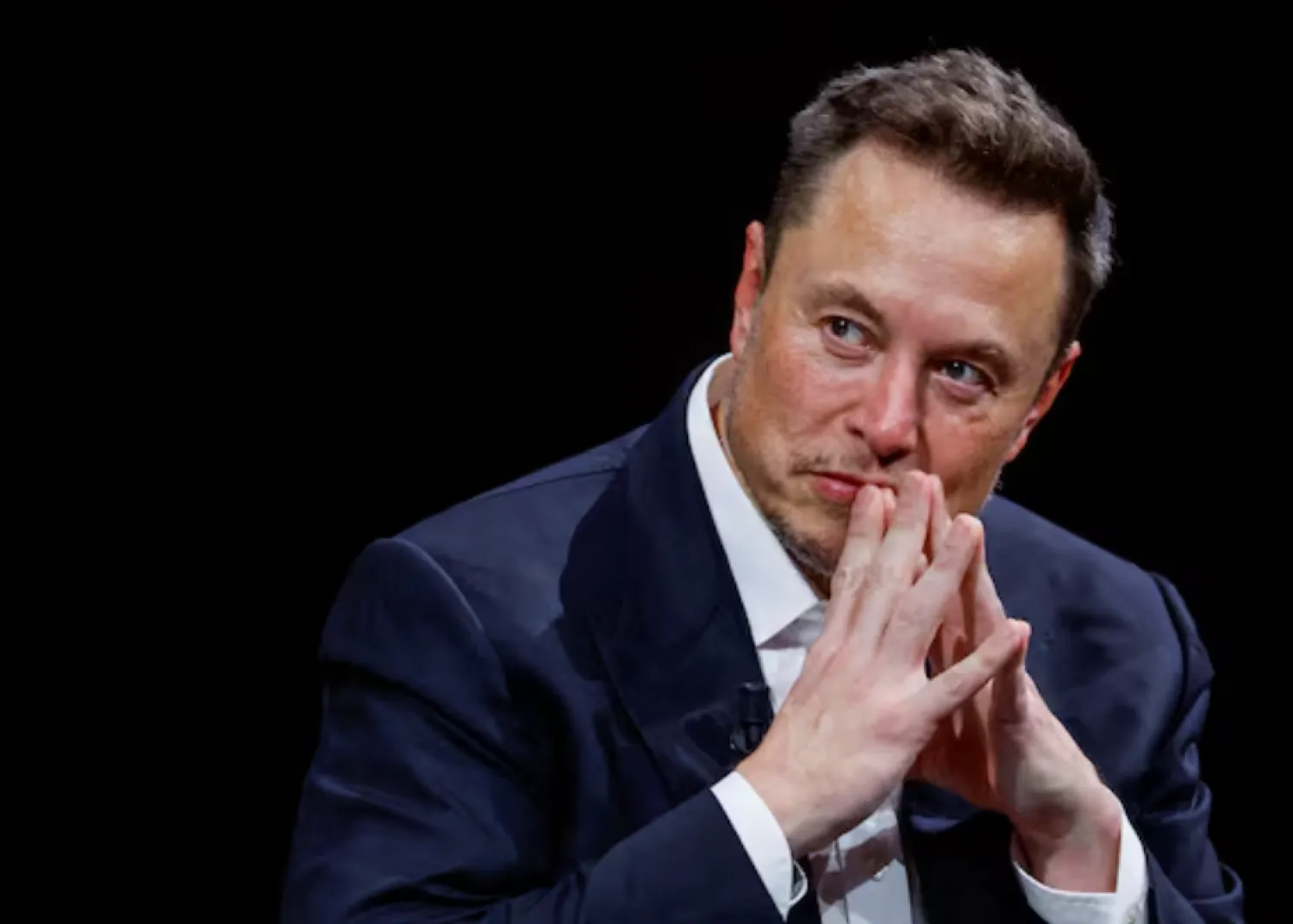
Elon Musk, Chief Executive Officer of SpaceX and Tesla, gestures as he attends the Viva Technology conference dedicated to innovation and startups at the Porte de Versailles exhibition center in Paris, France, June 16, 2023. REUTERS/Gonzalo Fuentes/File Photo
TT

SpaceX Buys Wireless Spectrum from EchoStar in $17 Billion Deal

Elon Musk, Chief Executive Officer of SpaceX and Tesla, gestures as he attends the Viva Technology conference dedicated to innovation and startups at the Porte de Versailles exhibition center in Paris, France, June 16, 2023. REUTERS/Gonzalo Fuentes/File Photo

Elon Musk's SpaceX said Monday it will buy wireless spectrum licenses from EchoStar for its Starlink satellite network for about $17 billion, the latest major deal crucial for 5G connectivity.

The companies also agreed to a deal that will enable EchoStar's Boost Mobile subscribers to access Starlink direct-to-cell service to extend satellite service to areas without service, Reuters reported.

Gwynne Shotwell, president and COO, SpaceX, said the deal will help the company "end mobile dead zones around the world... With exclusive spectrum, SpaceX will develop next-generation Starlink Direct to Cell satellites, which will have a step change in performance and enable us to enhance coverage for customers wherever they are in the world." The news sent shares of EchoStar surging nearly 22% in premarket trading. Shares of US wireless carriers AT&T and T-Mobile were down more than 5% and Verizon was down more than 4% in premarket trading.

SpaceX has launched more than 8,000 Starlink satellites since 2020, building a distributed network in low-Earth orbit which has seen demand from militaries, transportation firms and consumers in rural areas.

The deal comes months after the Federal Communications Commission questioned EchoStar's use of mobile-satellite service spectrum and raised concerns about whether it was meeting its obligations to deploy 5G in the country. The company in August sold some nationwide wireless spectrum licenses to AT&T for $23 billion. AT&T agreed to acquire 50 MHz of nationwide mid-band and low-band spectrum.

President Donald Trump

previously prodded EchoStar

and FCC Chair Brendan Carr to reach an amicable deal for the company's wireless spectrum licenses.

The FCC did not immediately comment.

EchoStar said it anticipates that the transaction with SpaceX and AT&T deal will resolve the FCC's inquiries.

SpaceX will pay up to $8.5 billion in cash and issue up to $8.5 billion in stock. SpaceX has also agreed to cover roughly $2 billion in interest payments on EchoStar's debt obligations through late 2027.

After the sale, EchoStar will continue operating its satellite television service Dish TV, streaming TV platform Sling, internet service Hughes and its Boost Mobile brand.

SpaceX had aggressively pressed the FCC to reallocate underused airwaves for satellite-to-phone service after alleging EchoStar failed to meet certain obligations.

In a letter to the FCC in April, SpaceX said EchoStar's spectrum in the 2 gigahertz band "remains ripe for sharing among next-generation satellite systems" and that the company has left "valuable mid-band spectrum chronically underused".

The deal with EchoStar will allow SpaceX to operate Starlink direct-to-cell services on frequencies it owns, rather than relying solely on those leased from mobile carriers like T-Mobile. In May, the FCC approved Verizon's $20 billion deal to acquire fiber-optic internet providers Frontier Communications. Verizon spent $52 billion to acquire and clear key spectrum in 2021.



Huawei's New AI Chip Finds Favor with ByteDance, Alibaba Which Plan to Place Orders

FILE PHOTO: The logo of Huawei is seen at the Viva Technology conference dedicated to innovation and startups at Porte de Versailles exhibition center in Paris, France, June 12, 2025. REUTERS/Benoit Tessier/File Photo
TT

Huawei's New AI Chip Finds Favor with ByteDance, Alibaba Which Plan to Place Orders

FILE PHOTO: The logo of Huawei is seen at the Viva Technology conference dedicated to innovation and startups at Porte de Versailles exhibition center in Paris, France, June 12, 2025. REUTERS/Benoit Tessier/File Photo

Customer testing of Huawei's new AI chip, designed to challenge Nvidia in the China market, has gone well and big tech giants including ByteDance and Alibaba plan to place orders, two people familiar with the matter said.

The development marks a milestone for Huawei, said Reuters.

Despite a government campaign to encourage the use of domestic semiconductors, the Shenzhen-based firm struggled to persuade big tech firms in the private sector to adopt its current flagship chip, the Ascend 910C, in large quantities, industry sources have previously said.

This ‌time around, tech ‌firms intend to use the new 950PR more extensively, much happier ‌now ⁠that the chip ⁠is more compatible with Nvidia's CUDA software system and has better response speeds, said the two people and a third person with knowledge of those plans.

Huawei plans to ship around 750,000 950PRs this year, according to two of the people. They said samples were sent to customers in January, and that mass production should begin next month, setting the stage for fully fledged shipments to start in the second half of the year.

The sources were not authorized to speak ⁠to media and declined to be identified. Huawei, ByteDance, Alibaba did not reply ‌to Reuters requests for comments.

RESTRICTIONS ON NVIDIA CHIPS

A ‌launch of the 950PR comes at a difficult time for Nvidia in China. Many of its ‌artificial intelligence chips have been banned from sale in China by Washington on worries ‌that the technology could boost the capabilities of the Chinese military.

The Trump administration last year greenlighted the sale of Nvidia's H200 chips - more powerful than currently restricted products - albeit with a number of conditions that could limit amounts sold.

The H200 has also recently received approval from Chinese authorities, but it remains unclear ‌when they will be allowed into the country.

Huawei mentioned its new chip last September when it outlined its long-term semiconductor plans for ⁠the first time and ⁠said it would be launching some of the world's most powerful computing systems.

The 950PR, which uses traditional DDR memory, will be priced at around 50,000 yuan ($6,900) per card, while a premium version with faster HBM memory will sell for around 70,000 yuan, the sources said.

Where previously Huawei had stuck to its proprietary CANN software system, the new chips will allow developers at Chinese tech firms, which have generally used Nvidia's software system thus far, to migrate those models more easily.

The sources said that compared to the 910C, the chip only offers a small improvement in raw computing power, but it is designed to excel in handling inference workloads - the process of running trained AI models to answer queries or execute tasks.

Demand for AI inference computing in China is surging as the country's tech sector shifts its focus from model development to real-world deployment, a trend turbocharged by the rapid adoption of open-source AI agent OpenClaw.


ByteDance Quietly Rolls Out SeeDance 2.0 Globally

A smartphone displays the logo of Seedance 2.0, the image-to-video and text-to-video AI model. Lionel BONAVENTURE / AFP/File
TT

ByteDance Quietly Rolls Out SeeDance 2.0 Globally

A smartphone displays the logo of Seedance 2.0, the image-to-video and text-to-video AI model. Lionel BONAVENTURE / AFP/File

Chinese artificial intelligence powerhouse and TikTok creator ByteDance has quietly rolled out its latest video generator SeeDance 2.0 worldwide, while its US rival OpenAI called time on a similar product.

The SeeDance 2.0 model was launched in China last month, both stunning and spooking the entertainment industry with its ability to produce near-Hollywood-quality clips from simple text prompts.

However, it has also sparked concerns over copyright infringement, said AFP.

"We have further expanded Dreamina Seedance 2.0 in more markets in CapCut today, across Africa, South America, the Middle East and Southeast Asia, with more regions coming soon," CapCut, ByteDance's popular video editing tool, posted on X on Thursday.

It said the SeeDance 2.0 model would initially be available to some paid users.

The rollout includes "firm safeguards" to prevent violations of its safety policies, including the unauthorized use of individuals' likenesses or intellectual property, CapCut said.

Major Hollywood production studios including Disney, Paramount, Warner Bros and Netflix, have threatened legal action against Beijing-based ByteDance over accusations of copyright infringement.

Reports this month suggested that backlash had prompted ByteDance to pause SeeDance 2.0's global launch.

It was not immediately clear if ByteDance had resolved those legal issues. The United States is not among the current rollout markets.

ByteDance, which runs popular short video platforms TikTok and Douyin, has invested heavily in AI in recent years against a backdrop of increasing global regulatory scrutiny of such platforms.

ByteDance announced on Friday the sale of Moonton, an important gaming asset, to a subsidiary of Saudi Arabia's sovereign fund for more than $6 billion.

Moonton runs Mobile Legends: Bang Bang, one of Southeast Asia's most popular gaming titles.

ByteDance's move coincides with a broader shift in the AI industry towards more "agentic" tools that focus on performing practical, real-life tasks.

US AI giant OpenAI said on Tuesday it was shutting down its popular consumer-facing video-generating service Sora, a move widely understood to focus more on providing business users with agentic AI capacities.


South Korea to Invest $166 Million in AI Chip Startup Rebellions

People walk near Gwanghwamun Square in Seoul, South Korea, 22 March 2026. The band performed their comeback concert on 21 March.  EPA/YONHAP
People walk near Gwanghwamun Square in Seoul, South Korea, 22 March 2026. The band performed their comeback concert on 21 March. EPA/YONHAP
TT

South Korea to Invest $166 Million in AI Chip Startup Rebellions

People walk near Gwanghwamun Square in Seoul, South Korea, 22 March 2026. The band performed their comeback concert on 21 March.  EPA/YONHAP
People walk near Gwanghwamun Square in Seoul, South Korea, 22 March 2026. The band performed their comeback concert on 21 March. EPA/YONHAP

South Korea's industry ministry on Tuesday said the Financial Services Commission's advisory board approved a 250 billion won ($166 million) investment in a local artificial intelligence chip startup called Rebellions, part of a government-backed push to nurture a homegrown advanced semiconductor firm.

Here are some details:

South Korea's Financial Services Commission advisory board, which evaluates investments in advanced strategic industries, ⁠approved a 250 ⁠billion won direct investment into Rebellions, an AI chip startup.

Rebellions, founded in 2020, designs neural processing units (NPUs) that handle AI computations.

The decision was made at a ⁠fund management committee meeting for the state-led "National Growth Fund," marking the first direct investment under the country's "K-Nvidia" initiative.

The funding will support Rebellions' mass production of NPU chips and the development of next-generation AI semiconductors, the industry ministry said in a statement.

The "K-Nvidia" project, jointly led by the Financial Services Commission and the ⁠Ministry ⁠of Science and ICT, seeks to nurture a globally competitive AI chip company amid intensifying competition in the sector, which is dominated by US firms like Nvidia.

The move underscores Seoul's efforts to strengthen its position in the AI supply chain and reduce reliance on foreign technology, as demand for high-performance computing chips surges.