
Syria Charts Path to Recovery as Saudi Arabia Bolsters Support

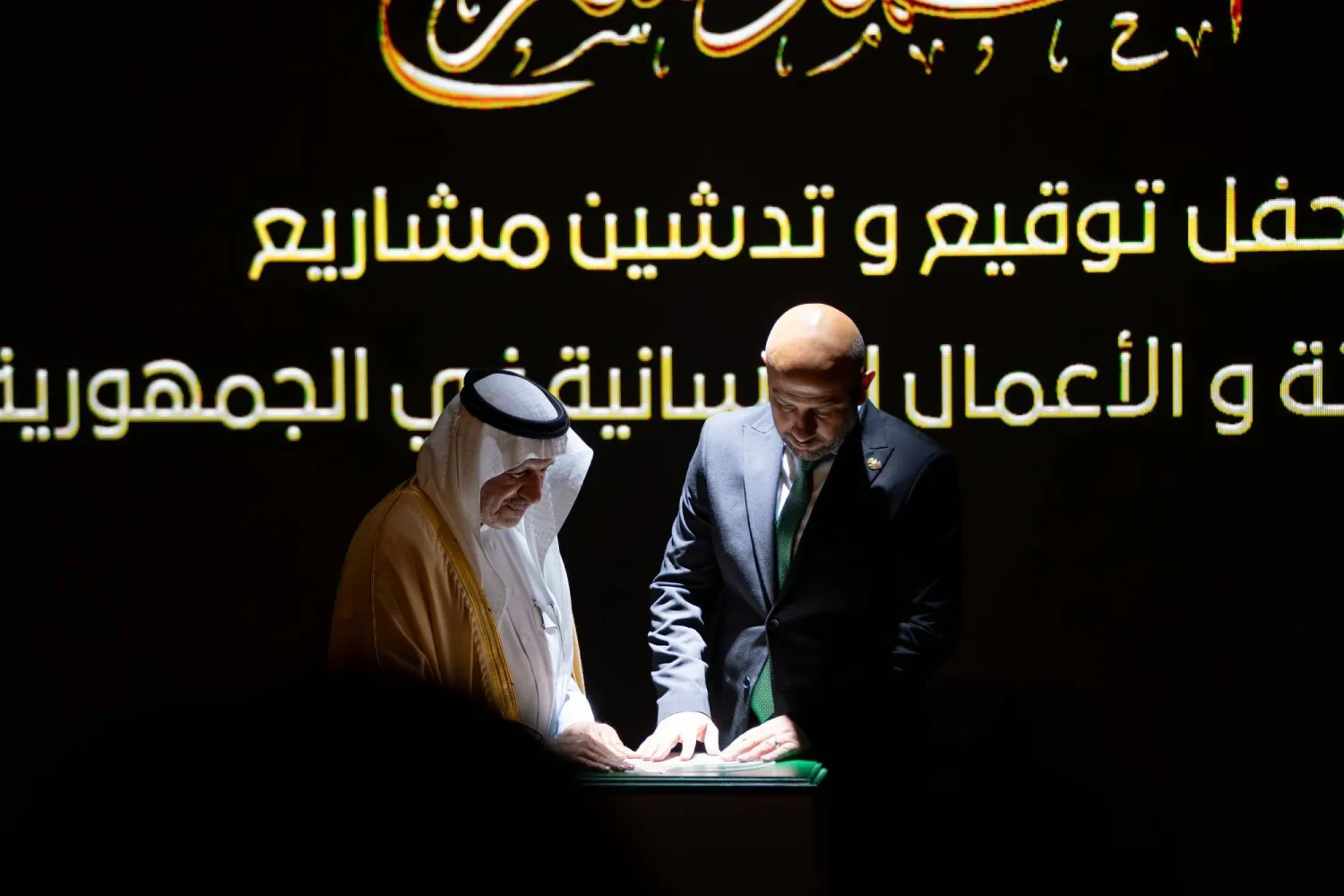
Signing of the agreements in Damascus on Sunday, attended by Dr. Abdullah Al-Rabeeah, Supervisor General of the King Salman Humanitarian Aid and Relief Center, and Syrian Minister of Emergency and Disaster Management Raed Al-Saleh (Photo: Turki Al-Oqaili). 
TT

Syria Charts Path to Recovery as Saudi Arabia Bolsters Support

Signing of the agreements in Damascus on Sunday, attended by Dr. Abdullah Al-Rabeeah, Supervisor General of the King Salman Humanitarian Aid and Relief Center, and Syrian Minister of Emergency and Disaster Management Raed Al-Saleh (Photo: Turki Al-Oqaili). 

The journey from Damascus International Airport into the heart of the Syrian capital reveals the scale of the challenges confronting a nation striving to emerge from more than a decade of turmoil.

In Eastern Ghouta, the destruction remains stark. Once-bustling neighborhoods have been reduced to empty shells, with entire blocks lying in ruins. Only a few residents remain, attempting to rebuild their lives with limited means. Across the country, the obstacles to recovery are profound: under-resourced hospitals, food insecurity, devastated infrastructure, and a battered economy that weighs heavily on both government and citizens.

For many Syrians, the struggle is deeply personal. Mohammed Al-Idlibi, 29, traveled from Idlib to Damascus seeking treatment for his nephew, who lost both arms to a landmine four months ago. His brother, blinded in earlier fighting, lives with similar scars. “There is still hope,” he told Asharq Al-Awsat in Damascus, “but the challenges are harsh and exhausting.” Unemployed, Al-Idlibi has applied to join the country’s security services, though he has yet to receive a reply. Like countless Syrians, finding work remains his greatest concern.

Amid such hardships, Saudi Arabia has stepped up its role in supporting Syria’s recovery. A high-level delegation of Saudi businessmen, doctors, and volunteers arrived in Damascus on Sunday, led by Dr. Abdullah Al-Rabeeah, Supervisor General of the King Salman Humanitarian Aid and Relief Center (KSrelief). The group came to launch hundreds of humanitarian and development projects across the country, building on Saudi Arabia’s earlier relief efforts.

Before the formal inaugurations, the Saudi delegation toured some of the worst-affected neighborhoods around Damascus, including Jobar, Arbin, and Harasta. Their visit underscored the magnitude of the task ahead: buildings barely standing, streets filled with concrete rubble, and craters left by years of bombardment. Yet there were also glimpses of resilience - small-scale construction efforts, carpenters and blacksmiths waiting for work with limited tools, and the mayor of Harasta conducting business from an improvised office of sheet metal.

At the launch ceremony, however, the mood was different. Optimism replaced despair as Saudi initiatives addressed urgent needs, particularly in healthcare. “These volunteer projects will bring a qualitative leap across several fields, not least in reducing waiting lists at hospitals and treatment centers,” said Dr. Ali Al-Qarni, KSrelief’s Director of Volunteer Programs. Having visited Syria repeatedly to assess damage to its healthcare system, he stressed that the projects would “ease suffering, restore hope, and help the sector withstand immense pressures.”

The event, held at Damascus’s Four Seasons Hotel, concluded with the signing of agreements to roll out new Saudi humanitarian and development programs. Addressing the gathering, Al-Rabeeah pledged continued support: “The Kingdom, under its wise leadership, will remain a refuge for the needy, a source of relief for the distressed, and a partner for nations in their pursuit of recovery and prosperity.”


Countries Request Urgent UN Debate on Sudan's al-Obeid

Sudanese women make a wicker bowl at the al-Rahmaniyah camp for displaced people, near the city of El-Obeid in the South Kordofan region, on June 29, 2026. (Photo by AFP)
TT

Countries Request Urgent UN Debate on Sudan's al-Obeid

Sudanese women make a wicker bowl at the al-Rahmaniyah camp for displaced people, near the city of El-Obeid in the South Kordofan region, on June 29, 2026. (Photo by AFP)

The UN Human Rights Council has received a request for an urgent debate on the situation in Sudan's al-Obeid city, a spokesperson said on ⁠Tuesday.

"That will most ⁠likely take place on Friday," Pascal Sim, a spokesperson for the ⁠council, told a press briefing in Geneva.

The request was submitted by countries including Britain and Germany.

The UN has warned of "substantial" Rapid Support Forces troop movements around the city ahead of a possible ground assault, raising fears of a repeat of the atrocities seen in El-Fasher, the Darfur city which fell to the RSF last October in an attack the UN said bore "the hallmarks of genocide.”

After breaking a prolonged siege in February last year, the Sudanese army has struggled to stop the RSF from reimposing a blockade through repeated drone strikes targeting al-Obeid, its infrastructure and the main highway out.

Recent attacks have hit the main power station and fuel depots, plunged neighborhoods into darkness and shut down water pumps.


Egypt Moves to Step Up Fuel Supply Ahead of Rise in Power Demand This Summer

 Egyptian youths play football in an open area beside a mountain near Cairo, Egypt, June 29, 2026, as the country follows the FIFA World Cup. (Reuters)
Egyptian youths play football in an open area beside a mountain near Cairo, Egypt, June 29, 2026, as the country follows the FIFA World Cup. (Reuters)
TT

Egypt Moves to Step Up Fuel Supply Ahead of Rise in Power Demand This Summer

 Egyptian youths play football in an open area beside a mountain near Cairo, Egypt, June 29, 2026, as the country follows the FIFA World Cup. (Reuters)
Egyptian youths play football in an open area beside a mountain near Cairo, Egypt, June 29, 2026, as the country follows the FIFA World Cup. (Reuters)

Egypt's ‌electricity and petroleum ministers met on Tuesday to coordinate fuel supply and grid management ahead of a summer in which power demand is expected to rise 8% over last year's record peak of 40,000 megawatts, according to a joint ministry statement.

Electricity Minister Mahmoud Esmat and ‌Petroleum Minister Karim ‌Badawi said the two ‌ministries ⁠were working as "one ⁠team" to secure fuel supplies for power stations and stabilize the national grid during peak hours.

Esmat said the electricity sector planned to add 2,200 MW of renewable ⁠energy capacity and 1,300 MW ‌of battery ‌storage to the grid this year, and ‌had already cut fuel consumption ‌per kilowatt to below 170 grams.

Badawi said that LNG regasification vessels were operating at high efficiency to supplement gas ‌production, while the Damietta LNG export terminal was being used ⁠to ⁠store LNG cargoes to be used when needed.

Egypt suffered severe rolling blackouts in 2023 and had to rely on foreign funding to stabilize its grid in 2024.

Egypt's gas production stood at 3,214 million cubic meters in April, while imports were 2,190 million cubic meters, according to the Joint Organizations Data Initiative (JODI).


Arab League Secretary-General Condemns Israeli Attacks on Syria

A man holds an unexploded artillery shell that fell during reported overnight Israeli bombardment that hit the village of Abidin in Syria's southwestern Daraa province, close to the Israeli-occupied Golan Heights, on June 29, 2026. (AFP)
TT

Arab League Secretary-General Condemns Israeli Attacks on Syria

A man holds an unexploded artillery shell that fell during reported overnight Israeli bombardment that hit the village of Abidin in Syria's southwestern Daraa province, close to the Israeli-occupied Golan Heights, on June 29, 2026. (AFP)

Outgoing Arab League Secretary-General Ahmed Aboul Gheit strongly condemned on Tuesday the Israeli attacks and repeated incursions into Syrian territory, most recently the artillery shelling that targeted the governorates of Quneitra and Daraa.

He described these actions as a “blatant violation” of Syria's sovereignty and a “flagrant breach” of international law.

In a statement, Aboul Gheit warned that “the continued violations by the Israeli forces threaten to widen the scope of the conflict and undermine efforts to restore security and stability.”

He called on the United Nations Security Council “to fulfill its responsibilities by taking action to end these aggressive actions and ensure Israel's compliance with the 1974 Disengagement Agreement.”