

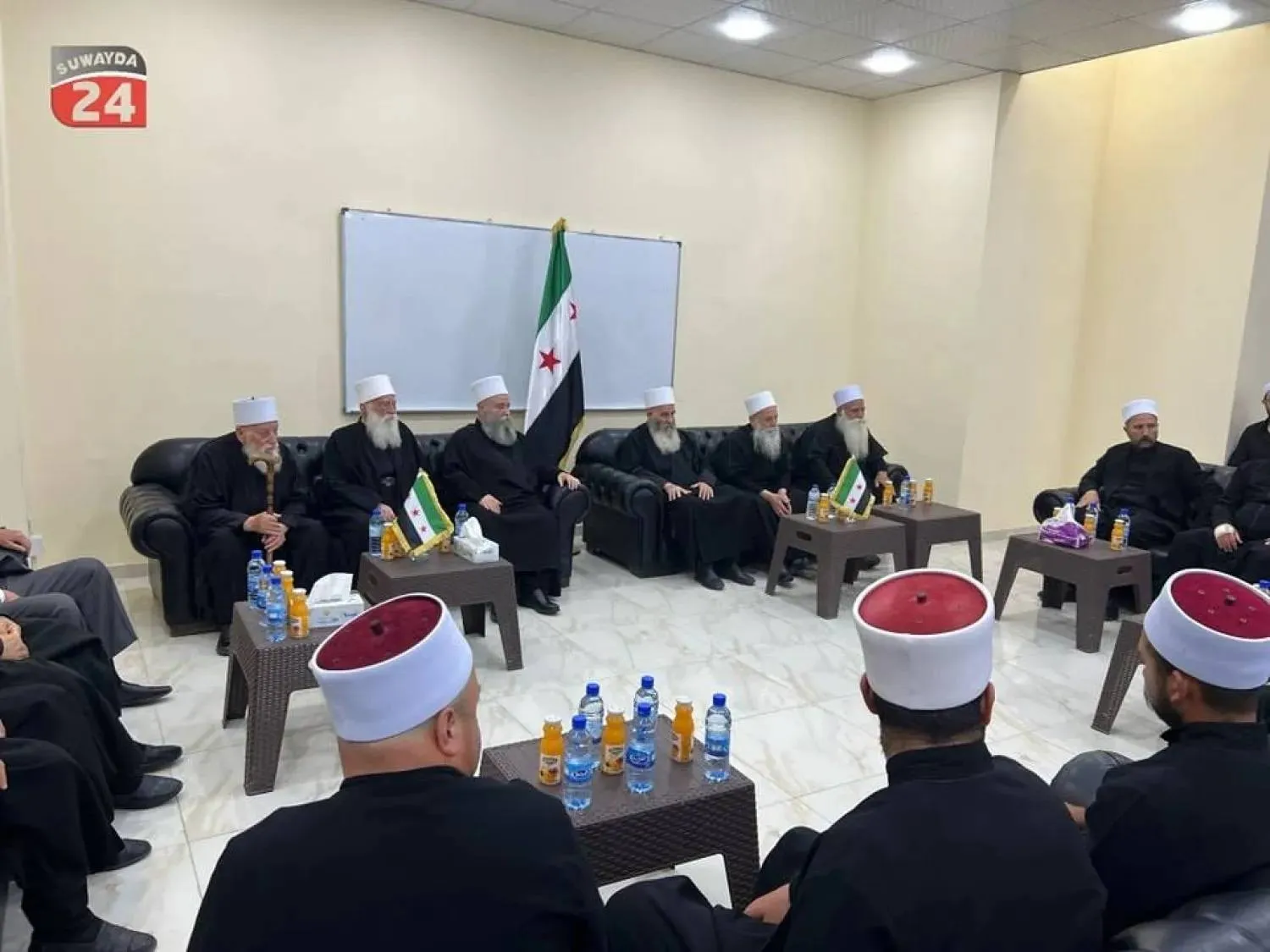

Majority of Sweida Druze Elders Oppose Secession from Syria

A delegation of Sweida Druze elders visits Daraya near Damascus in May. (Suwayda 24)
TT

Majority of Sweida Druze Elders Oppose Secession from Syria

A delegation of Sweida Druze elders visits Daraya near Damascus in May. (Suwayda 24)

Israel’s top Druze spiritual leader Sheikh Muwaffaq Tarif has called for a political settlement to safeguard Druze communities in southern Syria after deadly clashes in Sweida, a move political sources in Tel Aviv said reflects appeals from most Druze sheikhs inside Syria.

The sources said Druze elders in Sweida remain largely aligned with the Syrian state and oppose separatist initiatives pushed by Israel's Syrian counterpart, Sheikh Hikmat al-Hijri.

They have asked Druze leaders in Israel to respect that stance and help foster understandings with Damascus while discouraging secessionist movements.

Tarif, who met US envoy Tom Barrack in Paris last week, told Euronews that Israeli Druze were “messengers of peace” but deeply angered by massacres in Sweida and nearby towns.

He said he no longer blamed either Syrian authorities or Bedouin tribes for the killings, attributing them instead to “a minority of criminal gangs” who used tanks, armored vehicles and drones.

He criticized Damascus for failing to resolve the crisis, accusing the government of neglecting nearly 700 kidnapped Druze, including 100 women and 200 children, and preventing displaced residents from returning to some 40 villages.

“The government has not lifted the siege, restored services or punished the perpetrators,” he said.

Tarif praised Israeli intervention for halting bloodshed in the July clashes, claiming “without Israel, the Druze in Syria would have been wiped out.” But he also urged international engagement, calling for a safe corridor from Israel – after Jordan declined – to deliver aid into Sweida.

Hijri, by contrast, last week reaffirmed demands for self-determination, calling it a “sacred right” under international law.

His stance has drawn shrinking crowds at weekly rallies in Sweida, local media reported, while Tarif’s appeal for reintegration within the Syrian state has highlighted a widening rift between the two spiritual leaders.

Israeli officials are expected to raise the issue of Druze and other minorities during upcoming talks between Syrian Foreign Minister Asaad al-Shaibani and Israeli Strategic Affairs Minister Ron Dermer, political sources said.

Tarif also said Christian and Alawite clerics in Syria had contacted him directly to seek help, saying their communities faced similar dangers.

He linked his solidarity with Syrian Druze to the Druze principle of “preserving brethren,” citing a Tel Aviv University study showing 82% of Israeli Druze would risk their lives for fellow Druze abroad and 77% would take up arms alongside them.

Many Druze families in Israel have close kinship ties with the Druze of Syria, he added.


EU Condemns Israel's West Bank Control Measures

The Israeli settlement of Har Homa, seen from the West Bank city of Bethlehem, Tuesday, Dec. 17, 2024. (AP)
TT

EU Condemns Israel's West Bank Control Measures

The Israeli settlement of Har Homa, seen from the West Bank city of Bethlehem, Tuesday, Dec. 17, 2024. (AP)

The European Union on Monday condemned new Israeli measures to tighten control of the West Bank and pave the way for more settlements in the occupied Palestinian territory, AFP reported.

"The European Union condemns recent decisions by Israel's security cabinet to expand Israeli control in the West Bank. This move is another step in the wrong direction," EU spokesman Anouar El Anouni told journalists.


Atrocities in Sudan's El-Fasher Were 'Preventable Human Rights Catastrophe'

Sudanese displaced people who left El Fasher after its fall, sit in the shade in Tawila at the Rwanda camp reception point on December 17, 2025. (Photo by AFP)
TT

Atrocities in Sudan's El-Fasher Were 'Preventable Human Rights Catastrophe'

Sudanese displaced people who left El Fasher after its fall, sit in the shade in Tawila at the Rwanda camp reception point on December 17, 2025. (Photo by AFP)

The atrocities unleashed on El-Fasher in Sudan's Darfur region last October were a "preventable human rights catastrophe", the United Nations said Monday, warning they now risked being repeated in the neighbouring Kordofan region.


"My office sounded the alarm about the risk of mass atrocities in the besieged city of El-Fasher for more than a year ... but our warnings were ignored," UN rights chief Volker Turk told the Human Rights Council in Geneva.


He added that he was now "extremely concerned that these violations and abuses may be repeated in the Kordofan region".


Arab League Condemns Israel's Decisions to Alter Legal, Administrative Status of West Bank

A general view shows the opening session of the meeting of Arab foreign ministers at the Arab League Headquarters (Reuters)
TT

Arab League Condemns Israel's Decisions to Alter Legal, Administrative Status of West Bank

A general view shows the opening session of the meeting of Arab foreign ministers at the Arab League Headquarters (Reuters)

The General Secretariat of the Arab League strongly condemned decisions by Israeli occupation authorities to impose fundamental changes on the legal and administrative status of the occupied Palestinian territories, particularly in the West Bank, describing them as a dangerous escalation and a flagrant violation of international law, international legitimacy resolutions, and signed agreements, SPA reported.

In a statement, the Arab League said the measures include facilitating the confiscation of private Palestinian property and transferring planning and licensing authorities in the city of Hebron and the area surrounding the Ibrahimi Mosque to occupation authorities.

It warned of the serious repercussions of these actions on the rights of the Palestinian people and on Islamic and Christian holy sites.

The statement reaffirmed the Arab League’s firm support for the legitimate rights of the Palestinian people, foremost among them the establishment of their independent state on the June 4, 1967 borders, with East Jerusalem as its capital.
