


Israeli Strike Targets Hamas Leaders in Qatar as They Weigh Gaza Ceasefire Proposal

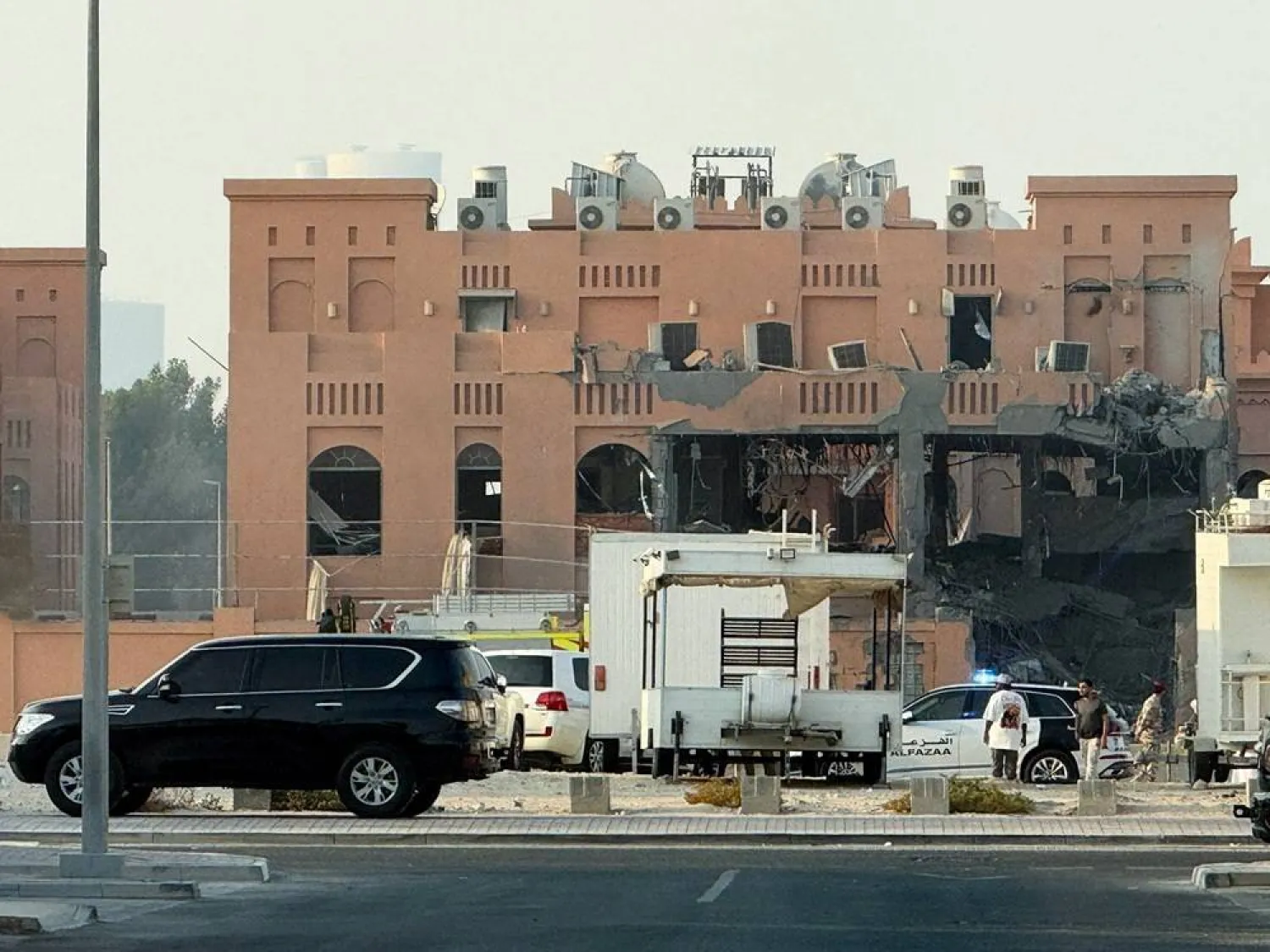
 A damaged building, following an Israeli attack on Hamas leaders, according to an Israeli official, in Doha, Qatar, September 9, 2025. (Reuters)
A damaged building, following an Israeli attack on Hamas leaders, according to an Israeli official, in Doha, Qatar, September 9, 2025. (Reuters)
TT

Israeli Strike Targets Hamas Leaders in Qatar as They Weigh Gaza Ceasefire Proposal

 A damaged building, following an Israeli attack on Hamas leaders, according to an Israeli official, in Doha, Qatar, September 9, 2025. (Reuters)
A damaged building, following an Israeli attack on Hamas leaders, according to an Israeli official, in Doha, Qatar, September 9, 2025. (Reuters)

Israel struck the headquarters of Hamas' political leadership in Qatar on Tuesday as the group's top figures gathered to consider a US proposal for a ceasefire in the Gaza Strip. The strike on the territory of a US ally marked a stunning escalation and risked upending talks aimed at winding down the war and freeing hostages. 

Qatar has served as a key mediator between Israel and Hamas throughout the 23-month-old war and even before. It condemned what it referred to as a “flagrant violation of all international laws and norms" as smoke rose over its capital, Doha. 

Hamas said in a statement its top leaders survived the strike, but five lower-level members were killed, including the son of Khalil al-Hayya — Hamas' leader for Gaza and its top negotiator — and the head of al-Hayya's office. Hamas, which has sometimes only confirmed the assassination of its leaders months later, offered no immediate proof that al-Hayya and other senior figures had survived. 

A member of Qatar’s Internal Security Force was also killed and others were wounded, Qatar's Interior Ministry said. 

Hamas has survived numerous assassinations of top leaders and still shows cohesion in Gaza, despite having suffered major blows in Israel's campaign, triggered by the militant group's Oct. 7, 2023, attack on Israel. 

The strike threatens to derail long-stalled ceasefire talks as more uncertain, as Israel gears up for a major offensive aimed at taking over Gaza City. That escalation has been met with heavy international condemnation and opposition within Israel from those who fear it will doom the remaining hostages. 

UN Secretary General Antonio Guterres condemned the attack, saying "all parties must work towards achieving a permanent ceasefire, not destroying it.” 

Surveillance footage aired by Al Jazeera showed the strike happened in Doha’s Diplomatic Quarter at a series of buildings that housed Hamas’ political wing. An Egyptian official said the strike came when a meeting by Hamas officials over the talks had been scheduled for the site. The official spoke on condition of anonymity because he wasn’t authorized to talk to reporters. 

Israel has long threatened to strike Hamas leaders wherever they are.  

In contrast to previous Israeli operations against senior militants abroad, Israeli Prime Minister Benjamin Netanyahu was quick to publicly claim the strike, saying: “Israel initiated it, Israel conducted it and Israel takes full responsibility." 

He said the decision was taken Monday after a shooting attack in Jerusalem that killed six people and an attack on Israeli forces in Gaza that killed four soldiers. 

Israel alerted the US ahead of time, according to an Israeli official, a White House official and another person familiar with the matter. The White House official would not say if Washington provided Israel with approval for carrying out the strike. Another US official said the American military did not participate. 

All four officials spoke on condition of anonymity because they were not authorized to comment publicly. 

The Israeli military said it used “precise munitions and additional intelligence” in the strike, without elaborating. It was not immediately clear how it carried out the attack. 

Hamas said the attack showed that Netanyahu and his government “do not want to reach any agreement and are deliberately seeking to thwart all opportunities and thwart international efforts.” It said it also held the United States responsible for the strike. 

Qatar condemned what it referred to as a “cowardly Israeli attack” on Hamas’ political headquarters in Doha. Foreign Ministry spokesman Majed al-Ansari called it a “flagrant violation of all international laws and norms" and said Qatar “will not tolerate this reckless Israeli behavior.” 

Egypt, another key mediator with Hamas, condemned the attack, saying it targeted Palestinian leaders who had met “to discuss ways to reach a ceasefire agreement.” It said the strike was a “direct assault” on Qatar’s sovereignty. 

The main group representing families of the hostages expressed “deep concern and great fear” after the strike. “The prospect of their return now faces greater uncertainty than ever, with one thing absolutely certain — their time is running out,” the Hostages and Missing Families Forum said in a statement. 

The US embassy in Qatar briefly instituted a shelter-in-place order for its staff, but later lifted that. 

Ceasefire negotiations in doubt  

Earlier this week, US President Donald Trump said he was giving his “last warning” to Hamas regarding a possible ceasefire, as the US advanced a new proposal that Arab officials said included the immediate release of all the hostages. 

A senior Hamas official called it a “humiliating surrender document,” but the group said it would discuss the proposal and respond within days. 

The proposal, presented by Trump’s Middle East envoy, Steve Witkoff, calls for a negotiated end of the war and the withdrawal of Israeli forces from Gaza once the hostages are released and a ceasefire is established. That's according to Egyptian and Hamas officials familiar with the talks, who spoke on condition of anonymity to discuss the closed-door discussions. 

Hamas has said it will only release the remaining 48 hostages, around 20 of whom are believed to be alive, in exchange for Palestinian prisoners, a lasting ceasefire and a complete Israeli withdrawal from Gaza. Netanyahu has rejected those terms, saying the war will continue until all the hostages are returned and Hamas has been disarmed, with Israel maintaining open-ended security control over Gaza. 

Mediators had previously focused on brokering a temporary ceasefire and the release of some hostages, with the two sides then holding talks on a more permanent truce. Witkoff walked away from those talks in July, after which Hamas accepted a proposal that mediators said was almost identical to an earlier one that Israel had approved. 

The war in Gaza has already left Israel increasingly isolated internationally, with even many of its Western allies calling for it to end the war and do more to address the humanitarian catastrophe in Gaza, parts of which are experiencing famine. 


Somalia Cancels All UAE Deals

A meeting of the Somali government. (Somali National News Agency)
TT

Somalia Cancels All UAE Deals

A meeting of the Somali government. (Somali National News Agency)

Somalia's government said on Monday that it was annulling all agreements with the United Arab Emirates, including port deals and defense and ‌security cooperation, ‌citing ‌evidence ⁠the UAE had ‌undermined its national sovereignty. 

"The Council of Ministers has annulled all agreements concluded with the United Arab Emirates, ⁠including those involving federal governmental ‌institutions, affiliated entities, and ‍regional administrations ‍operating within the territory ‍of the Federal Republic of Somalia," a statement from Somalia's Council of Ministers said. 

"This decision applies to all agreements ⁠and partnerships relating to the ports of Berbera, Bosaso, and Kismayo ... (and) bilateral security and defense cooperation agreements," the statement added. 


Somali Foreign Minister: Any Unilateral Recognition of Breakaway Regions Is Unviable

Somali Foreign Minister Abdisalam Abdi Ali (Somali Foreign Ministry)
TT

Somali Foreign Minister: Any Unilateral Recognition of Breakaway Regions Is Unviable

Somali Foreign Minister Abdisalam Abdi Ali (Somali Foreign Ministry)

At a highly sensitive regional juncture, Somali Foreign Minister Abdisalam Abdi Ali issued a clear warning against any unilateral recognition of breakaway regions, describing such moves as unviable and politically irresponsible, with negative repercussions for bilateral relations and regional stability.

In an interview with Asharq Al-Awsat, Ali stressed the alignment between Mogadishu and Riyadh on the need to shield the Red Sea and the Gulf of Aden from militarization, illicit activities and geopolitical rivalries.

He said his second visit to Saudi Arabia within two weeks reflects the depth of coordination with the Kingdom amid rapidly evolving regional developments, particularly those related to maritime security and the Horn of Africa.

Objectives of the Saudi visit

Ali said the primary aim of his visit was close consultation with Saudi Arabia on accelerating regional developments, notably those affecting the Red Sea, the Horn of Africa and maritime navigation security.

He added that discussions also focused on strengthening bilateral cooperation across political, economic, security and development fields, while ensuring full coordination on issues touching on Somalia’s sovereignty, unity and stability.

He noted that the visit — his second to Riyadh in less than two weeks — underscored the intensity of engagement with the Kingdom at a delicate moment, saying that his previous meeting with Saudi Foreign Minister Prince Faisal bin Farhan featured frank and constructive talks aimed at preventing escalation, maintaining regional balance and upholding international law.

Ali also highlighted the convening of an emergency meeting of foreign ministers of the Organization of Islamic Cooperation (OIC) to address what he described as the “illegal violation of Somalia’s sovereignty, unity and territorial integrity,” calling it further evidence of Saudi Arabia’s pivotal role in supporting regional stability.

Historic relations

The foreign minister described relations between Somalia and Saudi Arabia as “strong, historic and strategic,” grounded in shared faith, longstanding people-to-people ties and converging regional interests.

He said Somalia views the Kingdom as a key partner in national recovery, security-sector reform, economic stabilization and regional diplomacy, adding that current discussions are focused on translating this partnership into tangible outcomes that benefit both countries and reinforce wider regional stability.

Firm rejection of recognition of “Somaliland”

Ali stressed that the Somali federal government “categorically rejects” any declaration or action aimed at recognizing any part of Somalia as a separate entity. Such steps, he said, lack any legal basis, violate Somalia’s sovereignty and territorial integrity, and contravene international law, the UN Charter, the OIC charter and African Union principles.

He expressed Somalia’s appreciation for Saudi Arabia’s principled stance in support of Somali unity, as well as for regional and international partners that have voiced solidarity with Mogadishu.

He warned that unilateral recognition would not merely be a political position but a “destabilizing precedent” threatening the regional order. He added that Somalia is addressing the issue through balanced diplomacy and close coordination with regional and international partners.

A pivotal and constructive Saudi role

Ali said Saudi Arabia plays a “pivotal and constructive” role in promoting stability and security in the Arab world, the Red Sea region and the Horn of Africa, noting that its leadership in diplomacy, de-escalation and maritime security is widely recognized and appreciated.

Potential repercussions

The foreign minister warned that any unilateral recognition of Somaliland would be “legally and practically null and void,” further exacerbating fragility in a region already facing serious security, humanitarian and climate challenges. He said that such moves encourage fragmentation, fuel proxy conflicts and open the door to external interference, undermining the security of the Horn of Africa and international maritime navigation.

Militarization of the Red Sea

Ali said Mogadishu and Riyadh share a vital interest in protecting one of the world’s most strategic maritime corridors, stressing the need to keep the Red Sea and the Gulf of Aden free from militarization and illegal activities.

“We agree on the necessity of keeping the Red Sea and the Gulf of Aden away from militarization, illicit activities and geopolitical brinkmanship,” he underlined.


New KSrelief Aid Convoy Crosses Rafah to Deliver Food Baskets to Gaza

The latest KSrelief convoy was carrying food baskets for the people of Gaza. (SPA)
TT

New KSrelief Aid Convoy Crosses Rafah to Deliver Food Baskets to Gaza

The latest KSrelief convoy was carrying food baskets for the people of Gaza. (SPA)

A new humanitarian aid convoy from the King Salman Humanitarian Aid and Relief Center (KSrelief) crossed the Rafah border into Gaza on Friday with essential food baskets for Palestinians affected by the ongoing crisis, as part of the Saudi fundraising campaign to aid the Palestinian people.

The Saudi Center for Culture and Heritage, KSrelief’s implementing partner, has established several new camps in Al-Qarara area of southern Gaza and Al-Mawasi area of Khan Younis in preparation for winter.

Through these efforts, KSrelief aims to alleviate the severe suffering caused by the dire living conditions in Gaza, ensuring that vital food and shelter reach those in the most vulnerable areas.
