


Nepal Army Bids to Restore Order after Deadly Protests Oust PM

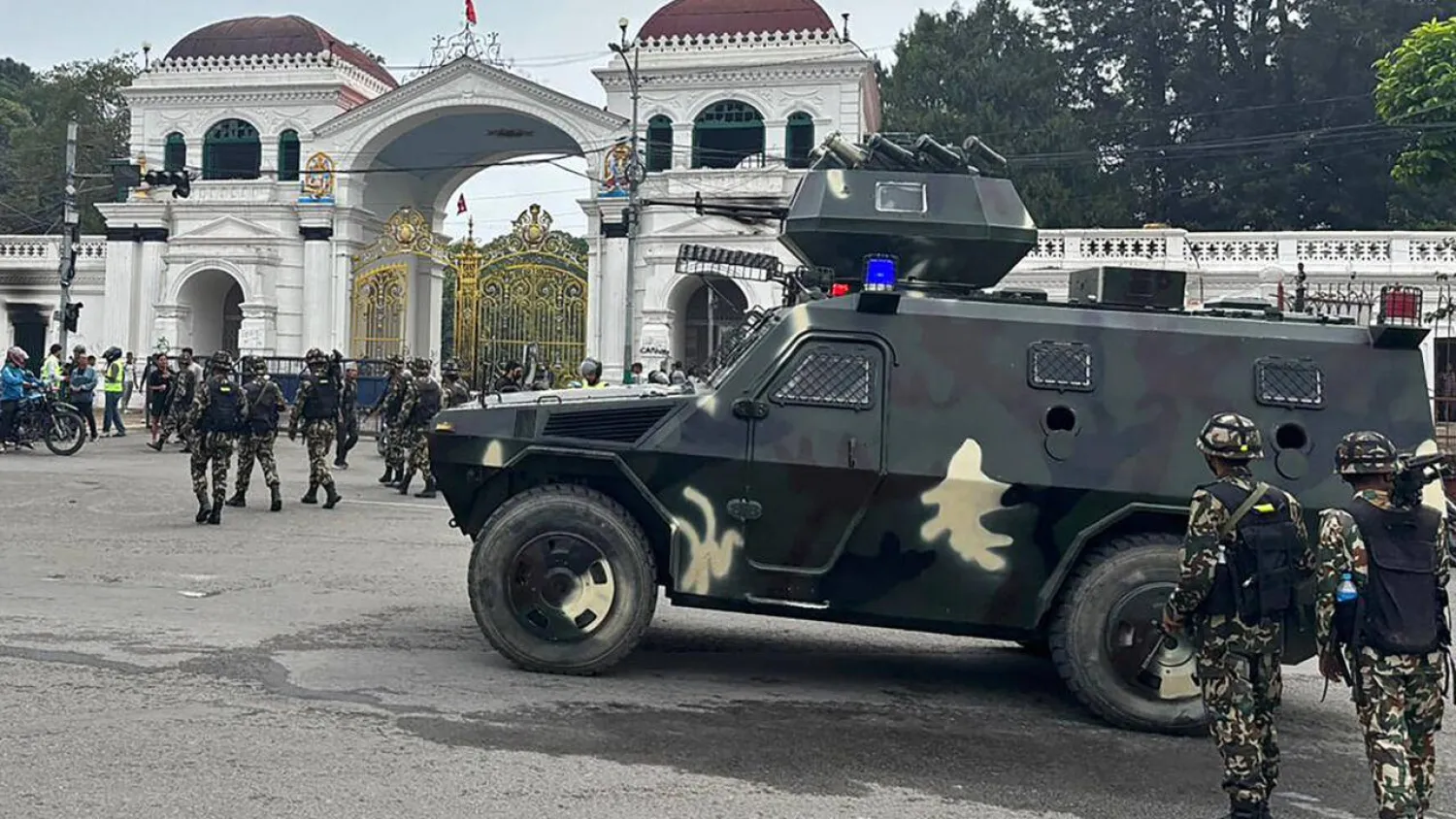
Army personnel patrol along a street outside the Singha Durbar, the main administrative building for the Nepal government, in Kathmandu. Paavan MATHEMA / AFP
TT

Nepal Army Bids to Restore Order after Deadly Protests Oust PM

Army personnel patrol along a street outside the Singha Durbar, the main administrative building for the Nepal government, in Kathmandu. Paavan MATHEMA / AFP

Nepali soldiers patrolled the streets of Kathmandu on Wednesday, seeking to restore order after protesters set parliament ablaze and forced the prime minister to quit in the worst violence to hit the Himalayan nation in two decades.

Protests had began Monday in the Nepali capital against the government's ban on social media and over corruption, but escalated into an outpouring of rage nationwide with government buildings set on fire after a deadly crackdown claimed at least 19 lives, said AFP.

The rapid descent into chaos shocked many, and Nepal's military warned against "activities that could lead the country into unrest and instability" in the country of 30 million people.

Soldiers issued orders via loudspeakers on the streets, as tanks rumbled past the carcasses of burnt vehicles and tyres.

The army warned Wednesday that "vandalism, looting, arson, or attacks on individuals and property in the name of protest will be treated as punishable crimes".

Kathmandu's airport is expected to resume operations later on Wednesday at 6:00 pm (1215 GMT), manager Hansa Raj Pandey told Nepali media.

Smoldering plumes of smoke rose from the government buildings, residences of politicians, supermarkets and other buildings targeted by protesters, an AFP reporter said Wednesday.

Firefighters doused remaining blazes, including at the tower block of the key Kantipur media group.

"It is quiet today, the army is on the streets in all places", one soldier inspecting cars at a makeshift street checkpoint said, who could not be named as he was not authorized to speak to reporters.

Gangs on Tuesday had attacked and set fire to the house of KP Sharma Oli, the 73-year-old, four-time prime minister and leader of the Communist Party.

He later quit to allow "steps towards a political solution". His whereabouts are not known.

'Call it off'

Nepali Army chief, General Ashok Raj Sigdel, has appealed for talks, in a video message issued late Tuesday.

"To provide the nation with a peaceful resolution, we urge all groups involved in the protest to call it off and engage in dialogue", he said.

The International Crisis Group called it a "major inflection point in the country's uneasy experience with democratic rule".

United Nations Secretary-General Antonio Guterres has urged "restraint to avoid a further escalation of violence", his spokesman Stephane Dujarric said in a statement.

Prime Minister Narendra Modi of neighboring India said that the "stability, peace and prosperity of Nepal are of utmost importance to us".

What happens next is unclear.

"The protesters, leaders who are trusted by them and the army should come together to pave the way for a caretaker government," constitutional lawyer Dipendra Jha told AFP.

But with the speed of the youth-led uprising, it remained unclear who the young protesters will mobilize behind to lead the country out of the political vacuum.

People aged 15-40 make up nearly 43 percent of the population, according to government statistics -- while unemployment hovers around 10 percent and GDP per capita is just $1,447, according to the World Bank.

Several social media sites -- including Facebook, YouTube and X -- were blocked on Friday, after the government cut access to 26 unregistered platforms.

Since then, videos contrasting the struggles of ordinary Nepalis with the children of politicians flaunting luxury goods and expensive vacations have gone viral on TikTok, which was not blocked.



‘Point of No Return’ Looming in Middle East War, Warns Red Cross

 A drone view shows a damage in a residential neighborhood, following a night of Iranian missile strikes which injured dozens of Israelis, amid the US-Israel conflict with Iran, in Dimona, southern Israel March 22, 2026. (Reuters)
A drone view shows a damage in a residential neighborhood, following a night of Iranian missile strikes which injured dozens of Israelis, amid the US-Israel conflict with Iran, in Dimona, southern Israel March 22, 2026. (Reuters)
TT

‘Point of No Return’ Looming in Middle East War, Warns Red Cross

 A drone view shows a damage in a residential neighborhood, following a night of Iranian missile strikes which injured dozens of Israelis, amid the US-Israel conflict with Iran, in Dimona, southern Israel March 22, 2026. (Reuters)
A drone view shows a damage in a residential neighborhood, following a night of Iranian missile strikes which injured dozens of Israelis, amid the US-Israel conflict with Iran, in Dimona, southern Israel March 22, 2026. (Reuters)

The International Committee of the Red Cross demanded Monday a halt to the "war on essential infrastructure" in the Middle East, warning of potential "irreversible consequences" including harm to nuclear facilities.

"What we have seen in recent days in the Middle East risks reaching a point of no return," ICRC president Mirjana Spoljaric warned in a statement.

"Most alarming is the potential harm to nuclear facilities, whether deliberate or incidental," she said.

Energy infrastructure has been repeatedly hit since the start of the war on February 28, when the United States and Israel began their attacks on Iran. Tehran has responded by striking targets in Israel and Gulf states.

Over the weekend, an Iranian strike hit the southern Israeli town of Dimona, home to a nuclear facility, in what Tehran said was in response to an earlier attack on its nuclear site at Natanz.

"Damage to these sites could trigger irreversible consequences, which is why they are afforded heightened protections under the rules of war," Spoljaric said.

She cautioned that "war on essential infrastructure is war on civilians".

"Deliberate attacks on essential services and civilian infrastructure can amount to war crimes."

Her comments came as US President Donald Trump suddenly backtracked on a threat to "obliterate" Iran's power infrastructure if it did not reopen the strategic Strait of Hormuz.

In response to Trump's initial threat, Iran had threatened to deploy naval mines in the Gulf and target power plants across the region.

On Monday, Trump said he was putting his ultimatum on hold after "very good" talks with unidentified Iranian officials, while Iranian media outlets quoted the foreign ministry in Tehran denying any negotiations and suggesting Trump was angling to bring down energy prices.

"Attacks on essential infrastructure have already punished millions of civilians both near and far from the front lines," Spoljaric said in her statement.

"This pattern, combined with an escalatory rhetoric that disregards the limits imposed by international humanitarian law, normalizes a style of warfare that strips away our shared humanity."


Iran’s True Casualty Figures Unknown as Internet Blackout Hampers Monitors

Emergency personnel work at the site of a strike on a residential building, amid the US-Israeli conflict with Iran, in Tehran, Iran, March 23, 2026. Majid Asgaripour/WANA (West Asia News Agency) via Reuters
TT

Iran’s True Casualty Figures Unknown as Internet Blackout Hampers Monitors

Emergency personnel work at the site of a strike on a residential building, amid the US-Israeli conflict with Iran, in Tehran, Iran, March 23, 2026. Majid Asgaripour/WANA (West Asia News Agency) via Reuters

Iran has not updated its official death toll figures for weeks, while human rights groups outside the country are struggling with chronic communication problems, meaning the number of people killed during the war remains largely unknown.

The last time Iran's health ministry gave a full update about casualties was on March 8, the ninth day of the conflict, when it said around 1,200 civilians had been killed in US and Israeli airstrikes across the country.

Overseas human rights groups have long been considered one of the most reliable sources of information about life inside the heavily censored country.

But with Iran's connections to the global internet cut off and phone lines down, they are struggling to reach their networks of contacts who are their eyes and ears on the ground.

The US-based Human Rights Activists News Agency (HRANA), which played an important role corroborating deaths during anti-government protests in January, estimates the civilian death toll at 1,407 people, including 214 children.

"I would say it's an absolute, absolute minimum, and that's simply because we don't have the capacity to be everywhere at one time, understanding the full extent of what's happening," HRANA deputy director Skylar Thompson told AFP.

"With the scale and the speed at which places are being targeted across the country, it's impossible to document it at the same pace," she added.

The Iranian Red Crescent is not providing casualty estimates, but its latest figures indicate 61,555 homes, 19,000 businesses, 275 medical centers, and nearly 500 schools have been damaged.

AFP journalists have been able to confirm that many civilian buildings in Tehran have been damaged, including apartment blocks caught in the blast wave of nearby missile or bomb strikes, but not beyond the city.

Reporters are unable to travel around the country without official authorization.

- Connection problems -

Distrust of Iran's official figures is high among human rights groups, particularly after the bloody crackdown on anti-government protests in January.

Although Iran acknowledged around 3,000 deaths, mostly among security forces, researchers and campaigners outside Iran estimated that anywhere from 7,000 to 35,000 people were killed in the indiscriminate shooting.

"The Islamic republic has a history of not publishing or not collecting data," Awyar Shekhi from the Norway-based human rights group Hengaw told AFP.

The problem for Hengaw and others seeking to provide a credible alternative to the incomplete official data has been the almost-total shutdown of Iran's internet connections to the outside world since the start of the war on February 28.

"The connection is worse than it ever was before, so it's really difficult to get accurate data of how many people have been killed, and the information we get is so little," Shekhi added.

Both she and Thompson stressed that Iranian authorities have been threatening and arresting people who have illegally accessed the global internet to send information abroad, sometimes accusing them of spying.

Making telephone calls to Iran from abroad is also largely impossible.

- 'Focus on the civilian harm' -

The biggest loss of life for civilians in the war so far was the airstrike on an elementary school in Minab on the first day of the war that killed at least 165 people, according to an official toll.

A US Tomahawk cruise missile hit the school because of a targeting mistake, according to the preliminary findings of a US military investigation reported by The New York Times.

Hengaw also documented an airstrike on a flour factory in the city of western Naqadeh on March 7 that killed 11 workers and injured another 21.

"I believe that the US and Israel are using a quite aggressive interpretation of what is a military target," Thompson from HRANA added.

Unlike in January, during the anti-government protests, she said there had so far been relatively little attention in the Western media on the toll of ordinary Iranians.

"There's such a focus on the geopolitics of it all, I think it's really important to have a focus on the civilian harm," she added.

Elsewhere in the region, Lebanon's health ministry said Israeli strikes had killed 1,029 people in the country.


Russia, Vietnam Advance Plans for First Nuclear Power Plant

FILE PHOTO: A tower of the Kremlin and the headquarters of the Russian foreign ministry in Moscow, Russia March 10, 2026.  REUTERS/Anastasia Barashkova/File Photo
FILE PHOTO: A tower of the Kremlin and the headquarters of the Russian foreign ministry in Moscow, Russia March 10, 2026. REUTERS/Anastasia Barashkova/File Photo
TT

Russia, Vietnam Advance Plans for First Nuclear Power Plant

FILE PHOTO: A tower of the Kremlin and the headquarters of the Russian foreign ministry in Moscow, Russia March 10, 2026.  REUTERS/Anastasia Barashkova/File Photo
FILE PHOTO: A tower of the Kremlin and the headquarters of the Russian foreign ministry in Moscow, Russia March 10, 2026. REUTERS/Anastasia Barashkova/File Photo

Russia and Vietnam on Monday signed a cooperation agreement on the construction of Vietnam's first nuclear power plant, Russia's Rosatom nuclear agency said on Monday.

Prime Minister Pham Minh Chinh was visiting energy-rich Russia as Vietnam seeks to shore up its fuel reserves at a time of disruption to energy supplies caused by the war in the Middle East, sparking fears of fuel shortages around the world.

Since the US-Israeli war against Iran began in late February, the cost of 95-octane petrol and diesel in Vietnam, a manufacturing hub, has soared by 50 percent and 70 percent respectively, AFP reported.

The agreement lays out the legal framework for the construction of two reactors with a total output of 2400 MW at Vietnam's proposed Ninh Thuan nuclear power plant, Rostam said.

Rosatom head Alexey Likhachev said the agreement would be the "foundation for a long-term industrial partnership, which will strengthen Vietnam's energy independence and open up new opportunities for economic growth".

No timeline was given for when construction would start or when the plant might come online.

Moscow and Hanoi had initially agreed to build the Ninh Thuan 1 atomic power station back in 2010, but later decided to suspend construction.

Another agreement between Russia's top liquefied natural gas (LNG) producer Novatek and a Vietnamese buyer was also signed recently, Novatek's CEO Leonid Mikhelson said on Monday.

"We have been in negotiations with potential buyers for over five years, and have very recently signed a preliminary supply agreement with one of them. We are ready to commence deliveries at the earliest opportunity," he told state broadcaster Rossiya 24, without naming the customer.

Russia and Vietnam have also signed a deal on oil and gas production in both countries, the TASS state news agency reported, citing Russian Prime Minister Mikhail Mishustin, without giving details.