


Astronomers Get Best View Yet of Two Merging Black Holes

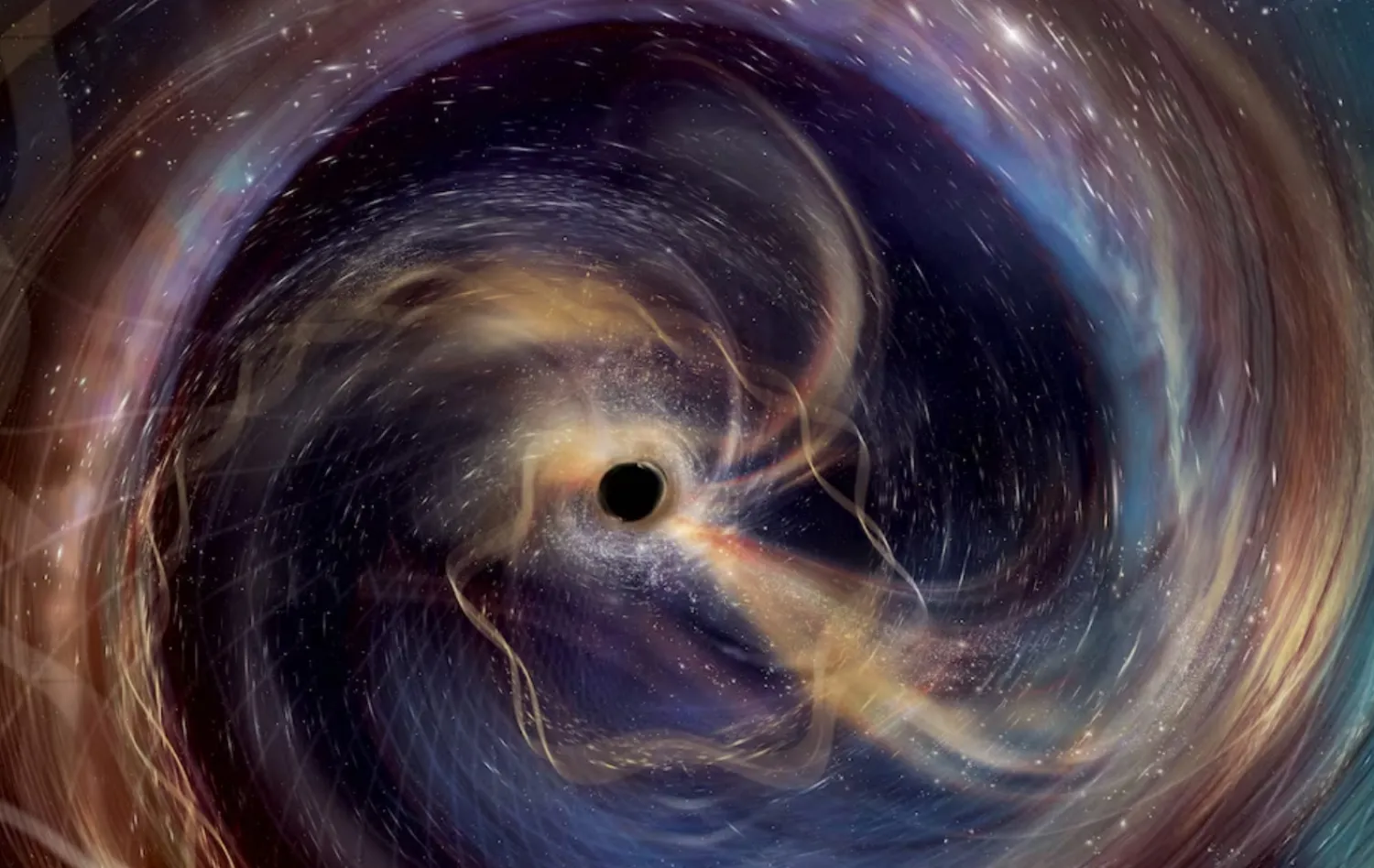
This artist's conception shows events immediately preceding a powerful collision between two black holes, observed in gravitational waves by the US National Science Foundation's LIGO. It depicts the view from one of the black holes as it spirals toward its cosmic partner. The image was released on September 9, 2025. - Reuters
TT

Astronomers Get Best View Yet of Two Merging Black Holes

This artist's conception shows events immediately preceding a powerful collision between two black holes, observed in gravitational waves by the US National Science Foundation's LIGO. It depicts the view from one of the black holes as it spirals toward its cosmic partner. The image was released on September 9, 2025. - Reuters

The merger of two black holes is a momentous event, revealing the wildest and most extreme configurations of space, time and gravity known to science.

Researchers have now gotten their best look yet at such an event based on the detection of ripples in space-time called gravitational waves in an observation that lends strong support to hypotheses from eminent physicists Albert Einstein and Stephen Hawking, Reuters reported.

The collision occurred 1.3 billion light-years from Earth in a galaxy beyond our Milky Way, and involved two black holes - one about 34 times the mass of the sun and the other about 32 times the sun's mass. They merged in a fraction of a second after orbiting each other at nearly the speed of light, and left behind a single black hole around 63 times the mass of the sun that was spinning at approximately 100 revolutions per second.

A light-year is the distance light travels in a year, 5.9 trillion miles (9.5 trillion km). Black holes are extraordinarily dense objects with a gravitational pull so strong not even light can escape.

The merger unleashed a tremendous amount of energy that radiated outward as gravitational waves, an amount equivalent to pulverizing three sun-sized stars. These waves were detected on January 14 at research sites in Hanford, Washington and Livingston, Louisiana that are part of the US National Science Foundation's Laser Interferometer Gravitational-Wave Observatory, or LIGO.

These observations came about a decade after the groundbreaking first detection of gravitational waves, which were produced by a similar merger. Technological improvements since 2015 meant this merger was observed with four times better resolution than the prior one.

Gravitational waves propagate outward from a source like ripples in a pond. In this case, the pond is space-time, the four-dimensional fabric that combines the three dimensions of space - height, width and length - with the dimension of time.

"Thanks to Albert Einstein, we know that space and time are intertwined and are best thought of as facets of a single entity, space-time," said astrophysicist Maximiliano Isi of Columbia University and the Flatiron Institute, one of the leaders of the study published on Wednesday in the journal Physical Review Letters.

"This manifests, for example, in that time flows at different rates depending on where you are: close to a heavy object, like a black hole, time flows more slowly compared to someone farther away, so that someone close to a black hole would age more slowly," Isi said.

The researchers analyzed the frequencies of the detected gravitational waves to discern fundamental qualities of the black holes immediately before and after the merger. While these frequencies were not sound waves, the researchers compared them to the ringing of a bell.

"This is just like trying to figure out what a bell is made out of from the ringing sound it makes when struck," Isi said.

A large iron bell, for instance, makes a different sound than a small aluminum bell.

What the researchers learned based on the frequency of gravitational waves offered validation for a basic tenet of scientific understanding of black holes advanced by Hawking, who died in 2018.

Hawking hypothesized that the total surface area of black holes - specifically the surface area of the event horizon, the boundary beyond which nothing can escape - should never decrease. His hypothesis implies that the surface area of the single black hole produced in a merger should exceed the combined surface areas of the two black holes that merged.

This merger met that expectation. Before colliding, the black holes together had a total surface area of about 93,000 square miles (240,000 square km). The single black hole produced by the merger had a surface area of about 155,000 square miles (400,000 square km).

"This is the first time that we have been able to make this measurement so precisely, and it's exciting to have direct experimental confirmation of such an important idea about the behavior of black holes," said astrophysicist Will Farr of Stony Brook University and the Flatiron Institute, one of the study leaders.

The observations also provided the most direct evidence yet that black holes are the paradoxically simple objects foreseen in Einstein's theory of general relativity, which holds that gravity results from the curvature of space-time caused by mass and energy.

The findings validated Einstein's proposed simplicity of black holes - that they can be fully understood based exclusively on their mass and spin - as worked out by mathematician Roy Kerr in 1963.

The gravitational wave measurements were obtained in a remarkably short time. Caltech astrophysicist Katerina Chatziioannou said the black holes were observed spiraling inward toward each other for about 200 milliseconds, and the signal from the merged black hole was measured for about 10 milliseconds.



Spain and Portugal Continue to Battle Storm Leonardo as New Storm Approaches

 A mountain landslide blocks railway tracks during heavy rains, as storm Leonardo hits parts of Spain, in Benaojan, Spain, February 6, 2026. (Reuters)
A mountain landslide blocks railway tracks during heavy rains, as storm Leonardo hits parts of Spain, in Benaojan, Spain, February 6, 2026. (Reuters)
TT

Spain and Portugal Continue to Battle Storm Leonardo as New Storm Approaches

 A mountain landslide blocks railway tracks during heavy rains, as storm Leonardo hits parts of Spain, in Benaojan, Spain, February 6, 2026. (Reuters)
A mountain landslide blocks railway tracks during heavy rains, as storm Leonardo hits parts of Spain, in Benaojan, Spain, February 6, 2026. (Reuters)

Storm Leonardo continued to batter the Iberian Peninsula on Friday, bringing floods and putting rivers at risk of bursting their banks while thousands of people were evacuated from their homes in Spain and Portugal.

In southern Spain's Andalusia region, some 7,000 people have had to leave their homes due to successive storms.

Among them were around 1,500 people ordered to evacuate the mountain village of Grazalema, where Andalusia's regional leader Juan Manuel Moreno warned that aquifers were "full to the brim with water,” and at risk of collapsing.

“It's raining on already saturated ground. The land is unable to drain," Moreno said. “We urge extreme caution. This is not over.”

Spanish police said Friday they had found a body located 1,000 meters (about 0.6 miles) away from where a woman had disappeared Wednesday after she fell into a river in Malaga province while trying to rescue her dog. Police said they had not yet identified the body, but believed it belonged to the 45-year-old woman.

Another storm front, Marta, was expected to arrive Saturday, with Spain's weather agency AEMET saying it would bring even more rain and heavy winds, including to areas already drenched by Storm Leonardo.

Marta is expected to affect Portugal, too.

Of particular concern was southern Spain's Guadalquivir River, which flows through Córdoba and Seville and eventually into the Atlantic Ocean, and whose water levels have dramatically risen in recent days.

Additional rain Saturday could leave many more homes at risk in Córdoba, local authorities warned.

In Portugal, parts of Alcacer do Sal were submerged after the Sado River overflowed, forcing residents to leave the city located 90 kilometers (about 56 miles) south of Lisbon.

Alerts were issued also for regions near the Tagus River due to rising water levels.

A separate storm in late January left a trail of destruction in Portugal, killing several people, according to Portuguese authorities.


AROYA Cruises Debuts Arabian Gulf Voyages for 2026

AROYA offers a curated experience featuring culturally inspired entertainment and diverse dining options - SPA
TT

AROYA Cruises Debuts Arabian Gulf Voyages for 2026

AROYA offers a curated experience featuring culturally inspired entertainment and diverse dining options - SPA

AROYA Cruises, a subsidiary of the PIF-owned Cruise Saudi, has officially launched its inaugural season in the Arabian Gulf.

Running from February 21 to May 8, the season marks a milestone in regional tourism by blending authentic Saudi hospitality with international maritime standards, SPA reported.

AROYA offers a curated experience featuring culturally inspired entertainment and diverse dining options.

The season is designed to provide guests with a dynamic way to explore the Gulf, setting a new benchmark for luxury travel that reflects the Kingdom's heritage on a global stage.


Snowstorm Brings Much of Denmark to a Halt

A car drives in heavy snow at Store Heddinge in South Zealand, Denmark, 05 February 2026.  EPA/Mads Claus Rasmussen
A car drives in heavy snow at Store Heddinge in South Zealand, Denmark, 05 February 2026. EPA/Mads Claus Rasmussen
TT

Snowstorm Brings Much of Denmark to a Halt

A car drives in heavy snow at Store Heddinge in South Zealand, Denmark, 05 February 2026.  EPA/Mads Claus Rasmussen
A car drives in heavy snow at Store Heddinge in South Zealand, Denmark, 05 February 2026. EPA/Mads Claus Rasmussen

Denmark authorities halted public transport, closed schools and cancelled flights on Friday as heavy snowfall blanketed much of the country.

The Nordic country's meteorological institute DMI warned that heavy snow would likely continue until Friday evening in the east, where the capital Copenhagen is located.

Police said people should avoid going outdoors unless necessary and stay indoors in the capital and the surrounding region.

Copenhagen's airport cancelled flights to Paris and Berlin and warned of "delay and cancellation risks because of snowy conditions." Many schools were closed.

In the second-largest city of Aarhus, bus services were cancelled.