
Gaza Antiquities Rescued Ahead of Israeli Strike

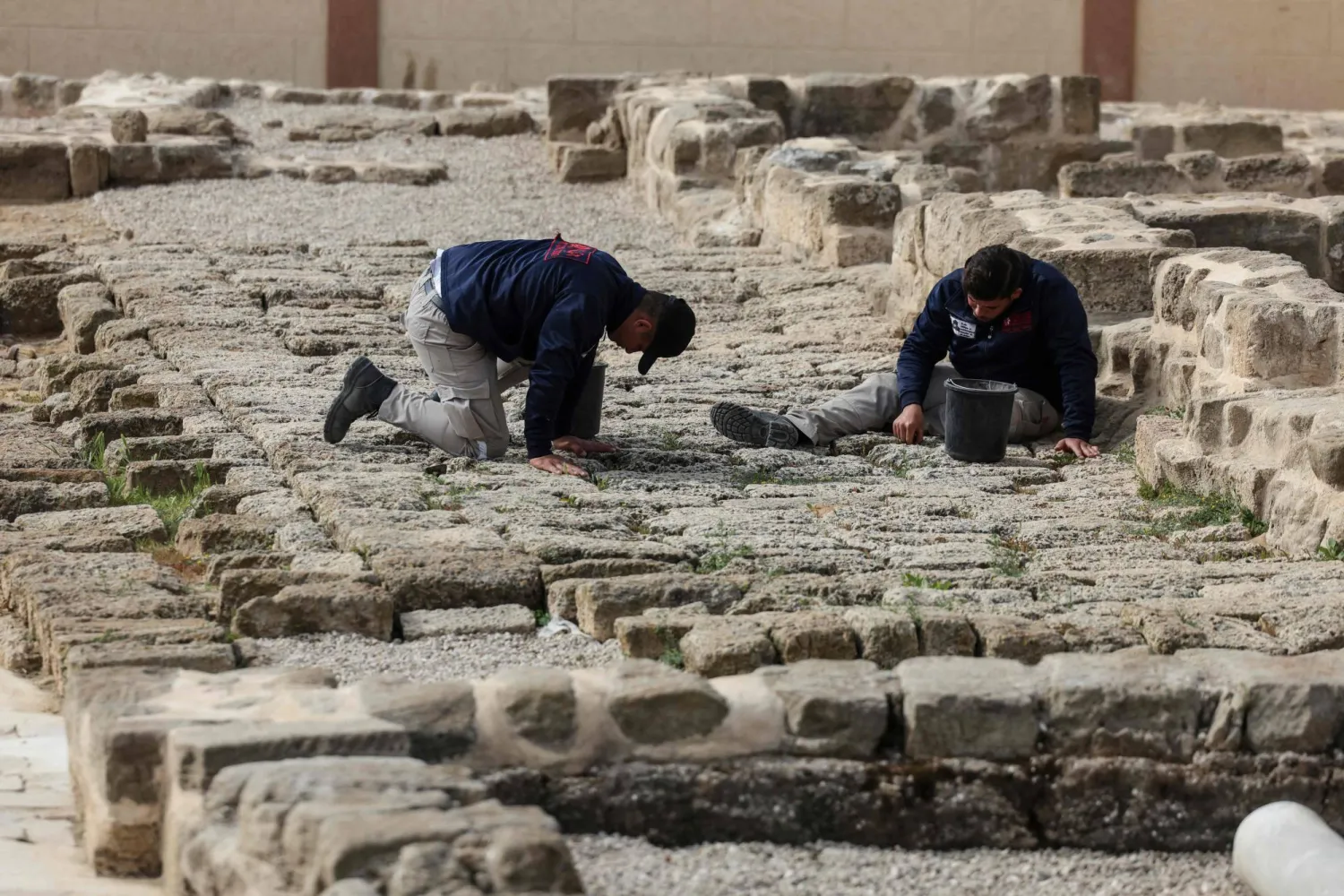
(FILES) Palestinian students work at the archaeological site of Saint Hilarion, also known as Tell Umm Amer, in the central Gaza Strip on March 7, 2023. (Photo by Mahmud HAMS / AFP)
TT

Gaza Antiquities Rescued Ahead of Israeli Strike

(FILES) Palestinian students work at the archaeological site of Saint Hilarion, also known as Tell Umm Amer, in the central Gaza Strip on March 7, 2023. (Photo by Mahmud HAMS / AFP)

Nearly three decades of archaeological finds in Gaza were hurriedly evacuated Thursday from a Gaza City building threatened by an Israeli strike, an official in charge of the antiquities told AFP.

"This was a high-risk operation, carried out in an extremely dangerous context for everyone involved -- a real last-minute rescue," said Olivier Poquillon, director of the French Biblical and Archaeological School of Jerusalem (EBAF), whose storehouse housed the relics.

On Wednesday morning, Israeli authorities ordered EBAF -- one of the oldest academic institutions in the region -- to evacuate its archaeological storehouse located on the ground floor of a residential tower in Gaza City that was due to be targeted.

The Israeli army did not confirm the warning when asked by AFP, but several sources said France, UNESCO and the Latin Patriarchate of Jerusalem played a key role in securing a brief reprieve that allowed most of the artifacts to be removed.

"With almost no international actors left on the ground, no infrastructure, nothing functioning, we had to improvise transport, labor and logistics," said Poquillon.

The evacuation, he added, was carried out in strict secrecy, with "the overriding concern, as a religious organization, of not endangering human lives", as Israeli military pressed operations in the territory's largest urban hub.

The depot contained around 180 cubic meters of finds from Gaza's five main archaeological sites, including the fourth-century Saint Hilarion Monastery, listed as a UNESCO World Heritage site.

All of these sites have been damaged, EBAF said, expressing concern for "unique" mosaics left exposed despite their fragility.

Poquillon said Gaza has "an extremely ancient heritage, very precious for the region, showing the succession and coexistence of peoples, cultures and religions.”

Of Gaza's two museums, one has been destroyed and the other heavily damaged since the war erupted nearly two years ago.

Researchers told AFP that aside from scattered ruins highly vulnerable to bombardment, the EBAF storehouse was the only significant repository of artifacts left in the Palestinian territory.

The rediscovery of Gaza's past began in the wake of the 1993 Oslo accords.

Two years later, the newly created Gaza antiquities service opened its first archaeological dig in cooperation with EBAF, unearthing remnants of the ancient Greek port of Anthedon and a Roman necropolis.

Excavations stalled after Hamas seized power in 2007 and Israel imposed a blockade, resuming years later with support from the British Council and French NGO Premiere Urgence Internationale (PUI).

Now, with Israel contemplating a full takeover of Gaza and ceasefire talks stalled, archaeologists say prospects for renewed excavations are remote.

UNESCO, which has already identified damage to 94 heritage sites in Gaza using satellite images, including the 13th-century Pasha's Palace, has not yet been able to take a full inventory.

"We saved a large part, but in a rescue you always lose things, and you always face painful choices," said Rene Elter, an archaeologist affiliated with EBAF and scientific coordinator for PUI.

The depot, he said, was especially valuable because collections had been classified systematically.

"Many items have been broken or lost, but they had been photographed or drawn, so the scientific information is preserved," Elter explained.

"Perhaps that will be the only trace that remains of Gaza's archaeology -- in books, publications, libraries."

Saudi Arabia, Syria Underline Depth of their Cultural Ties

Syrian President al-Sharaa receives the Saudi minister of culture and the accompanying delegation at the Conference Palace in Damascus on Thursday. (SPA)
TT

Saudi Arabia, Syria Underline Depth of their Cultural Ties

Syrian President al-Sharaa receives the Saudi minister of culture and the accompanying delegation at the Conference Palace in Damascus on Thursday. (SPA)

Saudi Arabia and Syria underlined the strength of their cultural relationship during high-level meetings held in Damascus on Thursday, on the sidelines of the opening of the Damascus International Book Fair 2026, where the Kingdom is participating as guest of honor.

Syrian President Ahmad al-Sharaa received Saudi Minister of Culture Prince Badr bin Abdullah bin Farhan at the Conference Palace in the capital.

Earlier the same day, Prince Badr met with his Syrian counterpart, Minister of Culture Mohammad Yassin Saleh, during an official visit to attend the fair. T

he Saudi minister congratulated Syria on hosting the exhibition and expressed his wishes for continued prosperity, progress, and stability for the Syrian government and people.

Both meetings highlighted the depth of cultural relations between the two countries, the importance of expanding joint cultural cooperation across various fields, and the alignment of positions on issues of mutual interest in a way that serves both nations.

The Saudi delegation included senior officials and advisers, among them representatives from the Royal Court, the Ministry of Culture, and the King Abdulaziz Public Library, reflecting broad institutional engagement in the visit.

In the evening, Prince Badr attended the opening ceremony of the fair’s special session, held under the patronage and in the presence of al-Sharaa. The event drew wide official and cultural participation, including Arab ministers, political and intellectual figures, and a distinguished group of writers and cultural figures.

In a post on the X platform, Prince Badr thanked “our brothers in Syria for their generous hospitality and their efforts in organizing the Damascus International Book Fair.”

The minister also inaugurated the Kingdom’s pavilion at the fair in the presence of the Syrian minister of culture and the Qatari minister of culture.

Saudi Arabia’s guest-of-honor participation continues until Feb. 16 and reflects its growing prominence and leadership in the Arab and global cultural landscape.

This participation aligns with Saudi Vision 2030, which places culture at the heart of national development, viewing it as a space for dialogue, a bridge for civilizational communication, and a tool for strengthening ties among Arab peoples.

The Saudi Literature, Publishing and Translation Commission is leading the Kingdom’s participation, highlighting the development of the cultural sector and reaffirming the central role of books as carriers of knowledge and awareness.

The Saudi pavilion boasts a comprehensive cultural program featuring intellectual seminars, poetry evenings, a manuscript exhibition, traditional Saudi fashion displays, hospitality corners, archaeological replicas, and performing arts that express the depth of the Kingdom’s cultural heritage.

On the sidelines of the visit, Prince Badr, accompanied by Minister Saleh, toured the National Museum of Damascus, which houses rare artifacts spanning prehistoric eras, ancient Syrian civilizations, classical and Islamic periods, as well as traditional and modern art.


UNESCO Honors Al-Bisht Al-Hasawi as Thousands Flock to Al-Ahsa Festival

Visitors can explore interactive displays, participate in live workshops, and witness the meticulous process of tailoring this iconic symbol of prestige - SPA
TT

UNESCO Honors Al-Bisht Al-Hasawi as Thousands Flock to Al-Ahsa Festival

Visitors can explore interactive displays, participate in live workshops, and witness the meticulous process of tailoring this iconic symbol of prestige - SPA

The third edition of Al-Bisht Al-Hasawi Festival is drawing thousands of regional and international visitors to Ibrahim Palace in historic Al-Hofuf.

Organized by the Heritage Commission, this year’s festival celebrates the inscription of the Bisht on UNESCO’s Representative List of the Intangible Cultural Heritage of Humanity.

The event showcases Al-Ahsa’s centuries-old tradition of hand-weaving and gold embroidery, a craft passed down through generations of local families, SPA reported.

Visitors can explore interactive displays, participate in live workshops, and witness the meticulous process of tailoring this iconic symbol of prestige.

With UNESCO's participation and representatives from six countries, the festival has evolved into a global platform for cultural dialogue, cementing the Bisht’s status as a world-class cultural treasure.


Saudi, Syrian Culture Ministers Tour National Museum of Damascus

The ministers observed the museum’s extensive collections spanning prehistoric eras to modern art. SPA
TT

Saudi, Syrian Culture Ministers Tour National Museum of Damascus

The ministers observed the museum’s extensive collections spanning prehistoric eras to modern art. SPA

Saudi Minister of Culture Prince Badr bin Abdullah bin Farhan and his Syrian counterpart, Mohammed Yassin Saleh, have toured the National Museum of Damascus during the Kingdom’s participation as guest of honor at the 2026 Damascus International Book Fair.

The ministers observed on Thursday the museum’s extensive collections spanning prehistoric eras to modern art.

A particular focus was placed on the Arab-Islamic wing, featuring significant artifacts from the Umayyad period.

The Kingdom's participation as guest of honor at the 2026 Damascus International Book Fair, which runs until February 16, stems from the role culture plays within Saudi Vision 2030.