


EU Extends Sanctions on Individuals Linked to Russia's War in Ukraine

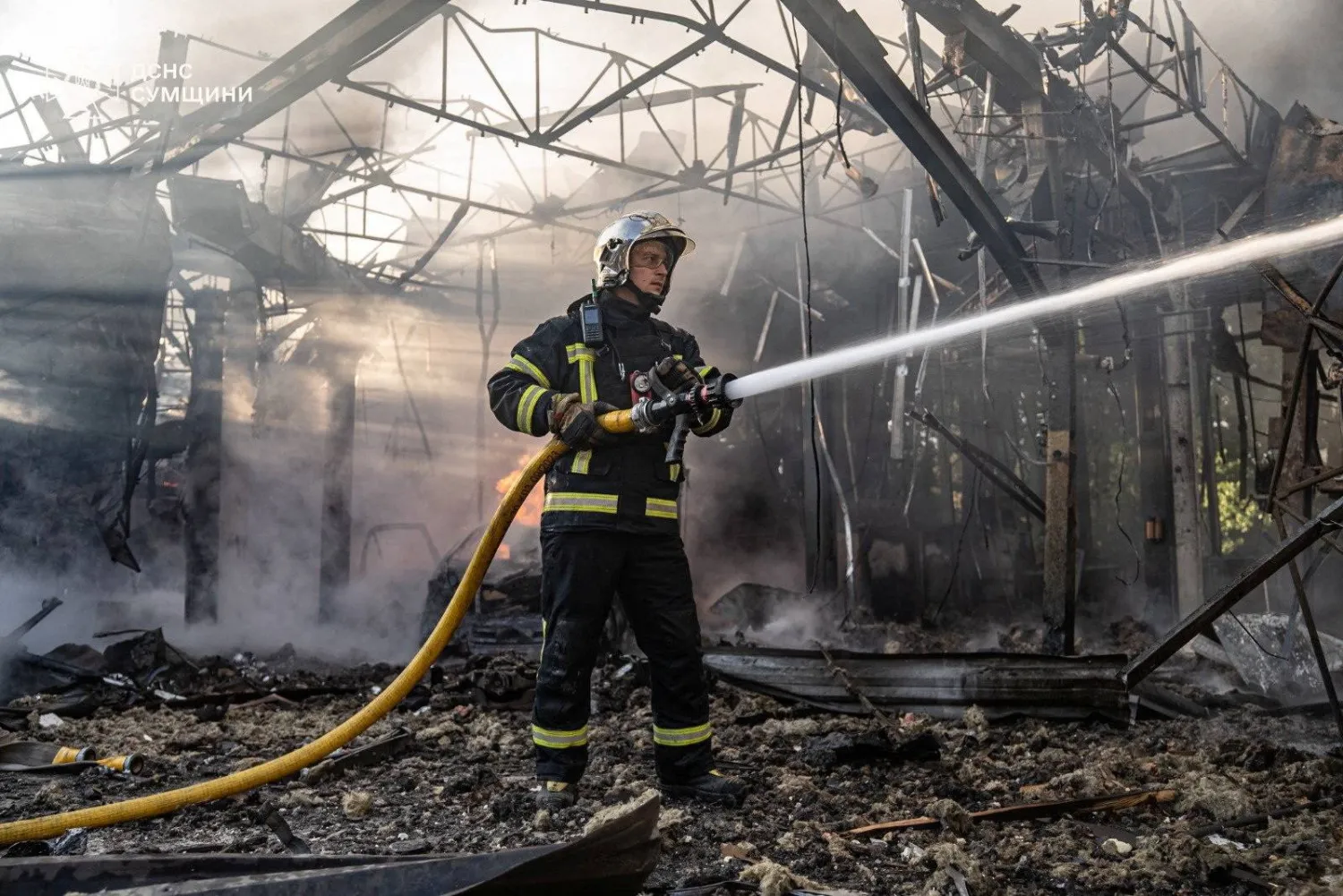
A firefighter works at the site of a Russian drone strike, amid Russia's attack on Ukraine, in Sumy, Ukraine, in this handout picture released September 12, 2025. Press service of the State Emergency Service of Ukraine in Sumy region/Handout via REUTERS
TT

EU Extends Sanctions on Individuals Linked to Russia's War in Ukraine

A firefighter works at the site of a Russian drone strike, amid Russia's attack on Ukraine, in Sumy, Ukraine, in this handout picture released September 12, 2025. Press service of the State Emergency Service of Ukraine in Sumy region/Handout via REUTERS

The European Union's member states agreed on Friday to extend sanctions on individuals related to Russia's war in Ukraine for another six months, Denmark acting as holder of the bloc's rotating presidency said in a post on X.

EU has listed over 2,500 entities and individuals as part of its Russia sanctions, which freezes bank accounts and bans travel into the EU. The rollover has sometimes been a fraught process with Hungary frequently making demands for delistings. In this instance, there were no political delistings, diplomats said.

Member states must unanimously agree to renew sanctions every six months. The EU uses two main sanctions frameworks against Moscow: one which targets a list of people and companies, and another comprising measures against sectors, such as a price cap on Russia's oil and the immobilization of its central bank's assets.

Also, Britain announced fresh sanctions against Russia, targeting military weapons, equipment suppliers and its shadow fleet as UK Foreign Secretary Yvette Cooper visited Kyiv.

Security analysts say Russia's so-called "shadow fleet" of aging vessels is used by Moscow to circumvent international sanctions that ban it from selling oil.

"The UK continues to lead the charge against the shadow fleet carrying Russian oil exports. Today, 70 more ships in the fleet have been sanctioned. The UK has now targeted more oil tankers than any other country," the foreign ministry said in a statement.

The fresh round of sanctions also hits 30 firms and individuals "propping up Russia's war machine by supplying key equipment such as electronics, chemicals and explosives used to manufacture missiles and other weapons systems,” it added.



Iran’s Revolutionary Guards Media Accuse Rouhani of ‘Serving Israel’

03 December 2025, Iran, Teheran: View of the smog-ridden metropolis of Tehran. Photo: Aref Taherkenareh/dpa
TT

Iran’s Revolutionary Guards Media Accuse Rouhani of ‘Serving Israel’

03 December 2025, Iran, Teheran: View of the smog-ridden metropolis of Tehran. Photo: Aref Taherkenareh/dpa

Media outlets aligned with Iran’s Revolutionary Guards have accused former president Hassan Rouhani and his associates of “doing Israel a service,” escalating a political backlash triggered by Rouhani’s recent criticism of Iran’s ability to defend its airspace if last June’s 12-day war with Israel were to resume.

Tasnim, the Guards’ main media arm, protested sharply against Rouhani’s latest speech and the recommendations he offered to prevent a repeat of the conflict.

The media attack coincided with rising political tensions inside Iran as Rouhani’s name resurfaced in the debate over who might succeed Supreme Leader Ali Khamenei, a succession file that has deepened domestic polarization.

Tasnim opened its weekly analytical supplement with the headline “Working for Israel,” placing Rouhani’s photograph on the cover. It accused him of offering “narcissistic, arrogance-filled interpretations” about his claims that he prevented a war on Iran through diplomacy during his past government roles.

The agency questioned whether Rouhani was suggesting that Iran had no deterrent other than his negotiations, and whether the United States and Israel were at full strength at the time while Iran lacked defensive capability.

It further asked why Rouhani’s diplomacy failed to prevent the US withdrawal from the nuclear agreement under Donald Trump or avert the assassinations of General Qassem Soleimani and Mohsen Fakhrizadeh, the senior nuclear official killed in late 2020 in an attack attributed to Israel.

Rouhani last week criticized the country’s tightened security climate, saying Iran needed “an atmosphere of safety, not an atmosphere of securitization.”

He warned that Iran could not remain in a state of “no war and no peace,” citing Khamenei’s own remarks, and urged efforts to rebuild deterrence across multiple fields to confront what he called “the conspiracies of enemies.”

He argued that Iran today lacks “broad regional deterrence,” noting that the airspace of neighboring countries, including Iraq, Syria, Lebanon and Jordan, had fallen under US and Israeli influence, making hostile aerial movement near Iran “safe and free of obstacles.”

Rouhani insisted continuation of the nuclear deal would have prevented the 12-day conflict, calling the nuclear file a pretext for the attacks and blaming subsequent governments for failing to revive the accord.

Tasnim said Rouhani’s positions “practically serve Israel” because they place responsibility on internal actors while removing Israel from the circle of blame. It portrayed his comments as a political act against “sacred unity,” adding that presenting such views “even within a realistic and careful framework” ultimately benefits Israel.

Tasnim also revived long-standing criticism that Rouhani’s government did not sufficiently support Iran’s intervention in Syria in 2013 and 2014, arguing that such reluctance approached “the level of treason.” It claimed one of General Soleimani’s biggest grievances was the administration’s lack of cooperation on the Syrian front.

Responding to Rouhani’s remarks on “securitization,” Tasnim said his own administration had been among the most security-dominated of the Islamic Republic era. The agency pointed to Rouhani’s intelligence background and argued that his current counsel contradicted his record in office.

Rouhani’s comments were also interpreted as an indirect response to Khamenei’s November 27 televised speech, in which the Supreme Leader warned against internal division, repeated his narrative that the US and Israel had “failed” to achieve their war aims and urged Iranians to maintain “national alignment.”

The renewed criticism comes as Rouhani has faced months of attacks from rivals, including parliamentarians, who accuse him of positioning himself to assume the role of Supreme Leader should Khamenei become unable to carry out his duties, including in the event of an Israeli assassination attempt.

Last month, parliament speaker Mohammad Bagher Ghalibaf accused Rouhani and former foreign minister Mohammad Javad Zarif of damaging Iran’s strategic ties with Russia.

Hardline lawmakers revived the chant “Death to Fereydoun,” using Rouhani’s birth family name. One conservative MP said the judiciary should address Rouhani’s “misconduct” so that anyone aspiring to senior posts would “return to his rightful place behind bars.”

After Rouhani’s latest remarks circulated, discussion of his possible leadership prospects reemerged, this time in reformist media.

Reformist theorist Sadegh Zibakalam said Rouhani believes he lacks nothing compared to other succession candidates, including Mojtaba Khamenei, arguing that Rouhani’s executive experience makes him “more qualified than others.”

At the same time, businessman Babak Zanjani, who was sentenced to death for corruption during Rouhani’s presidency but released last year, made a harsh post on X rejecting any future political role for Rouhani.

Iran, he wrote, needed a “young, educated and effective” force, “not holders of fake degrees,” warning that “we will cleanse Iran of incompetence.”


Iran Holds Massive Drills in Gulf

A handout photo made available on 05 December 2025 by the Iranian Revolutionary Guard Corps (IRGC) shows a missile being launched during a military drill in the waters off southern Iran coast. EPA/IRGC HANDOUT
TT

Iran Holds Massive Drills in Gulf

A handout photo made available on 05 December 2025 by the Iranian Revolutionary Guard Corps (IRGC) shows a missile being launched during a military drill in the waters off southern Iran coast. EPA/IRGC HANDOUT

Iran launched massive missiles in the Sea of Oman and near the strategic Strait of Hormuz during the second day of a naval drill, state TV reported Friday.

The report said the Revolutionary Guard launched the missiles from the depth of Iran's mainland, hitting targets in the Oman Sea and neighboring area near Strait of Hormuz in a drill that began on Thursday.

It identified the missiles as cruise Qadr-110, Qadr-380 and Ghadir that have a range of up to 2,000 kilometers. It said the Guard also launched a ballistic missile identified as 303, without elaborating.

The drill is the second one following the Israel-Iran war in June that killed nearly 1,100 people in Iran, including military commanders and nuclear scientists. Missile attacks by Iran killed 28 in Israel.

Earlier, Iran hosted an anti-terrorism drill in its northwestern province of East Azerbaijan with members of the Shanghai Cooperation Organization, which, according to state Press TV, was intended to signal both “peace and friendship” to neighboring states and warn enemies that “any miscalculation would meet a decisive response.”

The SCO, a Eurasian security and economic bloc founded in 2001 to combat terrorism, separatism and extremism, often conducts joint military exercises among its members.

The organization includes China, Russia, India, Pakistan, and several Central Asian countries, with observer and dialogue partners such as Iran, Saudi Arabia and others participating in selected operations.


Taiwan Says China Deploys Warships in ‘Military Operations’

A Chinese PLA navy ship monitors an area during a maritime cooperative activity between the Philippines, Australia and Canadian navy near Scarborough Shoal in the disputed South China Sea on Sep 3, 2025. (AFP)
TT

Taiwan Says China Deploys Warships in ‘Military Operations’

A Chinese PLA navy ship monitors an area during a maritime cooperative activity between the Philippines, Australia and Canadian navy near Scarborough Shoal in the disputed South China Sea on Sep 3, 2025. (AFP)

Taiwan said Friday that China had deployed warships for “military operations” stretching hundreds of kilometers from the Yellow Sea to the South China Sea, posing a “threat” to the region.

Beijing, which claims self-ruled Taiwan as part of its territory, neither confirmed nor denied the maneuvers.

Taiwan’s defense ministry and other security agencies were monitoring China’s activities and had a “complete grasp of the situation,” presidential office spokeswoman Karen Kuo told reporters.

She did not say how many Chinese ships were involved in the deployment, but a security source told AFP the number was “significant.” The source spoke on condition of anonymity because they were not authorized to speak to the media.

The operations were not limited to the Taiwan Strait, but extended from the southern Yellow Sea, to the East China Sea near the disputed Diaoyu Islands and on into the South China Sea and even the Western Pacific, Kuo said.

“This indeed poses a threat and impact on the Indo-Pacific and the entire region,” she said.

Taiwan urged China to “exercise restraint,” Kuo said, adding: “We are also confident that we can handle this matter well.”

Neither China’s armed forces nor state media have announced any increased military activity in the region where Taiwan said Chinese ships had been detected.

Beijing’s defense ministry spokesman Jiang Bin said Friday that the navy’s training on the high seas complies with international law and “is not directed at any specific country or target.”

He was responding to a question about a Chinese naval flotilla that reportedly may be heading toward Australia.

A spokesman for China’s foreign ministry said Beijing “has consistently followed a defensive policy” and urged “relevant parties” not to “overreact or... engage in groundless hype.”

China has refused to rule out using force to take Taiwan, and also contentiously claims sovereignty over nearly all of the South China Sea.

Taiwan’s intelligence chief Tsai Ming-yen said Wednesday that October to December was the “peak season” for China’s “annual evaluation exercises.”

There was a possibility that China’s ruling Communist Party could turn seemingly routine military activities into drills targeting Taiwan, Tsai warned.

Last December, Taiwan said about 90 Chinese warships and coast guard vessels took part in vast exercises including simulating attacks on foreign ships and practicing blockading sea routes in Beijing’s biggest maritime drills in years.

Beijing did not confirm the drills at that time.

The United States has historically been Taiwan’s main security backer.

But President Donald Trump’s administration signaled a potential shift in that policy on Friday, saying in a strategy document that its Asian allies Japan and South Korea should take on more of the burden of defending the region.