
Iraq's Yazidis Rediscover Lost History through Photos Found in a Museum Archive

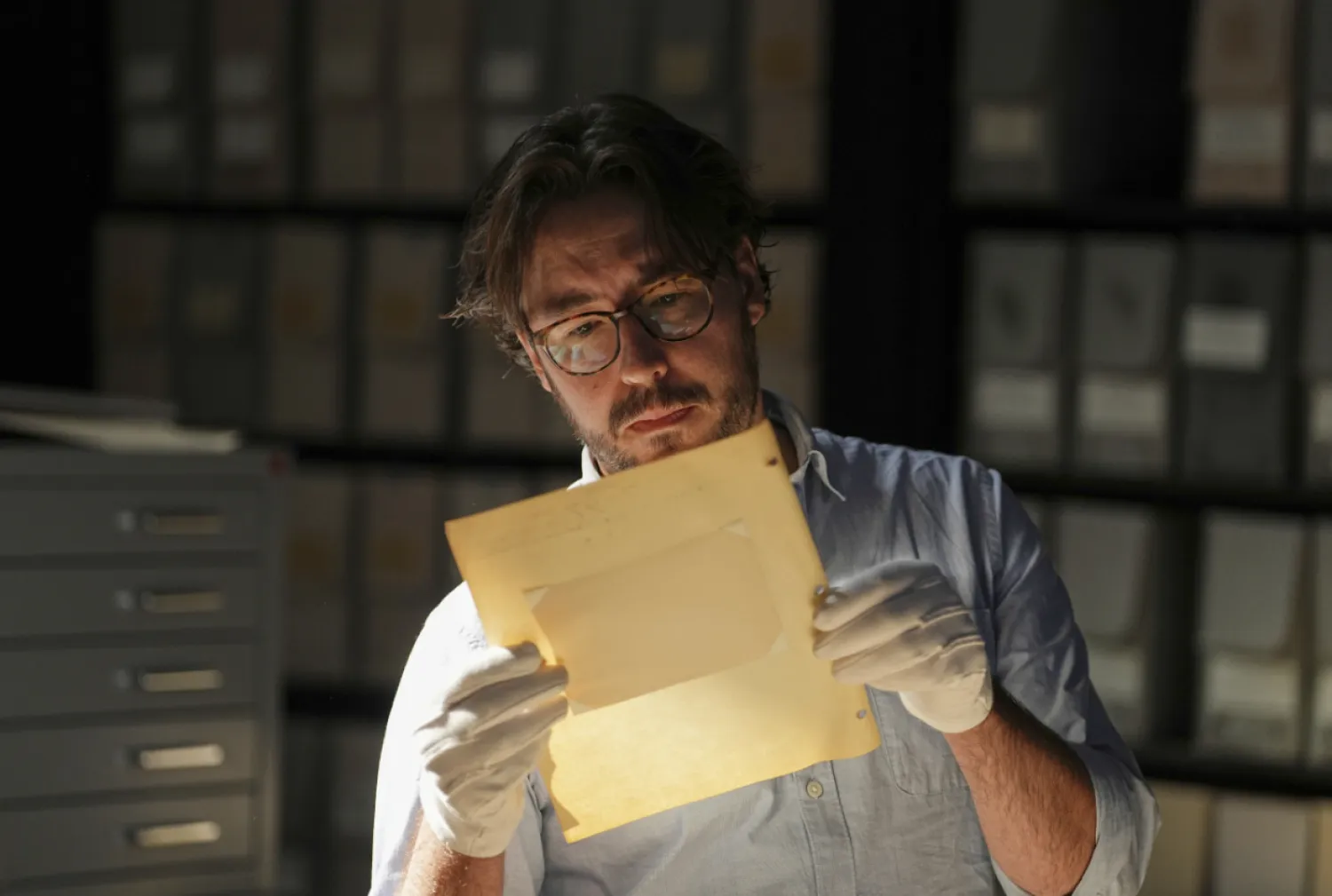
University of Victoria postdoctoral fellow Nathaniel Brunt views an image from a collection of photos of the Yazidi people in their northern Iraq homeland in the 1930s, during an interview at the Penn Museum Archives in Philadelphia, Aug. 27, 2025. (AP Photo/Matt Rourke)
TT

Iraq's Yazidis Rediscover Lost History through Photos Found in a Museum Archive

University of Victoria postdoctoral fellow Nathaniel Brunt views an image from a collection of photos of the Yazidi people in their northern Iraq homeland in the 1930s, during an interview at the Penn Museum Archives in Philadelphia, Aug. 27, 2025. (AP Photo/Matt Rourke)

Archeologists studying ancient civilizations in northern Iraq during the 1930s also befriended the nearby Yazidi community, documenting their daily lives in photographs that were rediscovered after the ISIS terrorist group devastated the tiny religious minority.

The black-and-white images ended up scattered among the 2,000 or so photographs from the excavation kept at the University of Pennsylvania Museum of Archaeology and Anthropology, which led the ambitious dig, The AP news reported.

One photo — a Yazidi shrine — caught the eye of Penn doctoral student Marc Marin Webb in 2022, nearly a decade after it was destroyed by ISIS extremists plundering the region. Webb and others began scouring museum files and gathered almost 300 photos to create a visual archive of the Yazidi people, one of Iraq's oldest religious minorities.

The systematic attacks, which the United Nations called a genocide, killed thousands of Yazidis and sent thousands more into exile or sexual slavery. It also destroyed much of their built heritage and cultural history, and the small community has since become splintered around the world.

Ansam Basher, now a teacher in England, was overwhelmed with emotion when she saw the photos, particularly a batch from her grandparents' wedding day in the early 1930s.

“No one would imagine that a person my age would lose their history because of the ISIS attack,” said the 43-year-old, using an acronym for the extremist group. Basher's grandfather lived with her family while she was growing up in Bashiqa, a town outside Mosul. The city fell to ISIS in 2014.

“My albums, my childhood photos, all videos, my two brothers' wedding videos (and) photos, disappeared. And now to see that my grandfather and great-grandfather’s photo all of a sudden just come to life again, this is something I'm really happy about,” she said. “Everybody is.”

A cache of cultural memory The archive documents Yazidi people, places and traditions that ISIS sought to erase. Marin Webb is working with Nathaniel Brunt, a Toronto documentarian, to share it with the community, both through exhibits in the region and in digital form with the Yazidi diaspora.

“When they came to Sinjar, they went around and destroyed all the religious and heritage sites, so these photographs in themselves present a very strong resistance against that act of destruction,” said Brunt, a postdoctoral student at the University of Victoria Libraries. The city of Sinjar is the ancestral homeland of the Yazidis near the Syrian border.

The first exhibits took place in the region in April, when Yazidis gather to celebrate the New Year. Some were held outdoors in the very areas the photos documented nearly a century earlier.

“(It) was perceived as a beautiful way to bring memory back, a memory that was directly threatened through the ethnic cleansing campaign,” Marin Webb said.

Basher’s brother was visiting their hometown from Germany when he saw the exhibit and recognized his grandparents. That helped the researchers fill in some blanks.

The wedding photos show an elaborately dressed bride as she stands anxiously in the doorway of her home, proceeds with her dowry to her husband’s village, and finally enters his family home as a crowd looks on.

“I see my sister in black and white,” said Basher, noting the similar green eyes and skin tone her sister shares with their grandmother, Naama Sulayman.

Her grandfather, Bashir Sadiq Rashid al-Rashidani, came from a prominent family and often hosted the Penn archaeology crews at his cafe. He and his brother, like other local men, also worked on the excavations, prompting him to invite the westerners to his wedding. They in turn took the photos and even lent the couple a car for the occasion, the family said.

Some of the photos were taken by Ephraim Avigdor Speiser, the Penn Museum archaeologist who led excavations at two ancient Mesopotamian sites in the area, Tepe Gawra and Tell Billa.

“My grandfather used to talk a lot about that time,” said Basher, who uses a different spelling of the family surname than other relatives.

Her father, Mohsin Bashir Sadiq, 77, a retired teacher now living in Cologne, Germany, believes the wedding was the first time anyone in the town used a car, which he described as a 1927 model. It can be seen at the back of the wedding procession.

Basher has shared the photos on social media to educate people about her homeland.

“The idea or the picture they have in their mind about Iraq is so different from the reality, ” she said. “We’ve been suffering a lot, but we still have some history.”

Found photos, history awakened Other photos in the collection show people at home, at work, at religious gatherings.

To Marin Webb, an architect from Barcelona, they show the Yazidis as they lived, instead of equating them with the violence they later endured. Locals who saw the exhibit told him it “shows the world that we’re also people.”

Basher is grateful the photos remained safe — if largely out of sight — at the museum all this time. Alessandro Pezzati, the museum's senior archivist, was one of several people who helped Marin Webb comb through the files to identify them.

“A lot of these collections are sleeping until they get woken up by people like him,” Pezzati said.
Cultural Development Fund Highlights Economic Value of Saudi Culture in Davos

The Cultural Development Fund (CDF) logo
TT

Cultural Development Fund Highlights Economic Value of Saudi Culture in Davos

The Cultural Development Fund (CDF) logo

The Cultural Development Fund (CDF) is participating in the Saudi House pavilion initiative, led by the Ministry of Economy and Planning, during the Annual Meeting of the World Economic Forum 2026, held in Davos, Switzerland, from January 19 to 23.

Through this participation, CDF aims to showcase the economic value of Saudi culture, highlight its role in diversifying the national economy and enhancing quality of life, attract international investment in the cultural sector, and spotlight Saudi cultural entrepreneurship.

According to a statement from the fund, the CDF’s participation includes a networking breakfast bringing together global economic leaders and investors from various countries, with the aim of raising awareness of Saudi culture as an economic force and a key pillar of Saudi Vision 2030.

The event will also provide a platform for exchanging perspectives and opportunities with international investors and financial institutions, while offering a closer look at the enablers of the Saudi cultural sector and its investment opportunities.

As part of the event, the CDF will host a panel discussion titled “Investing in Culture as an Economic Engine” that will feature CEO of the Cultural Development Fund Majed bin Abdulmohsen Al-Hugail, alongside Deputy Minister of Cultural Strategies and Policies at the Ministry of Culture Albara Al-Auhali.

The discussion will address the economic value of culture globally and locally, highlighting the CDF’s role in providing financial solutions that support cultural enterprises and enable their contribution to GDP growth and quality of life. The session will also explore cultural policies and their impact on strengthening the sector’s economic and investment potential.

Within the NextOn dialogue series organized by the Saudi House in Davos, the Cultural Development Fund will enable supported cultural projects to share their success stories and highlight their role in enhancing cultural production and increasing its economic value.

Participating entrepreneurs include Co-Founder of AlMashtal Creative Incubator Princess Noura bint Saud bin Naif, and CEO of Arabian Housing and Building company (AHB) Khalid Henaidy, who will speak about the role of entrepreneurship in shaping the future of the Kingdom’s cultural economy.

‏This participation underscores the CDF’s role as a center of excellence and financial enabler for the cultural sector in the Kingdom, and forms part of its efforts to strengthen the presence of Saudi cultural dynamism on the global stage. It aligns with the CDF’s objectives to maximize the cultural sector’s economic and social impact, increase its contribution to GDP, quality of life, and advance the goals of Saudi Vision 2030.


Red Sea Museum Signs Cooperation Agreement to Support Artisans and Designers

The cooperation agreement aims to support local and regional artisans and designers. SPA
TT

Red Sea Museum Signs Cooperation Agreement to Support Artisans and Designers

The cooperation agreement aims to support local and regional artisans and designers. SPA

Saudi Arabia’s Museums Commission announced the signing of a cooperation agreement between the Red Sea Museum and Ahmed Angawi Studio to launch the "Made in the Red Sea" initiative at the Red Sea Museum in the heart of Historic Jeddah, aiming to support local and regional artisans and designers.

The initiative aims to preserve traditional skills and develop contemporary products inspired by the rich heritage, traditions and the tangible and intangible culture of the Red Sea region, for sale at the museum gift shop.

It builds on the momentum of the Saudi Ministry of Culture's Year of Handicrafts 2025 initiative launched to reinforce pride in national identity and support artisans, as one of the goals of the National Culture Strategy.

The partnership includes content development, the delivery of workshops and the selection of participating artists and artisans, in addition to promoting the "Made in the Red Sea" initiative and overseeing specialized workshops in traditional wood designs inspired by the historic Bab Al Bunt building, which now houses the Red Sea Museum. These efforts contribute to a contemporary reinterpretation of its architectural elements.


Saudi Arabia Participates in Cairo International Book Fair 2026

Saudi Arabia Participates in Cairo International Book Fair 2026
TT

Saudi Arabia Participates in Cairo International Book Fair 2026

Saudi Arabia Participates in Cairo International Book Fair 2026

The Literature, Publishing and Translation Commission will lead the Kingdom’s participation in the 57th edition of the Cairo International Book Fair 2026 taking place from January 21 until February 3.

CEO of the Literature, Publishing and Translation Commission Abdullatif Alwasel stated that this participation is an extension of the commission’s ongoing efforts to enhance the Kingdom’s cultural and literary presence at the regional and international levels and to introduce Saudi cultural heritage, while underscoring the Kingdom’s role in leading the global cultural landscape.

He noted that the commission has mobilized its capabilities to support the participation of Saudi publishing houses in book fairs both within and outside the Kingdom, while also working to attract international publishers to participate in Saudi book fairs by building new partnerships and strengthening channels of cultural cooperation.

The Kingdom’s participation in the fair, which is organized by the General Egyptian Book Organization, aims to strengthen cultural relations and knowledge exchange between the Kingdom and Egypt, enhance cooperation in the fields of literature, publishing, and translation, support and promote Saudi publishing houses and literary agencies internationally, and raise awareness of Saudi cultural heritage in global forums.