


Bulgarian Mussel Farmers Face Risk, and Chance, in Hotter Sea

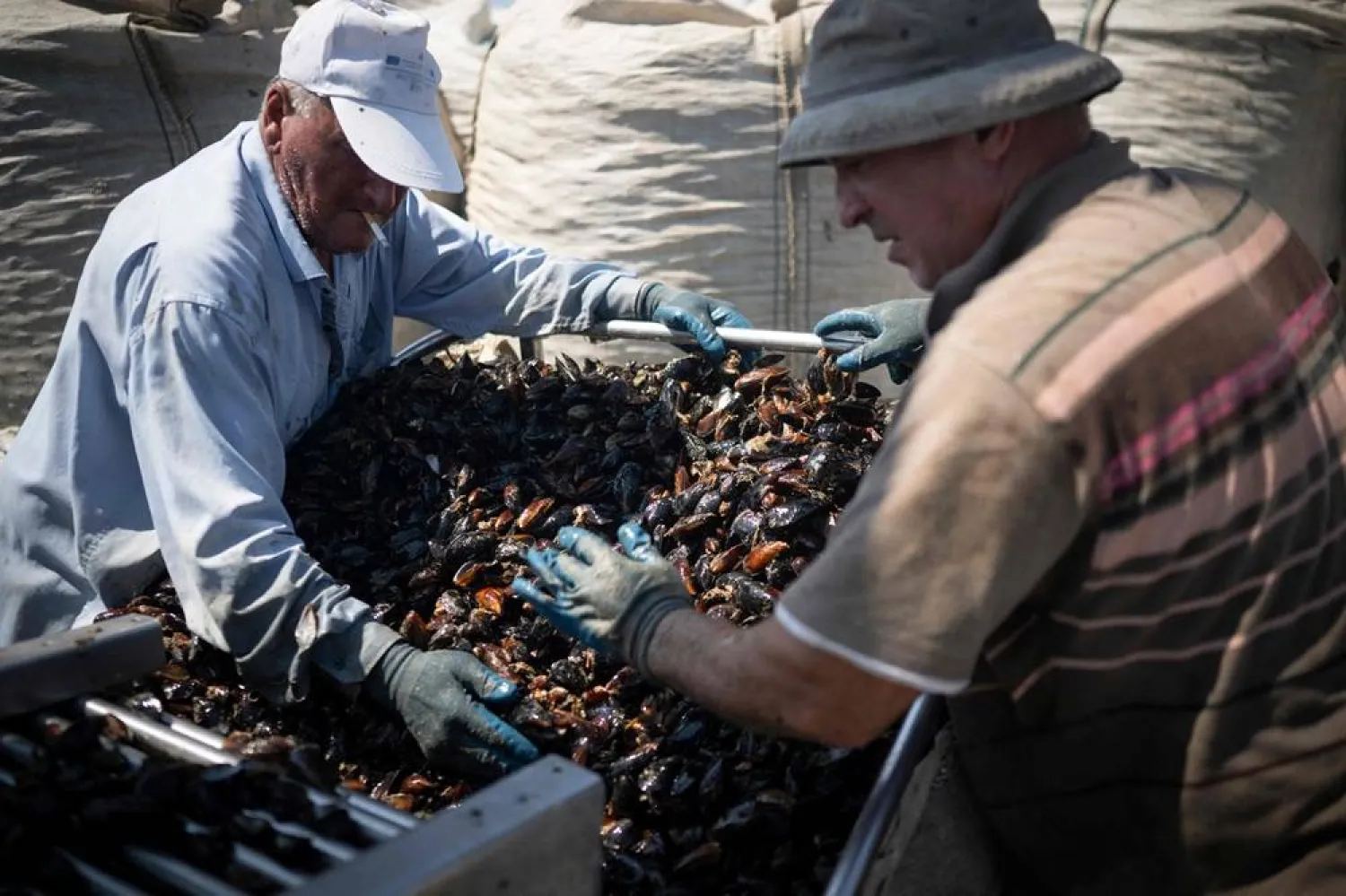
Harvesters sort mussels on a conveyor line of a harvesting ship during a mussel collection near Cape Kaliakra, in the northern Bulgarian Black Sea Coast on August 18, 2025. (AFP)
TT

Bulgarian Mussel Farmers Face Risk, and Chance, in Hotter Sea

Harvesters sort mussels on a conveyor line of a harvesting ship during a mussel collection near Cape Kaliakra, in the northern Bulgarian Black Sea Coast on August 18, 2025. (AFP)

Faced with rising Black Sea temperatures that suffocate his mussels, Bulgarian farmer Nayden Stanev has been forced to change his ways -- shifting his seeding schedule and harvesting at cooler depths.

Yet Stanev, a 56-year-old former marine commando, sees the fallout from climate change as both a threat and opportunity for his business.

As bad as it is for Bulgaria's mussel farmers, their peers in the Mediterranean Sea have had to deal with even higher water temperatures.

"We are better off," Stanev told AFP.

Though the Balkan EU member still trails far behind major Mediterranean mussel producers such as Spain and Italy, it has taken the lead in the Black Sea.

And it is less affected by marine heat waves, which have led to a sharp decline in Europe's mussel crop, according to experts.

But the warmer waters are still a threat to Black Sea mussel farmers.

"About 20 percent of the mussels didn't survive" this year, Stanev said gravely, as empty shells piled up on deck of his old diesel boat.

"Last year, it was a massacre -- 80 percent wiped out. The mussels literally suffocate in a sea that warms too fast," he added.

Scientists say climate change is making marine heatwaves more frequent and powerful, and the Mediterranean region is warming faster than the global average.

In July, the average surface temperature of the Mediterranean Sea was 26.79C, the hottest ever for that month, according to research center Mercator Ocean International.

During the same period, the average surface temperature in the Black Sea was 25.46C -- less than in the Mediterranean, though it is also warming.

"When temperatures approach or exceed about 26C -- a threshold associated with mass mussel mortalities -- for extended periods during peak market seasons, it creates disruptions in the supply chain," John Theodorou, an expert at the University of Patras in Greece, told AFP.

In the Black Sea, the surface temperature has risen by nearly two degrees in two years, according to Radoslava Bekova from the Institute of Oceanology at the Bulgarian Academy of Sciences.

"The sea is undergoing lasting changes," she told AFP.

She added prolonged warming periods, when the sea doesn't have time to cool down, weaken the mussels, making them more vulnerable to diseases.

Together with his six employees, Bulgaria pioneer Stanev is on deck at dawn to harvest and deliver his mussels, with the season reaching its peak at the end of August.

He set up his business more than 20 years ago in the bay of Cape Kaliakra, a prime location protected from currents.

His phone ringing incessantly, Stanev jots down the orders on a small notebook.

On this day, he has to deliver no fewer than 10 tons of mussels to cater to the demand of hundreds of restaurants and vendors in Bulgaria and neighboring Romania.

After a short trip from shore, the crew reaches the 200-hectare mussel farm.

Black buoys float on the surface, with long tubular nets holding the shells attached to them.

The men work in silence with synchronized gestures: one pulls the nets out of the water, another cleans them and a third sorts the shells.

Mussel bags pile up, each containing about 800 kilograms, as cormorants scout for leftovers.

When the boat returns to the quay in the early afternoon, several refrigerated trucks are already waiting, along with villagers with empty buckets, eager to buy fresh mussels for their families.

While global production has continued to grow, it has been declining in the EU since 2018, according to data from the European Market Observatory for Fisheries and Aquaculture Products (EUMOFA).

About 356,500 tons of mussels were harvested in the EU in 2023 -- about 21 percent fewer than in 2018, according to EUMOFA data.

Spain led with 155,700 tons followed by Italy with 57,279 tons -- by comparison, Bulgaria accounted for about 1,100 tons.

While European production fell over that period, their value increased almost 50 percent, standing at roughly 463 million euros in 2023.

"This value gap has created opportunities for Black Sea mussel production," Theodorou said.


Nepal Halts Search after Guide Killed, Iranian Climber Missing

A tourist looks at a view of Mt. Everest from the hills of Syangboche in Nepal December 3, 2009. REUTERS/Gopal Chitrakar
TT

Nepal Halts Search after Guide Killed, Iranian Climber Missing

A tourist looks at a view of Mt. Everest from the hills of Syangboche in Nepal December 3, 2009. REUTERS/Gopal Chitrakar

Bad weather forced Nepali rescuers to suspend the search Monday for an Iranian climber missing for four days after an accident which killed a Nepali team member, expedition organizers said.

Extreme conditions, including fierce winds, made rescue efforts impossible on the 8,481-meter (27,825-feet) high Mount Makalu, the world's fifth highest mountain.

Iranian climber Abolfazl Gozali, 42, and Nepali guide Phurba Ongel Sherpa, 44, were part of a rare winter expedition on the peak.

The four-member team successfully summited on Thursday, but during the descent the guide fell to his death.

Team lead Sanu Sherpa, who has climbed all 14 highest peaks in the world at least twice, and Lakpa Rinji Sherpa went to his aid but found that he had fallen hundreds of meters and did not survive.

When they returned to where they had left Gozali, he was no longer there.

"A team of eight experienced climbers have been sent but the wind has been very strong and affected the search," Madan Lamsal of expedition organizer Makalu Adventure told AFP.

"We hope to resume soon."

Lamsal said the rescuers intend to find Gozali, as well as recover the guide's body.

Phurba Ongel Sherpa was a highly experienced mountaineering guide with multiple summits of Everest and other major peaks.

Gozali is also an accomplished climber, who has climbed two of world's highest peaks and completed the "snow-leopard peaks" -- the five mountains of over 7,000 meters between Tajikistan and Kyrgyzstan.

This was his second attempt to summit Makalu in winter. Last year, freezing temperatures and high winds forced the team to turn back, just 800 meters short of the summit.

Nepal is home to eight of the world's 10 highest peaks, including Mount Everest, and welcomes hundreds of climbers every year during the spring and autumn climbing seasons.

Dangerous terrain and extreme weather can make winter expeditions particularly risky.


Shark Mauls Surfer in Sydney, 3rd Attack in Two Days

People stand next to warning signs in place, and beaches are closed after a surfer suffered a shark attack at Dee Why Beach in Sydney, Australia, January 19, 2026. REUTERS/Jeremy Piper
TT

Shark Mauls Surfer in Sydney, 3rd Attack in Two Days

People stand next to warning signs in place, and beaches are closed after a surfer suffered a shark attack at Dee Why Beach in Sydney, Australia, January 19, 2026. REUTERS/Jeremy Piper

A shark mauled a surfer off an ocean beach in Sydney on Monday in the Australian city's third shark attack in two days, authorities said.

The surfer, believed to be in his 20s, was in a critical condition in hospital with serious leg injuries after the attack at a northern Sydney beach, police said.

"The man was pulled from the water by members of the public who commenced first aid before the arrival of emergency services," New South Wales state police said in a statement.

All of Sydney's northern beaches were closed until further notice.

The attack at North Steyne Beach in the suburb of Manly came hours after a shark bit a large chunk out of a young surfer's board about 4 kilometers (2.5 miles) north along the coast at Dee Why Point.

That surfer, reportedly a boy aged about 11, was uninjured but the beach was closed immediately, AFP reported.

On Sunday, a large shark bit a 12-year-old boy in the legs as he played with friends at a beach in Sydney harbor, leaving him fighting for survival in hospital.

The boy and his friends were jumping from a six-meter (20-foot) rock into the water off Shark Beach in the eastern suburb of Vaucluse when the predator struck, police said.

"It was a horrendous scene at the time when police attended. We believe it was something like a bull shark that attacked the lower limbs of that boy," said Superintendent Joseph McNulty, New South Wales marine area police commander.

"That boy is fighting for his life now," he told reporters on Monday.

Recent heavy rain had drained into the harbor, and authorities believed the combination of the brackish seawater and the children's splashing created a "perfect storm" for a shark attack, McNulty said.

He warned people not to go swimming in the harbor or other river systems in New South Wales because of the risks.

He praised the boy's "brave" young friends for pulling him out of the water on Sunday.

Officers put the unconscious child in a police boat and gave him first aid, applying two tourniquets to stem the bleeding from his legs, McNulty said.

They tried to resuscitate the boy as they sped across the harbor to a wharf where ambulance paramedics were waiting.

The child, confirmed by police to be 12 years old, was in intensive care at Sydney Children's Hospital surrounded by family and friends, McNulty said.


China’s Population Falls Again as Births Drop to Lowest Rate Since 1949 Communist Revolution

 Women push baby strollers as they walk along a street in Beijing on January 4, 2026. (AFP)
Women push baby strollers as they walk along a street in Beijing on January 4, 2026. (AFP)
TT

China’s Population Falls Again as Births Drop to Lowest Rate Since 1949 Communist Revolution

 Women push baby strollers as they walk along a street in Beijing on January 4, 2026. (AFP)
Women push baby strollers as they walk along a street in Beijing on January 4, 2026. (AFP)

How do you persuade a population to have more babies after generations of limiting families to just one?

A decade after ending China's longtime one-child policy, authorities are pushing a range of ideas and policies to try and encourage more births — tactics that range from cash subsidies to taxing condoms to eliminating a tax on matchmakers and day care centers.

The efforts haven't paid off yet. At least, that's what population figures released Monday show for what is now the world's second-most populous nation. China's population of 1.4 billion continued to shrink, marking the fourth straight year of decrease, new government statistics show. The total population in 2025 stood at 1.404 billion, which was 3 million less than the previous year.

Measured another way, the birth rate in 2025 is the lowest on record since 1949, the year that Mao Zedong’s Communists overthrew the Nationalists and began running China. Figures before that, under the previous Nationalist government, were not available. The rate of 5.63% is the number of births per 1,000 people.

China was long the world’s most populous nation until 2023, when it was surpassed by regional neighbor and sometime rival India. Monday's statistics illustrate the stark demographic pressures faced by the country as it tries to pivot from a problem it is working hard to overcome: status as a nation with a growing but transitional economy that, as is often said, is “getting old before it gets rich.”

Is a snake involved? The number of new babies born was just 7.92 million in 2025, a decline of 1.62 million, or 17%. The latest birth numbers show that the slight tick upwards in 2024 was not a lasting trend. Births declined for seven years in a row through 2023.

Most families cite the costs and pressure of raising a child in a highly competitive society as significant hurdles that now loom larger in the face of an economic downturn that has impacted households struggling to meet their living costs. Another potential factor in the numbers: last year in China was the year of the snake, considered one of the least favored years for having a child under the Chinese zodiac.

Like many other countries in Asia, China has faced a declining fertility rate, or the average number of babies a woman is expected to have in her lifetime. While the government does not regularly publish a fertility rate, last saying it was 1.3 in 2020, experts have estimated it is now around 1. Both figures are far below the 2.1 rate that would maintain the size of China's population.

For decades, the Chinese government barred people from having more than one baby and often sanctioned those who did — a policy that produced more than two generations of only children. In 2015, the government raised the permitted amount of offspring to two and then, facing demographic pressure, further revised the limit to three kids in 2021.

The push for more births is about the economy. China now has 323 million people over 60, or 23% of the entire population. That number has continued to rise, while the working-age population is shrinking, meaning there are fewer workers to support the older population.

This demographic shift is happening while China is in the process of trying to transition away from labor-intensive industries like farming and manufacturing into a consumer-driven economy built with high-tech manufacturing. The difficulty is in trying to get richer as a country, while this population shift likely means a slowing economy.

Officials have had limited success with policy changes to incentivize families to have more children. In July, the government announced cash subsidies of 3,600 yuan ($500) per child to families.
