


Report: Rising Oceans to Threaten 1.5 Million Australians by 2050

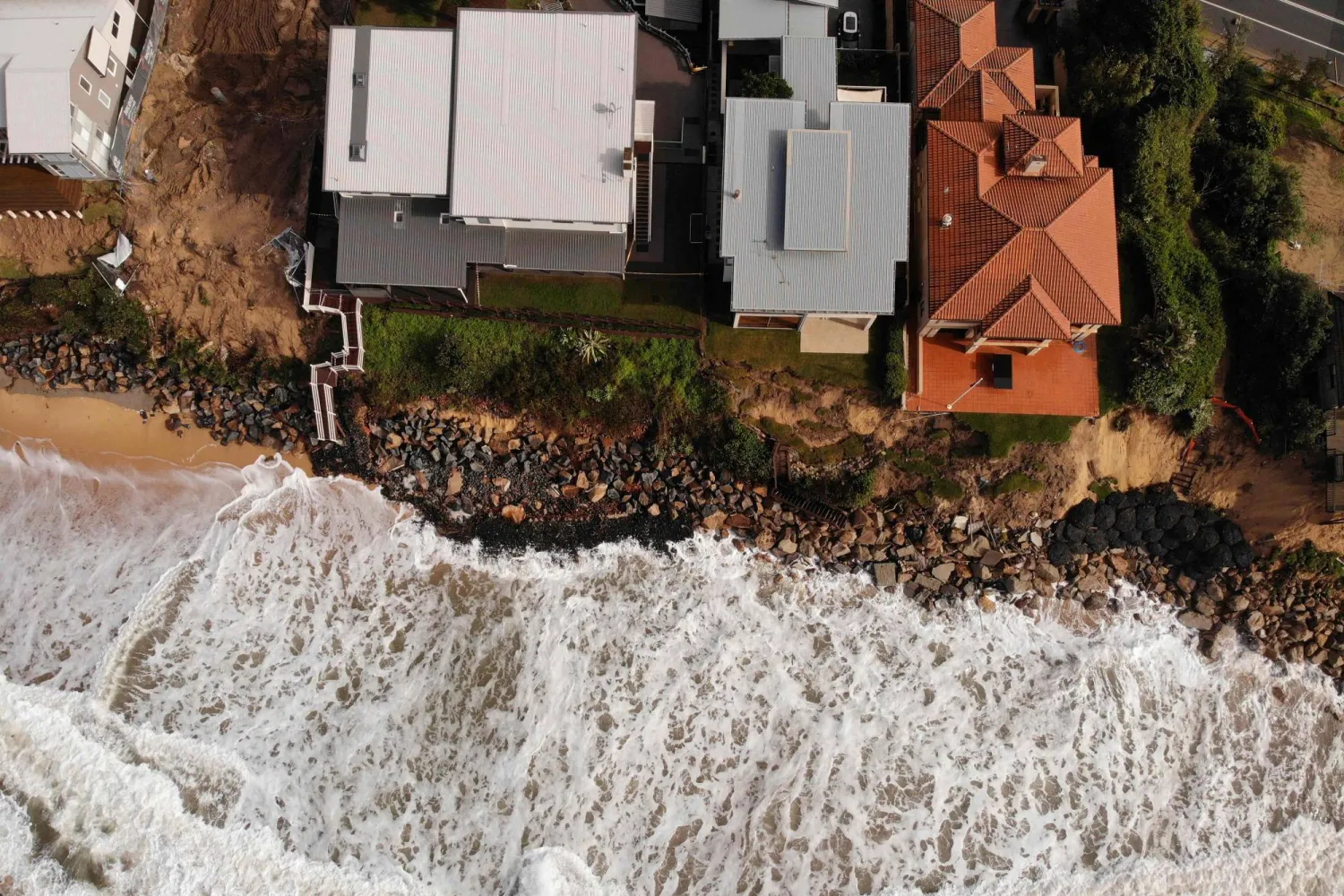
(FILES) An aerial file photo taken on July 28, 2020 shows homes perched on Australia's eastern coastal town of Wamberal that are at risk of being swept away, after days of driving rain, high winds and monster swells smashed the coastline. (Photo by Peter PARKS / AFP)
TT

Report: Rising Oceans to Threaten 1.5 Million Australians by 2050

(FILES) An aerial file photo taken on July 28, 2020 shows homes perched on Australia's eastern coastal town of Wamberal that are at risk of being swept away, after days of driving rain, high winds and monster swells smashed the coastline. (Photo by Peter PARKS / AFP)

Rising oceans and flooding caused by climate change will threaten the homes and livelihoods of over a million Australians by 2050 while deaths from heat-related illness will soar, a landmark report warned Monday ahead of the country's releasing its emission reduction targets this week.

The long-awaited national climate risk assessment found that rising temperatures will have "cascading, compounding, concurrent" impacts on life in Australia, home to more than 27 million people.

"We are living climate change now. It's no longer a forecast, a projection or prediction -- it is a live reality, and it's too late to avoid any impacts," AFP quoted Climate Minister Chris Bowen as saying.

The report, prepared independently for the government, found that 1.5 million people living in coastal areas will be at risk of sea level rise and coastal flooding by 2050.

By 2090, about three million people will be at risk from rising oceans.

Sea level rises pose a significant threat to homes, livelihoods, and cultural connections -- particularly in locations such as the Torres Strait Islands.

Scattered through the warm waters off Australia's northernmost tip, the sparsely populated islands are threatened by seas rising much faster than the global average.

Monday's report comes as Australia is set to release its next round of emissions reduction targets in the coming week, a key obligation under the landmark Paris climate agreement.

Many hope the country will reveal more ambitious targets.

Losses in Australian property values are estimated to soar to Aus$611 billion (US$406 billion) by 2050 and could increase to $770 billion by 2090.

Should the temperatures increase by 3C, heat-related deaths could soar by over 400 percent in the country's most-populated city of Sydney, the report said.

And Australia's unique species will be forced to move, adapt to the new conditions or die out, as climate change intensifies, the report added.

Amanda McKenzie, chief executive of the Climate Council NGO, described the report as "terrifying.”

"We can choose a better future by cutting climate pollution harder and faster now," McKenzie said.

"The first step is legislating the strongest possible 2035 climate target and stopping new polluting projects," she added.

One of the world's biggest fossil fuel exporters, Australia has been criticized for treating climate action as a political and economic liability.

The so-called "climate wars" -- a years-long domestic fight over emissions policy -- were blamed for curtailing progress in cutting heat-trapping carbon emissions.

In recent years, the center-left Labor government has stepped up efforts to bring down emissions and roll out renewable energy.

But despite its green ambitions, the government continues to approve fossil fuel projects, including granting a 40-year extension to a major liquified gas plant.

The extended lifeline of the North West Shelf project -- a sprawling industrial complex of offshore rigs and processing factories pumping out more than 10 million tons of liquified gas and petroleum each year -- has angered Indigenous and environmental groups.

Bowen said moving to a greener future presented a "complicated and complex" set of challenges and that gas would remain a necessary backup renewable in the future energy mix.

"But we also face that challenge from a position of strength, because we have the best renewable resources in the world," he added.



Singing Lemurs May Use a Soprano-Like Trick to Project Songs

An indri sits in a tree in Madagascar's Maromizaha Forest in this photograph taken on September 29, 2018, and released on September 21, 2026. (Filippo Carugati/Handout via Reuters)
TT

Singing Lemurs May Use a Soprano-Like Trick to Project Songs

An indri sits in a tree in Madagascar's Maromizaha Forest in this photograph taken on September 29, 2018, and released on September 21, 2026. (Filippo Carugati/Handout via Reuters)

When an opera singer reaches for a high note, a subtle shift in the shape of the mouth and throat can make the sound carry farther. New research shows that one of Madagascar's most unusual animals — a singing lemur — may be doing something similar high in the rainforest canopy.

In the dense forests of northeastern Madagascar, where thick vegetation can block visual contact beyond a few meters, lemurs called indris rely on haunting songs to communicate. Scientists have now found that these primates open their mouths wider when producing higher-pitched notes, a pattern consistent with a vocal technique called formant tuning.

"Picture the shape of your mouth and throat as a kind of tube. When you open your mouth wider, you change the shape of that tube, and that changes which frequencies it naturally resonates with — a bit like how a longer or shorter tube on a wind instrument changes its tone," said researcher Filippo Carugati of the ‌University of Turin ‌in Italy, lead author of the study published on Monday in the journal PLOS Computational Biology.

The ‌adjustment, ⁠done when indris ⁠hit higher notes, boosts the power and distance of their voices, just as trained opera singers do.

Study co-author Chiara De Gregorio of the University of Warwick in England hopes the research draws attention not only to this vocal ability but to the critically endangered animal behind it. Lemurs are found in the wild only in Madagascar, and indris are the only ones known for singing.

"While we may think of ourselves as the only 'sopranos' capable of producing such complex songs, there is another extraordinary singer in the forest, one that is singing, communicating and simply trying to survive," De Gregorio said.

'BETWEEN A WAIL AND A SIREN'

The researchers analyzed 83 video recordings of 19 wild indris in ⁠Madagascar's Maromizaha forest and Mitsinjo reserve. They tracked facial landmarks frame by frame and paired ‌these with synchronized audio to test statistically whether mouth opening predicted pitch.

"It did, very ‌robustly," Carugati said.

The indri's songs, Carugati said, are "often described as something between a wail and a siren: long, loud, rising and falling notes, quite ‌haunting and almost mournful to human ears, but highly structured, sung as a duet with male and female phrases interlocking ‌rather than simply overlapping."

The songs are central to how indri family groups relate to the world around them, but serve more than one social function.

"Its main role is territorial — a way of advertising 'we're here' across a landscape where you often can't see your neighbors through dense forest — and interestingly, these territorial songs tend to get longer specifically when a group visually encounters another group nearby, as if the song is being reinforced by ‌the direct sighting," Carugati said.

Indris hold their territories with striking precision. That suggests their songs do much of the work of spacing groups across the forest, allowing them to avoid ⁠many of the potentially dangerous ⁠confrontations that come with defending resources.

"It's a beautiful example of communication substituting for conflict," Carugati said.

'MARCO! POLO!'

According to De Gregorio, indris sometimes also sing to reunite after becoming separated in the forest, using slower songs with longer pauses.

"It reminds me of the way humans might find each other if they got lost in a forest: one person calls 'Marco!' and the other answers 'Polo! ... It makes their songs feel much more than just beautiful sounds. They are a way of staying connected to one another in the vastness of the forest," De Gregorio said.

Indris join a diverse group of animals that appear to modify their vocal tract to make sounds travel farther. Similar mechanisms have been reported in singing gibbons, howling grey wolves and even grasshopper mice, tiny rodents that amplify long-distance calls.

According to the Lemur Conservation Network, indris are the largest extant lemur species and their numbers are decreasing. The forests where they dwell are being cleared and fragmented by human activity.

"Unlike many other species, they have so far proved extremely difficult to maintain and reproduce in captivity," De Gregorio said. "Their survival ultimately depends on protecting them in the wild."


Turaif Governorate Adorned in Green in Preparation for Saudi National Day

The governorate is also hosting a diverse array of national, cultural, and artistic events - SPA
TT

Turaif Governorate Adorned in Green in Preparation for Saudi National Day

The governorate is also hosting a diverse array of national, cultural, and artistic events - SPA

Turaif Governorate in Northern Borders Region has been adorned in green in preparation for Saudi National Day.

The municipality showcased its preparations by decorating the streets with flags and green lighting, SPA reported.

The governorate is also hosting a diverse array of national, cultural, and artistic events, combining patriotic performances and entertainment programs with activities tailored for families and children.


Green Riyadh Launches Tree-Planting and Cleanup Campaign

File photo of the Saudi capital Riyadh - File/AAWSAT
TT

Green Riyadh Launches Tree-Planting and Cleanup Campaign

File photo of the Saudi capital Riyadh - File/AAWSAT

Green Riyadh, one of the programs overseen by the Royal Commission for Riyadh City, has launched a tree-planting and cleanup campaign at Shuaib Umm Qasr to coincide with Saudi National Day celebrations, the Saudi Press Agency said Sunday.

The campaign will be held on September 23 from 1:00 p.m. to 5:00 p.m. and is open to male and female volunteers from all segments of society. Participants will receive volunteer certificates in recognition of their active contributions to environmental service.

The initiative aims to attract volunteers to participate in tree planting and cleanup activities, thereby promoting community engagement and a culture of volunteerism while supporting national efforts to protect the environment and achieve sustainability.