

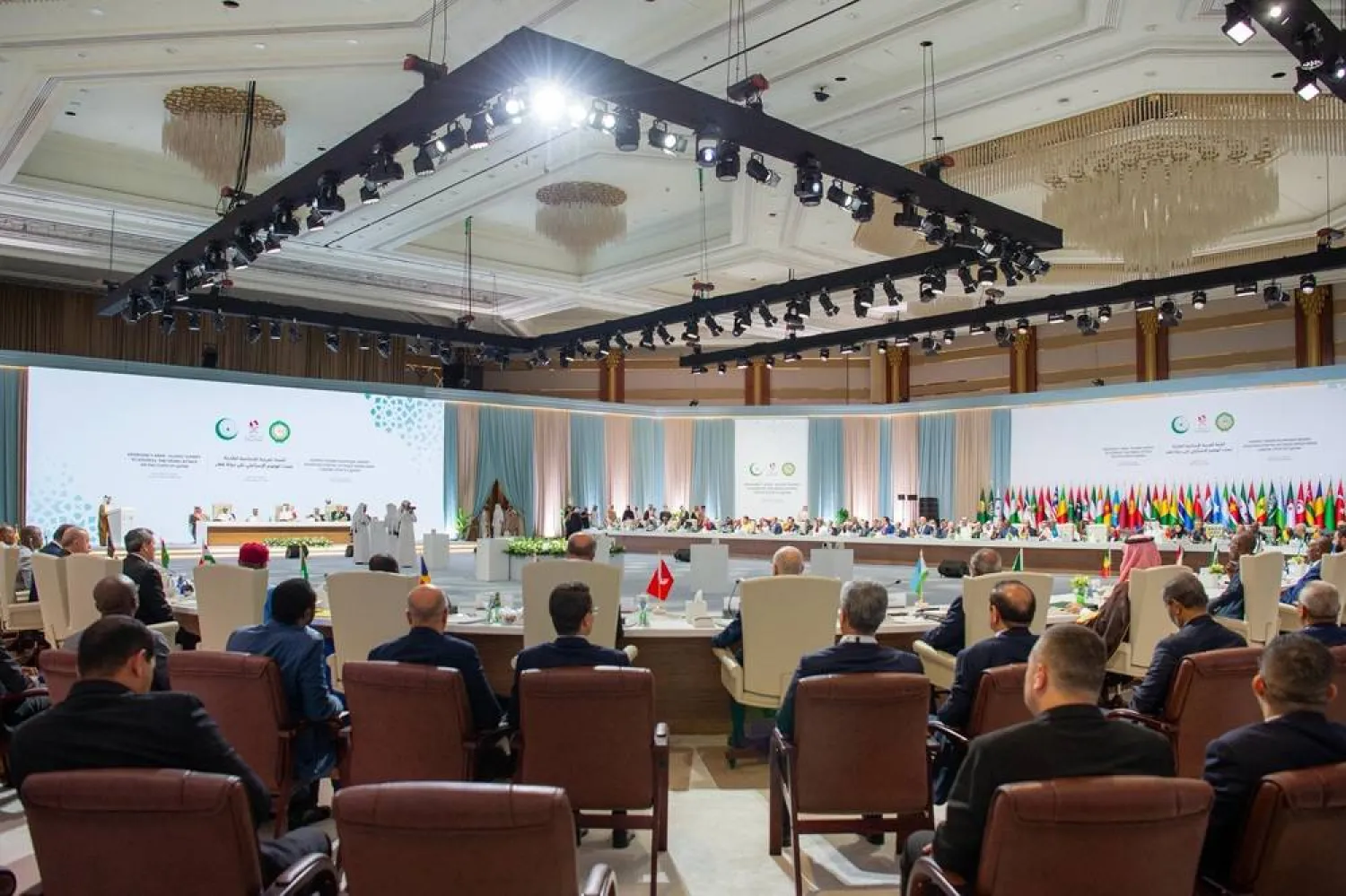

Doha Summit Declares Absolute Support to Qatar against Israeli Aggression

 15 September 2025, Qatar, Doha: A view of the Arab-Islamic emergency summit following Israel's air strike on Hamas leaders last week. (SPA/dpa)
15 September 2025, Qatar, Doha: A view of the Arab-Islamic emergency summit following Israel's air strike on Hamas leaders last week. (SPA/dpa)
TT

Doha Summit Declares Absolute Support to Qatar against Israeli Aggression

 15 September 2025, Qatar, Doha: A view of the Arab-Islamic emergency summit following Israel's air strike on Hamas leaders last week. (SPA/dpa)
15 September 2025, Qatar, Doha: A view of the Arab-Islamic emergency summit following Israel's air strike on Hamas leaders last week. (SPA/dpa)

Arab and Islamic leaders declared on Monday their absolute support to Qatar, its security, stability and sovereignty against Israeli aggression. 

Meeting at an emergency summit in Doha, they said they stand united in condemning and confronting the Israeli assault, which they said was a flagrant violation of Qatar’s sovereignty and international law and a dangerous threat to regional peace and security. 

They added that they stand by Qatar and all the measures it takes to respond to the attack, which targeted Hamas leaders in Doha last week. 

The closing statement of the Arab-Islamic summit said the “aggression on Qatari territory, a state serving as a principal mediator in efforts to secure a ceasefire and end the war on Gaza, and to release hostages and prisoners, is a grave escalation and an assault on diplomatic efforts to restore peace.” 

“Such an attack on a neutral venue for mediation not only violates Qatar’s sovereignty, but also undermines international mediation and peace-making processes. Israel bears full responsibility for this assault,” it stressed. 

The leaders commended the “civilized, wise, and responsible stance adopted by Qatar in addressing this treacherous assault, its firm adherence to international law, and its insistence on upholding its sovereignty and security and defending its rights by all legitimate means.” 

The statement expressed support for states engaged in mediation, in particular Qatar, Egypt, and the United States, to end the aggression on the Gaza Strip. 

It stressed “the categorical rejection of any attempts to justify the Israeli aggression under any pretext,” adding that the attack “undermines serious efforts to reach a just and comprehensive political solution that ends the Israeli occupation and ensures the realization of the inalienable rights of the Palestinian people.” 

The statement also “categorically rejected repeated Israeli threats of a possible renewed attack on Qatar or any Arab or Islamic state,” deeming them “provocative and a grave escalation that threatens international peace and security.” It called on the international community to condemn Israel in the strongest possible terms and take deterrent measures to halt it. 

It welcomed the adoption by the Council of the Arab League the resolution on the “Shared Vision for Security and Cooperation in the Region.” It underscored the concept of collective security and shared destiny of Arab and Islamic states, the need for unity in facing common challenges and threats, and the importance of beginning to put in place the required implementation mechanisms.  

“We stress that any future regional arrangements must enshrine the principles of international law and the UN Charter, good-neighborly relations, respect for sovereignty, noninterference in the internal affairs of states, equality of rights and duties without preference of one state over another, settlement of disputes by peaceful means, and renunciation of the use of force,” said the statement. 

It also stressed the need to end the Israeli occupation of all Arab territories, establish the State of Palestine along the lines of June 4, 1967, and rid the Middle East of nuclear weapons and all other weapons of mass destruction. 

It called for confronting “Israel's schemes to impose a new fait accompli in the region, which pose a direct threat to regional and international stability and security.” 

It reiterated the condemnation of “any Israeli attempts to forcibly displace the Palestinian people, under any pretext or designation, from their occupied territories of 1967, and to consider such acts crimes against humanity, flagrant violations of international law and international humanitarian law, and a policy of ethnic cleansing that are wholly rejected.” 

It condemned Israeli policies “that have caused an unprecedented humanitarian catastrophe, whereby siege, starvation, and deprivation of civilians of food and medicine are used as weapons of war against the Palestinian people, in flagrant violation of international humanitarian law and the Geneva Conventions.”  

It stressed that these practices are full-fledged war crimes “requiring urgent international action to put an end to them and to ensure the immediate, safe, and unimpeded entry of humanitarian assistance into all parts of the occupied Palestinian territory.” 

It warned “of the catastrophic consequences of any decision by Israel, the occupying power, to annex any part of the occupied Palestinian territory, and rejecting such a move as a blatant assault on the historical and legal rights of the Palestinian people, a violation of the Charter of the United Nations, the principles of international law, and relevant United Nations resolutions, and as a nullification of all efforts to achieve a just and comprehensive peace in the region.” 

It called on “all states to take all possible legal and effective measures to prevent Israel from continuing its actions against the Palestinian people, including by supporting efforts to end its impunity, holding it accountable for its violations and crimes, imposing sanctions on it, suspending the supply, transfer, or transit of weapons, ammunition, and military materials — including dual-use items — reviewing diplomatic and economic relations with it, and initiating legal proceedings against it.” 

It welcome the adoption by the United Nations General Assembly of the “New York Declaration” on the implementation of the two-State solution and the establishment of an independent Palestinian State, “as a clear expression of international will supporting the legitimate rights of the Palestinian people, foremost among them their right to establish their independent state.” 

It praised the efforts by Saudi Arabia and France, which contributed to the adoption of the declaration. 

It also welcomed the upcoming Two-State Solution Conference, co-chaired by Saudi Arabia and France, in New York on September 22. It urged concerted efforts by the international community to ensure broad recognition of the independent State of Palestine with East Jerusalem as its capital. 

“Just, comprehensive, and lasting peace in the Middle East will not be achieved by bypassing the Palestinian cause, ignoring the rights of the Palestinian people, or through violence and targeting mediators, but rather through adherence to the Arab Peace Initiative and relevant international legitimacy resolutions,” stressed the statement. 

“In this regard, we call upon the international community, in particular the Security Council, to assume its legal and moral responsibilities in ending the Israeli occupation and establishing a binding timetable for that purpose.” 



Saudi Arabia Condemns RSF Attacks on Civilians and Aid Convoys in Sudan

 An elderly man picks up his food aid ration at the Umdulu Camp, in Engpung County, Sudan, January 30, 2026. (Karl Schembri/Norweigan Refugee Council/Handout via Reuters)
An elderly man picks up his food aid ration at the Umdulu Camp, in Engpung County, Sudan, January 30, 2026. (Karl Schembri/Norweigan Refugee Council/Handout via Reuters)
TT

Saudi Arabia Condemns RSF Attacks on Civilians and Aid Convoys in Sudan

 An elderly man picks up his food aid ration at the Umdulu Camp, in Engpung County, Sudan, January 30, 2026. (Karl Schembri/Norweigan Refugee Council/Handout via Reuters)
An elderly man picks up his food aid ration at the Umdulu Camp, in Engpung County, Sudan, January 30, 2026. (Karl Schembri/Norweigan Refugee Council/Handout via Reuters)

Saudi Arabia strongly condemned on Saturday the Rapid Support Forces’ attack against a humanitarian aid convoy in Sudan’s Kordofan.

A Foreign Ministry statement said the Kingdom expressed its strong condemnation of the attack against Al-Kuweik Military Hospital, a humanitarian aid convoy affiliated with the World Food Program, and a vehicle transporting displaced civilians.

“These acts are unjustifiable under any circumstances and are flagrant violations of all humanitarian norms and relevant international agreements,” it stressed.

“The Kingdom called on the RSF to immediately cease these violations and to fulfill their moral and humanitarian obligations by ensuring the safe and unhindered delivery of humanitarian assistance to those in need, in accordance with international humanitarian law and the Jeddah Declaration signed on May 11, 2023,” it added.

The Kingdom reiterated its firm position in support of Sudan’s unity, security, and stability, the need to preserve its legitimate institutions.

It voiced its rejection of “foreign interference and the continued actions of certain parties in supplying illicit weapons, mercenaries, and foreign fighters, despite their stated support for a political solution,” saying such “conduct is a primary factor in prolonging the conflict and exacerbating the suffering of the Sudanese people.”

A drone attack by the RSF hit a vehicle carrying displaced families in central Sudan Saturday, killing at least 24 people, including eight children, a doctors’ group said, a day after a World Food Program aid convoy was targeted.

The attack occurred close to the city of Rahad in North Kordofan province, said the Sudan Doctors Network, which tracks the country’s ongoing war. The vehicle was transporting displaced people who fled fighting in the Dubeiker area, the group said in a statement. Among the dead children were two infants.


OIC Condemns Terrorist Bombing of Mosque in Islamabad

A Pakistani man reacts as people attend a protest against the suicide bomb blast that killed dozens of people, in Peshawar, Pakistan, 07 February 2026. (EPA)
TT

OIC Condemns Terrorist Bombing of Mosque in Islamabad

A Pakistani man reacts as people attend a protest against the suicide bomb blast that killed dozens of people, in Peshawar, Pakistan, 07 February 2026. (EPA)

The Organization of Islamic Cooperation (OIC) General Secretariat strongly condemned on Saturday the terrorist bombing that targeted a mosque in Islamabad.

The secretariat stressed its categorical rejection of terrorism in all its forms, especially those targeting places of worship.

It underlined its firm stance in condemning these criminal acts, which are contrary to human values and religious principles.

The OIC offered its sincere condolences to the government and people of Pakistan and to the families of the victims.

It also reiterated its full solidarity with Pakistan in its efforts to combat terrorism and boost its security and stability.

At least 30 people killed in a suicide bombing at a Muslim mosque during Friday prayers.


Bahrain, France Sign Defense Cooperation Agreement

Sheikh Nasser bin Hamad Isa Al Khalifa, Bahrain's King Hamad bin Isa Al Khalifa, France's President Emmanuel Macron and Junior Minister at the Ministry of Defense, Alice Rufo, pose after signing a bilateral agreement at the Elysee Palace in Paris, France, February 6, 2026. (Thibault Camus/Pool via Reuter)
TT

Bahrain, France Sign Defense Cooperation Agreement

Sheikh Nasser bin Hamad Isa Al Khalifa, Bahrain's King Hamad bin Isa Al Khalifa, France's President Emmanuel Macron and Junior Minister at the Ministry of Defense, Alice Rufo, pose after signing a bilateral agreement at the Elysee Palace in Paris, France, February 6, 2026. (Thibault Camus/Pool via Reuter)

Bahrain and France signed on Friday a joint defense cooperation agreement during talks between King Hamad bin Isa Al Khalifa met with President Emmanuel Macron in Paris.

The French presidency said the agreement consolidates cooperation in the field of defense, training and exchange of strategic information.

“This agreement will ⁠also open ‌up ‍new ‍opportunities for industrial ‍cooperation in defense, and strengthen solidarity between our two countries in a ⁠global and regional geopolitical context marked by increasing tensions,” it added.

The agreement was signed by Bahrain’s National Security Adviser and Secretary General of the Supreme Defense Council Sheikh Nasser bin Hamad Al Khalifa and France’s Minister Delegate to the Minister of the Armed Forces and Veterans Alice Rufo.

Macron highlighted the depth of the historical relations between Bahrain and France, as well as the progress achieved across various domains in support of common interests, reported Bahrain’s state news agency (BNA).

For his part, King Hamad commended the French president’s keenness to strengthen relations between the two countries.

The talks also addressed means to bolster bilateral relations across all sectors to achieve shared interests.

Both sides commended the efforts of the Joint Bahraini-French High Committee. They highlighted the positive outcomes achieved in advancing cooperation and underlined the importance of continuing the committee’s work to expand cooperation across various domains.

The talks addressed regional and international developments, and efforts aimed at resolving conflicts through dialogue and diplomatic solutions and reducing tensions.