


Trump Suggests US Troops Could Return to Base in Afghanistan, Citing Proximity to China

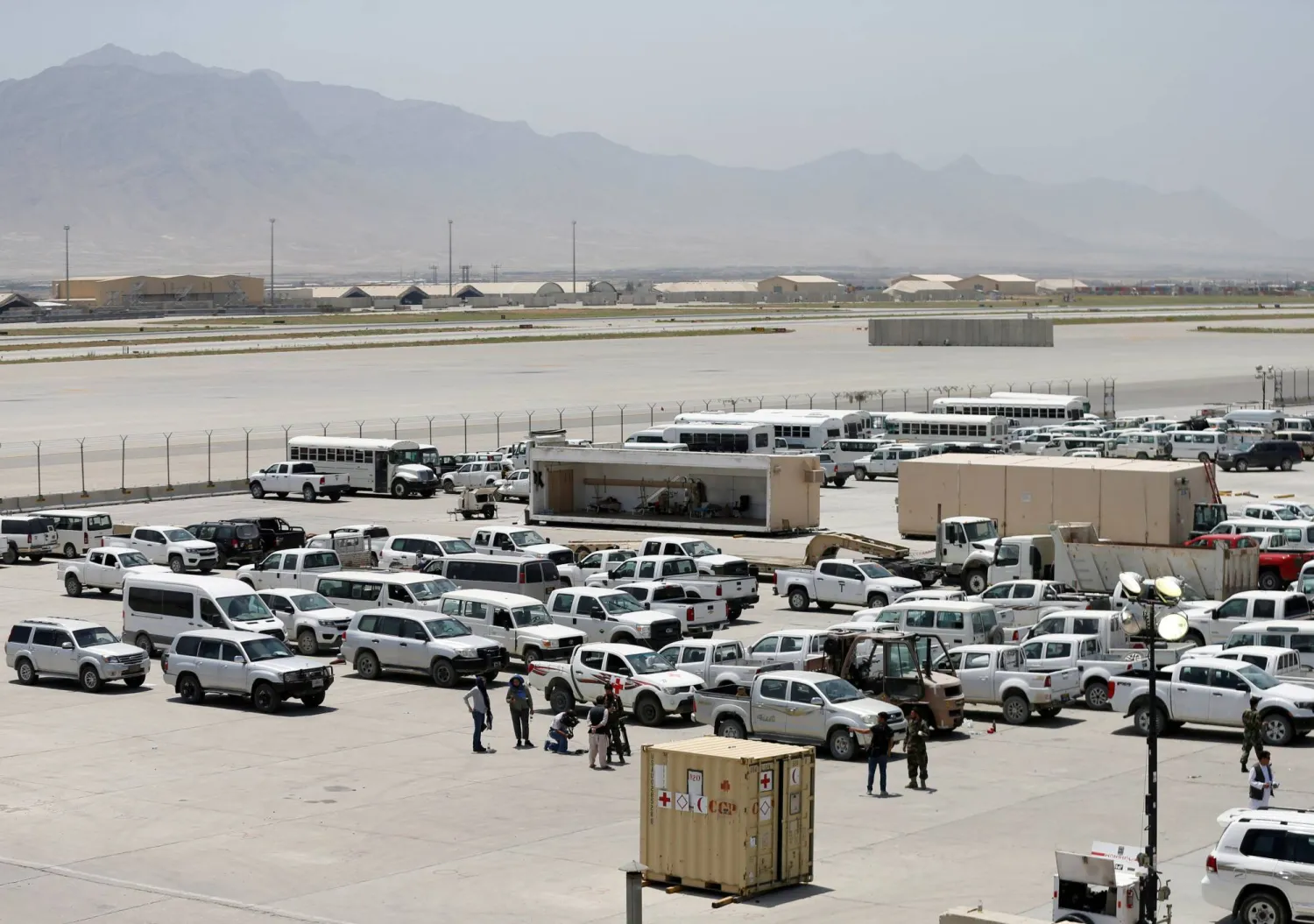
FILE PHOTO: Parked vehicles are seen in Bagram US air base, after American troops vacated it, in Parwan province, Afghanistan July 5, 2021. REUTERS/Mohammad Ismail/File Photo
TT

Trump Suggests US Troops Could Return to Base in Afghanistan, Citing Proximity to China

FILE PHOTO: Parked vehicles are seen in Bagram US air base, after American troops vacated it, in Parwan province, Afghanistan July 5, 2021. REUTERS/Mohammad Ismail/File Photo

President Donald Trump on Thursday suggested that he is working to reestablish a US presence at Bagram Air Base in Afghanistan, four years after America’s chaotic withdrawal from the country left the base in the Taliban’s hands.

Trump floated the idea during a press conference with British Prime Minister Keir Starmer as he wrapped up a state visit to the UK and tied it to the need for the US to counter its top rival, China, The Associated Press reported.

“We’re trying to get it back,” Trump said of the base in an aside to a question about ending Russia’s invasion of Ukraine.

While Trump described his call for the US military to reestablish a position in Afghanistan as “breaking news,” the Republican president has previously raised the idea. The White House did not immediately respond to questions about whether it or the Pentagon has done any planning around returning to the sprawling air base, which was central to America's longest war.

Trump has seized on the US withdrawal under Biden During his first presidency, Trump set the terms for the US withdrawal by negotiating a deal with the Taliban. The 20-year conflict came to an end in disquieting fashion under President Joe Biden: The US-backed Afghan government collapsed, a grisly bombing killed 13 US troops and 170 others, and thousands of desperate Afghans descended on Kabul’s airport in search of a way out before the final US aircraft departed over the Hindu Kush.

The Afghanistan debacle was a major setback just eight months into Biden’s Democratic presidency that he struggled to recover from.

Biden’s Republican detractors, including Trump, seized on it as a signal moment in a failed presidency. Those criticisms have persisted into the present day, including as recently as last week, when Trump claimed the move emboldened Russian President Vladimir Putin to invade Ukraine in February 2022.

“He would have never done what he did, except that he didn’t respect the leadership of the United States,” Trump said, speaking of Putin. “They just went through the Afghanistan total disaster for no reason whatsoever. We were going to leave Afghanistan, but we were going to leave it with strength and dignity. We were going to keep Bagram Air Base — one of the biggest air bases in the world. We gave it to them for nothing.”

Asked again about the proposal hours later on Air Force One, Trump offered no details but again bashed Biden for “gross incompetence” and said the base should have “never been given back.”

“It’s one of the most powerful bases in the world in terms of runway strength and length,” he said. “You can land anything on there. You can land a planet on top of it.”

No clarity if there have been discussions with the Taliban about Bagram It is unclear if the US has any new direct or indirect conversations with the Taliban government about returning to the country. But Trump hinted that the Taliban, who have struggled with an economic crisis, international legitimacy, internal rifts and rival militant groups since their return to power in 2021, could be game to allow the US military to return.

“We’re trying to get it back because they need things from us,” Trump said of the Taliban.

The president repeated his view that a US presence at Bagram is of value because of its proximity to China, the most significant economic and military competitor to the United States.

“But one of the reasons we want that base is, as you know, it’s an hour away from where China makes its nuclear weapons," Trump said. “So a lot of things are happening.”

Late Thursday, Zakir Jalaly, an official at the Taliban Foreign Ministry, dismissed the idea of the US returning to Bagram.

“Afghanistan and the US need to interact with each other and can have economic and political relations based on mutual respect and common interests,” Jalaly said on the social platform X. “The Afghans have not accepted a military presence in history, and this possibility was completely rejected during the Doha talks and agreement, but the door is open for further interaction.”

While the US and the Taliban have no formal diplomatic ties, the sides have had hostage conversations. An American man who was abducted more than two years ago while traveling through Afghanistan as a tourist was released by the Taliban in March.

Last week, the Taliban also said they reached an agreement with US envoys on an exchange of prisoners as part of an effort to normalize relations between the United States and Afghanistan.

The Taliban gave no details of a detainee swap, and the White House did not comment on the meeting in Kabul or the results described in a Taliban statement. The Taliban released photographs from their talks, showing their foreign minister, Amir Khan Muttaqi, with Trump’s special envoy for hostage response, Adam Boehler.

Officials at US Central Command in the Middle East and the Pentagon, including Defense Secretary Pete Hegseth’s office, referred questions about reestablishing a presence at Bagram to the White House.



Russia Unleashes Massive Drone and Missile Attack on Ukraine

An owner of a small private shop is seen through the broken window waiting for customers after Russia's night missile attack on a residential neighborhood in Vyshgorod, outside Kyiv, Ukraine, Sunday, Nov. 30, 2025. (AP Photo/Efrem Lukatsky)
TT

Russia Unleashes Massive Drone and Missile Attack on Ukraine

An owner of a small private shop is seen through the broken window waiting for customers after Russia's night missile attack on a residential neighborhood in Vyshgorod, outside Kyiv, Ukraine, Sunday, Nov. 30, 2025. (AP Photo/Efrem Lukatsky)

Russia unleashed a major missile and drone barrage on Ukraine overnight into Saturday, after US and Ukrainian officials said they’ll meet on Saturday for a third day of talks aimed at ending the nearly 4-year-old war.

Following talks that made progress on a security framework for postwar Ukraine, the two sides also offered the sober assessment that any “real progress toward any agreement” ultimately will depend “on Russia’s readiness to show serious commitment to long-term peace.”

The statement from US special envoy Steve Witkoff, Trump’s son-in-law Jared Kushner as well as Ukrainian negotiators Rustem Umerov and Andriy Hnatov came after they met for a second day in Florida on Friday.

They offered only broad brushstrokes about the progress they say has been made as Trump pushes Kyiv and Moscow to agree to a US-mediated proposal to end the war.

Russia used 653 drones and 51 missiles in the wide-reaching overnight attack on Ukraine, which triggered air raid alerts across the country and came as Ukraine marked Armed Forces Day, the country’s air force said Saturday morning.

Ukrainian forces shot down and neutralized 585 drones and 30 missiles, the air force said, adding that 29 locations were struck, The Associated Press reported.

At least eight people were wounded in the attacks, Ukrainian Minister of Internal Affairs Ihor Klymenko said.

Among these, at least three people were wounded in the Kyiv region, according to local officials. Drone sightings were reported as far west as Ukraine’s Lviv region.

Russia carried out a “massive missile-drone attack” on power stations and other energy infrastructure in several Ukrainian regions, Ukraine’s national energy operator, Ukrenergo, wrote on Telegram.

Ukraine’s Zaporizhzhia nuclear power plant temporarily lost all off-site power overnight, the International Atomic Energy Agency said Saturday, citing its Director General Rafael Mariano Grossi.

The plant is in an area that has been under Russian control since early in Moscow’s invasion of Ukraine and is not in service, but it needs reliable power to cool its six shut-down reactors and spent fuel, to avoid any catastrophic nuclear incidents.

Ukrainian President Volodymyr Zelenskyy said that energy facilities were the main targets of the attacks, also noting that a drone strike had “burned down” the train station in the city of Fastiv, located in the Kyiv region.

Russia’s Ministry of Defense said its air defenses had shot down 116 Ukrainian drones over Russian territory overnight into Saturday.

Russian Telegram news channel Astra said Ukraine struck Russia’s Ryazan Oil Refinery, sharing footage appearing to show a fire breaking out and plumes of smoke rising above the refinery. The Associated Press could not independently verify the video.

The General Staff of the Ukrainian Armed Forces later said Ukrainian forces had struck the refinery. Ryazan regional Gov. Pavel Malkov said a residential building had been damaged in a drone attack and that drone debris had fallen on the grounds of an “industrial facility,” but did not mention the refinery.

Months of Ukrainian long-range drone strikes on Russian refineries have aimed to deprive Moscow of the oil export revenue it needs to pursue the war.

Meanwhile, Kyiv and its western allies say Russia is trying to cripple the Ukrainian power grid and deny civilians access to heat, light and running water for a fourth consecutive winter, in what Ukrainian officials call “weaponizing” the cold.

The latest round of attacks came as US President Donald Trump’s advisers and Ukrainian officials said they’ll meet for a third day of talks on Saturday, after making progress on finding agreement on a security framework for postwar Ukraine.

Following Friday’s talks, the two sides also offered the sober assessment that any “real progress toward any agreement” ultimately will depend “on Russia’s readiness to show serious commitment to long-term peace.”

The statement from US special envoy Steve Witkoff, Trump’s son-in-law Jared Kushner as well as Ukrainian negotiators Rustem Umerov and Andriy Hnatov came after they met for a second day in Florida on Friday. They offered only broad brushstrokes about the progress they say has been made as Trump pushes Kyiv and Moscow to agree to a US-mediated proposal to end nearly four years of war.


Kallas: US Remains Biggest Ally and Europe Should be More Self-confident

EU Vice-President and High Representative for Foreign Affairs and Security Policy Kaja Kallas speaks during a session on the opening day of the Doha Forum, an annual diplomatic conference, in Doha on December 6, 2025. (Photo by Mahmud HAMS / AFP)
TT

Kallas: US Remains Biggest Ally and Europe Should be More Self-confident

EU Vice-President and High Representative for Foreign Affairs and Security Policy Kaja Kallas speaks during a session on the opening day of the Doha Forum, an annual diplomatic conference, in Doha on December 6, 2025. (Photo by Mahmud HAMS / AFP)

European Union foreign policy chief Kaja Kallas said on Saturday that the United States remains Europe's biggest ally, after the Trump administration said in a major strategy document that Europe faces "civilizational erasure" and may one day lose its status as a reliable ally.

The new US National Security Strategy, posted on the White House website overnight Thursday-to-Friday, denounced the European Union as anti-democratic and Europe as lacking in self-confidence, and said the goal of the US should be "to help Europe correct its current trajectory".

"There's a lot of criticism, but I think some of it is also true, if you look at Europe, it has been underestimating its own power towards Russia," Kallas said on a panel at the Doha Forum in Qatar, according to Reuters.

"We should be more self-confident," she said, adding that the "US is still our biggest ally".

"I think we haven't always seen eye to eye on different topics, but I think the overall principle is still there. We are the biggest allies and we should stick together," Kallas said.


Iran’s Revolutionary Guards Media Accuse Rouhani of ‘Serving Israel’

03 December 2025, Iran, Teheran: View of the smog-ridden metropolis of Tehran. Photo: Aref Taherkenareh/dpa
TT

Iran’s Revolutionary Guards Media Accuse Rouhani of ‘Serving Israel’

03 December 2025, Iran, Teheran: View of the smog-ridden metropolis of Tehran. Photo: Aref Taherkenareh/dpa

Media outlets aligned with Iran’s Revolutionary Guards have accused former president Hassan Rouhani and his associates of “doing Israel a service,” escalating a political backlash triggered by Rouhani’s recent criticism of Iran’s ability to defend its airspace if last June’s 12-day war with Israel were to resume.

Tasnim, the Guards’ main media arm, protested sharply against Rouhani’s latest speech and the recommendations he offered to prevent a repeat of the conflict.

The media attack coincided with rising political tensions inside Iran as Rouhani’s name resurfaced in the debate over who might succeed Supreme Leader Ali Khamenei, a succession file that has deepened domestic polarization.

Tasnim opened its weekly analytical supplement with the headline “Working for Israel,” placing Rouhani’s photograph on the cover. It accused him of offering “narcissistic, arrogance-filled interpretations” about his claims that he prevented a war on Iran through diplomacy during his past government roles.

The agency questioned whether Rouhani was suggesting that Iran had no deterrent other than his negotiations, and whether the United States and Israel were at full strength at the time while Iran lacked defensive capability.

It further asked why Rouhani’s diplomacy failed to prevent the US withdrawal from the nuclear agreement under Donald Trump or avert the assassinations of General Qassem Soleimani and Mohsen Fakhrizadeh, the senior nuclear official killed in late 2020 in an attack attributed to Israel.

Rouhani last week criticized the country’s tightened security climate, saying Iran needed “an atmosphere of safety, not an atmosphere of securitization.”

He warned that Iran could not remain in a state of “no war and no peace,” citing Khamenei’s own remarks, and urged efforts to rebuild deterrence across multiple fields to confront what he called “the conspiracies of enemies.”

He argued that Iran today lacks “broad regional deterrence,” noting that the airspace of neighboring countries, including Iraq, Syria, Lebanon and Jordan, had fallen under US and Israeli influence, making hostile aerial movement near Iran “safe and free of obstacles.”

Rouhani insisted continuation of the nuclear deal would have prevented the 12-day conflict, calling the nuclear file a pretext for the attacks and blaming subsequent governments for failing to revive the accord.

Tasnim said Rouhani’s positions “practically serve Israel” because they place responsibility on internal actors while removing Israel from the circle of blame. It portrayed his comments as a political act against “sacred unity,” adding that presenting such views “even within a realistic and careful framework” ultimately benefits Israel.

Tasnim also revived long-standing criticism that Rouhani’s government did not sufficiently support Iran’s intervention in Syria in 2013 and 2014, arguing that such reluctance approached “the level of treason.” It claimed one of General Soleimani’s biggest grievances was the administration’s lack of cooperation on the Syrian front.

Responding to Rouhani’s remarks on “securitization,” Tasnim said his own administration had been among the most security-dominated of the Islamic Republic era. The agency pointed to Rouhani’s intelligence background and argued that his current counsel contradicted his record in office.

Rouhani’s comments were also interpreted as an indirect response to Khamenei’s November 27 televised speech, in which the Supreme Leader warned against internal division, repeated his narrative that the US and Israel had “failed” to achieve their war aims and urged Iranians to maintain “national alignment.”

The renewed criticism comes as Rouhani has faced months of attacks from rivals, including parliamentarians, who accuse him of positioning himself to assume the role of Supreme Leader should Khamenei become unable to carry out his duties, including in the event of an Israeli assassination attempt.

Last month, parliament speaker Mohammad Bagher Ghalibaf accused Rouhani and former foreign minister Mohammad Javad Zarif of damaging Iran’s strategic ties with Russia.

Hardline lawmakers revived the chant “Death to Fereydoun,” using Rouhani’s birth family name. One conservative MP said the judiciary should address Rouhani’s “misconduct” so that anyone aspiring to senior posts would “return to his rightful place behind bars.”

After Rouhani’s latest remarks circulated, discussion of his possible leadership prospects reemerged, this time in reformist media.

Reformist theorist Sadegh Zibakalam said Rouhani believes he lacks nothing compared to other succession candidates, including Mojtaba Khamenei, arguing that Rouhani’s executive experience makes him “more qualified than others.”

At the same time, businessman Babak Zanjani, who was sentenced to death for corruption during Rouhani’s presidency but released last year, made a harsh post on X rejecting any future political role for Rouhani.

Iran, he wrote, needed a “young, educated and effective” force, “not holders of fake degrees,” warning that “we will cleanse Iran of incompetence.”