Israeli Strikes on South Lebanon Kill Two

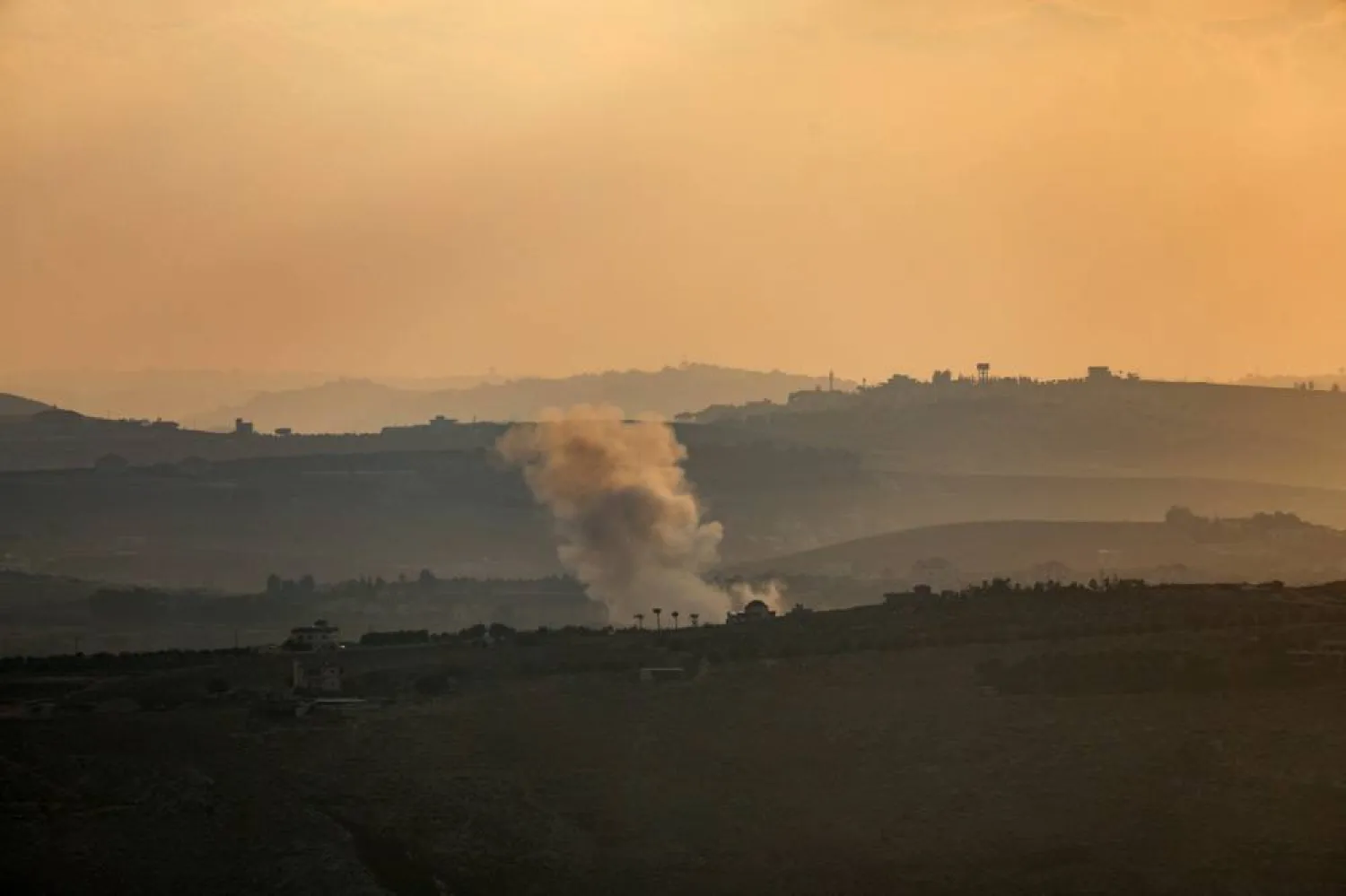
 Smoke billows over Kfar Tebnit after an Israeli strike near Lebanon’s border with Israel, as seen from Marjeyoun, Lebanon, September 18, 2025. (Reuters)
Smoke billows over Kfar Tebnit after an Israeli strike near Lebanon’s border with Israel, as seen from Marjeyoun, Lebanon, September 18, 2025. (Reuters)
TT

Israeli Strikes on South Lebanon Kill Two

 Smoke billows over Kfar Tebnit after an Israeli strike near Lebanon’s border with Israel, as seen from Marjeyoun, Lebanon, September 18, 2025. (Reuters)
Smoke billows over Kfar Tebnit after an Israeli strike near Lebanon’s border with Israel, as seen from Marjeyoun, Lebanon, September 18, 2025. (Reuters)

Israeli strikes on southern Lebanon killed two people and wounded 11 on Friday, Lebanon's health ministry said, in the latest attacks despite a ceasefire between Israel and Hezbollah.

The ministry said that an "Israeli air strike on a vehicle" outside a public hospital in Tibnin killed one person and wounded 11, while another strike on a vehicle in Ansar killed one person.

The Israeli army did not immediately comment on the strikes.

The attack comes a day after Israel bombed five towns it told residents to evacuate.

The Israeli military said it struck several weapons storage facilities belonging to Hezbollah's elite Radwan force on Thursday.

President Joseph Aoun condemned the attacks and "the silence of the countries who had sponsored" the ceasefire, which he said "encourages further aggression".

"The time has come to put an immediate end to these blatant violations of Lebanon's sovereignty," he said.

United Nations peacekeepers in southern Lebanon said the attacks "put the fragile stability that has been built since November of last year at risk" and called on Israel to "refrain from any further strikes and to fully withdraw from Lebanese territory".

Israel has repeatedly bombed Lebanon despite a November ceasefire that sought to end more than a year of hostilities with Hezbollah.

Lebanon's army said Thursday's strikes brought Israel's ceasefire "violations" to 4,500, adding that they hinder efforts to disarm Hezbollah.

Under US pressure, Beirut has ordered the Lebanese army to draw up a plan to disarm the Iran-backed group in areas near the Israeli border by the end of the year.

Foreign Minister Youssef Raggi said last week that Lebanon's army would fully disarm Hezbollah near the border within three months.


More Displacement in Sudan as Battles Intensify

Sudanese army solders take part in a military parade on August 17, 2026, in the city of Gedaref in eastern Sudan during celebrations to mark the 72nd anniversary of the Sudanese Armed Forces. (AFP)
TT

More Displacement in Sudan as Battles Intensify

Sudanese army solders take part in a military parade on August 17, 2026, in the city of Gedaref in eastern Sudan during celebrations to mark the 72nd anniversary of the Sudanese Armed Forces. (AFP)

At least 12 people were killed and other wounded in Sudan’s North Kordofan as the army launched air strikes and drone attacks on the Rapid Support Forces (RSF).

The fighting sparked a wave of displacement to the city of El Obeid.

Military troops continued to mobilize on the Kordofan and Blue Nile fronts, a sign that more fighting was to come.

Witnesses said the army launched airstrikes on RSF positions in North Kordofan and the Blue Nile at a time when ground fighting had eased between the two warring parties. The two sides had been relying increasingly on drones in the war.

The army and its allied forces have been focusing on expanding their control in North Kordofan and securing the surroundings of El Obeid. The RSF is positioned in areas west and south of the city.

The latest strikes were aimed at stemming any possible renewed fighting in the area.

The United Nations Office for the Coordination of Humanitarian Affairs (OCHA) warned that ongoing violence in Sudan continues to kill civilians and force more people from their homes.

In North Kordofan State, local authorities reported that more than a dozen civilians were killed and others injured in clashes in Um Arada town, southwest of the state capital El Obeid, on Friday, OCHA said in a statement.

The International Organization for Migration (IOM) says that more than 4,200 people were displaced from the town and surrounding areas on Friday and Saturday.

Increased violence across North Kordofan is also affecting humanitarian operations, forcing humanitarian partners to suspend activities in Al Mazroub locality, which is facing a cholera outbreak.

Meanwhile, in Blue Nile State, renewed fighting was reported in Geisan and Kurmuk towns and surrounding areas last week. IOM says that about 5,400 people were displaced in recent days.

OCHA once again “called on all parties to protect civilians and civilian infrastructure, and to allow aid to reach people quickly, safely and without obstruction.”

“Despite the insecurity, the UN and its humanitarian partners continue to deliver assistance to people in need. Across the Darfur region, the World Food Program reached about 2.3 million people with food assistance last month,” said OCHA.

OCHA continues to urge donors to provide additional funding for the humanitarian response. This year's humanitarian appeal for Sudan remains about 41 percent funded, with $1.2 billion received against the $2.9 billion required, added the statement.


Tetteh Says Moving Libya's Political Process Forward Remains Crucial

The UN Security Council discusses the situation in Libya. Photo: The Security Council
TT

Tetteh Says Moving Libya's Political Process Forward Remains Crucial

The UN Security Council discusses the situation in Libya. Photo: The Security Council

Special Representative of the Secretary General and Head of the United Nations Support Mission in Libya (UNSMIL) Hanna Tetteh has revealed that Libya possesses Africa’s largest oil reserves, yet hundreds of thousands of people have spent nearly a month and a half without electricity or water.

“The need to move Libya's political process forward remains crucial,” Tetteh told the Security Council on Tuesday.

“The recent widespread electricity outages and public discontent, exacerbated by a prolonged heat wave, have exposed the consequences of institutional fragmentation,” she said.

“Approximately $1 billion is spent monthly on fuel imports. Yet electricity systems remain vulnerable to fuel shortages,” she said, seen as “evidence of large scale diversion of subsidized fuel in the electricity and security sectors.”

Politically, she said the UN roadmap is based on three mutually reinforcing pillars: A credible path to presidential and legislative elections through electoral reforms, an inclusive, structured dialogue and the reunification of executive institutions through a unified government.

She told the Council that the Four Plus Four Committee, since its inaugural meeting on April 29 has met seven times, “having addressed some of the most contentious issues” and is set to meet again on August 20.

“Its recommendations, which I presented to the Council in my last briefing, address governance, the economy, security, reconciliation and human rights,” Tetteh said.

On fiscal affairs, she said that the central Bank of Libya commenced in June implementing salary increases for military and security personnel in eastern Libya following a request from the Libyan National Army (LNA) in December 2025, and subsequent legislation for this by the House of Representatives.

A similar request was reportedly made to the central bank from western Libya.

On August 9, the governor of the Central Bank submitted a letter to the two chambers requesting to be relieved of his position. “The move is an indication of the mounting pressure on the central bank,” Tetteh told Council members.

On Security issues, she mentioned that on August 3 heavy clashes erupted among armed actors engaged in trafficking, illicit drugs, human trafficking and fuel smuggling in residential areas across Zawiya and Sorman, resulting in civilian deaths and injuries.

“Furthermore, the use of several drones against the oil refinery and other vital infrastructure in Zawiya is an emerging and worrying development, suggesting deliberate targeting of the oil facility, causing structural damage, risk of fire and disruption of water supplies.

“On the 10th of August, the National Oil Corporation declared a state of emergency at the refinery and called for urgent investigations into these attacks,” she added.

She also referred to the assassination of Major General Fawzi Mansouri, director of the Military Intelligence Department for the LNA, in Benghazi on August 10 in a reported car bombing.

In a positive development, the two Chiefs of General Staff from the West and East met in Sirte on July 12, attended by the Five Plus five Joint Military Commission and the three plus three military committee established under the US track and UNSMIL.

“The meeting demonstrated that practical confidence building measures remain possible,” she said.

“The chiefs agreed on the principle to establish a joint border force and undertake joint exercises, regular coordination and harmonized training,” she added.


Palestinian-American Hoists US Flag on Home Besieged by Israeli Settlers

Palestinian-American dual citizen Louai Abu Ridi, whose home in the occupied West Bank village of Qusra is besieged by Israeli settlers, poses for a picture next to a US flag on the roof of the building in Qusra on August 18, 2026. (AFP)
TT

Palestinian-American Hoists US Flag on Home Besieged by Israeli Settlers

Palestinian-American dual citizen Louai Abu Ridi, whose home in the occupied West Bank village of Qusra is besieged by Israeli settlers, poses for a picture next to a US flag on the roof of the building in Qusra on August 18, 2026. (AFP)

A Palestinian-American has raised the US flag on his home besieged by Israeli settlers, as the United States renewed criticism of the siege that has generated condemnation around the world.

Louai Abu Ridi, who owns one of three houses in Qusra, near Nablus in the occupied West Bank, flew back from his adopted home of Ohio on Monday after settlers trapped residents inside and refused to let in food or other supplies for more than a week.

He was flying the Stars and Stripes outside his home on Tuesday and said he has asked the US embassy to keep raising his case.

"It's my message to all Americans in the United States to see what's going on here in the West Bank, how the settlers put us under siege trying to take my own house in the West Bank," Abu Ridi told AFP reporters inside his home.

Under US pressure, the Israeli military said last week it had given orders to remove the settlers.

Troops took down their tent and detained one Israeli but settlers repeatedly came back by foot or in vehicles.

"The settlers come in freely into my house and they're not doing anything," he said of the soldiers.

"They even shake hands with the settlers. It's like they're friends."

- Rare US criticism -

Israeli settlers in the West Bank have been increasingly harassing and assaulting Palestinian residents in recent months, often with an aim to take their property.

Prime Minister Benjamin Netanyahu's right-wing government has pushed to support settlements backed by the Jewish right ahead of close-fought October 27 elections.

US Ambassador to Israel Mike Huckabee, an evangelical pastor who has long supported settlers, has offered rare criticism over the Qusra siege and said he had asked Israel to intervene.

In interviews aired late Tuesday on Israeli television, Huckabee said the United States was committed to defending its own citizens.

"We would like to see severe consequences for people who engage in -- and I'll use the term -- terrorist activity," Huckabee told Channel 13.

"It's not fair to the families who are Palestinian, who own their homes, who have a right to raise their families without fear," said Huckabee, who before becoming ambassador had rejected the term Palestinian.

Of the extremist settlers, Huckabee said, "If this little minority, if they think they're doing their cause a favor, they are making a horrific mistake."

Around 500,000 Israelis live in the West Bank on settlements considered illegal under international law, amid three million Palestinians. Israel has occupied the West Bank since the 1967 Six-Day War.