Trump to Impose $100,000 Fee Per Year for H-1B Visas, in Blow to Tech

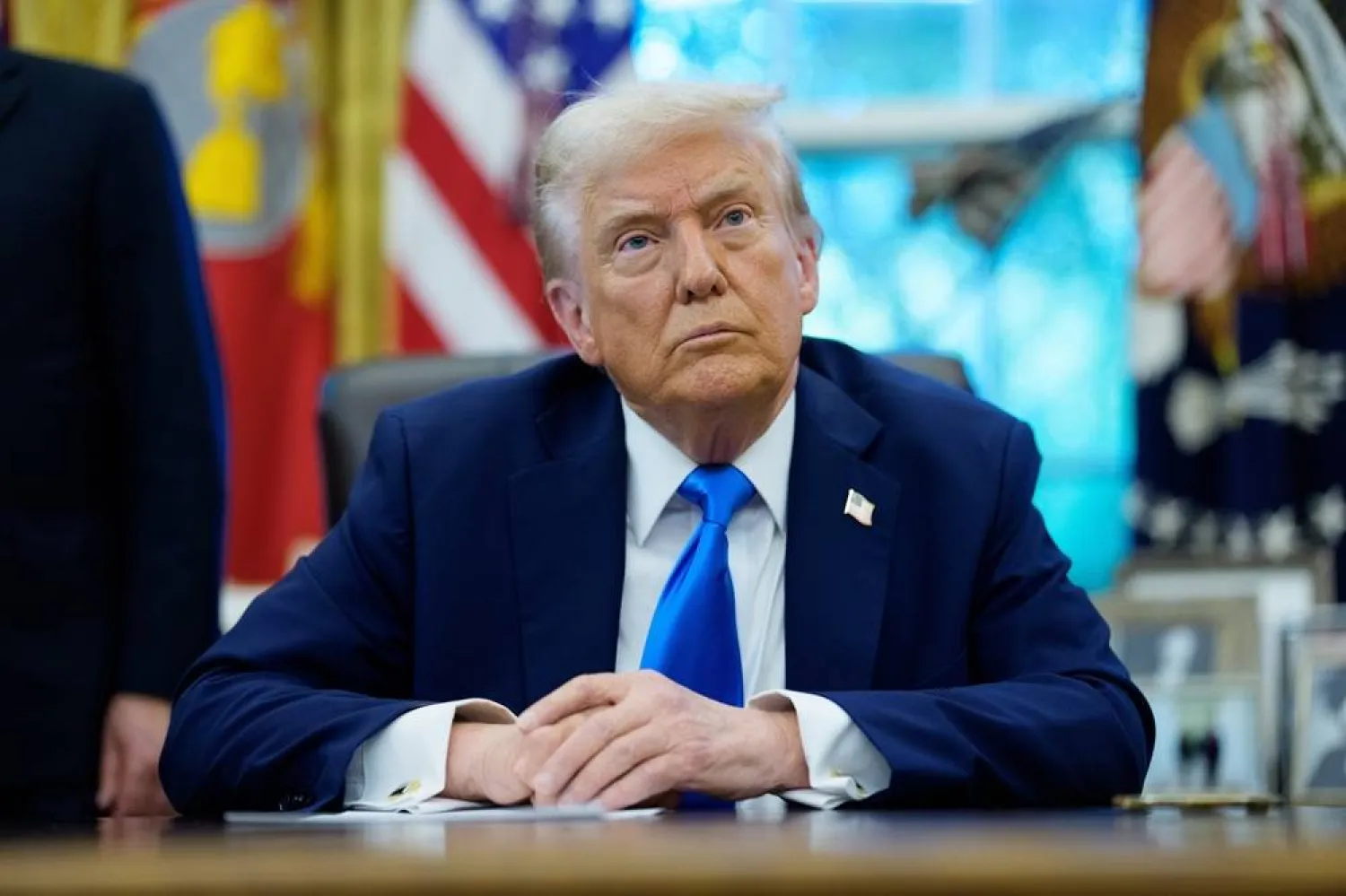
United States President Donald J Trump looks on to the media during an Executive Order signing which authorizes the new Trump Gold Card, a visa program to be overseen by the Secretary of Commerce 'that will facilitate the entry of aliens who have demonstrated their ability and desire to advance the interests of the United States by voluntarily providing a significant financial gift to the nation' in the Oval Office of the White House in Washington, DC, USA, 19 September 2025. (EPA)
TT

Trump to Impose $100,000 Fee Per Year for H-1B Visas, in Blow to Tech

United States President Donald J Trump looks on to the media during an Executive Order signing which authorizes the new Trump Gold Card, a visa program to be overseen by the Secretary of Commerce 'that will facilitate the entry of aliens who have demonstrated their ability and desire to advance the interests of the United States by voluntarily providing a significant financial gift to the nation' in the Oval Office of the White House in Washington, DC, USA, 19 September 2025. (EPA)

The Trump administration said on Friday it would ask companies to pay $100,000 per year for H-1B worker visas, prompting some big tech companies to warn visa holders to stay in the US or quickly return.
The change could deal a big blow to the technology sector that relies heavily on skilled workers from India and China, said Reuters.
Since taking office in January, Trump has kicked off a wide-ranging immigration crackdown, including moves to limit some forms of legal immigration. The step to reshape the H-1B visa program represents his administration's most high-profile effort yet to rework temporary employment visas.
"If you're going to train somebody, you're going to train one of the recent graduates from one of the great universities across our land," said Commerce Secretary Howard Lutnick. Train Americans. Stop bringing in people to take our jobs."
Trump's threat to crack down on H-1B visas has become a major flashpoint with the tech industry, which contributed millions of dollars to his presidential campaign.
Microsoft, JPMorgan and Amazon responded to the announcement by advising employees holding H-1B visas to remain in the United States, according to internal emails reviewed by Reuters.
They advised employees on the H-1B visas who were outside the US to return before midnight on Saturday (0400 GMT on Sunday), when the new fee structures are set to take effect.
"H-1B visa holders who are currently in the US should remain in the US and avoid international travel until the government issues clear travel guidance," read an email sent to JPMorgan employees by Ogletree Deakins, a company that handles visa applications for the US investment bank.
Microsoft, JPMorgan, law firm Ogletree Deakins, which represents the bank on the issue, and Amazon did not immediately respond to Reuters requests for comment.
Critics of the H-1B program, including many US technology workers, argue that it allows firms to suppress wages and sideline Americans who could do the jobs. Supporters, including Tesla CEO and former Trump ally Elon Musk, say it brings in highly skilled workers essential to filling talent gaps and keeping firms competitive. Musk, himself a naturalized US citizen born in South Africa, has held an H-1B visa.
Some employers have exploited the program to hold down wages, disadvantaging US workers, according to the executive order Trump signed on Friday.
The number of foreign science, technology, engineering and mathematics (STEM) workers in the US more than doubled between 2000 and 2019 to nearly 2.5 million, even as overall STEM employment only increased 44.5% during that time, it said.
MOVE COULD DETER GLOBAL TALENT
Adding new fees "creates disincentive to attract the world's smartest talent to the US," said Deedy Das, partner at venture capital firm Menlo Ventures, on X. "If the US ceases to attract the best talent, it drastically reduces its ability to innovate and grow the economy."
The move could add millions of dollars in costs for companies, which could hit smaller tech firms and start-ups particularly hard.
Reuters was not immediately able to establish how the fee would be administered. Lutnick said the visa would cost $100,000 a year for each of the three years of its duration but that the details were "still being considered."
Under the current system, entering the lottery for the visa requires a small fee and, if approved, subsequent fees could amount to several thousand dollars.
Some analysts suggested the fee may force companies to move some high-value work overseas, hampering America's position in the high-stakes artificial intelligence race with China.
"In the short term, Washington may collect a windfall; in the long term, the US risks taxing away its innovation edge, trading dynamism for short-sighted protectionism," said eMarketer analyst Jeremy Goldman.
INDIA ACCOUNTS FOR MOST H-1B VISAS
India was the largest beneficiary of H-1B visas last year, accounting for 71% of approved beneficiaries, while China was a distant second at 11.7%, according to government data.
In the first half of 2025, Amazon.com and its cloud-computing unit, AWS, had received approval for more than 12,000 H-1B visas, while Microsoft and Meta Platforms had over 5,000 H-1B visa approvals each.
Lutnick said on Friday that "all the big companies are on board" with $100,000 a year for H-1B visas.
"We've spoken to them," he said.
Many large US tech, banking and consulting companies declined to comment or did not immediately respond to requests for comment. The Indian embassy in Washington and the Chinese Consulate General in New York also did not immediately respond to requests for comment.
Shares of Cognizant Technology Solutions, an IT services company that relies extensively on H-1B visa holders, closed down nearly 5%. US-listed shares of Indian tech firms Infosys and Wipro closed between 2% and 5% lower.
IMMIGRATION CRACKDOWN
Aaron Reichlin-Melnick, policy director of the American Immigration Council, questioned the legality of the new fees. "Congress has only authorized the government to set fees to recover the cost of adjudicating an application," he said on Bluesky.
The H-1B program offers 65,000 visas annually to employers bringing in temporary foreign workers in specialized fields, with another 20,000 visas for workers with advanced degrees.
Nearly all the visa fees have to be paid by the employers. The H-1B visas are approved for a period of three to six years.
Trump also signed an executive order on Friday to create a "gold card" for individuals who can afford to pay $1 million for US permanent residency.



Business-Friendly Climate Draws 123,000 New Commercial Registrations in Saudi Arabia

 Employees at the Saudi Business Center (SPA). 
 Employees at the Saudi Business Center (SPA). 
TT

Business-Friendly Climate Draws 123,000 New Commercial Registrations in Saudi Arabia

 Employees at the Saudi Business Center (SPA). 
 Employees at the Saudi Business Center (SPA). 

Saudi Arabia’s business environment attracted 123,000 new commercial registrations in the fourth quarter of 2025, pushing the total number of active registrations past 1.8 million by year-end. Foreign investment in the healthcare sector surged by nearly 560 percent over the past three years, highlighting strong international confidence in the Saudi market.

According to a recent report by the Ministry of Commerce, reviewed by Asharq Al-Awsat, the number of active sole proprietorship registrations reached 1.26 million by the end of 2025, reflecting 20 percent growth over the past five years.

Active limited liability companies (LLCs) totaled 571,000, with a sharp 183 percent increase over five years. Meanwhile, the number of joint-stock companies grew 50 percent over the same period to 4,733 active registrations.

Regional and Sectoral Performance

Riyadh led the Kingdom in new commercial registrations during the final quarter of 2025 with 45,600 records, followed by the Eastern Province with more than 20,000, and Makkah Region with 19,200.

The construction sector topped all industries, with more than 66,000 registrations issued during the quarter. It was followed by wholesale and retail trade with 24,900, and manufacturing industries with 23,700, while the remainder was spread across other activities.

The report also highlighted a strong rise in e-commerce sales conducted via Mada cards in October, which hit a record SAR 30.7 billion ($8.1 billion) - a 68 percent year-on-year increase, up SAR 12.4 billion ($3.3 billion) from October 2024, according to data from the Saudi Central Bank (SAMA).

Healthcare Sector Momentum

The Ministry of Commerce said Saudi Arabia continues to roll out development projects aimed at improving healthcare quality and capacity by strengthening national talent, adopting innovative digital solutions, and upgrading medical facilities.

The Kingdom ranks first regionally in healthcare investment, with agreements signed at the recent Global Health Exhibition in Riyadh valued at about SAR 133 billion ($35.4 billion). Foreign investment in the sector has expanded by more than 560 percent in three years, with healthcare contributing 5 percent of GDP.

Healthcare-related activities saw strong growth in the fourth quarter, including medical laboratories (+33%), pharmaceutical manufacturing (+31%), physiotherapy centers (+31%), and telemedicine and remote care services (+30%).

E-Commerce and High-Growth Sectors

Active e-commerce registrations rose 9 percent year-on-year to 43,800 by the end of the fourth quarter, up from 40,000 in the same period of 2024. Strengthening the e-commerce ecosystem is a key objective of the National Transformation Program, with Saudi Arabia ranked among the world’s top 10 fastest-growing e-commerce markets.

Promising sectors highlighted by the report include artificial intelligence, gaming, cybersecurity, health software, and electric vehicle charging stations. AI-related registrations grew 34 percent to more than 19,000, while gaming rose 27 percent to 841 registrations. UI/UX design activities climbed 28 percent to 18,900.

Cybersecurity registrations increased 27 percent to 9,700, while health and medical software surged 85 percent to 4,300. Power generation and distribution activities grew 27 percent, and EV charging station operations expanded 26 percent to 4,300 registrations.

Investment Deals and Forums

The report cited the success of the Biban Forum, recently held in Riyadh, which generated agreements and launches exceeding SAR 38 billion ($10.1 billion). Investment deals worth SAR 22.2 million ($5.9 million) benefited 55 startups, with participation from 1,021 companies across 66 countries.

It also highlighted the Northern Borders Forum, which offered more than 240 investment opportunities valued at SAR 40 billion ($10.6 billion) across sectors including livestock, food, mining and energy, tourism, environment, and logistics.


SABIC Reshapes Global Footprint With $950m Divestment Deals

A SABIC employee (company website) 
TT

SABIC Reshapes Global Footprint With $950m Divestment Deals

A SABIC employee (company website) 

Saudi Basic Industries Corporation (SABIC) has announced a major overhaul of its global portfolio, accelerating its exit from petrochemical and engineering plastics assets in Europe and the Americas through two divestment deals worth a combined $950 million.

The move marks a fundamental shift in the company’s operating model and investment identity. It comes as part of an intensive portfolio-optimization program launched in 2022, aimed at boosting returns on capital, freeing up cash, and refocusing investments on higher-growth markets and more sustainable profit margins.

Following the announcement, SABIC shares came under heavy selling pressure on Thursday, falling to 48.78 riyals — their lowest level since April 2009. The decline reflected investor reaction to deal details that include non-cash losses of about $4.88 billion (18.3 billion riyals), stemming from the fair-value revaluation of divested assets. These charges are expected to weigh on the company’s fourth-quarter 2025 results.

While the market response was cautious, analysts say the accounting hit represents a necessary short-term sacrifice to build a leaner, more competitive company aligned with the new centers of global economic growth in East Asia. The divestments also fit within SABIC’s longer-term strategic shift that began in 2020, when Saudi Aramco acquired a 70% stake in the company from the Public Investment Fund for $69.1 billion in the largest deal in the history of the Saudi stock market.

Focus on Higher-Margin Markets

According to SABIC, the first transaction involves the sale of its European petrochemicals business to investment firm AEQUITA for an enterprise value of $500 million. The second covers the sale of its thermoplastics engineering plastics business in Europe and the Americas to Mutares SE & Co. KGaA for $450 million, with potential additional payments linked to future free cash flow over the next four years or a subsequent resale of the business.

SABIC said the transactions represent a key step in reshaping its portfolio, sharpening its focus on higher-margin markets and products with strong competitive advantages, while redeploying capital into opportunities that deliver stronger returns and improved free cash flow. The company stressed that the divestments will not detract from its commitment to technology and innovation or its ability to serve customers worldwide.

Short-Term Pain, Long-Term Gain

SABIC chairman Khalid Al-Dabbagh described the deals as a “transformational step” in the company’s strategy to maximize shareholder value by strengthening cash generation.

Chief executive Abdulrahman Al-Fageeh said the transactions extend the portfolio-optimization program launched in 2022, which included earlier exits from functional forms and the Hadeed and Alba businesses. He said the strategy allows SABIC to reshape its portfolio more effectively and concentrate on areas where it has clear and sustainable competitive advantages in a rapidly changing global environment.

For his part, Chief financial officer Salah Al-Hareky added that the divestments reflect SABIC’s disciplined approach to capital management. Freeing up capital for redeployment into higher-return opportunities, he said, will improve capital efficiency and enhance returns over the medium to long term.

Assets Involved

The European petrochemicals business being sold includes the production and marketing of ethylene, propylene, polyethylene, polypropylene and value-added polymer compounds, with manufacturing sites in the UK, the Netherlands, Germany and Belgium.

The engineering thermoplastics deal covers SABIC assets producing materials such as polycarbonate, polybutylene terephthalate and ABS resins, with manufacturing facilities in the United States, Mexico, Brazil, Spain and the Netherlands. Mutares co-founder and chief executive Robin Laik said the priority after completion will be ensuring business continuity and supporting employees during the transition, while unlocking the full potential of the assets as a standalone platform.

Completion of both transactions remains subject to customary conditions and regulatory approvals, including employee consultations where required. SABIC expects the deals to close in the second half of 2026.

Analysts see the exits from lower-return assets as a catalyst for improved margins and stronger free cash flow, positioning SABIC for a more resilient and profitable phase beyond the near-term pressures on its share price.


Lebanon Signs Gas Exploration Deal with International Consortium Amid Economic Crisis

In this photo released by the Lebanese Government press office, Lebanese Prime Minister Nawaf Salam, right background, attends the signing of an international consortium deal for gas exploration in the cost of southern Lebanon between the Lebanese government and representing officials from the international consortium consisting of France's Total, Italy's ENI, and state-owned oil and gas company Qatar Energy, in Beirut, Lebanon, Friday, Jan. 9, 2026. (Lebanese Government press office via AP)
TT

Lebanon Signs Gas Exploration Deal with International Consortium Amid Economic Crisis

In this photo released by the Lebanese Government press office, Lebanese Prime Minister Nawaf Salam, right background, attends the signing of an international consortium deal for gas exploration in the cost of southern Lebanon between the Lebanese government and representing officials from the international consortium consisting of France's Total, Italy's ENI, and state-owned oil and gas company Qatar Energy, in Beirut, Lebanon, Friday, Jan. 9, 2026. (Lebanese Government press office via AP)

Lebanon ’s government on Friday signed a deal with an international consortium to explore gas in an offshore area bordering Israel. 

The deal for exploration at the so-called Block 8 off the coast of southern Lebanon comes after Lebanon and Israel signed a 2022 agreement over their maritime border. The new deal is the latest to be granted by Lebanon to international companies to search for gas in its territorial waters. 

Cash-strapped Lebanon hopes that future gas discoveries will help the country pull itself out of the worst economic and financial crisis in its modern history. 

The deal was signed at the government’s headquarters in downtown Beirut by Energy Minister Joe Saddi from the Lebanese side and officials from the international consortium consisting of France’s TotalEnergies, Italy’s ENI, and state-owned oil and gas company Qatar Energy. 

TotalEnergies said in a statement that the consortium plans to start with a 1,200-square kilometer (463 square mile) 3D seismic survey to assess the area’s exploration potential. 

In 2017, Lebanon approved licenses for France’s TotalEnergies, Italy’s ENI and Russia’s Novatek to move forward with offshore oil and gas development for two of 10 blocks in the Mediterranean Sea, including one that was at the time in a disputed part with neighboring Israel. 

The companies did not find viable amounts of oil and gas in one of the blocks north of Beirut, and drilling in another in the south was repeatedly postponed because of the maritime border dispute with Israel. Lebanon and Israel later signed a deal over their maritime border in 2022. 

In August 2023, an offshore drilling rig began operations in the Mediterranean Sea off Lebanon’s coast. 

That did not give positive results, but Patrick Pouyanné, Chairman and CEO of TotalEnergies, said in a statement that they will keep trying in other areas. 

“We remain committed to pursue our exploration activities in Lebanon,” said Pouyanné. “We will now focus our efforts on Block 8, together with our partners Eni and QatarEnergy and in close cooperation with Lebanese authorities.” 

On Oct. 8, 2023 Lebanon’s Hezbollah started firing rockets toward Israeli posts along the border to back its Hamas allies a day after the Palestinian group attacked southern Israel. The war lasted 14 months during which Hezbollah was severely weakened. 

In January 2023, Lebanon, ENI, TotalEnergies and state-owned oil and gas company Qatar Energy signed an agreement in which the Qatari firm replaced Novatek. Under the deal, Qatar Energy takes Novatek’s 20% stake in addition to 5% each from ENI and TotalEnergies, leaving the Arab company with a total stake of 30%. TotalEnergies and ENI will each have 35% stakes.