


Israeli Strikes on Gaza City Kill at Least 14 as Some Countries Move to Recognize Palestinian State

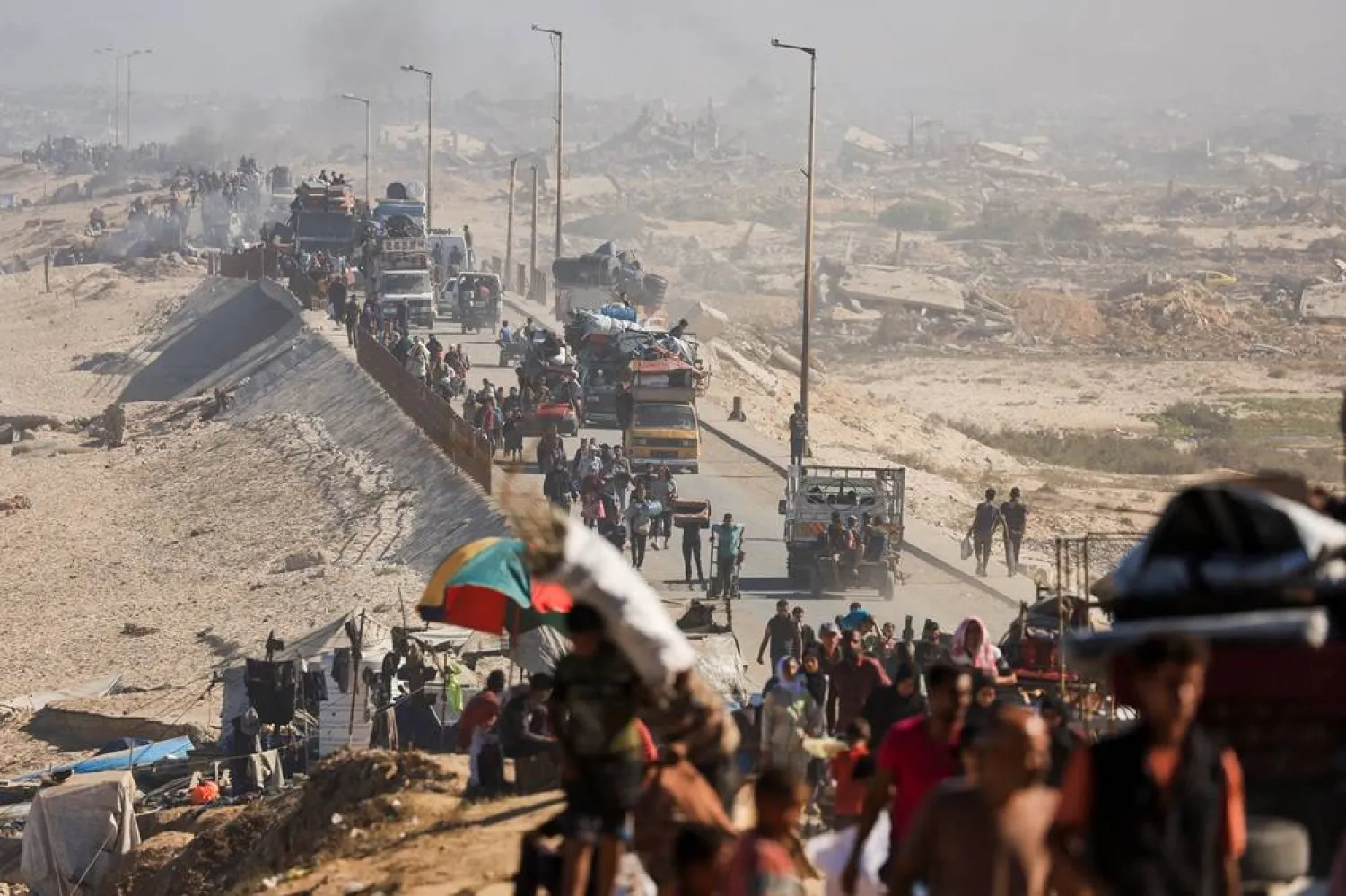
 Displaced Palestinians, fleeing northern Gaza due to an Israeli military operation, move southwards after Israeli forces ordered residents of Gaza City to evacuate to the south, in the central Gaza Strip, September 20, 2025. (Reuters)
Displaced Palestinians, fleeing northern Gaza due to an Israeli military operation, move southwards after Israeli forces ordered residents of Gaza City to evacuate to the south, in the central Gaza Strip, September 20, 2025. (Reuters)
TT

Israeli Strikes on Gaza City Kill at Least 14 as Some Countries Move to Recognize Palestinian State

 Displaced Palestinians, fleeing northern Gaza due to an Israeli military operation, move southwards after Israeli forces ordered residents of Gaza City to evacuate to the south, in the central Gaza Strip, September 20, 2025. (Reuters)
Displaced Palestinians, fleeing northern Gaza due to an Israeli military operation, move southwards after Israeli forces ordered residents of Gaza City to evacuate to the south, in the central Gaza Strip, September 20, 2025. (Reuters)

Israeli strikes killed at least 14 people overnight in Gaza City, said health officials, as Israel ramps up its offensive there and urges Palestinians to leave.

The strikes come as Western countries are increasingly fed up with the intensifying war in Gaza with some moving to recognize Palestinian statehood at the gathering of world leaders at the United Nations General Assembly next week. In a statement Friday, Portugal’s Foreign Affairs Ministry said it will recognize a Palestinian state on Sunday. The Iberian country had previously announced its plans to do so but has now set an official date.

Portugal is among other Western nations, including the UK, Canada, Australia, Malta, Belgium and Luxembourg. expected to recognize Palestinian statehood in the coming days.

The latest Israeli operation, which started this week, further escalates a conflict that has roiled the Middle East and likely pushes any ceasefire farther out of reach. The Israeli military, which says it wants to “destroy Hamas’ military infrastructure,” hasn’t given a timeline for the offensive, but there were indications it could take months.

Israeli bombardment over the past 23 months has killed more than 65,000 people in Gaza, destroyed vast areas of the strip, displaced around 90% of the population and caused a catastrophic humanitarian crisis, with experts saying Gaza City is experiencing famine.

Dr. Rami Mhanna, the managing director of Shifa Hospital, where some of the bodies were brought, said the dead included six people from the same family after a strike hit their home early Saturday morning. They were relatives of the hospital’s director, Dr. Mohamed Abu Selmiya, he said.

The Palestinian Red Crescent said five other people were killed in another strike close to Shawa Square.

Israel's military didn't immediately respond to questions about the strikes.

In recent days, Israel has been urging hundreds of thousands of Palestinians sheltering in Gaza City to move south to what it calls a humanitarian zone.

Palestinians have streamed out of the city — some by car, others on foot. Israel opened another corridor south of Gaza City for two days this week to allow more people to evacuate. But many Palestinians in the famine-stricken city are unwilling to be uprooted again, too weak to leave or unable to afford the cost of moving.

Aid groups have warned that forcing thousands of people to evacuate will exacerbate the dire humanitarian crisis. They are urging for a ceasefire so aid can reach those who need it.

On Friday, UNICEF said lifesaving therapeutic food meant for thousands of children in Gaza was stolen from four of its trucks. The statement said armed individuals approached the trucks outside their compound in Gaza City, the drivers were held at gunpoint while the food was taken.

“They were intended to treat malnourished children in Gaza City where famine is declared ... it was a life-saving shipment amid the severe restrictions on aid delivery to Gaza City,” said Ammar Ammar, a spokesperson for UNICEF.

In a statement Friday, Israel's army blamed Hamas for stealing the food.

Israel accuses Hamas of siphoning off aid and using it to fund its military activities, without providing evidence. The UN says there are mechanisms in place that prevent any significant diversion of aid.

The death count in Gaza has climbed over 65,100, according to Gaza’s Health Ministry, which is part of the Hamas-run government, since the Oct. 7, 2023, attack by Hamas that triggered the war. The ministry does not say how many of the dead were civilians or fighters. Its figures are seen as a reliable estimate by the UN and many independent experts.

Hamas-led fighters stormed into southern Israel in the 2023 attack, killing around 1,200 people, mostly civilians, and abducting 251 others. Forty-eight hostages remain in Gaza, with fewer than half believed to be alive.



Paris Urges Baghdad to Avoid Being Dragged in Regional Escalation

 Iraqi Foreign Minister Fuad Hussein (R) shake hands as he receives French Foreign Minister Jean-Noel Barrot (L) upon his arrival for an official visit to Baghdad on February 5, 2026. (AFP)
Iraqi Foreign Minister Fuad Hussein (R) shake hands as he receives French Foreign Minister Jean-Noel Barrot (L) upon his arrival for an official visit to Baghdad on February 5, 2026. (AFP)
TT

Paris Urges Baghdad to Avoid Being Dragged in Regional Escalation

 Iraqi Foreign Minister Fuad Hussein (R) shake hands as he receives French Foreign Minister Jean-Noel Barrot (L) upon his arrival for an official visit to Baghdad on February 5, 2026. (AFP)
Iraqi Foreign Minister Fuad Hussein (R) shake hands as he receives French Foreign Minister Jean-Noel Barrot (L) upon his arrival for an official visit to Baghdad on February 5, 2026. (AFP)

French diplomatic sources said Paris has warned of the risks posed by the involvement of Iraqi armed factions in any potential regional escalation, stressing that Iraq should not be drawn into conflicts that do not serve its national interests at a time of mounting regional tensions.

The sources told Asharq Al-Awsat on Friday that the warning was among the messages delivered by French Foreign Minister Jean-Noel Barrot during his visit to Baghdad on Thursday, where he held talks with Prime Minister Mohammed Shia al-Sudani and Foreign Minister Fuad Hussein. The trip marked Barrot’s second official visit to Iraq in less than a year.

According to the sources, the French minister underscored that the stability and security achieved in Iraq “with great patience and effort” should not be jeopardized under any circumstances.

He cautioned that the involvement of non-state armed groups in regional confrontations could undermine Iraq’s recovery and threaten the security of both the country and the wider region.

The stance echoed remarks Barrot made to news agencies in Baghdad on Thursday, in which he said France’s priority in the region remains the fight against ISIS and preventing its resurgence.

Any security deterioration, whether in Iraq or in camps and prisons in northeastern Syria, would benefit the group, he warned.

Barrot said France is working with its partners to ensure continued security at these sites, adding that a collapse there “would not serve anyone’s interests.”

He praised Iraq’s efforts to receive detainees linked to ISIS, calling it a crucial step in international efforts to address one of the most sensitive post-conflict files.

For his part, Hussein reiterated Baghdad’s commitment to continued cooperation with the international coalition against terrorism, emphasizing Iraq’s determination to safeguard internal stability and steer clear of regional power struggles.

Iraqi foreign policy is based on balance and building relations with all partners to shield the country from regional tensions, he stressed.

The talks also addressed Iran, amid fears of escalation and its potential repercussions for Iraq.

Barrot urged the need for Tehran to respond to a US proposal for negotiations and to make substantive concessions on its nuclear program, ballistic arsenal, and destabilizing regional activities, while ending repressive policies.

Iraq, he said, must stay out of any regional confrontation.

Paris and Baghdad are also aligned on Syria, supporting a peaceful, inclusive political transition involving all components of Syrian society, alongside continued efforts to combat ISIS and prevent its return to liberated areas, he added.

French sources said Paris’ core message was to shield Iraq from being pulled into any regional escalation and to preserve its stability.


Damascus Moves to Implement SDF Deal amid Regional and International Backing

Fighters from the Syrian Democratic Forces welcome a convoy of the Syrian Ministry of Interior heading to Qamishli in northeastern Syria. (AP)
TT

Damascus Moves to Implement SDF Deal amid Regional and International Backing

Fighters from the Syrian Democratic Forces welcome a convoy of the Syrian Ministry of Interior heading to Qamishli in northeastern Syria. (AP)

Damascus is pressing ahead with steps to implement its agreement with the Syrian Democratic Forces (SDF) on the gradual integration of its fighters, redeployment in northeastern Syria, and the return of key facilities to state control.

The deal is receiving regional and international support and is being framed as an opportunity to integrate Syria’s Kurds into state institutions and help build a “new Syria.”

On Friday, a delegation from the Syrian Ministry of Defense was in Hasakah to discuss practical measures for incorporating SDF personnel into the national military, said the ministry’s Media and Communications Directorate.

The move is in line with the agreement announced on Jan. 29 between the Syrian government and the SDF. The accord includes a ceasefire, the gradual integration of Kurdish military and administrative structures into state institutions, and the restoration of government control over vital installations in the province.

Interior Ministry spokesman Nour al-Din al-Baba said the deployment of Internal Security Forces in Qamishli, in northeastern Syria, is proceeding under a clear timeline and operational plan to complete the agreement’s implementation.

This includes taking over and managing strategic facilities such as border crossings, Qamishli International Airport, and oil fields, with the aim of reactivating them “in service of the Syrian people,” he said in statements carried by state television Al-Ikhbariya.

Al-Baba added that the deployment is being carried out “in coordination with the other side in the city,” referring to the SDF, following a similar security deployment in Hasakah.

The agreement is also expected to address the issue of foreign fighters and to integrate the local Kurdish internal security force, known as the Asayish, into the Interior Ministry.

Al-Baba stressed that the ministry welcomes “all Syrian national cadres who serve the people.”

French support

French diplomatic sources told Asharq Al-Awsat that French Foreign Minister Jean-Noel Barrot informed SDF commander Mazloum Abdi that Paris wants to the January 29 agreement implemented “clause by clause” over the long term.

Barrot, who visited Iraq, Syria and Lebanon this week, described the deal as a “historic opportunity” for Syria’s Kurds to take part in building a new Syria alongside other components of society, the sources said.

The FM also discussed developments in Syria with leaders of Iraq’s Kurdistan Region, acknowledging their role in securing the ceasefire between Damascus and the SDF and agreeing to maintain close coordination to ensure the agreement’s success.

On Friday, Kurdistan Democratic Party leader Masoud Barzani met with Abdi and urged both the Syrian government and SDF to commit to the agreement.

A statement from Barzani’s office said the talks focused on conditions in northeastern Syria and underlined coordination among all parties to safeguard Kurdish rights within the country’s constitutional framework.


Axios: US Plans Meeting for Gaza 'Board of Peace' in Washington on Feb 19

Trump and leaders and representatives of the countries participating in the signing of the founding charter of the “Peace Council” in Davos (AFP - Archive)
TT

Axios: US Plans Meeting for Gaza 'Board of Peace' in Washington on Feb 19

Trump and leaders and representatives of the countries participating in the signing of the founding charter of the “Peace Council” in Davos (AFP - Archive)

The White House is planning the first leaders meeting for President Donald Trump's so-called "Board of Peace" in relation to Gaza on February 19, Axios reported on Friday, citing a US official and diplomats from four countries that are on the board.

The plans for the meeting, which would also be a fundraising conference for Gaza reconstruction, are in early stages and could still change, Axios reported.

The meeting is planned to be held at the US Institute of Peace in Washington, the report added, noting that Israeli Prime ‌Minister Benjamin Netanyahu ‌is scheduled to meet Trump at the ‌White ⁠House on ‌February 18, a day before the planned meeting.

The White House and the US State Department did not respond to requests for comment.

In late January, Trump launched the board that he will chair and which he says will aim to resolve global conflicts, leading to many experts being concerned that such a board could undermine the United Nations, Reuters said.

Governments around ⁠the world have reacted cautiously to Trump's invitation to join that initiative. While some ‌of Washington's Middle Eastern allies have joined, many ‍of its traditional Western allies have ‍thus far stayed away.

A UN Security Council resolution, adopted in ‍mid-November, authorized the board and countries working with it to establish an international stabilization force in Gaza, where a fragile ceasefire began in October under a Trump plan on which Israel and Palestinian militant group Hamas signed off.

Under Trump's Gaza plan revealed late last year, the board was meant to supervise Gaza's temporary governance. Trump thereafter said ⁠it would be expanded to tackle global conflicts.

Many rights experts say that Trump overseeing a board to supervise a foreign territory's affairs resembled a colonial structure and have criticized the board for not including a Palestinian.

The fragile ceasefire in Gaza has been repeatedly violated, with over 550 Palestinians and four Israeli soldiers reported killed since the truce began in October.

Israel's assault on Gaza since late 2023 has killed over 71,000 Palestinians, caused a hunger crisis and internally displaced Gaza's entire population.

Multiple rights experts, scholars and a UN inquiry say it amounts to genocide. Israel calls its actions self-defense after Hamas-led ‌militants killed 1,200 people and took over 250 hostages in a late 2023 attack.