


Winner of the AlMusalla Prize and the Great Mosque of Bukhara: A Meeting of Architectural Design and Spirituality.

AlMusalla at the Bukhara Biennial. (SPA)
TT

Winner of the AlMusalla Prize and the Great Mosque of Bukhara: A Meeting of Architectural Design and Spirituality.

AlMusalla at the Bukhara Biennial. (SPA)

In the inaugural edition of the Bukhara Biennial, Saudi Arabia is represented through its artists and culture. A dramatic example is the winner of the AlMusalla Prize, which was first unveiled at the Jeddah Islamic Art Biennale earlier this year. Called "On Weaving", it was created by a team comprising Studio East Architecture, the international engineering firm AKT II, and artist Rayyane Tabet.

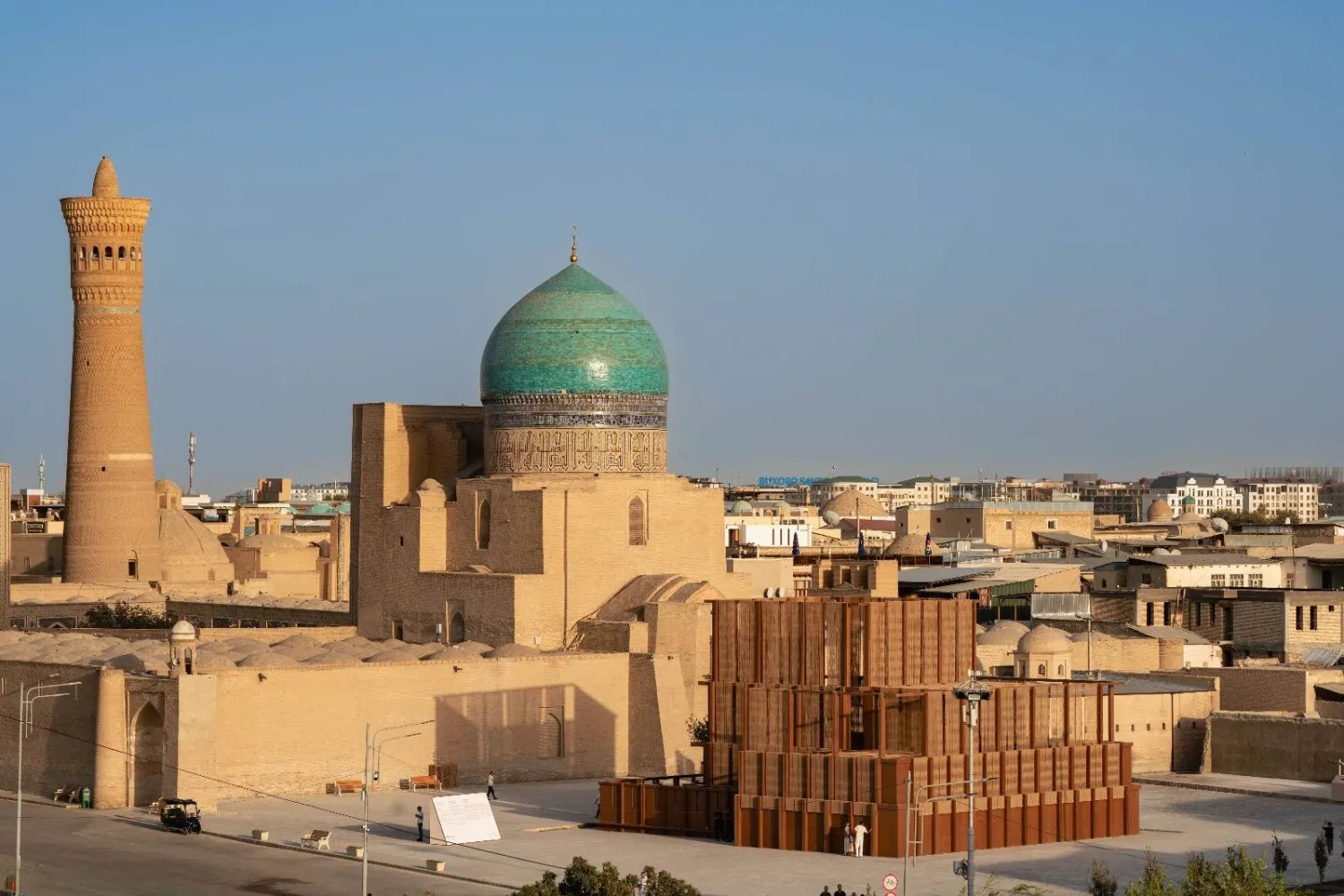
The prize-winning design is displayed outside the walls of Bukhara’s Great Mosque, its iconic blue dome providing a stunning backdrop to the installation. This juxtaposition of the historic 16th-century building with a completely modern feature, crafted from palm waste and inspired by traditional weaving techniques, creates a remarkable visual conversation, opening up avenues for discussion, contemplation and comparison.

The Art of Utilizing Open Spaces

Inside the installation, I met Nicolas Fayyad, co-founder of the East Architecture Studio. Our conversation focuses on the new design and how open spaces can be utilized to create areas for worship, gathering and contemplation.

"We looked at the open space of the Great Mosque in Bukhara," he said, "and asked ourselves how to bring open spaces within the city to life. Placing the installation next to the Great Mosque was a way of framing this idea and exploring the use of space, from the vast courtyard within the old mosque to the smaller spaces surrounding it. We see these spaces as more than just places of prayer; they allow for gatherings, meetings and contemplation."

How does the design team view this juxtaposition of two buildings, separated by centuries of history and architectural styles? To answer this question, I turned to Christopher Blust, design director at AKT II. "Since both buildings are oriented towards Makkah," he explained, "this proximity is not accidental; the direction of the qibla (prayer direction) created this view. I think this juxtaposition has created a wonderful visual effect."
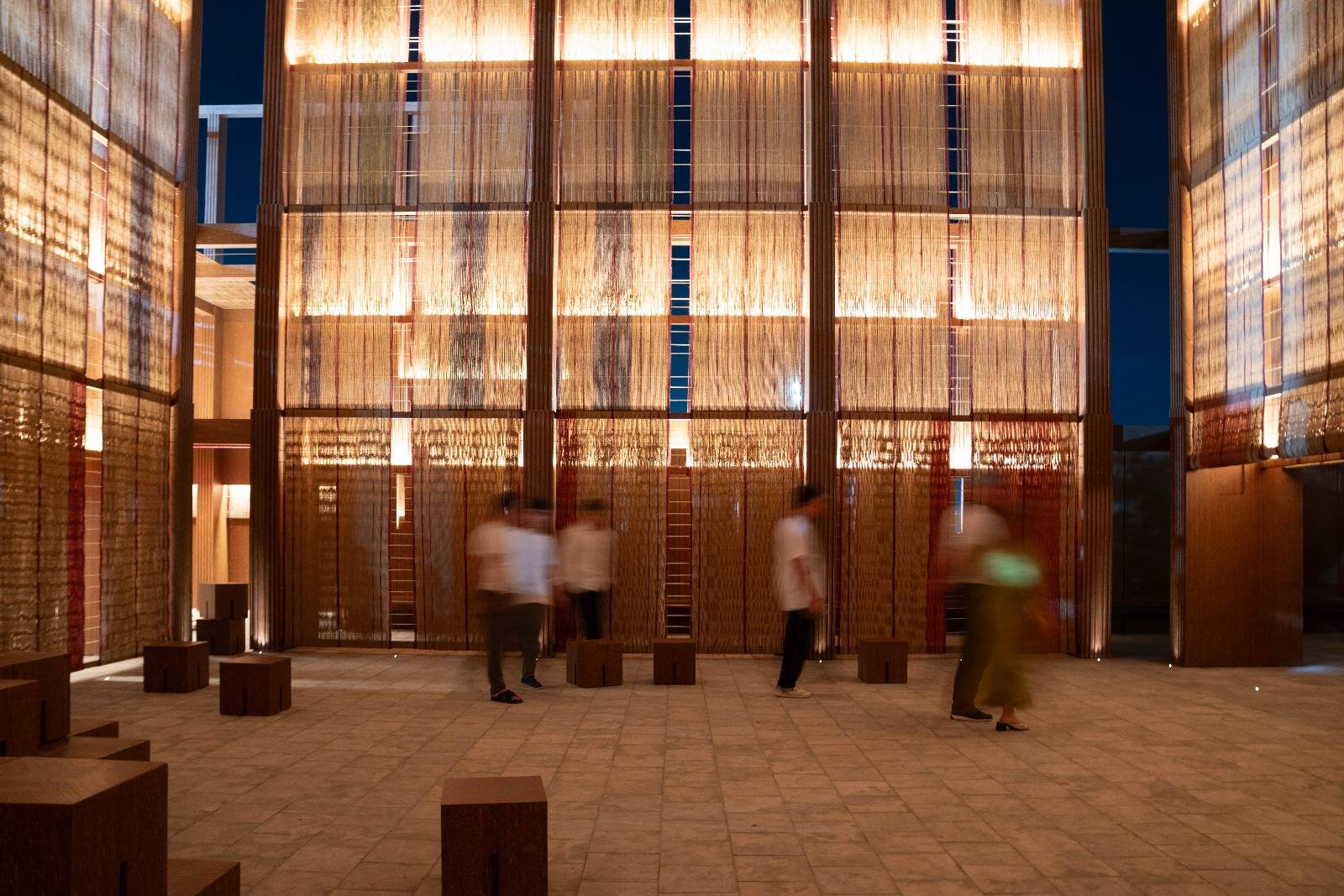
The use of open spaces is among the features of the design. (Photography by Sara Saad, Courtesy of Diriyah Biennale Foundation)

A Dialogue of Architecture and Design

Fayyad added: "There is also a dialogue that emerges between the two. Perhaps the first thing that comes to mind is the integration of two buildings from different backgrounds. Yet, upon closer observation, we feel that the two buildings are not strangers to each other. In a way, they complement each other."

And yet it’s hardly obvious what a 21st-century building and a 16th-century building have in common. "I think this is an important point," said Fayyad. "It’s closely related to the research we conducted. I see this courtyard as the unifying element between the two designs. There is a stylistic similarity and a dialogue between them. In Islamic societies, the courtyard wasn’t solely used for gatherings. It was sometimes used as a study hall. And other spaces, such as halls or prayer rooms, surrounded it."

Blust added that the design has connections to Jeddah. "We must remember that the materials used in constructing this prayer hall were inspired by the original building techniques there, from 200 or 300 years ago, and the materials used back then, such as mud, stone, and wood, are also present in this building."
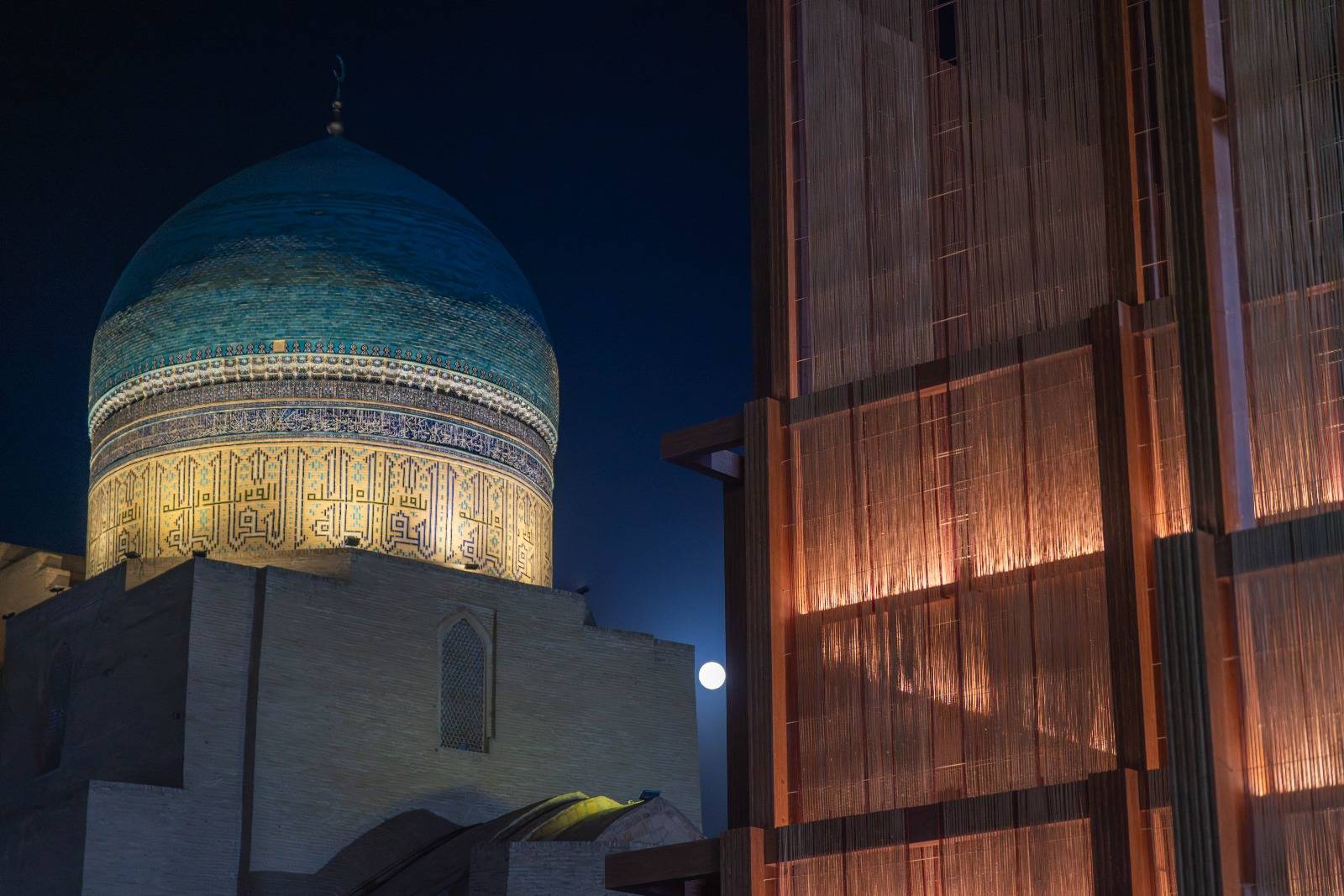
AlMusalla at the Bukhara Biennial. (Photography by Sara Saad, Courtesy of Diriyah Biennale Foundation)

It’s no surprise that the installation bears the imprint of its original location. However, it also establishes connections with the place to which it has been transported. How do the designers view this?

Fayyaz sees the connection between the new work and the Great Mosque in Bukhara, firstly geographically, and secondly through the shared history that binds them. Bukhara may be a new environment, but it is closely related to the original setting, as both cities share a rich history of openness to ideas and cultures from near and far.

Jeddah's location on the Red Sea made it a transit point for pilgrims on their way to the holy cities of Makkah and Madinah to perform the Hajj and Umrah rituals, and a destination for Muslims from all over the world, thus contributing to its unique cultural identity. At the same time, Bukhara served as a center of learning and knowledge along the Silk Road, fostering religious, scientific, artistic, architectural, and commercial exchange.

The design underwent a similar juxtaposition in Venice, where it was erected in the courtyard of the San Gregorio monastery as part of an exhibition called "Transitory and Rooted." The occasion was the 19th International Architecture Exhibition. This fact serves to highlight the design's flexibility, its ability to be disassembled, reassembled and reused. Fayyadh believed that the exhibition in Venice was "a beautiful dialogue between a Renaissance building and a piece from Saudi Arabia. The interaction between these two elements was very interesting."
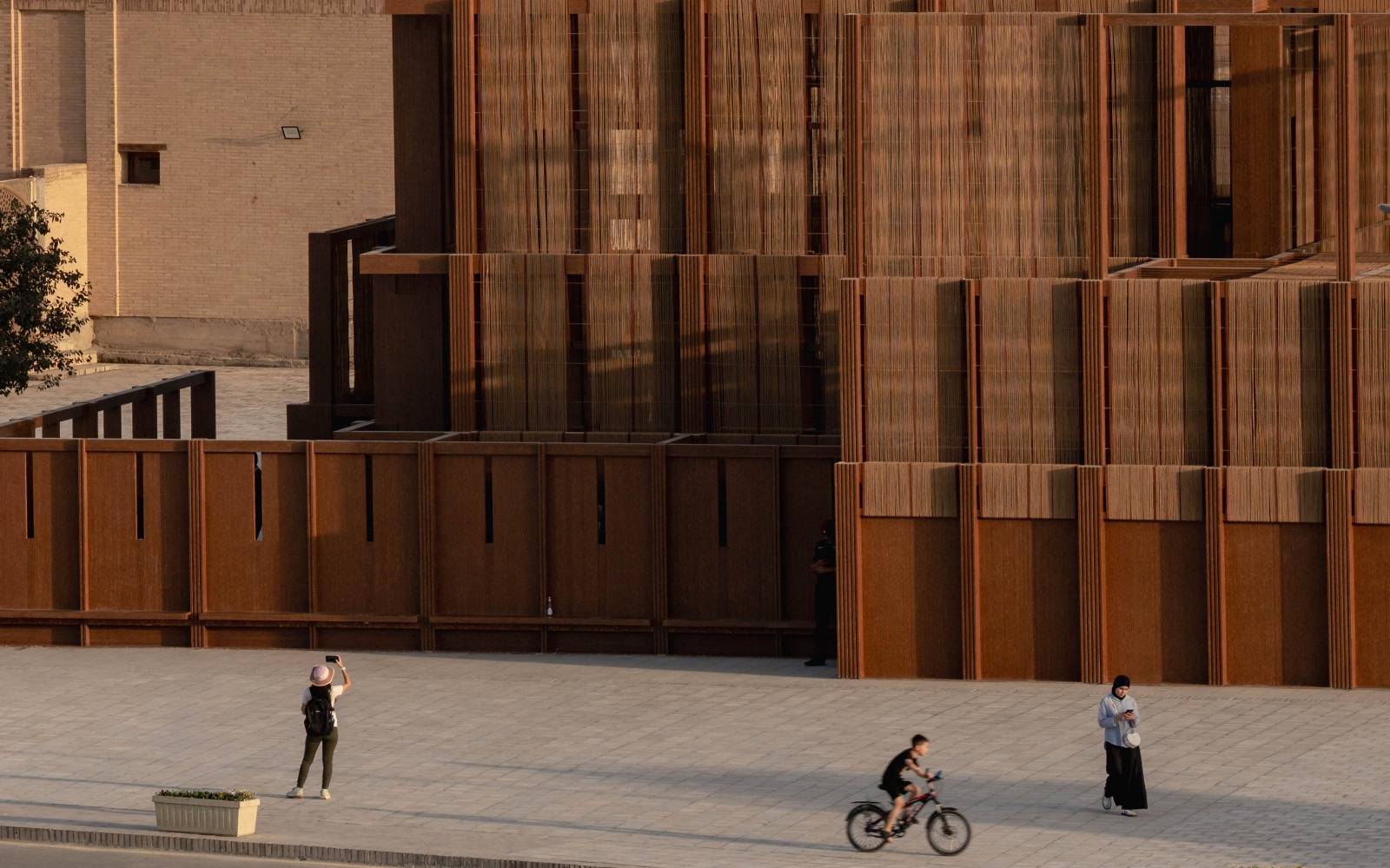
The prize-winning design is displayed outside the walls of Bukhara’s Great Mosque. (Photography by Sara Saad, Courtesy of Diriyah Biennale Foundation)

Light as a Design Feature

Light filters through the screens of the installation and Fayyadh said that this feature was extremely important: "We can observe a level of opacity and transparency, from bottom to top, so there is this intentional gradation of light. At the lower level, the opacity creates a sense of privacy, which is important in a mosque. But as you ascend, the light becomes brighter, giving the visitor a feeling of openness. It was, in fact, an interplay of light levels, and when the sun shines on the inner courtyard, the visitor feels as if they are standing under a tall palm tree."

The Next Stop

After Venice and Bukhara, what’s next for the installation? "We don't know yet," Fayyadh admitted, "but there is a plan to relocate it, to expand its legacy and story, and to give different communities the opportunity to experience it."



Spain and Portugal Continue to Battle Storm Leonardo as New Storm Approaches

 A mountain landslide blocks railway tracks during heavy rains, as storm Leonardo hits parts of Spain, in Benaojan, Spain, February 6, 2026. (Reuters)
A mountain landslide blocks railway tracks during heavy rains, as storm Leonardo hits parts of Spain, in Benaojan, Spain, February 6, 2026. (Reuters)
TT

Spain and Portugal Continue to Battle Storm Leonardo as New Storm Approaches

 A mountain landslide blocks railway tracks during heavy rains, as storm Leonardo hits parts of Spain, in Benaojan, Spain, February 6, 2026. (Reuters)
A mountain landslide blocks railway tracks during heavy rains, as storm Leonardo hits parts of Spain, in Benaojan, Spain, February 6, 2026. (Reuters)

Storm Leonardo continued to batter the Iberian Peninsula on Friday, bringing floods and putting rivers at risk of bursting their banks while thousands of people were evacuated from their homes in Spain and Portugal.

In southern Spain's Andalusia region, some 7,000 people have had to leave their homes due to successive storms.

Among them were around 1,500 people ordered to evacuate the mountain village of Grazalema, where Andalusia's regional leader Juan Manuel Moreno warned that aquifers were "full to the brim with water,” and at risk of collapsing.

“It's raining on already saturated ground. The land is unable to drain," Moreno said. “We urge extreme caution. This is not over.”

Spanish police said Friday they had found a body located 1,000 meters (about 0.6 miles) away from where a woman had disappeared Wednesday after she fell into a river in Malaga province while trying to rescue her dog. Police said they had not yet identified the body, but believed it belonged to the 45-year-old woman.

Another storm front, Marta, was expected to arrive Saturday, with Spain's weather agency AEMET saying it would bring even more rain and heavy winds, including to areas already drenched by Storm Leonardo.

Marta is expected to affect Portugal, too.

Of particular concern was southern Spain's Guadalquivir River, which flows through Córdoba and Seville and eventually into the Atlantic Ocean, and whose water levels have dramatically risen in recent days.

Additional rain Saturday could leave many more homes at risk in Córdoba, local authorities warned.

In Portugal, parts of Alcacer do Sal were submerged after the Sado River overflowed, forcing residents to leave the city located 90 kilometers (about 56 miles) south of Lisbon.

Alerts were issued also for regions near the Tagus River due to rising water levels.

A separate storm in late January left a trail of destruction in Portugal, killing several people, according to Portuguese authorities.


AROYA Cruises Debuts Arabian Gulf Voyages for 2026

AROYA offers a curated experience featuring culturally inspired entertainment and diverse dining options - SPA
TT

AROYA Cruises Debuts Arabian Gulf Voyages for 2026

AROYA offers a curated experience featuring culturally inspired entertainment and diverse dining options - SPA

AROYA Cruises, a subsidiary of the PIF-owned Cruise Saudi, has officially launched its inaugural season in the Arabian Gulf.

Running from February 21 to May 8, the season marks a milestone in regional tourism by blending authentic Saudi hospitality with international maritime standards, SPA reported.

AROYA offers a curated experience featuring culturally inspired entertainment and diverse dining options.

The season is designed to provide guests with a dynamic way to explore the Gulf, setting a new benchmark for luxury travel that reflects the Kingdom's heritage on a global stage.


Snowstorm Brings Much of Denmark to a Halt

A car drives in heavy snow at Store Heddinge in South Zealand, Denmark, 05 February 2026.  EPA/Mads Claus Rasmussen
A car drives in heavy snow at Store Heddinge in South Zealand, Denmark, 05 February 2026. EPA/Mads Claus Rasmussen
TT

Snowstorm Brings Much of Denmark to a Halt

A car drives in heavy snow at Store Heddinge in South Zealand, Denmark, 05 February 2026.  EPA/Mads Claus Rasmussen
A car drives in heavy snow at Store Heddinge in South Zealand, Denmark, 05 February 2026. EPA/Mads Claus Rasmussen

Denmark authorities halted public transport, closed schools and cancelled flights on Friday as heavy snowfall blanketed much of the country.

The Nordic country's meteorological institute DMI warned that heavy snow would likely continue until Friday evening in the east, where the capital Copenhagen is located.

Police said people should avoid going outdoors unless necessary and stay indoors in the capital and the surrounding region.

Copenhagen's airport cancelled flights to Paris and Berlin and warned of "delay and cancellation risks because of snowy conditions." Many schools were closed.

In the second-largest city of Aarhus, bus services were cancelled.