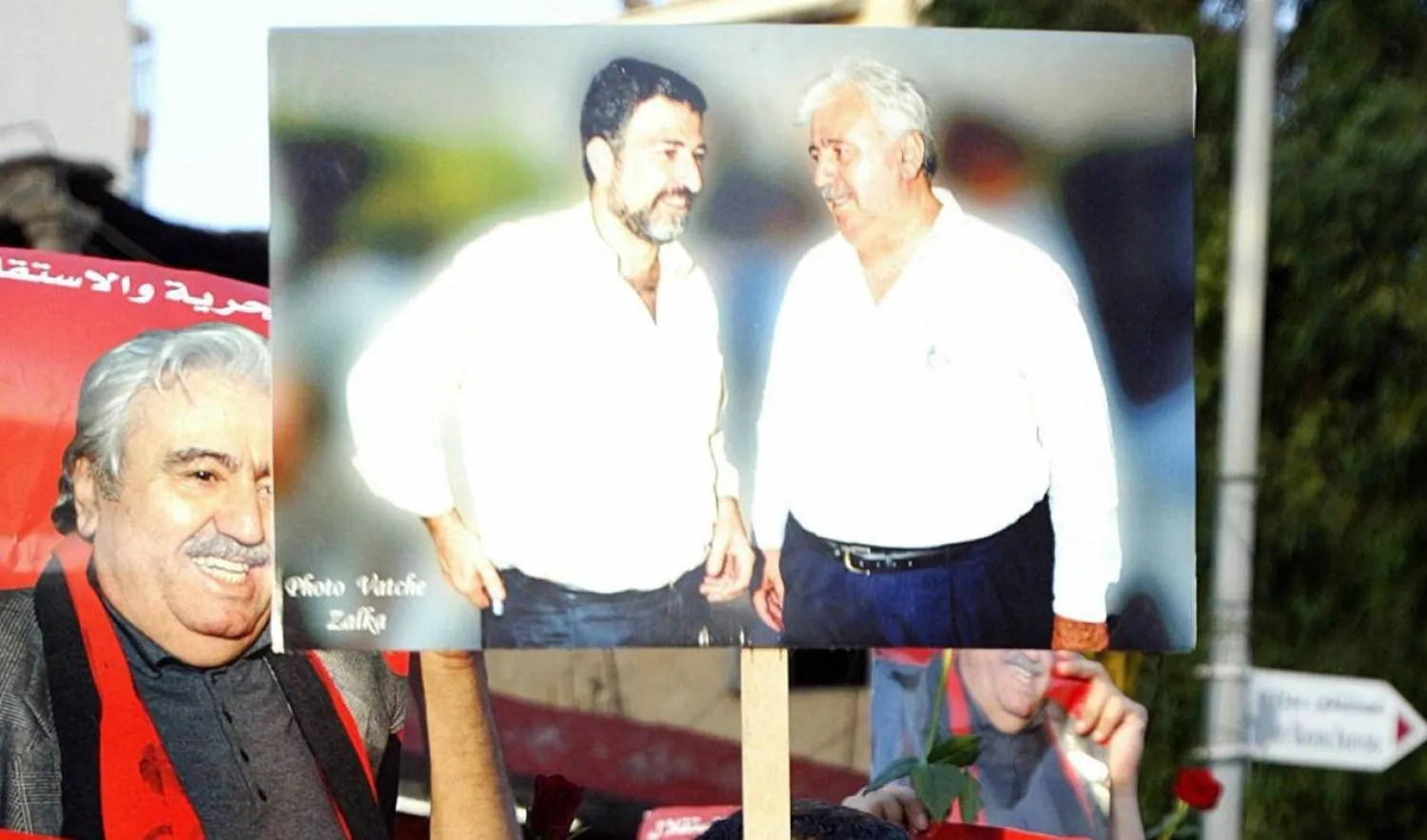

In this final part of an interview with Asharq Al-Awsat, Elias Atallah, former political bureau member of the Lebanese Communist Party and coordinator of operations for the Lebanese National Resistance Front (JNFR), recounted a turbulent chapter of Lebanon’s modern history.
Atallah revisited the blood-soaked years of the 1980s, when Lebanon was torn apart by wars with Israel, battles in Beirut, and the volatile triangle of Syrian, Palestinian and Lebanese entanglements. He said his experience had been “harsh and painful.”
Confrontation with Israel had reached its zenith; the price of war in Beirut had been high; and relations within the Lebanese-Palestinian-Syrian triangle had been dangerously booby-trapped.
He said that a long-running exchange of strikes had taken place, between the Communist Party and Elie Hobeika, who served as the security chief and later head of the Lebanese Forces.
“I met him about twenty times,” Atallah explained. “He was a man without a heart and absolutely without feeling. It would be wrong to call him pragmatic. He was Machiavellian, willing to do anything to get what he wanted. He was physically brave and would openly state his opinion. He tried to present himself as a deep intelligence man. He had no cultural formation but he was physically strong and courageous.”
Atallah recounted a hunting trip that illustrated Hobeika’s ruthlessness. “I intended to go to Syria to shoot birds,” he said. “George Hawi (the Communist Party’s secretary-general) said we would go together with Elie Hobeika. I disliked the idea but I went. In the wheat plain I noticed Hobeika sliding the rifle under his arm and firing - a method that did not hit birds but could be used against people. I told him, ‘It seems you only go hunting people.’ He replied, ‘Yes, I killed people, but they deserved to die.’ We argued. George invited us to lunch; he had bought a lamb. I pretended I would join them but I climbed into a car and returned to Beirut.”
Atallah added that Hobeika boasted of operations he had carried out, including the explosive device that struck the Communist Party office on Baalbek Street near the Arab University. “We were supposed to hold a Central Council meeting,” he said. “It seems Hobeika received information, so he put his men to plant the explosives. Chance played its role. Our comrade George Batal asked me to drive him to the meeting and I was delayed a few minutes. I was about 150 meters away when the blast shook out. There were dead and injured.”
Atallah also described kidnappings. “One day Hobeika’s group kidnapped three of our youths in the Jiyyeh area; they were transporting explosives for the resistance. I had no option but to kidnap an important person in return,” he recalled. “That was what happened. Two were released because he had killed the third. They two told us Hobeika’s fighters were testing new rifles and pistols by firing at captives they had.”
When asked whether the two men had spoken about the Iranian diplomats whose fate later became the subject of rumors - that one of them had died while his captors were testing a firearm on the bulletproof vest he had been compelled to wear - Atallah replied: “I did not know the fate of the Iranian diplomats, but Hobeika told me in a meeting that he had kidnapped them.”
The former Lebanese Communist Party official contended that Hafez al-Assad had not stopped at Hobeika’s past because he sought to push through a “tripartite agreement,” a formula Atallah described as “a plan to consume Lebanon.” He suggested that Hobeika’s relationship with General Michel Aoun (who later became president) had not begun in the mid-1980s as commonly reported; rather, Atallah believed they had “a prior relationship somewhere in Syria, a matter that required research to untangle.”
He claimed Walid Jumblatt had suffered humiliations under Hafez al-Assad, including being forced to eat lunch with military officers among them Major General Ibrahim Huweija, who had overseen the assassination of Jumblatt’s father, Kamal. While Atallah did not deny that Assad supplied Jumblatt with weapons and tanks during the Mountain War, he stressed that Assad had not given Jumblatt “the right to decide.”
The Soviet abduction
Atallah described the 1985 abduction of four Soviet embassy staff in Beirut in detail. “They called us at the Soviet embassy,” he said. “They told me that yesterday four people from the embassy apparatus were kidnapped; I did not think they were high-ranking, then they disappeared.”
Despite intense searching, day after day, they had found no trace. Walid Jumblatt mobilized everything he had; Atallah and his group did all they could, both publicly and covertly. Days passed without a hint.
Then a senior KGB general, “Yuri,” arrived as an envoy. He thanked them and, it seemed, realized they had failed to locate the missing men. “He told me, in broken Arabic: ‘Look, sheikh; today the detainees ate a breakfast that included labneh, olives and cucumbers, and they were wearing striped pajamas of a particular color. Your fate is at stake. We, the Soviet Union, do not let these matters pass without consequence, be it from the small or the big. I expect them tomorrow at 4 pm, and after that everyone will know his role.’”
General Yuri went alone to see Sayyed Mohammad Hussein Fadlallah, the cleric often portrayed in the media as the spiritual godfather of Hezbollah, a depiction Atallah said he did not necessarily accept as accurate. Fadlallah received him and, by four in the afternoon, three of the four Soviets had been released. Fadlallah’s guards explained that the fourth Soviet had resisted during the transfer, tried to seize a rifle, and was shot dead. The account appeared credible, as he had been killed only recently.
Finger-pointing fell on the Islamic Dawa Party and on an element hidden under the mantle of the Amal movement.
On assassinations and Tripoli battles
Atallah denied that the Communist Party had planned the assassination of Bashir Gemayel. “Absolutely not,” he insisted. “From the time I led these apparatuses, we decided in principle to refuse involvement in assassinations. There was one assassination attempt on General Michel Aoun in the Baabda palace courtyard, and when the Syrian army moved to remove Aoun, the perpetrator fired and we took custody of him. That attempt did not go through us.”
On the battles in Tripoli in the north, Atallah pointed to a bitter rift between Hafez al-Assad and Yasser Arafat. “One day Assad told him: ‘I will pursue an independent decision. Independent of whom?’ Arafat replied: ‘Independent of you. You do not recognize Palestine; Palestine, in turn, does not recognize Syria.’”
Arafat returned to Tripoli in 1983 and entered what Atallah described as Assad’s personal battle with the Palestinian leader. “One hundred percent, it was a mistake for us to participate,” Atallah admitted. “We should have declared ourselves unable to intervene.”
The Communist Party paid dearly: 34 dead in the first round in 1983, and 21 more in the second round during the period of Sheikh Saeed Shaaban. “We paid 55 martyrs for no justification,” he said.
A meeting with Hafez al-Assad
Atallah recalled a 1984 visit with George Hawi to Hafez al-Assad in which Hawi had pushed for immediate unity between Lebanon and Syria. The idea, Atallah said, had been alien to Lebanese sentiment and even dangerous.
In their palace meeting Assad spoke for two hours, repeating themes that were familiar from other encounters, according to Atallah. Oddly, Assad probed into where exactly Atallah lived in Ramlet, down to the house’s location on the side of the road near Saida. As they departed, Assad turned to Hawi with a warning: “Never repeat the story of immediate Lebanon-Syria unity. This talk is dangerous and forbidden. There are things to be carried out silently, without words.”
On Hariri, Hawi and Syrian-Iranian partnerships
When asked who killed Prime Minister Rafik Hariri, Atallah answered bluntly: “Three, and one leader: Bashar al-Assad.” He argued that after the departure of investigator Detlev Mehlis, the tribunal had lost its way. He named Assef Shawkat and other Syrian officers, as well as Hezbollah, as participants. He noted wryly that all Syrian intelligence officers who had overseen Lebanon were themselves later killed, including Rustom Ghazaleh, who was “torn to pieces.”
As for George Hawi’s assassination, Atallah maintained that until 2005 most assassinations in Lebanon were Syrian operations, but from that year onward there had been Syrian-Iranian partnerships in carrying out killings.
The killing of René Moawad
The climax of Atallah’s testimony came with his version of the assassination of President René Moawad, elected on November 5, 1989. Moawad had no presidential palace or guard, as Baabda Palace was still held by General Michel Aoun. He lived instead in a Hariri-owned building in West Beirut, considered secure because it lay inside the Syrian intelligence perimeter.
Atallah said Syrian intelligence had placed Major Jameh Jameh in charge of Moawad’s security, with Ghazi Kanaan and Hafez al-Assad’s blessing. Moawad, suspicious, had asked that Jameh be lodged in the adjacent Beaurivage Hotel and kept away from his entourage.
Atallah then recounted a chilling episode: A Communist soldier, recruited into Moawad’s guard at Syrian request, was later given a tiny explosive to attach to the president’s clothing during a church crowd in Ehden. Atallah said he learned of the plan and warned Moawad personally, along with George Hawi and Karim Mroueh. He remembered Moawad’s hands trembling as he heard the soldier’s name and the Syrian officer behind the plot.
The attempt failed when the soldier vanished. Ten days later, Moawad was killed. Witnesses later told Atallah they saw Jameh Jameh on the rooftop of the building, holding a device. “He pressed the button and the explosion went off,” they said. Jameh descended calmly and walked away.
Reflections on failure and lessons
Atallah ended the final part of his Asharq Al-Awsat interview with reflections on the futility of the cycle of violence. “I review this past not because I want to live in it, but because I hope no one will repeat it,” he said. His aim was twofold: “To state my criticisms of what happened, and to show the truth about the national resistance and the failure of resistances that were political projects, not national ones.”
He continued: “Hezbollah’s so-called resistance was not resistance. It was the occupation of the liberated land and turned into a profession. Resistance ceased to be a mission and became a career.”
Response from the Ibrahim Qais Family to Elias Atallah’s Testimony
To the esteemed Editor-in-Chief and Editorial Board of Asharq Al-Awsat:
We, the family of the late Ibrahim Qais, address you with this letter in exercise of our right of reply to what was stated in the interview titled: “Elias Atallah: Syrian Officer Jameh Jameh Pressed the Button and Killed President René Moawad”, published in your newspaper on September 20, 2025.
We kindly request that you publish this response in full, in order to preserve the credibility of your newspaper and to clarify the facts:
What was attributed to the late Ibrahim Qais by Mr. Elias Atallah in the interview is completely false.
Our father was not a witness to what Atallah claims, and he never said that he saw Jameh Jameh press the detonation button in the assassination of President René Moawad.
The truth is that on October 22, 1989, Independence Day, we - the Qais family - were gathered with the family of our friend Majed Muqalled for lunch at our home, located near the Daaboul Travel Agency building, opposite a plot of land that separated us from Beirut prison. Muqalled, like our father, was seated with us. When the presidential convoy passed by the house, Majed went out onto the balcony to watch, and the explosion occurred at that very moment.
The violent blast came from the Flippers playroom, which was adjacent to Raml al-Zarif School, where an explosive device had been detonated remotely. We experienced that horrifying moment in which the windows shattered and the house was damaged, and several family members and neighbors were injured.
Our father, who rushed to help our wounded mother, was not observing the buildings or following any specific individuals; he was in the midst of the destroyed house, searching for his children and aiding the injured.
Mr. Atallah’s claim that Jameh Jameh was seen on the roof of a building across the street pressing the detonation button contradicts both logic and the facts:
First: Jameh Jameh was part of the convoy itself, as confirmed by MP Michel Moawad in a documented testimony, and the Syrian officer’s cars were about 150 meters ahead of the vehicle carrying the martyred president.
Second: The buildings that Atallah claims our father and Majed Muqalled witnessed the explosion from were at the very heart of the blast and were directly damaged.
Third: There was no way anyone could have witnessed the “pressing of the button”; we were all victims of this criminal explosion, right at the scene of the crime.
If Atallah’s statements were truly accurate, why did he not report them during his years in a position of decision-making within the Communist Party, or in the years that followed? Why did he not disclose them while serving as a member of parliament for the city of Tripoli? It would have been more appropriate for him to show the courage to confront the truth directly instead of hiding behind colleagues who have passed away and can no longer refute his fabrications.
Mr. Atallah’s attempt to implicate our late father Ibrahim Qais as a sole witness - alive, according to his account - in one of the most serious political and security cases in Lebanese history is nothing but a baseless slander lacking any credibility.
Our father, the well-known communist activist, never exploited bloodshed and never accepted being part of a game of defamation or falsification.