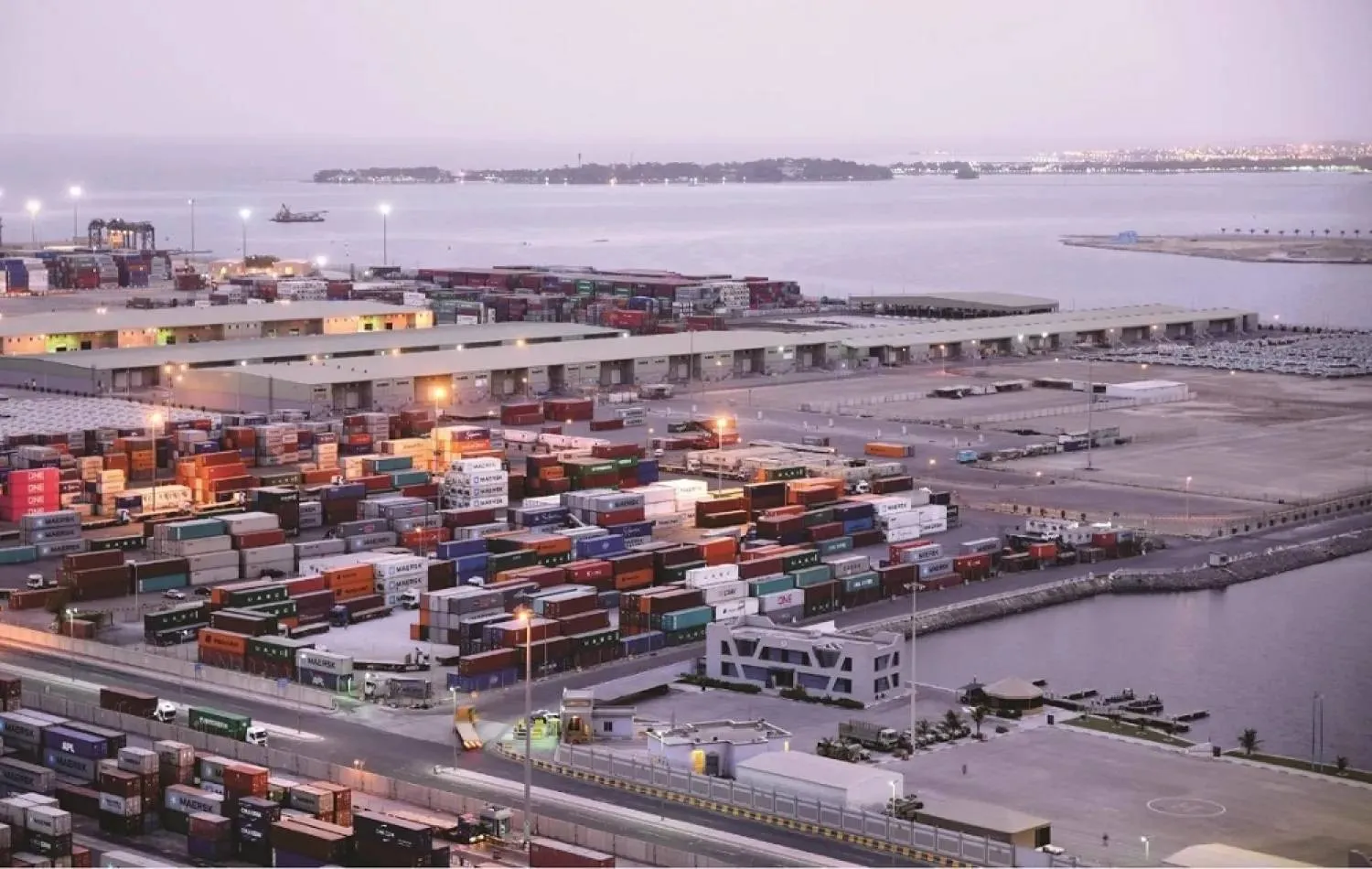
Marsa Ocean Shipping's JSS Service Added to Jeddah Islamic Port 

A view of the Jeddah Islamic Port. (SPA)
TT

Marsa Ocean Shipping's JSS Service Added to Jeddah Islamic Port 

A view of the Jeddah Islamic Port. (SPA)

The Saudi Ports Authority (Mawani) announced on Sunday the addition of Marsa Ocean Shipping’s new JSS service to Jeddah Islamic Port, a move that will expand direct trade opportunities and enhance maritime shipping operations between the Kingdom and global markets while supporting national exports.

The new service links Jeddah Islamic Port with Port Sudan, with a capacity of up to 1,118 standard containers.

Mawani said the addition of this service reflects its ongoing efforts to strengthen the Kingdom’s position in global performance indicators and raise the operational efficiency of Jeddah Islamic Port, in line with the National Transport and Logistics Strategy. The strategy aims to establish the Kingdom as a leading global logistics hub connecting three continents.

Jeddah Islamic Port is one of the region’s largest ports, with a capacity of 130 million tons. It is equipped with advanced infrastructure that includes 62 multi-purpose berths, in addition to specialized terminals such as two container terminals, two general cargo terminals, docks for ship repair and marine maintenance, and facilities dedicated to marine services.


China Rejects US Sanctions on Five Oil Refineries

Independent small Chinese refineries purchase 90% of Iranian oil shipments (Reuters).
TT

China Rejects US Sanctions on Five Oil Refineries

Independent small Chinese refineries purchase 90% of Iranian oil shipments (Reuters).

China will not comply with US sanctions against five firms targeted for purchasing Iranian oil, Beijing's commerce ministry said on Saturday.

China is a key customer for Iranian oil, mainly through independent "teapot" refineries that rely on discounted crude from Iran.

The United States, seeking to choke off revenue to Tehran, has ramped up sanctions on such refineries.

The commerce ministry's injunction, relating to sanctions announced separately since last year, states that the US measures "shall not be recognized, implemented, or complied with".

The sanctions "improperly prohibit or restrict Chinese enterprises from conducting normal economic, trade and related activities with third countries... and violate international law and the basic norms governing international relations," the ministry said in a statement.

"The Chinese government has consistently opposed unilateral sanctions lacking UN authorization and a basis in international law."

The injunction applies to three companies in Shandong province -- Shandong Jincheng Petrochemical Group, Shandong Shouguang Luqing Petrochemical and Shandong Shengxing Chemical -- and two others based elsewhere in China, Hengli Petrochemical (Dalian) Refinery and Hebei Xinhai Chemical Group.

Washington imposed on Friday sanctions on yet another Chinese firm which it said had imported "tens of millions of barrels" of Iranian crude oil, generating billions of dollars in revenue for Tehran.

The firm, Qingdao Haiye Oil Terminal Co., Ltd., was not mentioned in the commerce ministry's injunction.


Spirit Airlines Shuts Down, Industry’s First Iran War Casualty

A Spirit Airlines self bag-drop counter at Orlando International Airport, as the airline announced it was ceasing operations early Saturday morning following an impasse in talks with some creditors on a $500 million government bailout plan, in Orlando, Florida, US, May 2, 2026. (Reuters)
TT

Spirit Airlines Shuts Down, Industry’s First Iran War Casualty

A Spirit Airlines self bag-drop counter at Orlando International Airport, as the airline announced it was ceasing operations early Saturday morning following an impasse in talks with some creditors on a $500 million government bailout plan, in Orlando, Florida, US, May 2, 2026. (Reuters)

Bankrupt discount carrier Spirit Airlines ceased operations on Saturday, the industry's first casualty linked to the Iran war, after failing to secure creditor support for a US government bailout plan.

The collapse of the first carrier due to a doubling in jet fuel prices during the two-month-old Iran war will cost thousands of jobs. It is a blow to President Donald Trump, who had proposed $500 million to save Spirit despite opposition from some of his closest advisers and many Republicans in Congress.

No US carrier of Spirit's size - it accounted for 5% of US flights at one point - has liquidated in two decades. Spirit helped keep fares lower in markets where it competed against major carriers.

ALL FLIGHTS CANCELED, RIVALS TO BENEFIT

A Spirit board meeting had ended without an agreement to rescue the company, a person close to the discussions told Reuters late on Friday.

"Unfortunately, despite the Company's ‌efforts, the recent material ‌increase in oil prices and other pressures on the business have significantly impacted Spirit's financial outlook," Spirit ‌said ⁠in a statement ⁠announcing "an orderly wind-down of operations."

All flights have been canceled, the statement said, asking passengers not to go to the airport.

Spirit had 4,119 domestic flights scheduled between May 1 and May 15, offering 809,638 seats, according to data from aviation analytics firm Cirium.

A spokesperson said Spirit had notified the Federal Aviation Administration before halting operations, declining to comment further.

Global carriers are contending with surging jet fuel prices after the US-Israeli strikes on Iran disrupted traffic through the Strait of Hormuz. Spirit was already struggling to turn a profit before the fuel shock.

Spirit built its brand around affordable fares for budget-conscious travelers ready to eschew add-ons like checked bags and seat assignments.

That demand tapered off quickly after the COVID-19 pandemic, as passengers preferred to opt for comfort and experience-based travel, leaving ⁠ultra-low-cost carriers struggling to adapt.

Spirit's shutdown will benefit its rivals like JetBlue Airways and Frontier Airlines, ‌who themselves are reeling from the cost shock. Spirit's volatile over-the-counter stock plunged 25% on Friday, ‌while Frontier rose 10% and JetBlue gained 4%.

Trump said on Friday that the White House had given Spirit and its creditors a final rescue proposal, ‌after talks hit an impasse over a $500 million financing package that would have helped the airline keep operating through bankruptcy.

"If we can help ‌them, we will, but we have to come first," Trump told reporters. "If we could do it, we'd do it, but only if it's a good deal."

FUEL-PRICE SHOCK THREATENS WEAKER AIRLINES

The collapse shows how the Iran war's fuel-price shock has exposed weaker airlines.

Spirit's restructuring plan assumed jet fuel costs of about $2.24 a gallon in 2026 and $2.14 in 2027, but prices had climbed to around $4.51 a gallon by the end of April, leaving the carrier unable to survive without fresh ‌financing.

Transportation Secretary Sean Duffy told Reuters he had tried to get many airlines to buy Spirit but found no takers. "What would someone buy?" Duffy asked. "If no one else wants to buy them, ⁠why would we buy them?"

A ⁠creditor close to the deal said, "The Trump administration made an extraordinary effort to try and save Spirit, but you can’t breathe life into a corpse. Given that, the company should make its intentions clear for the sake of its customers and employees."

Spirit had reached a deal with its lenders that would have helped it emerge from its second bankruptcy by late spring or early summer. But those plans derailed after the war triggered a spike in jet fuel prices, upending Spirit's cost projections and complicating its bankruptcy exit.

The airline flew around 1.7 million US domestic passengers in February, with a 3.9% market share, down from 5.1% last year, Cirium data showed.

After Spirit's announcement, major US carriers rolled out rescue-fare options for affected passengers. Frontier announced systemwide discounts and plans to add summer routes, JetBlue offered $99 fares through Wednesday, Southwest introduced special fares, United capped prices on one-way tickets and American added rescue fares while reviewing options to boost capacity on key routes.

Last month Trump said his administration was looking to buy the embattled carrier at the "right price."

Sources said that the administration had proposed $500 million in financing in exchange for warrants equivalent to 90% of Spirit's equity.

There had been disagreements inside the Trump administration over whether and how to fund the bailout, the Wall Street Journal reported, citing people familiar with the matter.


China’s Railway Hit New Single-Day Passenger Record on May Day

Passengers prepare to board trains at Shanghai Hongqiao Railway Station in Shanghai on April 30, 2026, ahead of the Labour Day holiday which starts on May 1. (AFP)
TT

China’s Railway Hit New Single-Day Passenger Record on May Day

Passengers prepare to board trains at Shanghai Hongqiao Railway Station in Shanghai on April 30, 2026, ahead of the Labour Day holiday which starts on May 1. (AFP)

China's railway network transported 24.8 million passengers on May 1, setting a new single-day record, according to data from the China State Railway Group.

A report ‌on Saturday ‌in the official ‌Xinhua ⁠news agency said the ⁠national railway system is also expected to transport 19.7 million passengers on May 2.

Some ⁠lines had to ‌add ‌new trains to handle ‌the holiday passengers, Xinhua ‌reported.

The Zhengzhou line added 140 passenger trains, and the Chengdu line ‌added 184, Xinhua said.

China's tourism market ⁠is ⁠a bright spot in domestic demand, injecting momentum into a national economy facing pressure from weak consumption and a prolonged property downturn.