


As the World Convulses in War and Contentiousness, Its Leaders Convene at the UN to Figure it Out

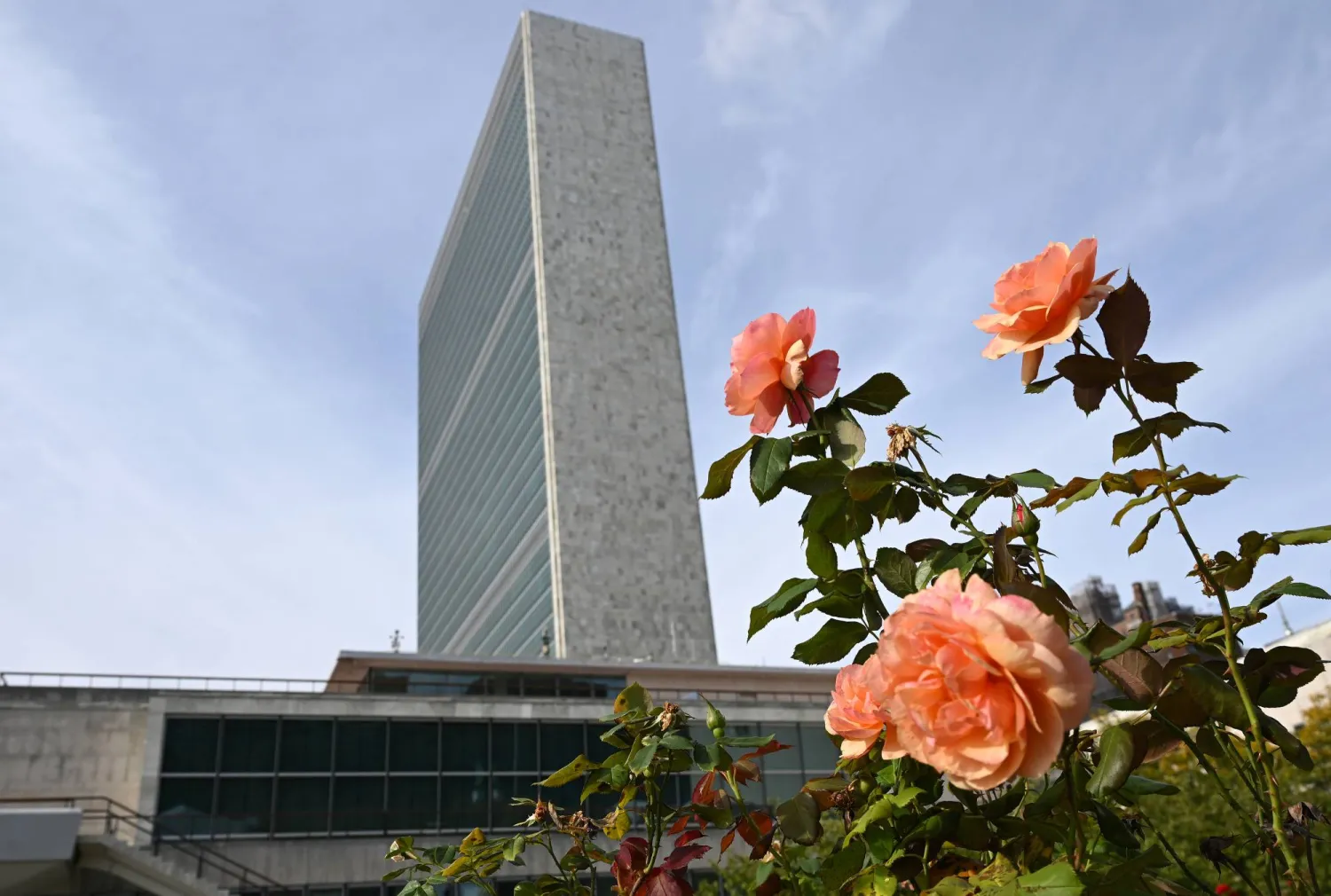
The United Nations (UN) headquarters, as seen from the Rose Garden, in New York, USA, 21 September 2025. EPA/LUKAS COCH AUSTRALIA AND NEW ZEALAND OUT
TT

As the World Convulses in War and Contentiousness, Its Leaders Convene at the UN to Figure it Out

The United Nations (UN) headquarters, as seen from the Rose Garden, in New York, USA, 21 September 2025. EPA/LUKAS COCH AUSTRALIA AND NEW ZEALAND OUT

World leaders begin convening Monday at one of the most volatile moments in the United Nations' 80-year history, and the challenges they face are as dire as ever if not more so: unyielding wars in Gaza and Ukraine, escalating changes in the US approach to the world, hungry people everywhere and technologies that are advancing faster than the understanding of how to manage them.

The United Nations itself, which emerged from World War II's rubble on the premise that nations would work together to tackle political, social and financial issues, is in crisis itself. As Secretary-General Antonio Guterres said last week: "International cooperation is straining under pressures unseen in our lifetimes.”

Yet the annual high-level gathering at the UN General Assembly will bring presidents, prime ministers and monarchs from about 150 of the 193 UN member nations to UN headquarters. The secretary-general says it is an opportunity that can’t be missed — even in the most challenging of moments.

“We are gathering in turbulent — even uncharted — waters,” Guterres said. He pointed to, among other specters, "our planet overheating, new technologies racing ahead without guardrails, inequalities widening by the hour.”

They gather for a better world, but can they build it? Guterres said he will use the more than 150 one-on-one meetings he has with leaders and ministers to urge that they speak to each other, bridge divides, reduce risks and find solutions — to conflicts, to keep the planet from increased warming, to put guardrails on fast-expanding artificial intelligence, and to find funding for lagging UN goals for 2030 including ending poverty in all countries and ensuring quality education for every child.

He said leaders must make progress, not merely engage in “posturing and promises."

But UN watchers say that in a deeply polarized world, with no prospects of ceasefires in Gaza, Ukraine and Sudan, whether the high-level meeting makes any progress remains a big question mark.

Richard Gowan, UN director for the International Crisis Group, said he is confident three topics will dominate high-level week – US President Donald Trump’s first appearance in his second term, the horrific situation in Gaza, and what’s next for the United Nations as it grapples with major funding and staff cuts, mainly due to the cutoff in US payments to its regular and peacekeeping budgets.

Gowan said he expects the nearly two-year war in Gaza to be the central issue, as Israel launches a major offensive in Gaza City forcing thousands to flee and following a report by independent experts commissioned by the UN Human Rights Council that accused Israel of committing genocide in Gaza. Israel rejected the allegation, calling the report “distorted and false.”

Riyad Mansour, the Palestinian ambassador to the United Nations, has stressed that “Palestine is going to be the huge elephant in this session of the General Assembly.”

It will be front and center on Monday at a high-level meeting co-chaired by France and Saudi Arabia on implementing a two-state solution to the nearly eight-decade Israeli-Palestinian conflict. And the spotlight will be even brighter because the Trump administration refused to give a US visa to Palestinian President Mahmoud Abbas to speak at that meeting and the General Assembly.

On Friday, the General Assembly overwhelmingly adopted a resolution enabling Abbas to speak by video — as it did in 2022 for Ukrainian President Volodymyr Zelenskyy following Russia's invasion. This year Zelenskyy will be attending in person, and the Security Council is expected to meet on Ukraine on Tuesday.

The assembly voted overwhelmingly earlier this month to support a two-state solution and urge Israel to commit to a Palestinian state. Hours before that vote, Israeli Prime Minister Benjamin Netanyahu said that “there will be no Palestinian state.”

More than 145 countries already recognize Palestine as a state, and Mansour told The Associated Press on Sunday that “it's going to be 10 more” announcing their recognition at Monday afternoon’s meeting. High-level week is also expected to see a Security Council meeting on Gaza, possibly Tuesday afternoon.

Lots of thorny issues are on the docket

The high-level meeting starts Tuesday morning in the vast General Assembly chamber. Trump will speak that day shortly after Guterres' opening “state of the world” speech.

Gowan said there is “hope” that Trump will come in a positive mood, touting the international accomplishments that the president says merit the Nobel Peace Prize. Also on the docket: Trump's financial approach to the larger world. “Obviously, most leaders are going to be focusing on what he has to say about tariffs,” Gowan said, but also about Russia and China.

Other speakers to watch are interim Syrian President Ahmad al-Sharaa, making his debut on the international stage following the ouster of former strongman Bashar Assad in December, and Iranian President Masoud Pezeshkian.

The Iranian leader will be in New York days after the Security Council decided not to permanently lift UN sanctions on his country over its escalating nuclear program, but it gave Tehran and key European powers France, Germany and the United Kingdom until midnight Sept. 27 to agree to a delay. That’s when the sanctions will automatically “snapback” unless a deal is reached.

High-level week will also see numerous meetings on tackling climate change; on the more than two-year war in Sudan started by rival military and paramilitary generals that has sparked the world’s worst displacement crisis; on Somalia, which is home to the extremist group Al-Shabab; and on Haiti, where gangs control over 90% of the capital and have expanded into the countryside .

An event on Monday will commemorate the 30th anniversary of the Beijing women’s conference, which adopted a platform to achieve gender equality. The United Nations says that goal is growing more distant and Guterres has said it is 300 years away on the current track.

One of Guterres’ major aims this year: to generate support for his plans to reform the United Nations and make it more responsive to the world as it is in 2025. Because of funding cuts by the US and others, the UN announced last week that its regular operating budget for 2026 needs to be cut by 15% to $3,2 billion along with a 19% cut in that budget's staff positions. — 2,681 posts.

Gowan said he doesn’t see the United States or other countries running away from the United Nations. But he stressed that it is going through “an extraordinarily difficult period” and will have to shrink and change.

“The UN’s resonance on peace and security issues is unquestionably not what it was," he said, “but I think that the organization will continue to muddle through.”



Top Trump Iran Negotiator Says Visits US Aircraft Carrier in Middle East

US Special Envoy Steve Witkoff delivers a press conference upon the signing of the declaration on deploying post-ceasefire force in Ukraine, during the so-called "Coalition of the Willing" summit, at the Elysee Palace in Paris, France, January 6, 2026. (Reuters)
TT

Top Trump Iran Negotiator Says Visits US Aircraft Carrier in Middle East

US Special Envoy Steve Witkoff delivers a press conference upon the signing of the declaration on deploying post-ceasefire force in Ukraine, during the so-called "Coalition of the Willing" summit, at the Elysee Palace in Paris, France, January 6, 2026. (Reuters)

US President Donald Trump's lead Iran negotiator Steve Witkoff on Saturday said he visited the USS Abraham Lincoln aircraft carrier currently in the Arabian Sea, with Washington and Tehran due to hold further talks soon.

"Today, Adm. Brad Cooper, Commander of US Naval Forces Central Command, Jared Kushner, and I met with the brave sailors and Marines aboard the USS Abraham Lincoln, her strike group, and Carrier Air Wing 9 who are keeping us safe and upholding President Trump's message of peace through strength," said Witkoff in a social media post.

Iranian Foreign Minister Abbas Araghchi said on Saturday he hoped talks with the United States would resume soon, while reiterating Tehran's red lines and warning against any American attack.


Israel’s Netanyahu Expected to Meet Trump in US on Wednesday and Discuss Iran

Israeli Prime Minister Benjamin Netanyahu delivers a speech during a special session to mark the 77th anniversary of the Knesset's establishment and the 60th anniversary of the dedication of the current building at the Knesset, the Israeli parliament, in Jerusalem, 02 February 2026. (EPA)
TT

Israel’s Netanyahu Expected to Meet Trump in US on Wednesday and Discuss Iran

Israeli Prime Minister Benjamin Netanyahu delivers a speech during a special session to mark the 77th anniversary of the Knesset's establishment and the 60th anniversary of the dedication of the current building at the Knesset, the Israeli parliament, in Jerusalem, 02 February 2026. (EPA)

Israeli Prime Minister Benjamin Netanyahu is expected to meet US President Donald Trump on Wednesday in Washington, where they will discuss negotiations with Iran, Netanyahu's office said on Saturday.

Iranian and US officials held indirect nuclear ‌talks in the ‌Omani capital ‌Muscat ⁠on Friday. ‌Both sides said more talks were expected to be held again soon.

A regional diplomat briefed by Tehran on the talks told Reuters Iran insisted ⁠on its "right to enrich uranium" ‌during the negotiations with ‍the US, ‍and that Tehran's missile capabilities ‍were not raised in the discussions.

Iranian officials have ruled out putting Iran's missiles - one of the largest such arsenals in the region - up ⁠for discussion, and have said Tehran wants recognition of its right to enrich uranium.

"The Prime Minister believes that any negotiations must include limiting ballistic missiles and halting support for the Iranian axis," Netanyahu's office said in a ‌statement.


Italy FM Rules Out Joining Trump’s ‘Board of Peace’

Italy's Minister for Foreign Affairs Antonio Tajani speaks to the press during the EPP Leaders’ meeting, in Zagreb, Croatia, 30 January 2026. (EPA)
TT

Italy FM Rules Out Joining Trump’s ‘Board of Peace’

Italy's Minister for Foreign Affairs Antonio Tajani speaks to the press during the EPP Leaders’ meeting, in Zagreb, Croatia, 30 January 2026. (EPA)

Italy will not take part in US President Donald Trump's "Board of Peace", Italian Foreign Minister Antonio Tajani said Saturday, citing "insurmountable" constitutional issues.

Trump launched his "Board of Peace" at the World Economic Forum in Davos in January and some 19 countries have signed its founding charter.

But Italy's constitution bars the country from joining an organization led by a single foreign leader.

Prime Minister Giorgia Meloni, a Trump ally, last month noted "constitutional problems" with joining, but suggested Trump could perhaps reopen the framework "to meet the needs not only of Italy, but also of other European countries".

Tajani appeared Saturday to rule that out.

"We cannot participate in the Board of Peace because there is a constitutional limit," he told the ANSA news agency.

"This is insurmountable from a legal standpoint," he said, the day after meeting US Secretary of State Marco Rubio and US Vice President JD Vance at the Olympics in Milan.

Although originally meant to oversee Gaza's rebuilding, the board's charter does not limit its role to the Palestinian territory and appears to want to rival the United Nations.