

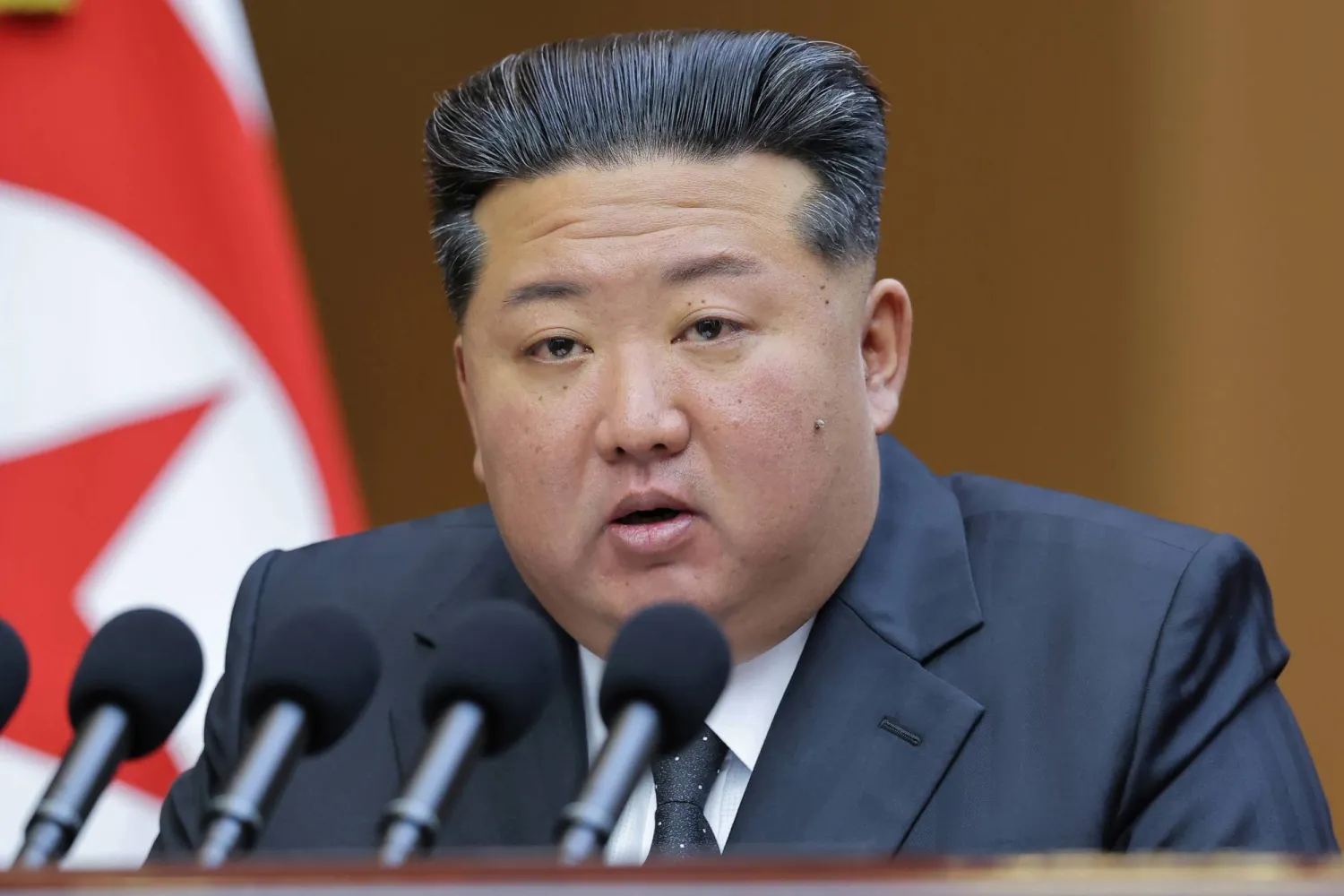

North Korea’s Kim Says He Is Open to Talks if US Drops Denuclearization Demand 

22 September 2025, North Korea, Pyongyang: A undated photo released by the North Korean State News Agency (KCNA) shows North Korean leader Kim Jong Un speaking during a parliamentary session at Mansudae Assembly Hall in Pyongyang. (KCNA/KNS by YNA/dpa)
TT

North Korea’s Kim Says He Is Open to Talks if US Drops Denuclearization Demand 

22 September 2025, North Korea, Pyongyang: A undated photo released by the North Korean State News Agency (KCNA) shows North Korean leader Kim Jong Un speaking during a parliamentary session at Mansudae Assembly Hall in Pyongyang. (KCNA/KNS by YNA/dpa)

North Korea's Kim Jong Un said there was no reason to avoid talks with the US if Washington stopped insisting his country give up nuclear weapons, but he would never abandon the nuclear arsenal to end sanctions, state media reported on Monday.

"Personally, I still have fond memories of US President (Donald) Trump," KCNA reported the North Korean leader saying in a speech at the Supreme People's Assembly on Sunday. The two leaders met three times during Trump's first presidency.

Kim's comments come as the new liberal government in Seoul urges Trump to take the lead in reopening dialogue with Kim, six years after all peace talks with Pyongyang collapsed over sanctions and nuclear dismantlement.

"If the United States drops the absurd obsession with denuclearizing us and accepts reality, and wants genuine peaceful coexistence, there is no reason for us not to sit down with the United States," Kim was quoted as saying.

It is the first time Kim has mentioned Trump by name since the US president's inauguration in January, said Rachel Minyoung Lee, a North Korea expert with the US-based Stimson Center.

"This is an overture," she said. "It is Kim's invitation to Trump to rethink US policy on denuclearization, the implication being that if the US drops denuclearization, he could sit face-to-face with Trump."

Kim's warm words towards Trump were a contrast with his strident assertion that he will never give up nuclear weapons or engage in dialogue with South Korea, which he has designated a main enemy.

It was a matter of survival for North Korea to build nuclear weapons to safeguard its security against grave threats from the United States and South Korea, Kim said, listing a series of regular military drills by the allies that he said had evolved into exercises for nuclear war.

South Korean President Lee Jae Myung said in an interview with Reuters that North Korea was building 15 to 20 nuclear bombs a year and any deal that froze that manufacturing would be a useful step towards eventually dismantling the program altogether.

"Based on that, we can proceed to medium-term negotiations for nuclear weapons reductions, and in the long run, once mutual trust is restored and North Korea’s regime-security concerns are reduced, we can pursue denuclearization," he said.

Kim bluntly rejected any phased plan, saying recent overtures from Washington and Seoul for dialogue were disingenuous because their fundamental intent to weaken the North and destroy his regime remained unchanged, and that Lee's phased plan was proof of that.

"The world already knows full well what the United States does after it makes a country give up its nuclear weapons and disarms," Kim said. "We will never give up our nuclear weapons."

'CONDITIONS FOR DIALOGUE'

Kim said sanctions had been "a learning experience" and made his country stronger and more resilient.

North Korea has been under UN sanctions and arms embargoes since its first nuclear test in 2006. But while the sanctions have squeezed funding for military development, Pyongyang has continued to make advances in building nuclear weapons and powerful ballistic missiles.

"The reality is that the previous approach of sanctions and pressure has not solved the problem; it has worsened it," South Korea's Lee told Reuters.

Lee had urged Trump to try and meet Kim when the US president visits South Korea next month for an Asia-Pacific summit, but the Stimson Center's Lee said Kim's remarks seemed aimed at blocking the South's involvement.

"Perhaps he wants to get ahead of the Lee government and dissuade the Trump administration from cooperating with South Korea by reiterating that South Korea is a separate country and, therefore, cannot be a party to the North Korean nuclear issue," she said.

The South Korean president said Pyongyang was refusing to talk to the South and he did not believe North Korea and the United States were having concrete discussions, but he believed the phased approach remained the realistic option.

"Our main task now is to create the conditions for dialogue," Lee said.


Top Trump Iran Negotiator Says Visits US Aircraft Carrier in Middle East

US Special Envoy Steve Witkoff delivers a press conference upon the signing of the declaration on deploying post-ceasefire force in Ukraine, during the so-called "Coalition of the Willing" summit, at the Elysee Palace in Paris, France, January 6, 2026. (Reuters)
TT

Top Trump Iran Negotiator Says Visits US Aircraft Carrier in Middle East

US Special Envoy Steve Witkoff delivers a press conference upon the signing of the declaration on deploying post-ceasefire force in Ukraine, during the so-called "Coalition of the Willing" summit, at the Elysee Palace in Paris, France, January 6, 2026. (Reuters)

US President Donald Trump's lead Iran negotiator Steve Witkoff on Saturday said he visited the USS Abraham Lincoln aircraft carrier currently in the Arabian Sea, with Washington and Tehran due to hold further talks soon.

"Today, Adm. Brad Cooper, Commander of US Naval Forces Central Command, Jared Kushner, and I met with the brave sailors and Marines aboard the USS Abraham Lincoln, her strike group, and Carrier Air Wing 9 who are keeping us safe and upholding President Trump's message of peace through strength," said Witkoff in a social media post.

Iranian Foreign Minister Abbas Araghchi said on Saturday he hoped talks with the United States would resume soon, while reiterating Tehran's red lines and warning against any American attack.


Israel’s Netanyahu Expected to Meet Trump in US on Wednesday and Discuss Iran

Israeli Prime Minister Benjamin Netanyahu delivers a speech during a special session to mark the 77th anniversary of the Knesset's establishment and the 60th anniversary of the dedication of the current building at the Knesset, the Israeli parliament, in Jerusalem, 02 February 2026. (EPA)
TT

Israel’s Netanyahu Expected to Meet Trump in US on Wednesday and Discuss Iran

Israeli Prime Minister Benjamin Netanyahu delivers a speech during a special session to mark the 77th anniversary of the Knesset's establishment and the 60th anniversary of the dedication of the current building at the Knesset, the Israeli parliament, in Jerusalem, 02 February 2026. (EPA)

Israeli Prime Minister Benjamin Netanyahu is expected to meet US President Donald Trump on Wednesday in Washington, where they will discuss negotiations with Iran, Netanyahu's office said on Saturday.

Iranian and US officials held indirect nuclear ‌talks in the ‌Omani capital ‌Muscat ⁠on Friday. ‌Both sides said more talks were expected to be held again soon.

A regional diplomat briefed by Tehran on the talks told Reuters Iran insisted ⁠on its "right to enrich uranium" ‌during the negotiations with ‍the US, ‍and that Tehran's missile capabilities ‍were not raised in the discussions.

Iranian officials have ruled out putting Iran's missiles - one of the largest such arsenals in the region - up ⁠for discussion, and have said Tehran wants recognition of its right to enrich uranium.

"The Prime Minister believes that any negotiations must include limiting ballistic missiles and halting support for the Iranian axis," Netanyahu's office said in a ‌statement.


Italy FM Rules Out Joining Trump’s ‘Board of Peace’

Italy's Minister for Foreign Affairs Antonio Tajani speaks to the press during the EPP Leaders’ meeting, in Zagreb, Croatia, 30 January 2026. (EPA)
TT

Italy FM Rules Out Joining Trump’s ‘Board of Peace’

Italy's Minister for Foreign Affairs Antonio Tajani speaks to the press during the EPP Leaders’ meeting, in Zagreb, Croatia, 30 January 2026. (EPA)

Italy will not take part in US President Donald Trump's "Board of Peace", Italian Foreign Minister Antonio Tajani said Saturday, citing "insurmountable" constitutional issues.

Trump launched his "Board of Peace" at the World Economic Forum in Davos in January and some 19 countries have signed its founding charter.

But Italy's constitution bars the country from joining an organization led by a single foreign leader.

Prime Minister Giorgia Meloni, a Trump ally, last month noted "constitutional problems" with joining, but suggested Trump could perhaps reopen the framework "to meet the needs not only of Italy, but also of other European countries".

Tajani appeared Saturday to rule that out.

"We cannot participate in the Board of Peace because there is a constitutional limit," he told the ANSA news agency.

"This is insurmountable from a legal standpoint," he said, the day after meeting US Secretary of State Marco Rubio and US Vice President JD Vance at the Olympics in Milan.

Although originally meant to oversee Gaza's rebuilding, the board's charter does not limit its role to the Palestinian territory and appears to want to rival the United Nations.
