


Typhoon Ragasa Batters Hong Kong and South China After Killing Dozens in Taiwan and Philippines 

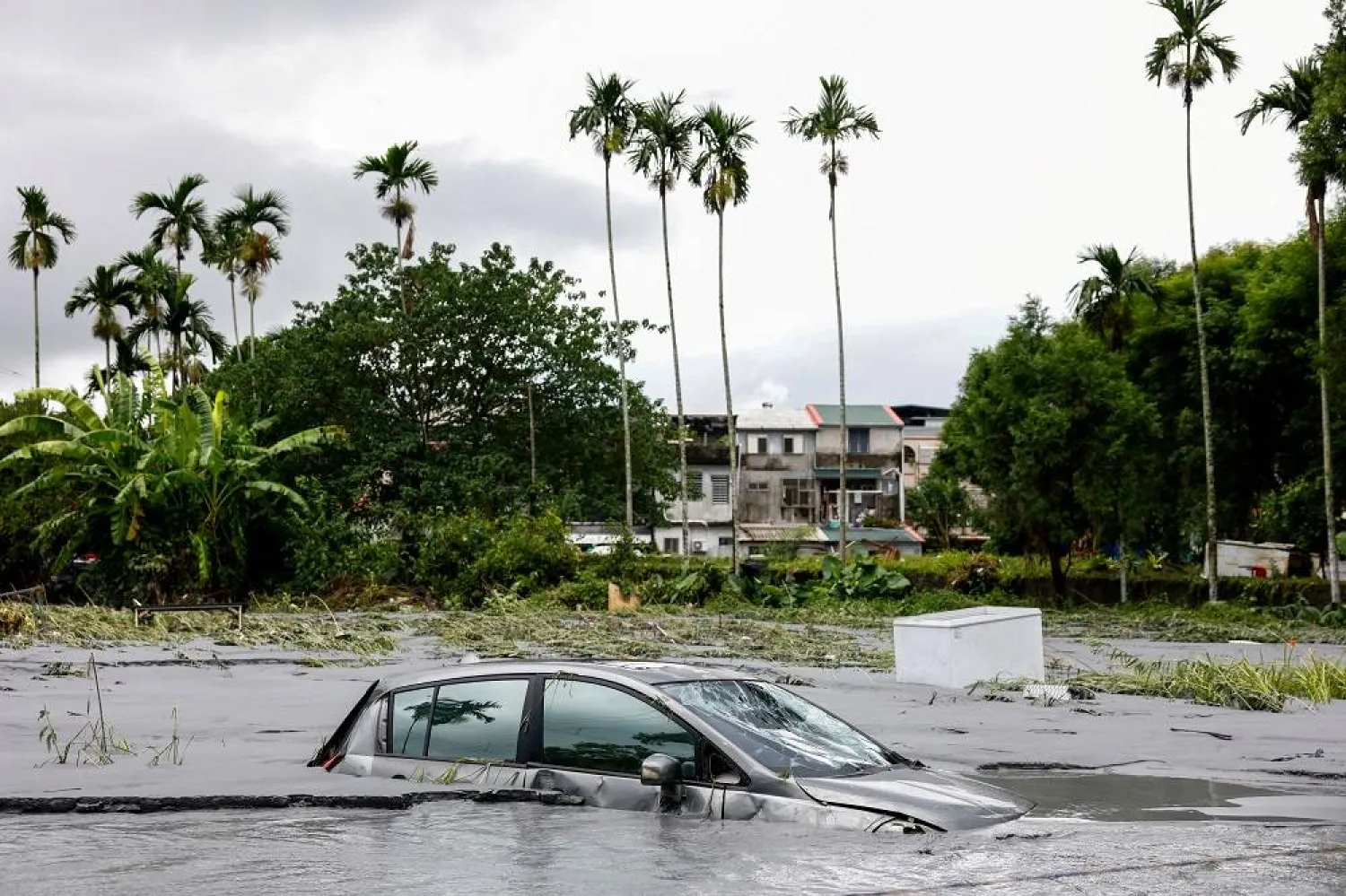
A car is partially submerged following flooding brought by Super Typhoon Ragasa in Hualien, Taiwan, September 24, 2025. (Reuters)
TT

Typhoon Ragasa Batters Hong Kong and South China After Killing Dozens in Taiwan and Philippines 

A car is partially submerged following flooding brought by Super Typhoon Ragasa in Hualien, Taiwan, September 24, 2025. (Reuters)

Typhoon Ragasa, one of the strongest in years, whipped waves taller than lampposts onto Hong Kong promenades and turned seas rough on the southern Chinese coast on Wednesday after leaving deadly destruction in Taiwan and the Philippines. 

In Taiwan, 17 people died in a flooded township, and 10 deaths were reported in the northern Philippines. 

Nearly 1.9 million people were relocated across Guangdong province, the southern Chinese economic powerhouse. A weather station in Chuandao town recorded maximum gusts of 241 kph (about 150 mph) at noon, a high in Jiangmen city since record-keeping began. Huge waves battered Zhuhai city’s coastline and strong winds buffered trees under intense rain. Fallen branches were scattered on the streets. 

State broadcaster CCTV said the typhoon made landfall along the coast of Hailing Island in Yangjiang city at about 5 pm, packing maximum winds near the center of 144 kph (89 mph). It is forecast to keep moving west. Schools, factories and transportation services were initially suspended in about a dozen cities, but a few of them distant from the landfall location were preparing to resume work as winds weakened 

The fierce winds, brought by Ragasa, once a super typhoon, woke Hong Kong residents in the early hours, and many went online to describe scenes like a kitchen ventilation fan being blown down and a crane swaying. 

Winds and waves lash Hong Kong, push seawater onto promenade Strong winds blew away parts of a pedestrian bridge’s roof and knocked down hundreds of trees across the city. A vessel crashed into the shore, shattering a row of glass railings along the waterfront. Areas around some rivers and promenades were flooded, including cycling lanes and playgrounds. At several promenade restaurants, furniture was scattered chaotically by the winds. Over 80 injured people were treated at hospitals. 

A video that showed waves of water crashing through the doors of a hotel and flooding its interiors went viral in the financial hub. The hotel has not immediately commented on the incident. But staff were seen cleaning up the lobby, with parts of its exterior damaged. 

Hong Kong and Macao canceled schools and flights, with many shops closed. Hundreds of people sought refuge in temporary centers in each city. Streets in Macao turned into streams with debris floating on the water. Rescue crews deployed inflatable boats to save those who were trapped. The gambling city's local electricity supplier suspended its power supply in some flooded, low-lying areas for safety. 

Hong Kong’s observatory said Ragasa had maximum sustained winds near the center of about 195 kph (120 mph) and skirted around 100 kilometers (62 miles) to the south of the city. Hong Kong categorizes cyclones with sustained winds 185 kph or stronger as super typhoons to make residents extra vigilant about intense storms. 

The observatory said Ragasa is the strongest tropical cyclone in the northwestern Pacific and South China Sea region so far this year. Preliminary analysis showed it also ranks as the second-strongest one in the South China Sea region since the observatory's record-keeping began in 1950, tying with typhoons Saola in 2023 and Yagi in 2024, it said. 

Ragasa earlier caused deaths and damage in Taiwan and the Philippines after the typhoon took a path between them. 

In Taiwan, 17 people died after heavy rain caused a barrier lake in Hualien County to overflow Tuesday and torrents of muddy water destroyed a bridge, turning roads in Guangfu township into churning rivers that carried vehicles and furniture away. 

Guangfu has about 8,450 people, more than half of whom sought safety on higher floors of their homes or on higher ground on Wednesday morning. 

Rescuers managed to establish contact with more than 100 others who were previously unreachable, and were going door-to-door to check on the remaining 17 residents. A total of 32 people were injured across the self-ruled island. 

At least 10 deaths were reported in the northern Philippines, including seven fishermen who drowned after their boat was battered by huge waves and fierce wind and flipped over on Monday off Santa Ana town in northern Cagayan province. Five other fishermen remained missing, provincial officials said. 

Nearly 700,000 people were affected by the onslaught, of whom 25,000 fled to government emergency shelters. 


Thousands Join Anti-Trump 'Hands Off Greenland' Protests in Denmark

Protesters wave Greenlandic flags as they take part in a rally under the slogans 'hands off Greenland' and 'Greenland for Greenlanders', in front of City Hall in Copenhagen, Denmark on January 17, 2026. (Photo by Emil Helms / Ritzau Scanpix / AFP)
TT

Thousands Join Anti-Trump 'Hands Off Greenland' Protests in Denmark

Protesters wave Greenlandic flags as they take part in a rally under the slogans 'hands off Greenland' and 'Greenland for Greenlanders', in front of City Hall in Copenhagen, Denmark on January 17, 2026. (Photo by Emil Helms / Ritzau Scanpix / AFP)

Thousands of people took to the streets of Denmark's capital on Saturday to protest at US President Donald Trump's push to take over Greenland, an autonomous Danish territory.

The protest followed Trump's warning on Friday that he "may put a tariff" on countries that oppose his plans to take over mineral-rich Greenland, which is an autonomous territory of Denmark.

They also coincided with a visit to Copenhagen by a bipartisan delegation from the US Congress that has made clear the opposition of many Americans to the Trump administration's sabre-rattling.

Waving the flags of Denmark and Greenland, the protesters formed a sea of red and white outside Copenhagen city hall, chanting "Kalaallit Nunaat!" -- the vast Arctic island's name in Greenlandic.

Thousands of people had said on social media they would to take part in marches and rallies organized by Greenlandic associations in Copenhagen, and in Aarhus, Aalborg, Odense and the Greenlandic capital Nuuk.

"The aim is to send a clear and unified message of respect for Greenland's democracy and fundamental human rights," Uagut, an association of Greenlanders in Denmark, said on its website.

"Recent events have put Greenland and Greenlanders in both Greenland and Denmark under pressure," Uagut chairwoman Julie Rademacher said in a statement to AFP, calling for "unity".

"When tensions rise and people go into a state of alarm, we risk creating more problems than solutions for ourselves and for each other. We appeal to Greenlanders in both Greenland and Denmark to stand together," she said.

Speaking in Copenhagen, where the Congressional delegation met top Danish and Greenlandic politicians and business leaders, US Democratic Senator Chris Coons insisted there was no security threat to Greenland to justify the Trump administration's stance.

He was responding after Trump advisor Stephen Miller claimed on Fox News that Denmark was too small to defend its sovereign Arctic territory.

"There are no pressing security threats to Greenland, but we share real concern about Arctic security going forward, as the climate changes, as the sea ice retreats, as shipping routes change," Coons told the press.

"There are legitimate reasons for us to explore ways to invest better in Arctic security broadly, both in the American Arctic and in our NATO partners and allies," said Coons, who is leading the US delegation.

Trump has repeatedly criticized Denmark -- a NATO ally -- for, in his view, not doing enough to ensure Greenland's security.

The US president has pursued that argument, despite strategically located Greenland -- as part of Denmark -- being covered by NATO's security umbrella.

European NATO members are deploying troops in Greenland for a military exercise designed to show the world, including the United States, that they will "defend (their) sovereignty", French armed forces minister Alice Rufo said this week.

Britain, Finland, France, Germany, the Netherlands, Norway and Sweden have announced they are sending small numbers of military personnel to prepare for future exercises in the Arctic.

The United States has been invited to participate in the exercise, Denmark said on Friday.


Taiwan Says Chinese Drone Made 'Provocative' Flight over South China Sea Island

Motorists maneuver at the street in Taipei, Taiwan, 14 January 2025. EPA/RITCHIE B. TONGO
TT

Taiwan Says Chinese Drone Made 'Provocative' Flight over South China Sea Island

Motorists maneuver at the street in Taipei, Taiwan, 14 January 2025. EPA/RITCHIE B. TONGO

A Chinese reconnaissance drone briefly flew over the Taiwan-controlled Pratas Islands at the top end of the South China Sea on Saturday, in what Taiwan's defense ministry called a "provocative and irresponsible" move.

Democratically governed Taiwan, which China claims as its own territory, reports Chinese military activity around it on an almost daily basis, including drones though they very rarely enter Taiwanese airspace.

Taiwan's defense ministry said the Chinese reconnaissance drone was detected around dawn on Saturday approaching the Pratas Islands and ⁠flew in its airspace for eight minutes at an altitude outside the range of anti-aircraft weapons.

"After our side broadcast warnings on international channels, it departed at 0548," Reuters quoted it as saying in a statement.

"Such highly provocative and irresponsible actions by the People's Liberation Army seriously undermine regional peace and stability, violated international ⁠legal norms, and will inevitably be condemned," it added.

Taiwan's armed forces will continue to maintain strict vigilance and monitoring, and will respond in accordance with the routine combat readiness rules, the ministry said. A spokesperson for China's Southern Theater Command said that drones had conducted "normal flight training" in the airspace, in a statement on its official WeChat account.

China also views the Pratas as its own territory.

In 2022, Taiwan's military for the first time shot down an unidentified civilian ⁠drone that entered its airspace near an islet off the Chinese coast controlled by Taiwan.

Lying roughly between southern Taiwan and Hong Kong, the Pratas are seen by some security experts as vulnerable to Chinese attack due to their distance - more than 400 km (250 miles) - from mainland Taiwan.

The Pratas, an atoll which is also a Taiwanese national park, are only lightly defended by Taiwan's military, but lie at a highly strategic location at the top end of the disputed South China Sea.


Cautious Calm in Iran Amid Heightened Security Measures

Iranians walk past a sign reading in Persian “This is not a protest” on a street in Tehran (EPA) 
TT

Cautious Calm in Iran Amid Heightened Security Measures

Iranians walk past a sign reading in Persian “This is not a protest” on a street in Tehran (EPA) 

Iran is facing a sweeping security crackdown after a wave of arrests and the heavy deployment of forces in Tehran and other cities, as residents and a rights group said protests have largely abated under the weight of the clampdown.

Accounts from residents in the capital described a cautious calm since Sunday, with drones circling overhead and patrols stationed at major intersections and squares, amid a sharp curtailment of information flows because of internet outages and restricted communications.

Videos circulating online pointed to what were described as “maximum security” conditions in cities, including Mashhad, where security personnel in dark uniforms and special vehicles were seen on the streets, alongside a complete internet blackout that has lasted for eight days.

Despite the broader lull, videos showed a group of residents in Zahedan marching through the city’s streets on Friday after weekly prayers, even as reports spoke of tight security and extensive measures around the prayers. Independent rights sources, including the Baloch Activists Campaign, said Zahedan had seen a heavy security presence.

Protests erupted on Dec. 28 after a surge in inflation and worsening economic conditions in Iran, whose economy is weighed down by sanctions, before escalating into one of the biggest challenges to the ruling establishment since 1979.

While residents said streets appeared calm, many asked not to be named for safety reasons. A resident in a northern city on the Caspian Sea said conditions there were also quiet, with security overshadowing daily life. An elderly woman in a northwestern town that was an early flashpoint said sporadic protests were still occurring but with less intensity, adding she had never seen scenes like those that accompanied the earlier escalation in violence.

Iran’s education ministry said it would decide on Saturday whether Tehran’s schools would return to in-person classes or continue remote learning, as they did last week, a sign of broader disruption to public life.

On the ground, a woman in Tehran told Reuters by phone that her daughter was killed on Friday after taking part in a protest near their home. She said the girl was 15 and rejected descriptions of her as a “terrorist” or “rioter,” adding that her daughter was chased by Basij forces as she tried to return home.

The Iranian Kurdish rights group Hengaw, based in Norway, said no protest gatherings had been recorded since Sunday, adding that “security conditions remain extremely tight” with a dense military and security presence in several areas.

Hengaw said its independent sources confirmed a significant security and military deployment in cities and towns that had seen earlier protests, as well as in places that had not witnessed large demonstrations, reflecting the breadth of precautionary measures.

In Isfahan, Tasnim, which is affiliated with the Iranian Revolutionary Guard Corps, said “rioters” had set fire to a local education office in the Falavarjan district.

New videos from last week showed protests in the Piroozi area in eastern Tehran, with sustained gunfire audible. A voice in one video is heard telling people, “They are shooting at us. One of us has been killed.”

Official narrative

In an effort to reinforce the security agencies’ account, state-owned Press TV quoted Iran’s police chief as saying calm had returned nationwide, while state television aired footage of traffic flowing through major Tehran intersections.

Alongside that narrative, state television aired a report on disturbing images from a forensic medicine center in southern Tehran, presenting them as evidence of what authorities described as the “organized and violent nature” of the unrest, insisting armed elements and “terrorist attacks” were involved.

Videos circulating in recent days showed scenes of panic inside the center, with dozens of bodies lying on floors and stretchers, most in body bags and some uncovered.

A security expert interviewed on state television said forensic facilities had been overwhelmed by the number of bodies, leading to overcrowding in halls, which the report framed as a sign of a “non-spontaneous killing wave.”

The expert said forensic examinations showed the use of weapons and ammunition “not in circulation in Iran,” alongside hunting rifles and bladed weapons. He pointed to knives, sharp tools, and injuries he said were caused by “prepared” gunfire.

He described repeated strikes carried out by more than one attacker and killings he called “brutal,” including broken necks, arguing that the nature of the injuries pointed to “organized terrorist attacks” rather than spontaneous clashes, according to Tasnim.

State television also aired footage it said showed the arrest of armed suspects in security operations linked to the unrest, while official media broadcast videos of pursuits and weapons seizures.

Tasnim published clips it said showed confrontations between security forces and “rioters,” including what it described as a surprise arrest of armed men by police.

Tasnim said “rioters” broke into a public parking garage and destroyed all vehicles inside, part of an official narrative that blames opponents of the state for organized sabotage.

Arrests and casualties

Casualty figures reported by the rights agency HRANA showed little change since Wednesday, standing at 2,677 dead, including 2,478 protesters and 163 people identified as government-affiliated, according to the group.

An Iranian official told Reuters this week that about 2,000 people had been killed in the unrest, a lower figure than HRANA’s tally, which is based on a network of sources inside the country.

The differing numbers come amid the absence of comprehensive official data.

HRANA said more than 19,000 people had been arrested, while Tasnim put the number at 3,000.

Tasnim said many leaders of what it called “riots” had been detained in Kermanshah in western Iran, adding that five suspects were arrested over the vandalism of a fuel station and a Basij base in the southeastern city of Kerman.

In a parallel display of deterrence, state television broadcast funerals for security personnel in Semnan in northern Iran and Semirom in central Iran, highlighting state losses and framing them within a narrative of “defending security.”

“Await severe retaliation”

Abdolrahim Mousavi, chief of staff of Iran’s armed forces, said, “If our young men wanted to confront the instigators with weapons, they would have resolved the matter and rounded them all up within two hours,” in a direct threat.

He said protesters had used “human shields,” while “our young men defended this country and its people with their lives alone,” remarks that sought to justify the use of force and underscore readiness to escalate.

For his part, Ahmad Khatami, Tehran’s Friday prayer imam, called for the execution of detained protesters and for the arrest of anyone who supported the protests “in any form.”

He described protesters as “servants of Netanyahu” and “soldiers of Trump.”

Khatami said in his sermon that Netanyahu and Trump should “await severe retaliation,” and that Americans and “Zionists” should not expect peace.

He cited figures he said showed damage to 350 mosques, 126 prayer halls, and 20 religious sites, as well as 80 homes of Friday prayer leaders.

International dimension

The internal developments came as fears of a US attack eased from Wednesday, when President Donald Trump said he had received information indicating that killings had declined.

The White House said warnings of “severe consequences” remained in place.

White House spokeswoman Karoline Leavitt said Trump and his team had warned Tehran of consequences if killings continued, adding that Trump was aware of a halt to 800 executions while keeping “all options” on the table.

A US official, speaking on condition of anonymity, said the US military was expected to send additional defensive and offensive capabilities to the region, without detailing their nature or timing. US Central Command declined to comment.

A source familiar with the matter said David Barnea, head of Israel’s Mossad, was visiting the United States for talks on Iran and was expected to meet US envoy Steve Witkoff, with no immediate comment from the office of Israeli Prime Minister Benjamin Netanyahu.

In contrast, the Kremlin said President Vladimir Putin discussed the situation in Iran in separate calls with Netanyahu and Iranian President Masoud Pezeshkian, expressing Moscow’s readiness to mediate and ease tensions.

Iranian state media said Pezeshkian told Putin that the United States and Israel had played a direct role in the unrest.

“Key figures of the system”

At home, the office of Supreme Leader Ali Khamenei urged what it called the system’s “key figures” to act publicly and break their silence, addressing prominent political figures across factions, including former reformist president Mohammad Khatami, his ally Hassan Rouhani, hardliner Mahmoud Ahmadinejad, and former parliament speaker Ali Akbar Nategh-Nuri.

The weekly magazine “Voice of Iran,” affiliated with the leader’s office, said responsibility lay with elites to counter what it called “the enemies’ nonsense” and stand with “the facts,” adding there was “no longer room for doubt or silence” because the issue “concerns Iran itself.”

In a swift response, Mohammad Khatami described the protests as a “major, premeditated conspiracy,” saying he did not doubt the role of Israel and the United States.

He said the entry of “naked violence” had quickly altered acceptance of the right to protest.

Khatami added that Israeli officials’ statements and US support left no doubt about the “formation of a major conspiracy,” while also saying the protests stemmed from “existing policies and structural imbalances,” as well as sanctions and external pressure.

He called the failure to draw lessons from past events regrettable, but said the conduct of Pezeshkian’s government in the early days of the protests had been “civil.”

Pahlavi calls for international help

In Washington, Reza Pahlavi, son of Iran’s last shah, urged the international community to intensify political, economic, and military pressure to help protesters overthrow the ruling system.

Speaking at a news conference, Pahlavi said “large segments” of the army and security forces had pledged loyalty to him “in secret,” and that the time had come for the international community to join fully. Pahlavi has lived outside Iran since before 1979.

“The Iranian people are taking decisive action on the ground. Now is the time for the international community to join them fully,” he said, according to Reuters.

He said he was uniquely positioned to ensure a stable transition, although the US president expressed skepticism this week about Pahlavi’s ability to mobilize support inside Iran.

The opposition remains fragmented among competing groups and rival ideological factions.
