
Former French President Sarkozy Found Guilty on Key Charge, Acquitted of Others in Libya Case

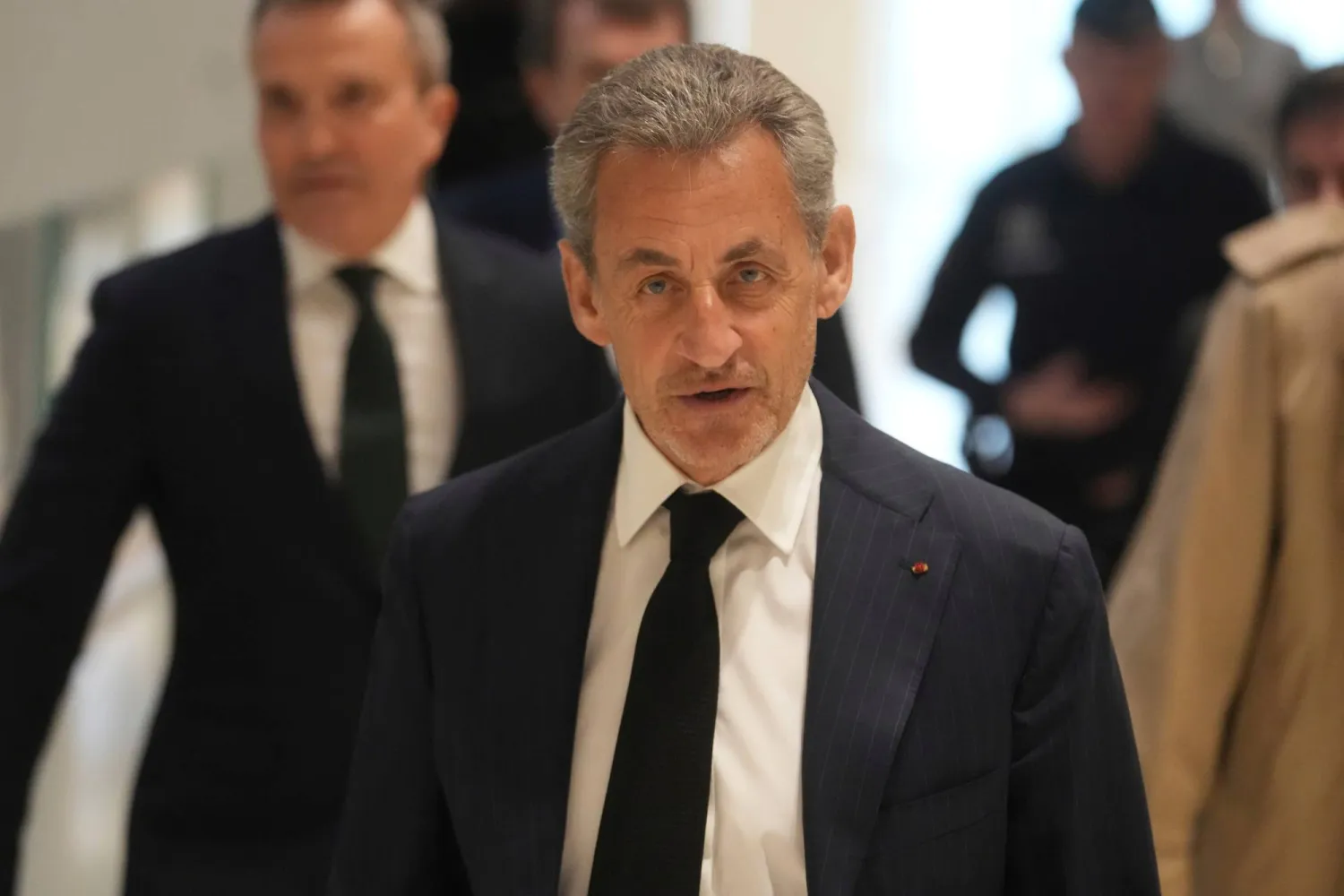
FILE - Former French President Nicolas Sarkozy arrives as he goes on trial over alleged illegal financing of his 2007 presidential campaign by the government of late Libyan leader Moammar Gadhafi, Monday, Jan. 6, 2025 in Paris. (AP Photo/Thibault Camus, File)
TT

Former French President Sarkozy Found Guilty on Key Charge, Acquitted of Others in Libya Case

FILE - Former French President Nicolas Sarkozy arrives as he goes on trial over alleged illegal financing of his 2007 presidential campaign by the government of late Libyan leader Moammar Gadhafi, Monday, Jan. 6, 2025 in Paris. (AP Photo/Thibault Camus, File)

A Paris court found former French President Nicolas Sarkozy guilty on a key charge but acquitted him on three others Thursday in his trial for the alleged illegal financing of his 2007 presidential campaign with money from the government of then-Libyan leader Moammar Gadhafi. 

The court is still detailing its ruling and hasn’t immediately sentenced the 70-year-old Sarkozy. That step would come later in the court proceedings Thursday. Sarkozy can appeal the guilty verdict, which would suspend any sentence pending the appeal. 

The court found Sarkozy guilty of criminal association in a scheme from 2005 to 2007 to finance his campaign with funds from Libya in exchange for diplomatic favors. But it cleared him of three other charges -- including passive corruption, illegal campaign financing and concealment of the embezzlement of public funds. 

Still, criminal association is a serious charge, carrying a potential sentence of up to 10 years in prison. 

The court also found two of Sarkozy’s closest associates when he was president -- former ministers Claude Gueant and Brice Hortefeux — guilty of criminal association but likewise acquitted them of some other charges. 

Overall, the verdicts appeared to suggest that the court believed that the men conspired together to seek Libyan funding for Sarkozy’s 2007 campaign but that judges weren’t convinced that the conservative leader himself was guilty of then putting the scheme in place. 

Sarkozy, accompanied by his wife, the singer and model Carla Bruni-Sarkozy, was present in the courtroom, which was also filled with reporters and members of the public. Sarkozy sat in the front row of the defendant’s seats. His three adult sons were also in the room. 

Sarkozy, who was elected in 2007 but lost his bid for reelection in 2012, denied all wrongdoing during a three-month trial earlier this year that also involved 11 co-defendants, including three former ministers. 

Despite multiple legal scandals that have clouded his presidential legacy, Sarkozy remains an influential figure in right-wing politics in France and in entertainment circles, by virtue of his marriage to Bruni-Sarkozy. 

Alleged Libya financing  

The accusations trace their roots to 2011, when a Libyan news agency and Gadhafi himself said the Libyan state had secretly funneled millions of euros into Sarkozy’s 2007 campaign. 

In 2012, the French investigative outlet Mediapart published what it said was a Libyan intelligence memo referencing a 50 million-euro funding agreement. Sarkozy denounced the document as a forgery and sued for defamation. 

French magistrates later said that the memo appeared to be authentic, though no conclusive evidence of a completed transaction was presented at the three-month Paris trial. 

Investigators also looked into a series of trips to Libya made by people close to Sarkozy when he served as interior minister from 2005 and 2007, including his chief of staff. 

In 2016, Franco-Lebanese businessman Ziad Takieddine told Mediapart that he had delivered suitcases filled with cash from Tripoli to the French Interior Ministry under Sarkozy. He later retracted his statement. 

That reversal is now the focus of a separate investigation into possible witness tampering. Both Sarkozy and his wife were handed preliminary charges for involvement in alleged efforts to pressure Takieddine. That case has not gone to trial yet. 

Takieddine, who was one of the co-defendants, died on Tuesday in Beirut. He was 75. He had fled to Lebanon in 2020 and did not attend the trial. 

Prosecutors alleged that Sarkozy had knowingly benefited from what they described as a “corruption pact” with Gadhafi’s government. 

Libya’s longtime Gadhafi was toppled and killed in an uprising in 2011, ending his four-decade rule of the North African country. 

Sarkozy denounced a ‘plot’  

The trial shed light on France’s back-channel talks with Libya in the 2000s, when Gadhafi was seeking to restore diplomatic ties with the West. Before that, Libya was considered a pariah state. 

Sarkozy has dismissed the allegations as politically motivated and reliant on forged evidence. During the trial, he denounced a “plot” he said was staged by “liars and crooks” including the “Gadhafi clan.” 

He suggested that the allegations of illegal campaign financing were retaliation for his call — as France’s president — for Gadhafi’s removal. 

Sarkozy was one of the first Western leaders to push for military intervention in Libya in 2011, when Arab Spring pro-democracy protests swept the Arab world. 

“What credibility can be given to such statements marked by the seal of vengeance?” Sarkozy asked in comments during the trial. 

Stripped of the Legion of Honor  

In June, Sarkozy was stripped of his Legion of Honor medal — France’s highest award — after his conviction in a separate case. 

Earlier, he was found guilty of corruption and influence peddling for trying to bribe a magistrate in 2014 in exchange for information about a legal case in which he was implicated. 

Sarkozy was sentenced to wear an electronic monitoring bracelet for one year. He was granted a conditional release in May due to his age, which allowed him to remove the electronic tag after he wore it for just over three months. 

In another case, Sarkozy was convicted last year of illegal campaign financing in his failed 2012 reelection bid. He was accused of having spent almost twice the maximum legal amount and was sentenced to a year in prison, of which six months were suspended. 

Sarkozy has denied the allegations. He has appealed that verdict to the highest Court of Cassation, and that appeal is pending. 


Danish Foreign Minister to Visit NATO Allies Over Greenland

Denmark's Foreign Minister Lars Lokke Rasmussen reacts, following his and Greenland's Foreign Minister Vivian Motzfeldt meeting with US Senators Angus King (I-ME), Lisa Murkowski (R-AK), Ruben Gallego (D-AZ) and a press conference, in Washington DC, US, January 14, 2026. (Reuters)
TT

Danish Foreign Minister to Visit NATO Allies Over Greenland

Denmark's Foreign Minister Lars Lokke Rasmussen reacts, following his and Greenland's Foreign Minister Vivian Motzfeldt meeting with US Senators Angus King (I-ME), Lisa Murkowski (R-AK), Ruben Gallego (D-AZ) and a press conference, in Washington DC, US, January 14, 2026. (Reuters)

Denmark's foreign minister is to visit fellow NATO members Norway, the UK and Sweden to discuss the alliance's Arctic security strategy, his ministry announced Sunday.

Foreign Minister Lars Lokke Rasmussen will visit Oslo on Sunday, travel to London on Monday and then to Stockholm on Thursday.

The diplomatic tour follows US President Donald Trump's threat to punish eight countries -- including the three Rasmussen is visiting -- with tariffs over their opposition to his plan to seize control of Greenland, an autonomous Danish territory.

Trump has accused Denmark, Norway, Sweden, France, Germany, the UK, the Netherlands and Finland of playing a "very dangerous game" after they sent a few dozen troops to the island as part of a military drill.

"In an unstable and unpredictable world, Denmark needs close friends and allies," Rasmussen stated in a press release.

"Our countries share the view that we all agree on the need to strengthen NATO's role in the Arctic, and I look forward to discussing how to achieve this," he said.

An extraordinary meeting of EU ambassadors has been called in Brussels for Sunday afternoon.

Denmark, "in cooperation with several European allies", recently joined a declaration on Greenland stating that the mineral-rich island is part of NATO and that its security is a "shared responsibility" of alliance members, the ministry statement added.

Since his return to the White House for a second term, Trump has made no secret of his desire to annex Greenland, defending the strategy as necessary for national security and to ward off supposed Russian and Chinese advances in the Arctic.


Iran Considers ‘Gradually’ Restoring Internet After Shutdown

10 January 2026, Iran, Tehran: A police station is set on fire during protests in Tehran in response to worsening economic conditions. ZUMA Press Wire/dpa
TT

Iran Considers ‘Gradually’ Restoring Internet After Shutdown

10 January 2026, Iran, Tehran: A police station is set on fire during protests in Tehran in response to worsening economic conditions. ZUMA Press Wire/dpa

Iranian authorities have said they are considering "gradually" restoring internet access after imposing a sweeping communications shutdown across the country more than a week ago, local media reported. 

On Sunday morning, AFP was able to connect to the internet from its Tehran office, though the vast majority of internet providers and mobile internet remain cut. 

It was not immediately clear why the limited connection was possible. 

Outgoing international calls have been possible since Tuesday, and text messaging was restored Saturday morning. 

Late Saturday, the Tasnim news agency reported "the relevant authorities announced that internet access would also be gradually restored", but gave no further details. 

Citing an unnamed "informed source", the agency said local messaging applications "will soon be activated" on Iran's domestic intranet. 

The unprecedented communications blackout was imposed as calls proliferated for anti-government demonstrations initially triggered by the country's economic malaise. 

For days, text messages and international phone calls -- and at times even local calls -- were cut off. 

Iran has since been relying on its intranet, which has supported local media websites, ride-hailing apps, delivery service and banking platforms. 

State television has since Saturday been promoting local messaging applications including Rubika -- which was largely unavailable earlier this week. 

Even before the blackout, popular applications such as Instagram, Facebook, X, Telegram and YouTube had been blocked in Iran for years, requiring VPN connections to bypass the restrictions. 

The protests, which began on December 28, have been widely seen as the biggest challenge to the Iranian leadership since the months-long demonstrations that followed the 2022 death in custody of Mahsa Amini. 

But the latest demonstrations appear to have subsided in recent days. 

Iranian officials have not given an exact death toll for the protests, but Norway-based rights group Iran Human Rights (IHR) reported that 3,428 people were verified to have been killed by security forces, while warning the actual toll could be several times higher. 

Other estimates place the toll at more than 5,000 -- and possibly as high as 20,000, IHR said. 

The opposition Iran International channel based outside the country has said at least 12,000 people were killed during the protests, citing senior government and security sources. 

Iran's judiciary has completely rejected that figure. 

Iranian officials have said the demonstrations were peaceful before turning into "riots" that included vandalism of public property. 

Authorities have blamed foreign influence, namely from Iran's foes the United States and Israel. 

On Saturday, supreme leader Ali Khamenei said "a few thousand" people had been killed by what he called "agents" of the two countries who instigated the unrest. 


Pakistan Security Forces Kill 12 Militants, Thwarting Attempted Hostage-taking in Southwest

File photo: Pakistani Army and security officials stand guard as the opposition party Pakistan Tehrik-e-Insaft (PTI) continue their protest for the third day demanding release of former Prime Minister Imran Khan, in Islamabad, Pakistan, 06 October 2024. EPA/SOHAIL SHAHZAD
TT

Pakistan Security Forces Kill 12 Militants, Thwarting Attempted Hostage-taking in Southwest

File photo: Pakistani Army and security officials stand guard as the opposition party Pakistan Tehrik-e-Insaft (PTI) continue their protest for the third day demanding release of former Prime Minister Imran Khan, in Islamabad, Pakistan, 06 October 2024. EPA/SOHAIL SHAHZAD

Pakistani security forces killed at least 12 militants and thwarted an attempted hostage-taking in southwestern Pakistan after assailants attacked a police station, the military said Friday.

In a statement, it said the attackers also targeted two banks and looted millions of rupees (dollars) during the assault in Kharan district of Balochistan province a day earlier. The militants attempted to seize hostages at the police station, but a swift response by security forces forced them to retreat, it said.

The military identified the assailants as “Fitna al-Hindustan,” a phrase the government uses for the outlawed Baloch Liberation Army, or BLA, and other separatist groups. It claimed the attackers, including those killed in the shootouts with security forces, were backed by India, though it provided no evidence. India has repeatedly denied Pakistan’s accusations that it supports separatists in Balochistan or Pakistani Taliban fighters.

Pakistan's Interior Minister Mohsin Naqvi in a statement praised the security forces for killing the militants and foiling the attacks by the insurgents in Kharan, reported The Associated Press.

Balochistan, Pakistan’s largest but least populated province, has long been the scene of insurgency by separatist groups, along with attacks by the Pakistani Taliban. The BLA, which the United States designated a terrorist organization in 2019, has been behind numerous attacks targeting security forces and civilians across the province in recent years.