

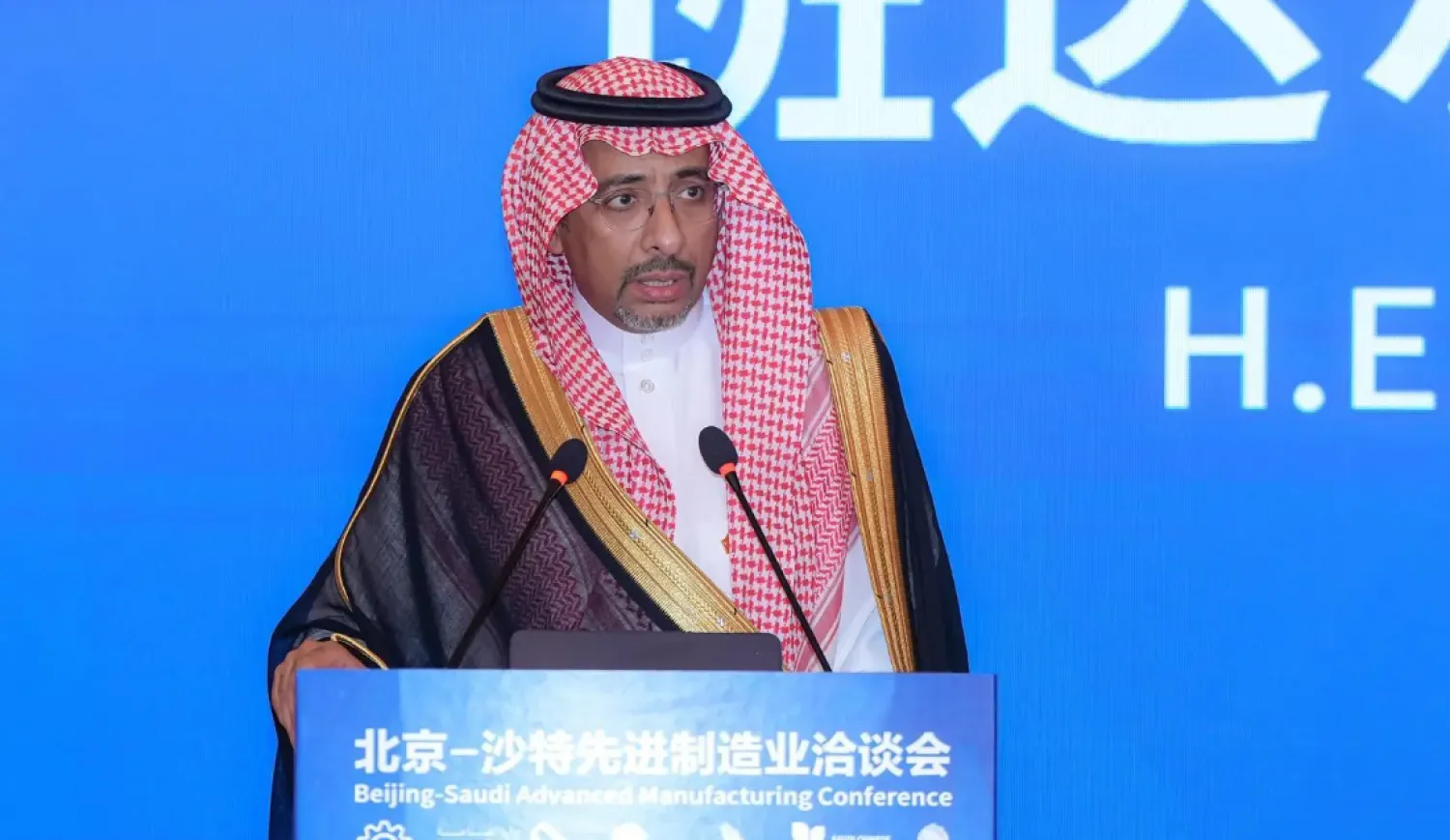

$1.74 Billion in Investment Deals Signed at Saudi-Chinese Business Forum

The forum, organized by the Federation of Saudi Chambers, gathered about 200 Saudi and Chinese companies with private sector representatives - SPA
TT

$1.74 Billion in Investment Deals Signed at Saudi-Chinese Business Forum

The forum, organized by the Federation of Saudi Chambers, gathered about 200 Saudi and Chinese companies with private sector representatives - SPA

Saudi Minister of Industry and Mineral Resources Bandar Alkhorayef witnessed the signing of 42 investment agreements between Saudi and Chinese companies, valued at over $1.74 billion, during his participation in the Saudi-Chinese Business Forum held in Beijing.

The agreements spanned advanced industries, smart vehicles, energy solutions, medical devices, equipment, and mineral resources, SPA reported.

The forum, organized by the Federation of Saudi Chambers, brought together around 200 Saudi and Chinese companies alongside private sector representatives from both countries, creating a platform for enhanced economic cooperation and strategic alignment.

In his keynote address at the forum, Alkhorayef commended the key role of the Saudi-Chinese Business Council in facilitating investment partnerships and leveraging mutual opportunities across various sectors since its establishment in 2006. He emphasized the council’s role in creating frameworks that enable sustainable development outcomes for both nations, highlighting the organization's contributions to achieving shared economic objectives through private sector engagement.

The minister detailed the remarkable development of economic relations between Saudi Arabia and China, affirmed by substantial growth in bilateral trade volume, which reached approximately SAR403 billion in 2024. This figure, more than double the trade volume in less than a decade, demonstrates the accelerating pace of economic integration.

The Kingdom remains China’s leading supplier of fuel, petrochemicals, and advanced materials, while China has been Saudi Arabia's largest source of imports, including machinery, electronics, transportation equipment, and consumer goods. This trading relationship demonstrates increasing diversification, extending beyond traditional commodities to high-value industrial products.

On mutual investments, Alkhorayef highlighted substantial growth, with Chinese investment in the Kingdom rising approximately 30% in 2024 to exceed SAR31 billion. This expansion is particularly notable in emerging sectors, including mining, automotive manufacturing, and petrochemicals. More than 750 Chinese companies now operate within Saudi Arabia, contributing significantly to major projects including NEOM and strategic industrial cities like Jubail and Jazan. On the other hand, Saudi investment in China continues to grow, surpassing SAR8 billion, bolstered by memoranda of understanding between the Public Investment Fund and Chinese financial institutions valued at $50 billion.

Alkhorayef emphasized the strategic synergy between Saudi Vision 2030 and China's Belt and Road Initiative, noting their shared objectives of enhancing connectivity, expanding trade, and building resilient industrial systems.

He outlined 12 priority sub-industrial sectors targeted by the National Industrial Strategy for development. These include sectors vital to national security, such as food, pharmaceuticals, and military industries; sectors leveraging the Kingdom's comparative advantages in raw materials, oil, gas, and minerals; and sectors capitalizing on Saudi Arabia's strategic geographic location that positions it as an ideal partner for Chinese companies seeking global market access. A third category focuses on Fourth Industrial Revolution technologies, including artificial intelligence, additive manufacturing, and future industries.

Moreover, the minister highlighted that the comprehensive strategy for mining and metals industries focuses on exploring the Kingdom's mineral resources and maximizing their value to the national economy. He specifically applauded the partnership with the China Geological Survey, which has contributed significantly to the discovery of additional mineral resources within the Kingdom.

Alkhorayef highlighted how the Kingdom's reforms to enhance investment attractiveness, improve the mining regulatory framework, and streamline licensing processes have dramatically improved its global standing, with Saudi Arabia jumping from 104th to 23rd in the Mining Investment Environment Attractiveness Index.



Fitch Affirms Saudi Arabia’s Credit Rating at ‘A+’ with Stable Outlook

FILE PHOTO: The Fitch Ratings logo is seen at their offices at Canary Wharf financial district in London,Britain, March 3, 2016. REUTERS/Reinhard Krause/File Photo
TT

Fitch Affirms Saudi Arabia’s Credit Rating at ‘A+’ with Stable Outlook

FILE PHOTO: The Fitch Ratings logo is seen at their offices at Canary Wharf financial district in London,Britain, March 3, 2016. REUTERS/Reinhard Krause/File Photo

Fitch Ratings has affirmed Saudi Arabia’s sovereign credit rating at A+ with a stable outlook, according to a report issued by the agency on Friday.

The agency said the Kingdom’s credit profile reflects the strength of its fiscal position, noting that its government debt-to-GDP ratio and net sovereign foreign assets are significantly stronger than the medians for both the “A” and “AA” rating categories.

Fitch also highlighted Saudi Arabia’s substantial financial buffers, including deposits and other public sector assets.

The ratings agency projected real GDP growth of 4.8% in 2026 and expects the fiscal deficit to narrow to 3.6% of GDP by the end of 2027.

Fitch also said non-oil revenues are expected to continue benefiting from strong economic activity and improved revenue efficiency.

The agency praised the momentum of economic reforms, including the updated investment system and the continued opening of the real estate and equity markets to foreign investors.


Oil Prices Rise 1% as Supply Risks Remain in Focus

The Nave Photon, carrying crude oil from Venezuela, is docked at Port Freeport in Freeport, Texas, US, January 15, 2026. REUTERS/Antranik Tavitian
TT

Oil Prices Rise 1% as Supply Risks Remain in Focus

The Nave Photon, carrying crude oil from Venezuela, is docked at Port Freeport in Freeport, Texas, US, January 15, 2026. REUTERS/Antranik Tavitian

Oil prices rose over 1% on Friday as supply risks remained in focus despite the receding likelihood of a US military strike against Iran.

Brent crude was up 84 cents, or 1.3%, to $64.60 a barrel at 1413 GMT, on course for a fourth consecutive weekly gain. US West Texas Intermediate was up 80 cents, or 1.4%, to $59.99.

At those levels, Brent was on course for a 2% weekly gain and WTI for a 1.4% gain. Brent ⁠was up a little more than $1 at its intraday peak as investors continue to weigh the potential for supply outages should tensions in the Middle East escalate, Reuters reported.

"While geopolitical tensions in the Middle East have eased, they have not disappeared, and market participants remain concerned about potential supply disruptions," said UBS analyst Giovanni Staunovo.

Both benchmarks hit multi-month highs this week ⁠after protests flared up in Iran and US President Donald Trump signaled the potential for military strikes, but lost over 4% on Thursday as Trump said that Tehran's crackdown on the protesters was easing, allaying concerns of possible military action that could disrupt oil supplies.

"Above all, there are worries about a possible blockade of the Strait of Hormuz by Iran in the event of an escalation, through which around a quarter of seaborne oil supplies flow," Commerzbank analysts said in a note.

"Should there be signs of a sustained easing on ⁠this front, developments in Venezuela are likely to return to the spotlight, with oil that was recently sanctioned or blocked gradually flowing onto the world market."

Meanwhile, analysts expect higher supply this year, potentially creating a ceiling for the geopolitical risk premium on prices.

"Despite the steady drumbeat of geopolitical risks and macro speculation, the underlying balance still points to ample supply," said Phillip Nova analyst Priyanka Sachdeva.

"Unless we see a genuine revival in Chinese demand or a meaningful bottleneck in physical barrel flows, oil looks range-bound, with Brent broadly hovering between $57 and $67."


Gold Eases as Strong US Data, Easing Geopolitical Tensions Sap Momentum

FILE PHOTO: A saleswoman displays a gold necklace inside a jewellery showroom on the occasion of Akshaya Tritiya, a major gold buying festival, in Kolkata, India, May 7, 2019. REUTERS/Rupak De Chowdhuri/File Photo
TT

Gold Eases as Strong US Data, Easing Geopolitical Tensions Sap Momentum

FILE PHOTO: A saleswoman displays a gold necklace inside a jewellery showroom on the occasion of Akshaya Tritiya, a major gold buying festival, in Kolkata, India, May 7, 2019. REUTERS/Rupak De Chowdhuri/File Photo

Gold prices ticked lower on Friday, extending losses from the previous session, as stronger-than-expected US economic data and easing geopolitical tensions in Iran hampered bullion's bullish momentum.

Spot gold eased 0.3% to $4,603.02 per ounce by 0918 GMT. However, the metal is poised for a weekly gain of about 2% after scaling a record peak of $4,642.72 on Wednesday. US gold futures for February delivery edged 0.4% lower to $4,606.70.

"There was ‌a lot of ‌momentum in the (gold) market, which seems to ‌have ⁠faded slightly ‌at the moment....the economic news flow out of the US has been causing some headwinds rather than tailwinds as of late, which is reflected in a somewhat stronger US dollar," said Julius Baer analyst Carsten Menke.

The US dollar hovered near a six-week high on the back of positive economic data on Thursday showing initial jobless claims dropped 9,000 ⁠to a seasonally adjusted 198,000 last week, below economists' forecast of 215,000.

A firmer ‌dollar makes greenback-priced bullion more expensive for overseas ‍buyers. On the geopolitical front, people ‍inside Iran, reached by Reuters on Wednesday and Thursday, said ‍protests appeared to have abated since Monday.

Safe-haven gold tends to do well during times of geopolitical and economic uncertainty. Meanwhile, gold demand in India stayed muted this week as prices hit record highs again, taking the shine off retail buying, while bullion traded at a premium in China as demand remained steady ahead of the Lunar ⁠New Year.

Spot silver shed 1.1% to $91.33 per ounce, although it was headed for a weekly gain of over 14% after hitting an all-time high of $93.57 in the previous session. "The silver market seemed very determined to reach the $100 per ounce threshold before moving lower again....speculative traders are keeping an eye on that level even though it would not be sustainable in the medium to longer-term," Menke added.

Spot platinum dropped 2.7% to $2,345.78 per ounce, and was set to gain more than 3.1% for the week so far. Palladium lost 2.6% to $1,755.04 per ‌ounce, after hitting a more than one-week low earlier, and was headed for a weekly loss of 3.3%.