

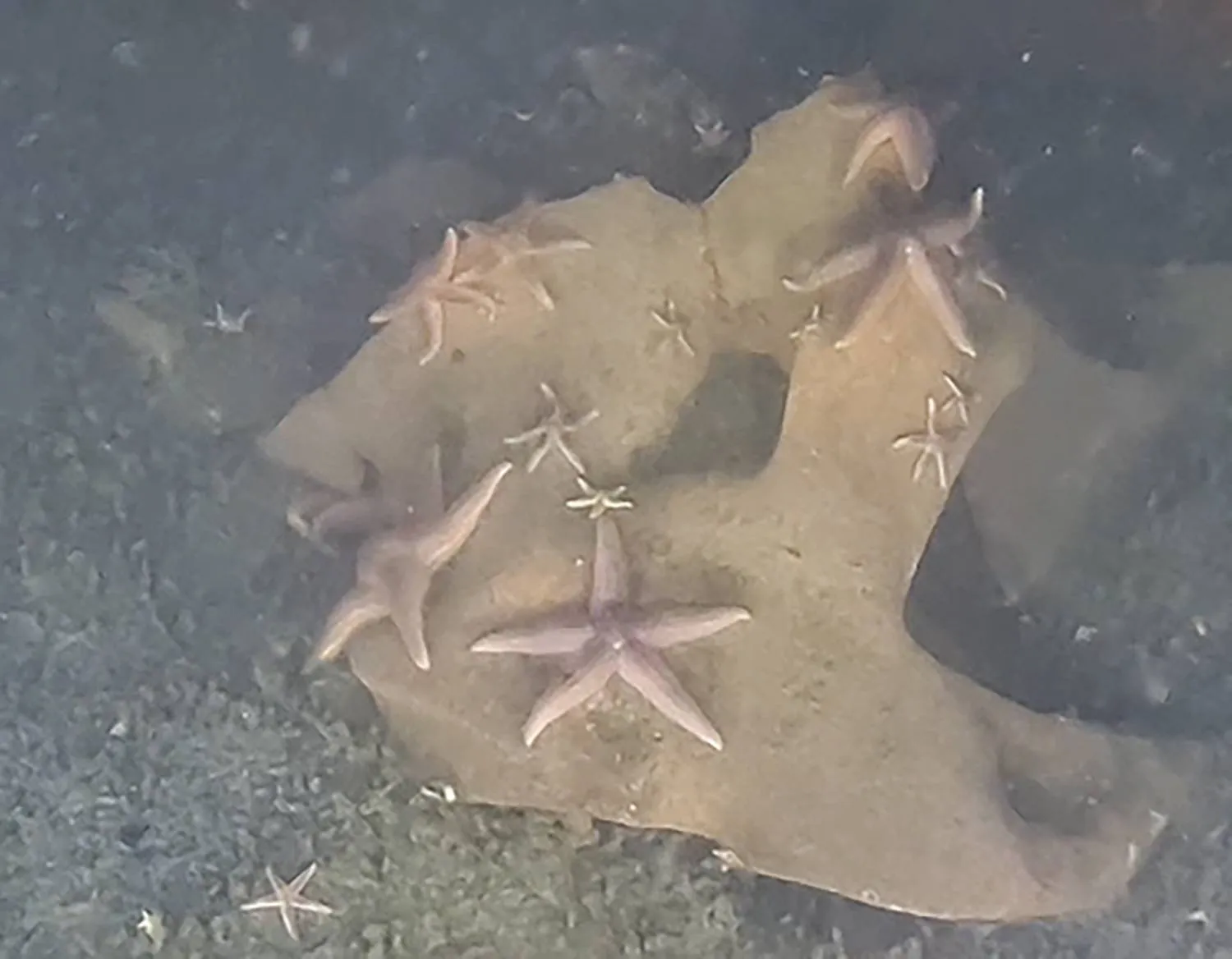

Sea Life Thriving on Unexploded Nazi Bombs, Sub Discovers

This handout photograph provided by DeepSea Monitoring Group and taken on October 2024 with an unmanned submersible shows starfish (Asterias rubens) on top of a chunk of TNT, part of an unexploded Nazi-era cruise missile, at the bottom Luebeck Bay in the German waters of the Baltic Sea. (Photo by Andrey VEDENIN / DeepSea Monitoring Group / AFP)
TT

Sea Life Thriving on Unexploded Nazi Bombs, Sub Discovers

This handout photograph provided by DeepSea Monitoring Group and taken on October 2024 with an unmanned submersible shows starfish (Asterias rubens) on top of a chunk of TNT, part of an unexploded Nazi-era cruise missile, at the bottom Luebeck Bay in the German waters of the Baltic Sea. (Photo by Andrey VEDENIN / DeepSea Monitoring Group / AFP)

Marine life is thriving on unexploded Nazi bombs sitting at the bottom of a German bay, a submersible has discovered, even capturing footage of starfishes creeping across a huge chunk of TNT.

The discovery, which was revealed in a study published Thursday, was "one of those rare but remarkable eureka moments," marine biologist Andrey Vedenin told AFP.

The waters off Germany's coast are estimated to be littered with 1.6 million tons of unexploded munitions left behind from both world wars.

In October last year, a team of German scientists went to a previously uncharted dump site in the Baltic Sea's Luebeck Bay and sent an unmanned submersible 20 metres down to the seafloor.

They were surprised when footage from the sub revealed 10 Nazi-era cruise missiles. Then they were stunned when they saw animals covering the surface of the bombs.

There were roughly 40,000 animals per square meter -- mostly marine worms -- living on the munitions, the scientists wrote in the journal Communications Earth & Environment.

They also counted three species of fish, a crab, sea anemones, a jellyfish relative called hydroids and plenty of starfishes.

While animals covered the hard casing of the bombs, they mostly avoided the yellow explosive material -- except for one instance.

The researchers were baffled to see that more than 40 starfishes had piled on to an exposed chunk of TNT.

"It looked really weird," said Vedenin, a scientist at Germany's Carl von Ossietzky University and the study's lead author.

Exactly why the starfishes were there was unclear, but Vedenin theorized they could be eating bacterial film collecting on the corroding TNT.

The explosive chemicals are highly toxic, but the animals appeared to have found a way to live near it.

Other than the death-wish starfishes, they did not seem to be behaving strangely.

"The crabs were just sitting and picking something with their claws," Vedenin said.

To find out what kind of bombs they were dealing with, he went online and found a manual from the Nazi air force Luftwaffe describing how to handle and store V-1 flying bombs. The cruise missile exactly matched the 10 bombs from the footage.

Vedenin said "there is some irony" in the discovery that these "things that are meant to kill everything are now attracting so much life."

He compared it to how animals such as deer now thrive in radioactive areas abandoned by humans near the site of the Chernobyl nuclear disaster.

Hard surfaces on the seafloor are important for marine life that want more than mud and sand.

Animals once flocked to huge boulders that littered the Baltic Sea, however humans removed the stones to build infrastructure such as roads at the start of the 20th century.

So when the Nazi bombs are eventually cleared from the bay, the researchers called for more stones -- or concrete structures -- to be put in place to continue supporting the sea life.

The scientists also plan to return to the spot next month to set up a time-lapse camera to watch what the starfishes do next.



ISS Crew Splashes Down on Earth After Medical Evacuation

FILE - This photo provided by NASA shows the Moon's shadow covering portions of Canada and the US during a total solar eclipse as seen from the International Space Station on Monday, Aug. 8, 2024. (NASA via AP, File)
TT

ISS Crew Splashes Down on Earth After Medical Evacuation

FILE - This photo provided by NASA shows the Moon's shadow covering portions of Canada and the US during a total solar eclipse as seen from the International Space Station on Monday, Aug. 8, 2024. (NASA via AP, File)

Four International Space Station (ISS) crewmembers splashed down in the Pacific Ocean early Thursday, video footage from NASA showed, after a medical issue prompted their mission to be cut short.

American astronauts Mike Fincke and Zena Cardman, Russian cosmonaut Oleg Platonov and Japan's Kimiya Yui landed off the coast of San Diego about 12:41 am (0841 GMT), marking the first-ever medical evacuation from the ISS.


Lonely Tree in Wales Is an Instagram Star, but its Fate Is Inevitable

The Lonely Tree, often pictured submerged in water, was first planted in 2010. (Getty Images)
TT

Lonely Tree in Wales Is an Instagram Star, but its Fate Is Inevitable

The Lonely Tree, often pictured submerged in water, was first planted in 2010. (Getty Images)

It is one of Wales' most-loved beauty spots - but the time of the so-called Lonely Tree being an Instagram star could be slowly coming to an end.

The birch tree's striking setting at Llyn Padarn in Eryri, also known as Snowdonia, draws photographers to capture the sight through the seasons, according to BBC.

But the local authority Cyngor Gwynedd has raised the prospect of the tree, which was planted around 2010, disappearing within the next decade or so.

A lack of nutrients in the soil means birch trees have “a relatively short lifespan” in the area, typically living for around 30 years, but the fact that The Lonely Tree is sometimes submerged in water means its time could be even shorter.

Thousands of walkers and photographers make their way there each year and the tree has many social media sites dedicated to it, including one with 3,500 members on Facebook.

Marc Lock from Bangor, Gwynedd, said: “The Lonely Tree holds a special place in my heart and that of my family.”

He added: “Nestled down by the Lonely Tree, it's a perfect spot for us to sit, reflect and soak in the breath-taking scenery. We often go paddleboarding there in the summer months.”

However, Lock said the area really became his sanctuary after his wife bought him a camera for Christmas and he took up photography.

It was the place he headed to straight away, and he returns regularly at various times of the day and throughout the seasons.

“It's my go-to spot whenever I have some free time and my camera in hand,” he added. “I can't imagine what I would do if anything devastating happened to it like that at the Sycamore Gap tree at Hadrian's Wall. It's simply unthinkable.”

The Sycamore Gap was a much-loved landmark beside Hadrian's Wall in Northumberland that also drew hikers and photographers from far and wide.

It was more than 100 years old and had been the scene of many proposals, with people making the trip there from around the world.

But it was cut down by vandals in September 2023, causing uproar, with thousands of people leaving tributes and posting messages about their love for the beauty spot.

Two men were jailed for four years and three months after admitting the illegal felling.

While maybe not quite as famous as the Sycamore Gap was, The Lonely Tree is every bit as special to those that hold it dear to their heart.


Four Signs You're Self-Sabotaging Your Joy

Threat or uncertainty can reduce cognitive regulation and increase avoidance behaviors. (Indiana University)
TT

Four Signs You're Self-Sabotaging Your Joy

Threat or uncertainty can reduce cognitive regulation and increase avoidance behaviors. (Indiana University)

Most of us, at some point in our lives, have stood in the way of our own growth.

We make progress on a project, start to feel hopeful about a relationship, or finally get on track with a goal, and then we do something that undermines it.

We fall into a procrastination spiral, pick a fight, or simply quit; in doing so, we talk ourselves out of something that could potentially bring us happiness.

There’s a name for this kind of behavior: self-sabotage.

Dr. Mark Travers, an American psychologist with degrees from Cornell University and the University of Colorado Boulder, wrote an essay at Psychology Today about four well-studied reasons why people sabotage good things, based on research in psychology.

Avoiding blame

According to Travers, one of the most consistently researched patterns in self-sabotage comes from what psychologists call self-handicapping.

He said this is a behavior in which people create obstacles to their own success so that if they fail, they can blame external factors instead of internal ability.

A prime example comes from classic research in which researchers observed students who procrastinated studying for an important test. The ones who failed mostly attributed it to a lack of preparation rather than a lack of organization or discipline.

Self-handicapping is not simply laziness or whimsy. Rather, it is a strategy people use to protect their self-worth in situations where they might perform “poorly” or where they might be perceived as inadequate.

Fear of failure or success

People often think of the fear of failure as the main emotional driver behind self-sabotage.

But research points to the fear of success as an equal, yet less-talked-about engine of the phenomenon. Both fears can push people to undermine opportunities that are actually aligned with their long-term goals.

He said people who worry that failure will confirm their negative self-beliefs are more likely to adopt defensive avoidance tactics, like procrastination or quitting early.

Fear of success, though less widely discussed, operates in a similar fashion. What motivates this fear is the anxiety that comes with the consequences of success.

So, self-sabotaging success can be a way to stay within a comfort zone where expectations are familiar, even if that zone is unsatisfying.

Negative self-beliefs

Self-sabotage is tightly intertwined with how people view themselves. When someone doubts their worth, their ability, or their right to be happy, they may unconsciously act in ways that confirm those negative self-views.

Psychological theories help explain this.

Self-discrepancy theory proposes that people experience emotional discomfort when their actual self does not match their ideal self. This mismatch can lead to negative emotions such as shame, anxiety, or depression.

Coping with stress and anxiety

Self-sabotage often emerges in moments of high stress or emotional threat. When people feel overwhelmed, anxious, or stretched thin, their nervous systems shift into protective modes. Instead of moving forward, they retreat, avoid, or defensively withdraw.

Threat or uncertainty can reduce cognitive regulation and increase avoidance behaviors. In situations of perceived threat, even if the threat is potential success or evaluation, people can default to behaviors that feel safer, even if they undermine long-term goals.