


Hezbollah Defies Lebanon PM's Ban to Honor Fallen Leaders with Coastal Light Show

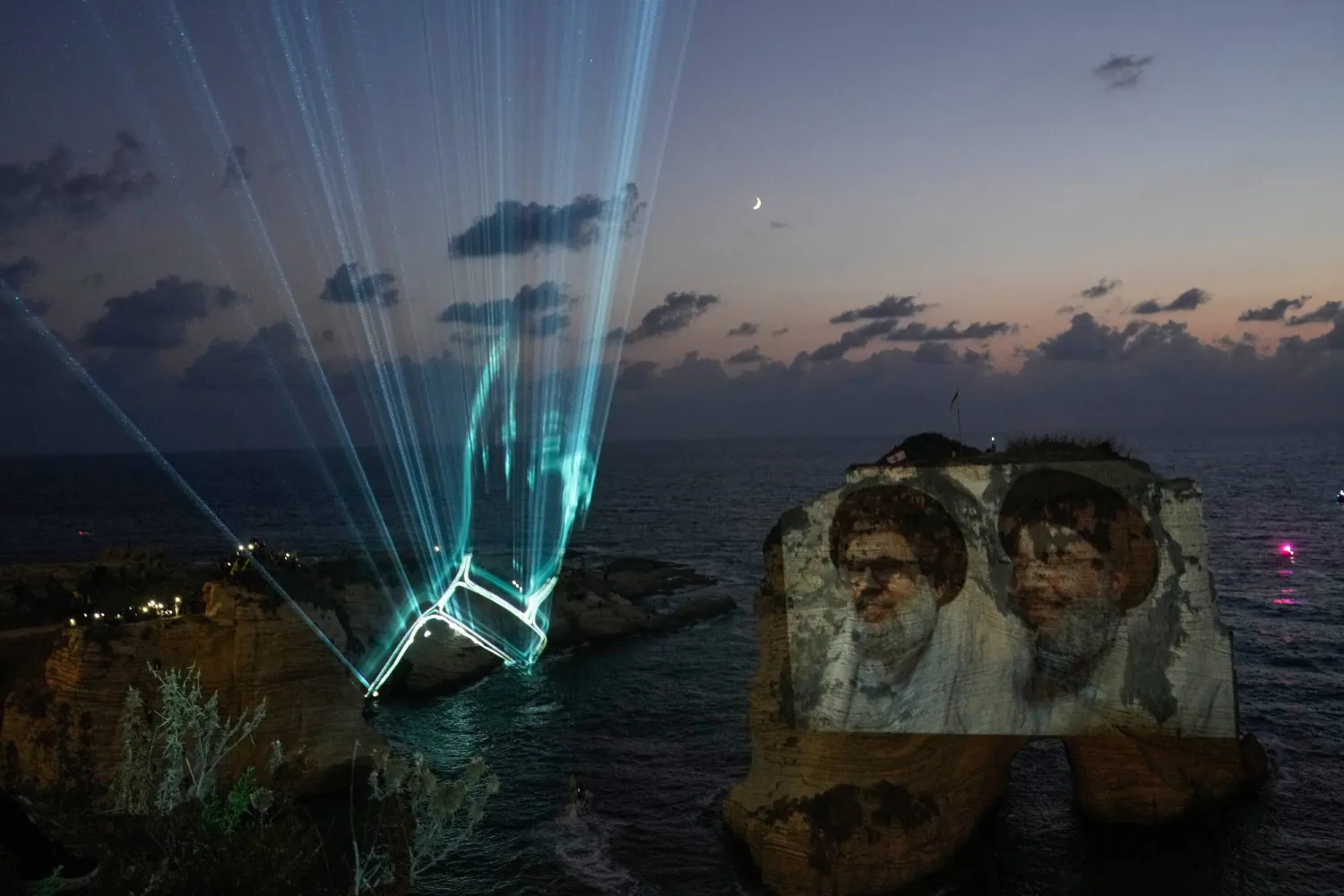
Portraits of former Hezbollah leaders Sayyed Hassan Nasrallah, right, and Hashem Safieddine, are projected onto the landmark Raouche sea rock during an event commemorating the anniversary of their assassination, in Beirut, Lebanon, Thursday, Sept. 25, 2025. (AP Photo/Hussein Malla)
TT

Hezbollah Defies Lebanon PM's Ban to Honor Fallen Leaders with Coastal Light Show

Portraits of former Hezbollah leaders Sayyed Hassan Nasrallah, right, and Hashem Safieddine, are projected onto the landmark Raouche sea rock during an event commemorating the anniversary of their assassination, in Beirut, Lebanon, Thursday, Sept. 25, 2025. (AP Photo/Hussein Malla)

Thousands of Hezbollah supporters gathered at a scenic overlook on Beirut’s coast Thursday and projected images of the group’s former longtime leader and his successor on the iconic arched Raouche rock to commemorate their deaths in Israeli airstrikes nearly a year ago.

The move came despite an apparent attempt by Lebanon’s Prime Minister Nawaf Salam to halt the planned light show, The Associated Press said.

Salam issued a circular earlier this week pointing to “the recent recurrence of the exploitation of national monuments for propaganda purposes and to hold activities in which partisan and political slogans are raised.”

He directed public bodies to “strictly prohibit the use of public land and sea areas, archaeological and tourist landmarks, or those that bear a unifying national symbolism before obtaining the necessary licenses and permits from the relevant authorities.”

Hassan Nasrallah, the longtime leader of the militant group and political party, was killed in a series of massive Israeli strikes on a site in Beirut’s southern suburbs on Sept. 27, 2024, that destroyed an entire block under which Nasrallah was meeting with an Iranian general and some of his top military commanders.

Days later, Nasrallah’s successor, Hashem Safieddine, was killed in another series of airstrikes on Beirut’s southern suburbs.

Salam said in a post on X that a gathering permit was issued by the governor of Beirut to the organizers of the demonstration, but “clearly stipulated that the Raouche rocks shall not be illuminated at all, whether from land, sea, or air, and no light images shall be broadcast on them.”

He said he had asked the ministers of interior, justice and defense to take “appropriate measures, including arresting the perpetrators and referring them for investigation” and that the incident “negatively impacting (Hezbollah’s) credibility in dealing with the logic of the state and its institutions.”

A Hezbollah representative, who spoke on condition of anonymity in accordance with the group's procedures, confirmed that the organizers had only requested permission for the gathering.

He said it was unclear which agency had authority to give permission for the light show on the rock and that they considered it was covered by “freedom of expression” under Lebanon's constitution.

The event was a show of force by the Shiite militant group and political party, which suffered serious blows in last year’s war with Israel and has been under domestic and international pressure to give up its remaining arsenal since then.

The conflict began a day after deadly the Hamas-led attack on southern Israel on Oct. 7, 2023, that triggered the ongoing war in the Gaza Strip. Hezbollah began firing rockets across the border in a “support front” for Hamas and Palestinians in Gaza. Israel responded with airstrikes and shelling, and the two sides were locked in a low-level conflict that escalated into a full-on war in September 2024.

It ended with a US-brokered ceasefire in November, but Israel has continued to carry out near-daily airstrikes in Lebanon, which it says aim at precenting Hezbollah from regrouping.

The Lebanese government has said it will work on disarming Hezbollah and consolidating weapons in the hands of the state. Hezbollah officials have said they will not discuss handing over the groups weapons until Israel stops its airstrikes and withdraws its forces from several key border points they are occupying in southern Lebanon.

Lebanese officials have been reluctant to push the country’s cash-strapped army to forcibly disarm the group, fearing that such a move would lead to civil conflict.



Hezbollah Continues to Defy Attempts to Disarm it, Slams FM

Hezbollah Secretary-General Sheikh Naim Qassem speaks during his televised address on Saturday. (Hezbollah media)
TT

Hezbollah Continues to Defy Attempts to Disarm it, Slams FM

Hezbollah Secretary-General Sheikh Naim Qassem speaks during his televised address on Saturday. (Hezbollah media)

Hezbollah reiterated on Saturday its rejection of attempts to disarm it days after the government vowed to kick off the second phase of the plan to impose state monopoly over arms.

The first phase called for limiting weapons to the state south of the Litani River and the second phase covers regions north of the river.

In a televised address, Hezbollah Secretary-General Sheikh Naim Qassem declared on Saturday that the new phase demands that the ceasefire with Israel be implemented in full.

“Lebanon carried out its end of the deal and the resistance [Hezbollah] ensured that not a single violation was committed by Lebanon,” he added.

Lebanon and Israel agreed to a ceasefire in November 2024 that ended a war between the Iran-backed party and Israel.

Moreover, Qassem said the ceasefire “is actually a single phase, and it has no second phase.” The Lebanese state fulfilled its end of the deal, while Israel has not met any of its commitments.

“It is unreasonable for us to give Israel any concessions without anything in return,” he went on to say.

Imposing state monopoly over arms is actually an Israeli and American demand to weaken the resistance, he charged.

“Offering more concessions is a form of weakness,” he stressed.

“Our weapons aim to defend ourselves, resistance, people and nation,” Qassem declared.

He also warned that “killings and abductions may happen anywhere if the arms are surrendered.”

Defying calls to disarm, he said: “We will maintain the resistance. Lebanon cannot exist without the resistance. It was liberated because of the resistance.”

Qassem also slammed Foreign Minister Youssef Raggi for saying last week that Israel has the right to act militarily if Hezbollah did not disarm in full.

“In whose name does this foreign minister speak?” asked Qassem. “He is basing his stance on the humiliating ceasefire that you signed after the ‘support war’.”

Hezbollah launched the support front in October 2023 to back Hamas in its conflict with Israel in Gaza. The border clashes between Hezbollah and Israel turned into a full-blown war nearly a year later, with Israel decimating the party’s leadership. The war ended with the November 2024 ceasefire.

Qassem accused Raggi of violating the state’s policies, undermining civil peace, and stoking strife. He also said the minister was working against the president, government, Lebanese people and resistance.

“The government will be held responsible” for the FM’s stances, he warned, urging it to “replace or silence him or obligate him to abide by Lebanon’s policies.”

Qassem’s statements were swiftly condemned by Lebanese Forces MP Ghayath Yazbeck.

In a post on the X platform, he slammed Qassem for “verbally” and “morally” assaulting LF ministers, “in complete disregard of ethical principles”.

He warned that Qassem’s remarks may be a prelude to the assassination of the ministers and “the assassination of the Lebanese state.”

“Our ministers represent dignity, sovereignty and the state,” he stressed. Indirectly addressing Qassem, he said: “Act smart. Your predecessors made these mistakes and ended up in history’s trash bin. Haven’t you learned anything?”


Israeli Troops Kill Palestinians for Crossing a Vague Ceasefire Line that's Sometimes Unmarked

A yellow block demarcating the "Yellow Line," which has separated the Gaza Strip's Israeli-held and Palestinian zones since the October ceasefire, is visible in Jabalia, northern Gaza Strip, where Hamas militants are searching for the remains of hostages, Monday, Dec. 1, 2025. (AP Photo/Jehad Alshrafi)
TT

Israeli Troops Kill Palestinians for Crossing a Vague Ceasefire Line that's Sometimes Unmarked

A yellow block demarcating the "Yellow Line," which has separated the Gaza Strip's Israeli-held and Palestinian zones since the October ceasefire, is visible in Jabalia, northern Gaza Strip, where Hamas militants are searching for the remains of hostages, Monday, Dec. 1, 2025. (AP Photo/Jehad Alshrafi)

A dividing line, at times invisible, can mean life or death for Palestinians in Gaza.

Those sheltering near the territory's “yellow line” that the Israeli military withdrew to as part of the October ceasefire say they live in fear as Israeli soldiers direct near-daily fire at anyone who crosses or even lingers near it.

Of the 447 Palestinians killed between the ceasefire taking effect and Tuesday, at least 77 were killed by Israeli gunfire near the line, including 62 who crossed it, according to the Gaza Health Ministry. Among them were teenagers and young children, The Associated Press found.

And although the military has placed some yellow barrels and concrete barriers delineating the limits of the Palestinian zone, the line is still unmarked in certain places and in others was laid nearly half a kilometer (0.3 miles) deeper than what was agreed to in the ceasefire deal, expanding the part of Gaza that Israel controls, according to Palestinians and mapping experts.

“We stay away from the barrels. No one dares to get close” said Gaza City resident Ahmed Abu Jahal, noting that the markers are less than 100 meters (110 yards) from his house — instead of the roughly 500 meters (546 yards) outlined in a map put out by the Israeli military.

As of Tuesday, the military had acknowledged killing 57 people around the yellow line, saying most were militants. It said its troops are complying with the rules of engagement in order to counter militant groups, and are informing Palestinians of the line’s location and marking it on the ground to “reduce friction and prevent misunderstandings.”

Easy to get lost

Under the ceasefire, Israel withdrew its troops to a buffer zone that is up to 7 kilometers (4 miles) deep and includes most of Gaza's arable land, its elevated points and all of its border crossings. That hems more than 2 million Palestinians into a strip along the coastline and central Gaza.

People of all ages, some already dead, have been showing up almost daily at the emergency room of Gaza City's Al-Ahli hospital with bullet wounds from straying near the line, said hospital director Fadel Naeem.

Amid the vast destruction in Gaza, the demarcation line often isn't easy to detect, Naeem said. He recounted picking his way through undamaged paths during a recent visit to the southern city of Khan Younis. He didn't notice he was almost across the line until locals shouted at him to turn back, he said.

The Israeli military said most of the people it has killed crossing the line posed a threat to its troops. According to a military official who spoke on the condition of anonymity in line with military rules, troops issue audible warnings and then fire warning shots whenever someone crosses the line. Many civilians retreat when warning shots are fired, though some have been killed, the official acknowledged.

Killed while playing near the line

Zaher Shamia, 17, lived with his grandfather in a tent 300 meters (330 yards) from the line in northern Gaza’s Jabaliya refugee camp. On Dec. 10, he was playing with his cousin and some friends near the line, according to video he took before his death.

Suddenly, shots rang out and the video stopped. Soldiers approaching the line with an armored bulldozer had fired on the teens, hitting Zaher, said a witness.

A neighbor eventually found Zaher’s body, which had been crushed by the bulldozer, said Zaher's grandfather, Kamal al-Beih: “We only recognized him from his head."

Two doctors, Mohamed Abu Selmiya and Rami Mhanna, confirmed that the teen had been killed by gunshots and then run over by a bulldozer. The military official said he was aware that Shamia was a civilian and that the military was looking into it.

Maram Atta said that on Dec. 7, her 3-year-old daughter, Ahed al-Bayouk, was playing with siblings outside of their tent, which was near the yellow line along Gaza's southern coast. Atta was preparing lentils when she heard aircraft overhead, then shots.

A stray projectile whizzed close to her and struck Ahed, who was dead before they reached the clinic.

“I lost my daughter to what they keep calling a ‘ceasefire’” said Atta, crying. “What ceasefire are they talking about?”

A military official denied the killing.

Deadly ambiguity

The line's exact location is ambiguous, differing on maps put out by the Israeli military and the White House.

Neither matches the line troops appear to be marking on the ground, according to Palestinians and geolocation specialists.

Chris Osiek, an open source intelligence analyst and consultant, has geolocated a number of yellow blocks based on social media videos. He found at least four urban areas where troops set the blocks several hundred meters deeper into Gaza than the military map-specified yellow line.

“This is basically what you get when you simply let Trump make an image and post it on Truth Social and let the Israeli army make their own,” he said. “If it’s not a proper system, with coordinates that make it easy for people to navigate where it is, then you leave the ambiguity free for the Israeli army to interpret the yellow line how they basically want.”

The military official dismissed such criticism, saying any deviations from the map amount to just a few meters. But to Palestinians hemmed in by widespread destruction and displacement, every few meters lost is another house that can't be sheltered in — another they doubt will ever be returned.

‘The line is getting very close’

Under the ceasefire, Israeli forces are only supposed to remain at the yellow line until a fuller withdrawal, though the agreement doesn't give a timeline for that. With the next steps in the deal lagging and troops digging into positions on the Israeli side, though, Palestinians wonder if they are witnessing a permanent land takeover.

In December, Israel’s defense minister described the yellow line as “a new border line — serving as a forward defensive line for our communities and a line of operational activity.”

The military has continued leveling buildings inside the Israeli-held zone, turning already damaged neighborhoods to moonscapes. Almost all of the city of Rafah, on Gaza's border with Egypt, has been razed over the past year. The army says this is necessary to destroy tunnels and prepare the area for reconstruction.

In some places, demolitions since the ceasefire have encroached beyond the official yellow line. Since November, troops have leveled a swath of Gaza City’s Tuffah neighborhood extending some 300 meters (330 yards) outside the Israeli-held zone, according to Oct. 14 and Dec. 18 satellite photos provided by Planet Labs.

Abu Jahal moved back to his damaged house in Tuffah at the ceasefire's start. He said he frequently saw new yellow barrels appear and the military forcing out anyone living on its side of the markers.

On Jan. 7, Israeli fire hit a house near him, and the residents had to evacuate, he said. Abu Jahal said his family — including his wife, their child, and seven other relatives — may also have to leave soon.

“The line is getting very close,” he said.


Syrian Army Seizes Control of Tabqa City, Euphrates Dam

A member of the Syrian army monitors the frontline from a fortified military post in the Deir Hafer area, eastern Aleppo countryside, northern Syria, 16 January 2026. (EPA)
TT

Syrian Army Seizes Control of Tabqa City, Euphrates Dam

A member of the Syrian army monitors the frontline from a fortified military post in the Deir Hafer area, eastern Aleppo countryside, northern Syria, 16 January 2026. (EPA)

The Syrian army announced early on Sunday that it has seized control of the strategic al-Tabqa city and the Euphrates Dam in the country’s north as it makes advances against Kurdish forces.

The Kurds have held control of those regions and ruled them autonomously for ten years.

The army also captured Tabqa military airport hours after seizing the city, which connects Aleppo to eastern Syria.

Syrian President Ahmed al-Sharaa issued a decree on Friday declaring Kurdish a "national language", in an apparent gesture of good will towards the minority following clashes in recent days.

The decree is the first formal recognition of Kurdish national rights since Syria's independence in 1946.

It stated Kurds were "an essential and integral part" of Syria, where they have suffered decades of marginalization and oppression under former rulers.

The announcement came as progress to implement a March deal to integrate the Kurds' de facto autonomous administration in the north into the state has stalled.

Syria's government is seeking to extend its authority across the country following the ouster of longtime leader Bashar al-Assad in 2024.

Kurdish forces were driven out of two Aleppo city neighborhoods by the Syrian army last week.

The Syrian army then deployed reinforcements near Deir Hafer, some 50 kilometers (30 miles) east of Aleppo, ordering Kurdish fighters to leave the area.

Syrian Democratic Forces (SDF) leader Mazloum Abdi announced on X that "based on calls from friendly countries and mediators... we have decided to withdraw our forces tomorrow morning at 7:00 am (0400 GMT)" east of Aleppo "towards redeployment in areas east of the Euphrates".

The defense ministry in Damascus welcomed Abdi's announcement, saying Syrian army troops will be deployed in the areas the SDF will withdraw from.