


Foreign Doctors in Gaza Describe Worst Wounds 'They've Ever Seen'

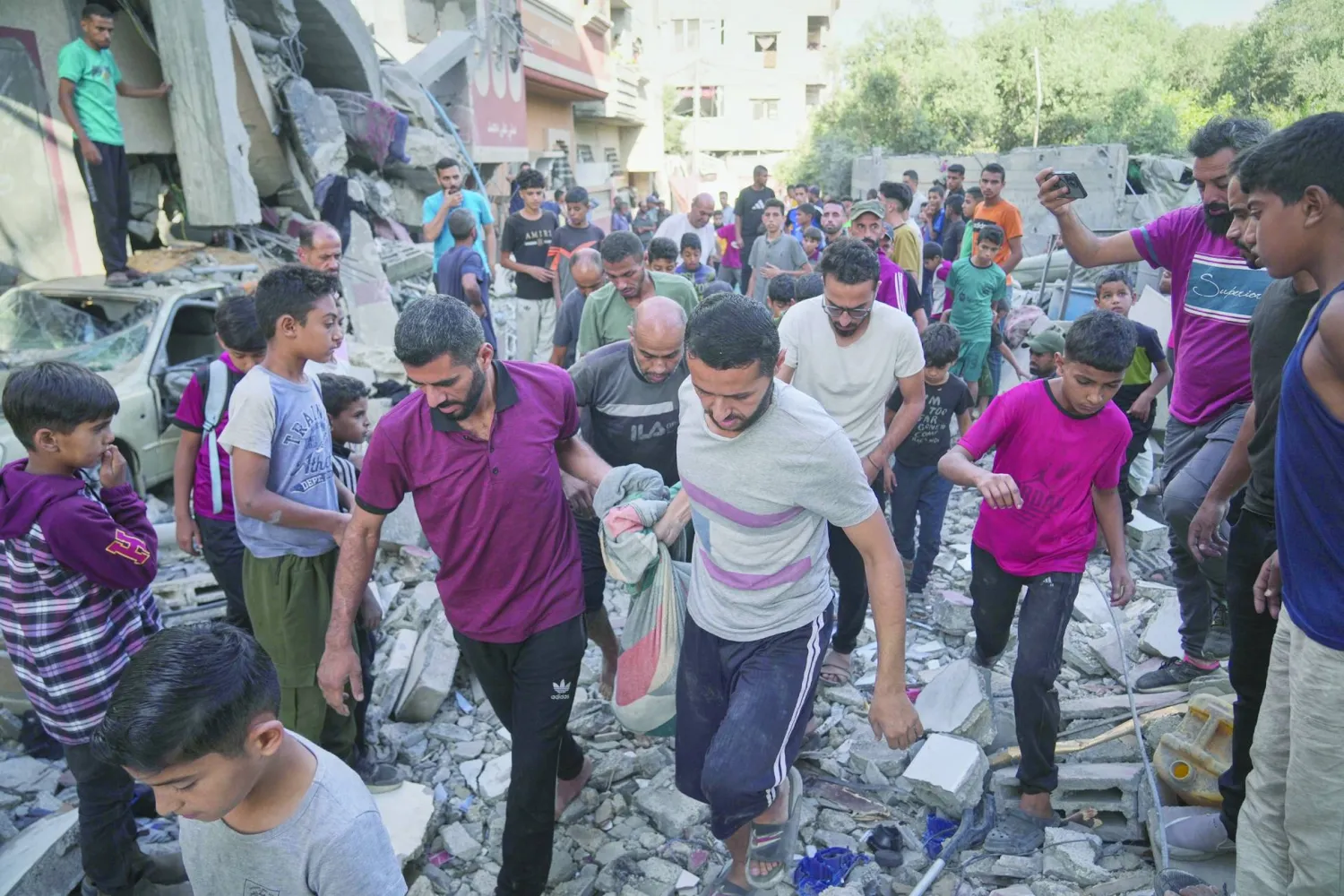
Palestinians carry the body of Hassan Nasr, 12, from the rubble of his relatives home, which was hit by an Israeli military strike in Zawaida, central Gaza Strip, Thursday, Sept. 25, 2025. (AP Photo/Abdel Kareem Hana)
TT

Foreign Doctors in Gaza Describe Worst Wounds 'They've Ever Seen'

Palestinians carry the body of Hassan Nasr, 12, from the rubble of his relatives home, which was hit by an Israeli military strike in Zawaida, central Gaza Strip, Thursday, Sept. 25, 2025. (AP Photo/Abdel Kareem Hana)

International doctors and nurses who treated Palestinians in Gazan hospitals described wounds more severe than civilians had suffered in other modern conflicts, according to a peer-reviewed study published Friday.

For the research in the leading medical journal BMJ, 78 humanitarian healthcare workers mostly from Europe and North America answered survey questions describing the severity, location and cause of the wounds they saw during their stints in the Gaza Strip.

The British-led team of researchers said it is the most comprehensive data available about Palestinian injuries during Israel's nearly two-year offensive against militant group Hamas, given that the territory's health facilities have been devastated and international access is heavily restricted.

Two thirds of the healthcare workers had previously deployed to other conflict zones, the vast majority of whom said the injuries in Gaza were "the worst thing that they've ever seen", the study's lead author, British surgeon Omar El-Taji, told AFP.

Up to three months after they returned from Gaza, the doctors and nurses -- aided by log books and shift records -- filled out a survey about the injuries they saw during deployments lasting from two to 12 weeks between August 2024 and February 2025.

They catalogued more than 23,700 trauma injuries and nearly 7,000 wounds caused by weapons -- numbers which broadly echoed data from the World Health Organization, the study said.

'Unusually severe'

It is difficult to get data about injuries in any conflict, but the study described the wounds in Gaza as "unusually severe".

In the territory, which has been relentlessly bombed and shelled by the Israeli military, over two thirds of the weapon-related injuries were caused by explosions, according to the study.

That is more than double the rate of explosive injuries recorded among civilians in other modern conflicts, the study said.

Instead, it was similar to the rate suffered by US soldiers during the wars in Iraq and Afghanistan, it added.

El-Taji emphasized this was a "really significant" difference, because unlike civilians, soldiers have training and protection, and know that they are headed towards danger.

"The volume, distribution, and military grade severity of injuries, indicate patterns of harm that exceed those reported in previous modern-day conflicts," the study said.

El-Taji said patients also had an uncommonly "huge" proportion of third- and fourth-degree burns, which are burns that go through the skin.

When he deployed to Gaza last year, El-Taji said he saw a shocking "amount of children that came in with burns so severe that you could literally see their muscle and see their bone".

Malnutrition and dehydration were the most commonly reported illnesses in the territory, where UN-backed assessment declared famine in August.

Anthony Bull, a professor at Imperial College London's Center for Blast Injury Studies who was not involved in the research, told AFP that "this is a very important piece of work".

Bull pointed out that the data only includes wounded people who "survived to the point of seeing a healthcare worker".

'The worst part'

The survey also had a section allowing the healthcare workers to write freely about what they had witnessed.

"The worst part was mothers begging us to save their already-dead children," one physician was cited as saying.

Others described children "expressing suicidal intent" after watching family members die.

Many described operating in dire circumstances with almost no supplies or support, a situation that led to decisions about how to ration care for the patients most likely to survive.

El-Taji arrived at the Gaza European Hospital in May last year, just days before Israel launched a major invasion in the neighboring southern city of Rafah.

For nights on end, groups of up to 70 seriously wounded people came to the hospital, he said.

One night El-Taji and other doctors and nurses gave blood to make up for dwindling supplies, he said.

The war was triggered by the October 7, 2023 attack by Palestinian militant group Hamas on Israel that resulted in the deaths of 1,219 people, mostly civilians, according to official data.

Israel's retaliatory campaign in Gaza has killed more than 65,500 people, also mostly civilians, according to figures from the Hamas-run territory's health ministry that the UN considers reliable.

More than 167,000 Gazans have been injured, according to the health ministry.

El-Taji lamented that international healthcare workers have been increasingly barred from Gaza.

In August, the WHO's representative in the Palestinian territories, Rik Peeperkorn, said that this "arbitrary denial" was leading to more preventable deaths.



Israel Says US Gaza Executive Board Composition Against its Policy

FILE - A displacement camp sheltering Palestinians on a beach amid stormy weather is seen in Gaza City, Jan. 13, 2026. (AP Photo/Jehad Alshrafi, File)
TT

Israel Says US Gaza Executive Board Composition Against its Policy

FILE - A displacement camp sheltering Palestinians on a beach amid stormy weather is seen in Gaza City, Jan. 13, 2026. (AP Photo/Jehad Alshrafi, File)

Prime Minister Benjamin Netanyahu's office said on Saturday that this week's Trump administration announcement on the composition of a Gaza executive board was not coordinated with Israel and ran counter to government policy.

It said Foreign Minister Gideon Saar would raise the issue with US Secretary of State Marco Rubio.

The ⁠statement did not specify what part of the board's composition contradicted Israeli policy. An Israeli government spokesperson declined to comment.

The board, unveiled by the White House on Friday, includes Turkish Foreign Minister Hakan Fidan. Israel ⁠has repeatedly opposed any Turkish role in Gaza.

Other members of the executive board include Sigrid Kaag, the UN special coordinator for the Middle East peace process; an Israeli-Cypriot billionaire; and a minister from the United Arab Emirates.

Washington this week also announced the start of the second phase of President ⁠Donald Trump's plan, announced in September, to end the war in Gaza. This includes creating a transitional technocratic Palestinian administration in the enclave.

The first members of the so-called Board of Peace - to be chaired by Trump and tasked with supervising Gaza's temporary governance - were also named. Members include Rubio, billionaire developer Steve Witkoff and Trump's son-in-law Jared Kushner.


Sisi Says he Values Trump Offer to Mediate Egypt-Ethiopia Dispute on GERD

FILE PHOTO: US President Donald Trump points as he attends a meeting with oil industry executives, at the White House in Washington, D.C., US, January 9, 2026. REUTERS/Evelyn Hockstein/File Photo
TT

Sisi Says he Values Trump Offer to Mediate Egypt-Ethiopia Dispute on GERD

FILE PHOTO: US President Donald Trump points as he attends a meeting with oil industry executives, at the White House in Washington, D.C., US, January 9, 2026. REUTERS/Evelyn Hockstein/File Photo

Egyptian President Abdel Fattah al-Sisi said he valued an offer by US President Donald Trump to mediate ⁠a dispute over Nile River waters between Egypt and Ethiopia.

In a post on ⁠X, Sisi said on Saturday that he addressed Trump's letter by affirming Egypt's position and concerns about the country's water ⁠security in regards to Ethiopia's Grand Ethiopian Renaissance Dam (GERD).

"I am ready to restart US mediation between Egypt and Ethiopia to responsibly resolve the question of 'The Nile Water Sharing' once and for all," Trump wrote to Sisi in the letter that was also posted on Trump’s Truth Social account.

Addis Ababa's September 9 inauguration of GERD has been a source of anger ⁠in Cairo, which is downstream on the Nile.

Ethiopia sees the $5 billion dam on a tributary of the Nile as central to its economic ambitions.

Egypt says the dam violates international treaties and could cause both droughts ⁠and flooding.

Sudan, another ​downstream country, has expressed concern about the regulation and safety of ⁠its own water supplies and dams.

Sudan's army leader Abdel Fattah al-Burhan also welcomed Trump's mediation offer on Saturday.


Kurds Say Sharaa's Decree Falls Short, Syrian Government Forces Enter Deir Hafer

Syrian army convoys enter the Deir Hafer area in the eastern Aleppo countryside, Syria, after the Kurdish-led Syrian Democratic Forces (SDF) announced the handover of the area west of the Euphrates to the Syrian government, 17 January 2026. EPA/AHMAD FALLAHA
TT

Kurds Say Sharaa's Decree Falls Short, Syrian Government Forces Enter Deir Hafer

Syrian army convoys enter the Deir Hafer area in the eastern Aleppo countryside, Syria, after the Kurdish-led Syrian Democratic Forces (SDF) announced the handover of the area west of the Euphrates to the Syrian government, 17 January 2026. EPA/AHMAD FALLAHA

Syria's Kurds on Saturday said a presidential decree recognizing the minority's rights and making Kurdish an official language fell short of their expectations as Syrian government forces entered the outskirts of a northern town.

In a statement, the Kurdish administration in Syria's north and northeast said the decree issued by President Ahmed al-Sharaa on Friday was "a first step, however it does not satisfy the aspirations and hopes of the Syrian people".

It added that "rights are not protected by temporary decrees, but... through permanent constitutions that express the will of the people and all components" of society.

Al-Sharaa’s decree affirmed that Syrian citizens of Kurdish origin are an integral and original part of the Syrian people, and that their cultural and linguistic identity is an inseparable component of Syria’s inclusive national identity.

The decree commits the state to protecting cultural and linguistic diversity and guarantees Kurdish citizens the right to preserve their heritage, arts, and mother tongue within the framework of national sovereignty.

It recognizes Kurdish as a national language and allows it to be taught in public and private schools in areas where Kurds make up a significant proportion of the population.

It also grants Syrian nationality to all residents of Kurdish origin living on Syrian territory, including those previously unregistered, while ensuring full equality in rights and duties.

The decree further designates Nowruz, celebrated annually on March 21, as an official public holiday.

Syrian government forces entered the outskirts of the northern town of Deir Hafer Saturday morning after the command of Kurdish-led fighters said it would evacuate the area in an apparent move to avoid conflict.

This came after deadly clashes erupted earlier this month between government troops and the US-backed and Kurdish-led Syrian Democratic Forces in the city of Aleppo, Syria’s largest.

It ended with the evacuation of Kurdish fighters from three neighborhoods taken over by government forces.

An Associated Press reporter saw on Saturday government tanks, armored personnel carriers and other vehicles, including pickup trucks with heavy machine-guns mounted on top of them, rolling toward the town of Deir Hafer from nearby Hamima after bulldozers removed barriers. There was no SDF presence on the edge of the town.

Meanwhile, the Syrian military said Saturday morning its forces were in full control of Deir Hafer, captured the Jarrah airbase east of the town, and were working on removing all mines and explosives. It added that troops would also move toward the nearby town of Maskana.

On Friday night, after government forces started pounding SDF positions in Deir Hafer, the Kurdish-led fighters’ top commander Mazloum Abdi posted on X that his group would withdraw from contested areas in northern Syria. Abdi said SDF fighters would relocate east of the Euphrates River starting 7 a.m. (0400 gmt) Saturday.

The easing of tension came after US military officials visited Deir Hafer on Friday and held talks with SDF officials in the area.

The United States has good relations with both sides and has urged calm.