


Facing Global Isolation at UN, a Defiant Netanyahu Says Israel ‘Must Finish the Job’ Against Hamas

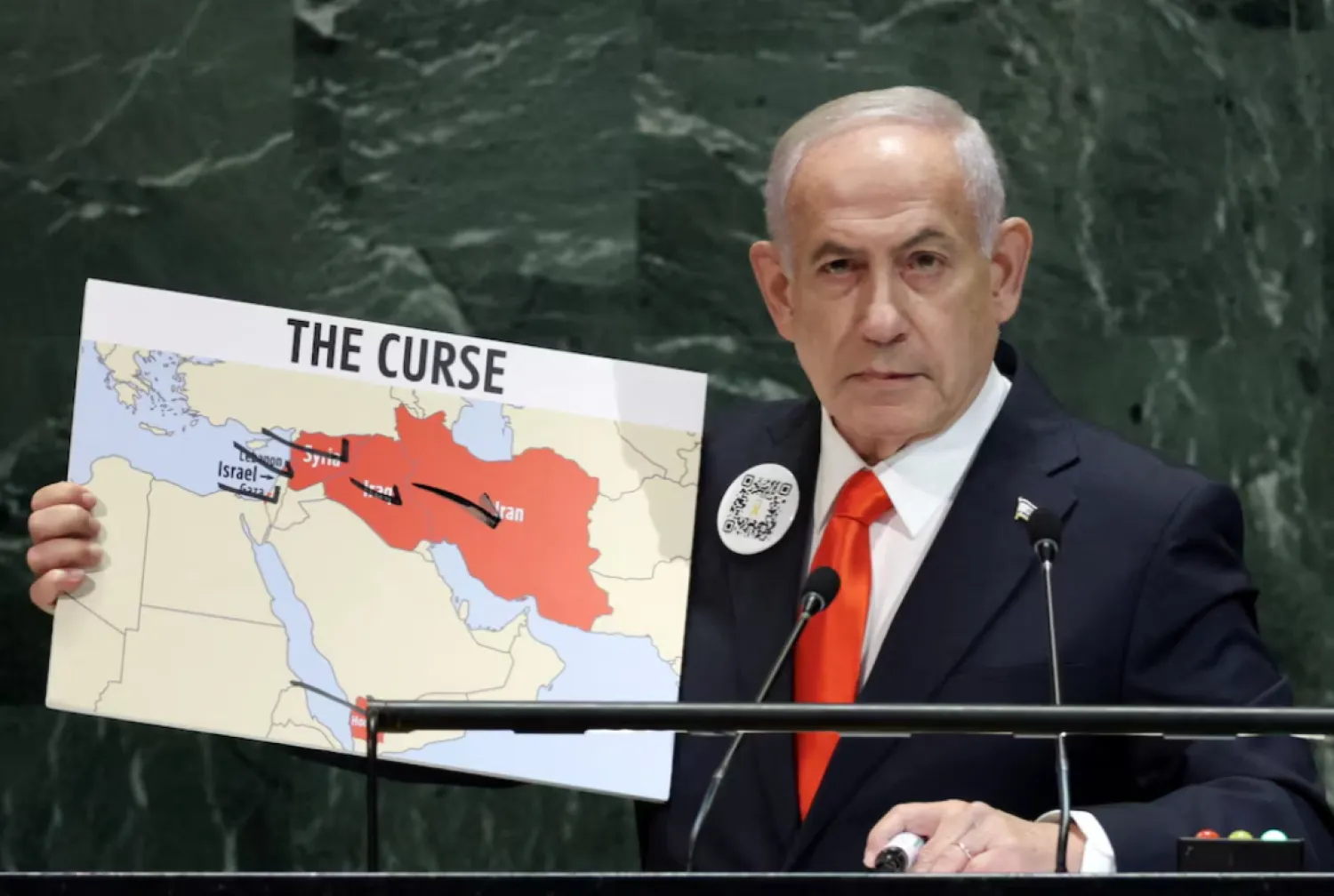
Israeli Prime Minister Benjamin Netanyahu addresses the 80th United Nations General Assembly (UNGA) at UN headquarters in New York City, US, September 26, 2025. REUTERS/Jeenah Moon
TT

Facing Global Isolation at UN, a Defiant Netanyahu Says Israel ‘Must Finish the Job’ Against Hamas

Israeli Prime Minister Benjamin Netanyahu addresses the 80th United Nations General Assembly (UNGA) at UN headquarters in New York City, US, September 26, 2025. REUTERS/Jeenah Moon

Encircled by critics and protesters at the United Nations, Israeli Prime Minister Benjamin Netanyahu told fellow world leaders on Friday that his nation "must finish the job" against Hamas in Gaza, giving a defiant speech despite growing international isolation over his refusal to end the devastating war. 

"Western leaders may have buckled under the pressure," he said. "And I guarantee you one thing: Israel won’t." 

Netanyahu's speech, aimed as much at his increasingly divided domestic audience as the global one, began after dozens of delegates from multiple nations walked out of the UN General Assembly hall en masse Friday as he began. 

Responding to countries’ recent decisions to recognize Palestinian statehood, Netanyahu said: "Your disgraceful decision will encourage terrorism against Jews and against innocent people everywhere." 

As the Israeli leader spoke, unintelligible shouts echoed around the hall, while applause came from supporters in the gallery. The US delegation, which has backed Netanyahu in his campaign against Hamas, stayed put.  

The few world powers in attendance, the United States and the United Kingdom, did not send their most senior officials or even their UN ambassador to their section. Instead, it was filled out with more junior, low-level diplomats. 

"Antisemitism dies hard. In fact, it doesn't die at all," Netanyahu said. Netanyahu routinely accuses his critics of antisemitism. 

Netanyahu faces international isolation, accusations of war crimes and growing pressure to end a conflict he has continued to escalate. Friday’s speech was his chance to push back on the international community’s biggest platform. 

As he has often in the past at the United Nations, Netanyahu held up a visual aid — a map of the region titled "THE CURSE," which chronicles Israel's challenges in its neighborhood. He marked it up with a large marker. He wore -- and pointed out -- a pin with a QR code that leads to a site about the Oct. 7, 2023, Hamas attack that led to the war and about the Israeli hostages taken by the group. Members of the Israeli delegation wore similar pins. 

Netanyahu also frequently praised President Donald Trump, his chief ally in his political and military approach in the region. Netanyahu said the changes across the Middle East have created new opportunities. He said Israel has begun negotiations with Syria aimed at reaching security arrangements with the country’s new government. 

The Israeli government took steps Friday to ensure that those in Gaza heard Netanyahu, setting up loudspeakers at the border to blast his words into the territory. The prime minister's office also claimed that the Israeli army had taken over mobile phones in Gaza to broadcast his message. AP journalists inside Gaza saw no immediate evidence of Netanyahu’s speech being broadcast on phones there. 

Netanyahu said the special measures were taken in an attempt to reach the Israeli hostages still being held in Gaza. He spoke in Hebrew at one point, and he read the names of the 20 who are believed to still be alive. But much of his speech was also aimed at an international audience that is increasingly critical of Israel. 

A closely watched speech  

Netanyahu's annual speech to the UN General Assembly is always closely watched, often protested, reliably emphatic and sometimes a venue for dramatic allegations. But this time, the stakes were higher than ever for the Israeli leader. 

In recent days, Australia, Canada, France, the United Kingdom and others announced their recognition of an independent Palestinian state. The European Union is considering tariffs and sanctions on Israel. The assembly this month passed a nonbinding resolution urging Israel to commit to an independent Palestinian nation, which Netanyahu has said is a non-starter. 

The International Criminal Court has issued an arrest warrant accusing Netanyahu of crimes against humanity, which he denies. And the UN’s highest court is weighing South Africa's allegation that Israel has committed genocide in Gaza, which it vehemently refutes. 

As Netanyahu spoke Friday, hundreds of pro-Palestinian protesters gathered a few blocks from the heavily secured United Nations. 

"Israel has chosen a war against every conscientious human being in this world," said Nidaa Lafi, an organizer with Palestinian Youth Movement, prompting chants of "shame" from the growing crowd. "The masses have come to the irreversible realization that this war was always about the complete ethnic cleansing of Palestine, about the exploitation and the stealing of Palestinian land." 

Opposition to Netanyahu's approach is growing  

At a special session of the UN Security Council this week, nation after nation expressed horror at the 2023 attack by Hamas that killed about 1,200 people in Israel, saw 251 taken hostage and triggered the war. Many of the representatives went on to criticize the response by Israel and call for an immediate ceasefire in Gaza and influx of aid. 

Israel's sweeping offensive has killed more than 65,000 Palestinians in Gaza and displaced 90 percent of its population, with an increasing number now starving. 

While more than 150 countries now recognize a Palestinian state, the United States has not, providing Israel with vociferous support. But Trump pointedly signaled Thursday there are limits, telling reporters in Washington that he wouldn’t let Israel annex the occupied West Bank. 

Israel hasn’t announced such a move, but several leading members in Netanyahu's government have advocated doing so. And officials recently approved a controversial settlement project that would effectively cut the West Bank in two, a move that critics say could doom chances for a Palestinian state. Trump and Netanyahu are scheduled to meet during his visit. 

Netanyahu's office also "instructed civilian groups in cooperation with the army to place loudspeakers on trucks on the Israeli side of the border," it said in a statement, noting that the broadcasts would be arranged so they would not endanger soldiers. 

Palestinians had their UN say the day before  

Netanyahu was preceded at the leaders' meeting a day earlier by Palestinian President Mahmoud Abbas, who addressed the General Assembly via video on Thursday after the US denied him a visa. He welcomed the recent announcements of recognition but said the world needs to do more to make statehood happen. 

"The time has come for the international community to do right by the Palestinian people" and help them realize "their legitimate rights to be rid of the occupation and to not remain a hostage to the temperament of Israeli politics," he said. 

Abbas leads the internationally recognized Palestinian Authority, which administers portions of the West Bank. Hamas won legislative elections in Gaza in 2006 before seizing control from Abbas’ forces the following year. 

Israel captured the West Bank, east Jerusalem and the Gaza Strip in the 1967 Middle East war, then withdrew from Gaza in 2005. The Palestinians want all three territories to form their envisioned state, part of a two-state solution that the international community has embraced for decades. 

Netanyahu opposes it robustly, maintaining that creating a Palestinian state would reward Hamas. In his speech, Netanyahu insisted that Israel is battling radicals on behalf of all nations. 

"You know deep down," he said, "that Israel is fighting your fight." 


Lebanese President: We are Determined to Hold Parliamentary Elections on Time

President Joseph Aoun between Prime Minister Nawaf Salam and Speaker Nabih Berri (Lebanese Presidency file photo)
TT

Lebanese President: We are Determined to Hold Parliamentary Elections on Time

President Joseph Aoun between Prime Minister Nawaf Salam and Speaker Nabih Berri (Lebanese Presidency file photo)

Lebanese President Joseph Aoun reiterated on Thursday that the country’s parliamentary elections are a constitutional obligation that must be carried out on time.

Lebanon’s state-run National News Agency quoted Aoun as saying that he, alongside Prime Minister Nawaf Salam and Parliament Speaker Nabih Berri, is determined to hold the elections on schedule.

Aoun also emphasized that diplomatic efforts have continued unabated to keep the specter of war at bay, noting that "things are heading in a positive direction".

The agency also cited Berri reaffirming that the elections will take place as planned, with "no delays, no extensions".

The Lebanese parliamentary elections are scheduled for May next year.


Israel Calls Countries Condemning New West Bank Settlements ‘Morally Wrong’

Newly constructed buildings are pictured in the Israeli settlement of Givat Zeev near the Palestinian city of Ramallah in the occupied West Bank on October 24, 2025. (AFP)
TT

Israel Calls Countries Condemning New West Bank Settlements ‘Morally Wrong’

Newly constructed buildings are pictured in the Israeli settlement of Givat Zeev near the Palestinian city of Ramallah in the occupied West Bank on October 24, 2025. (AFP)

Israel reacted furiously on Thursday to a condemnation by 14 countries including France and Britain of its approval of new settlements in the occupied West Bank, calling the criticism discriminatory against Jews.

"Foreign governments will not restrict the right of Jews to live in the Land of Israel, and any such call is morally wrong and discriminatory against Jews," Foreign Minister Gideon Saar said.

"The cabinet decision to establish 11 new settlements and to formalize eight additional settlements is intended, among other things, to help address the security threats Israel is facing."

On Sunday, Israel's far-right Finance Minister Bezalel Smotrich announced that authorities had greenlit the settlements, saying the move was aimed at preventing the establishment of a Palestinian state.

Fourteen countries, including Britain, France, Germany, Spain and Canada, then issued a statement urging Israel to reverse its decision, "as well as the expansion of settlements".

Such unilateral actions, they said, "violate international law", and risk undermining a fragile ceasefire in Gaza in force since October 10.

They also reaffirmed their "unwavering commitment to a comprehensive, just and lasting peace based on the two-state solution... where two democratic states, Israel and Palestine, live side-by-side in peace and security".

Israel has occupied the West Bank following the 1967 Arab-Israeli war.

Excluding east Jerusalem, which was occupied and annexed by Israel in 1967, more than 500,000 Israelis live in the West Bank, along with about three million Palestinian residents.

Earlier this month, the United Nations said the expansion of Israeli settlements in the West Bank, all of which are illegal under international law, had reached its highest level since at least 2017.


Iraq Criminalizes Volunteering in Russia-Ukraine War

A photo circulated on social media shows a 24-year-old Iraqi who traveled to Russia to join its armed forces. (AFP)
TT

Iraq Criminalizes Volunteering in Russia-Ukraine War

A photo circulated on social media shows a 24-year-old Iraqi who traveled to Russia to join its armed forces. (AFP)

The Iraqi judiciary warned on Wednesday that people involved in the war between Russia and Ukraine will face jail as it attempts to crack down on the recruitment of Iraqis joining the conflict.

Faiq Zidan, the head of Iraq's Supreme Judicial Council, received on Wednesday National Security Advisor Qasim Al-Araji and members of a committee tasked with combating the recruitment of Iraqis.

Zaidan stressed that Iraq criminalizes any Iraqi who joins the armed forces of another nation without the approval of the government.

The judiciary does not have a fixed prison term for anyone accused of the crime, but a court in Najaf last week sentenced to life an Iraqi accused of human trafficking.

He was convicted of belonging to an international criminal gang that recruits Iraqis to fight for Russia in its war against Ukraine.

In November, Prime Minister Mohammed Shia al-Sudani ordered the formation of a committee, headed by Araji, to crack down on the recruitment of Iraqis to fight for the Russian and Ukrainian militaries.

Iraq does not have official figures detailing how many of its citizens have joined the war. Media reports said some 50,000 Iraqis have joined Russian ranks, while unofficial figures put the number at around 5,000, with 3,000 fighting for Russia and 2,000 for Ukraine.

The debate over the recruitment played out over the media between the Russian and Ukrainian ambassadors to Iraq.

Ukrainian Ambassador Ivan Dovhanych accused Russia of recruiting Iraqis. Last week, the Ukrainian government sent a letter to the Iraqi government about the recruitment.

It hailed Baghdad’s criminalization of such activity. The letter also revealed that Ukrainian authorities had arrested an Iraqi who was fighting for Russia.

Ukraine has denied that it has recruited Iraqis to join the conflict, but reports indicate otherwise.

Meanwhile, Russian Ambassador to Baghdad Elbrus Kutrashev acknowledged that Iraqi fighters had joined the Russian army.

Speaking to the media, he declined to give exact figures, but dismissed claims that they reached 50,000 or even 5,000, saying instead they number no more than a few hundred.

He confirmed that Iraqis had joined the Russian army and “that some four to five had lost their lives”.

He revealed that the Russian embassy in Baghdad had granted visas to Russia to the families of the deceased on humanitarian grounds.

Russian law allows any foreign national residing in Russia and who speaks Russian to join its army with a salary of around 2,500 to 3,000 dollars.

There have been mounting calls in Iraq for the authorities to crack down on human trafficking gangs.

Would-be recruits are often lured by the monthly salary and the possibility of gaining the Russian or Ukrainian nationality.

Critics of the authorities have said Iraqi youths are lured to join foreign wars given the lack of job opportunities in Iraq.
