
Iran Weighs Confrontation or Diplomacy After UN Sanctions Reimposed over Its Nuclear Program

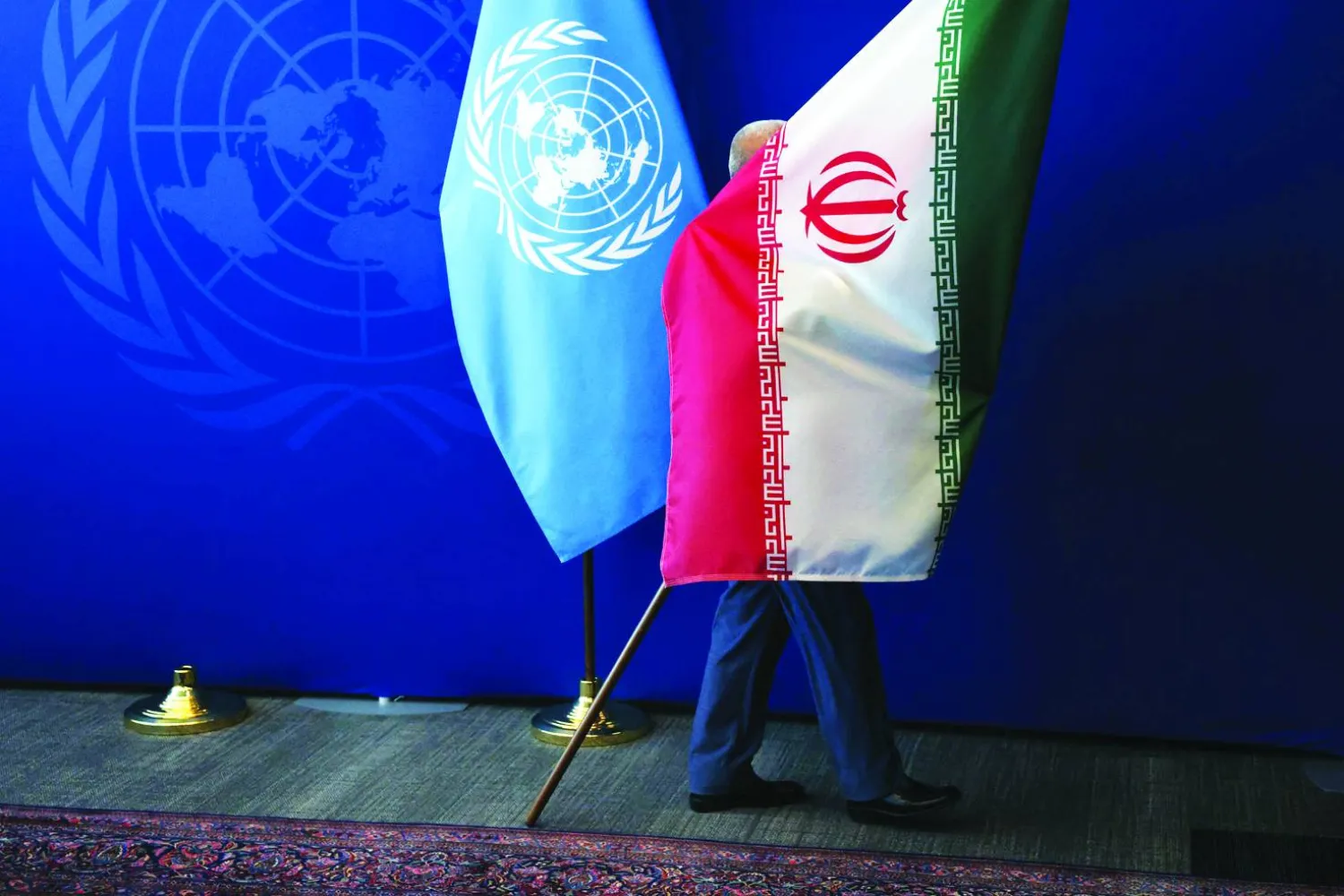
NEW YORK - SEPTEMBER 25: The Iranian flag is taken out of the room after Iranian President Masoud Pezeshkian met with the United Nations (UN) Secretary General Antonio Guterres during the UN's General Assembly on September 25, 2025, in New York City. Spencer Platt/Getty Images/AFP
TT

Iran Weighs Confrontation or Diplomacy After UN Sanctions Reimposed over Its Nuclear Program

NEW YORK - SEPTEMBER 25: The Iranian flag is taken out of the room after Iranian President Masoud Pezeshkian met with the United Nations (UN) Secretary General Antonio Guterres during the UN's General Assembly on September 25, 2025, in New York City. Spencer Platt/Getty Images/AFP

Iran's theocracy prepared Sunday for a possible confrontation with the West after the United Nations reimposed sanctions over its nuclear program, even as some pushed for continued negotiations to ease the economic pain squeezing the country. 

The sanctions imposed before dawn Sunday again freeze Iranian assets abroad, halt arms deals with Tehran and penalize any development of Iran’s ballistic missile program, among other measures. It came via a mechanism known as "snapback," included in Iran’s 2015 nuclear deal with world powers. 

Iran's Parliament briefly denounced the sanctions before going into a closed-door session likely to discuss the country's response, which could include abandoning the Nuclear Nonproliferation Treaty and rushing for the bomb. People worry about a new round of fighting between Iran and Israel, as well as potentially the United States, as missile sites struck during the 12-day war in June now appear to be being rebuilt. 

Meanwhile, Iran's rial currency fell to a new record low of 1.1 million to $1, sending food prices even higher and making daily life that much more challenging. 

"The government must negotiate. This is a world of business," said Mohsen Rahaei, a 49-year-old Tehran resident. "One must get along with everyone, with all countries. Until when we want to fight? We won’t gain anything." 

Iran considers withdrawing from treaty Iran tried a last-ditch diplomatic push at the UN General Assembly in New York this week, but efforts by its officials, as well as China and Russia, failed to stop the sanctions. 

Speaking to the Young Journalists Club, which is affiliated with Iranian state television, lawmaker Ismail Kowsari said Parliament would discuss withdrawing from the nuclear treaty. Nonproliferation experts fear such a move could see Iran follow a path first laid down by North Korea, which said it abandoned the treaty before obtaining nuclear weapons. 

Kowsari however said it wouldn't mean Iran would go for the bomb. Such a move would need the approval of Iran's 86-year-old Supreme Leader Ali Khamenei. Iranian diplomats have long pointed to Khamenei’s preachings as a binding fatwa, or religious edict, that Iran won’t build an atomic bomb. 

Parliament Speaker Mohammad Bagher Qalibaf issued his own warning to those who would honor the UN sanctions as the chamber began meeting Sunday. 

"We announce that if any country wants to take action against Iran based on these illegal resolutions, it will face serious reciprocal action from Iran, and the three European countries that are the initiators of this illegal action will also face our reaction," Qalibaf said without elaborating, according to a report by the state-run IRNA news agency. 

Parliament soon after entered a closed session, without any formal announcement on what, if anything, was decided. 

Iran warns against any military attack  

Leaders in both Iran's regular military and its paramilitary Revolutionary Guard both issued statements Sunday, warning that their forces were ready for any possible attack. Concerns have grown among the public that Israel could launch a new attack in the wake of the sanctions. 

Israel's Foreign Ministry applauded the sanctions being reimposed. 

"The goal is clear: prevent a nuclear-armed Iran," the ministry said. "The world must use every tool to achieve this goal." 

France, Germany and the United Kingdom triggered "snapback" over Iran 30 days ago, citing Tehran's restrictions of monitoring its nuclear program and the deadlock over its negotiations with the US. 

Iran further withdrew from the International Atomic Energy Agency monitoring after Israel’s war in June, which also saw the US strike nuclear sites in the Islamic Republic. 

Meanwhile, Iran still maintains a stockpile of uranium enriched up to 60% purity — a short, technical step away from weapons-grade levels of 90% — that is largely enough to make several atomic bombs, should Tehran choose to rush toward weaponization. 

Iran has long insisted its nuclear program is peaceful, though the West and IAEA say Tehran had an organized weapons program up until 2003. 

The three European nations on Sunday said they "continuously made every effort to avoid triggering snapback." But Iran "has not authorized IAEA inspectors to regain access to Iran’s nuclear sites, nor has it produced and transmitted to the IAEA a report accounting for its stockpile of high-enriched uranium." 

The nations also noted Iran enriches uranium at a level that no other peaceful program does. 

US Secretary of State Marco Rubio praised the three European nations for "an act of decisive global leadership" for imposing the sanctions on Iran and said "diplomacy is still an option." 

"For that to happen, Iran must accept direct talks," Rubio said. 

Tehran maintains ‘snapback’ shouldn't have happened  

Tehran has argued the three European nations shouldn’t be allowed to implement snapback, pointing in part to America’s unilateral withdrawal from the accord in 2018, during the first term of President Donald Trump’s administration. 

Iranian Foreign Minister Abbas Araghchi, speaking to Iranian state TV before the sanctions were imposed, sought to downplay the effect UN sanctions would have on the country. 

"It will have some damages, some losses for us," Araghchi said Saturday night. "However, they have presented it in their own media as something far greater and much bigger than it actually is, and they have tried to create a monster to frighten the Iranian people and then force our government and our foreign policy to give concessions and pay tribute in this regard." 

However, the Iranian public already say they feel the pinch of sanctions with the rial's fall and other economic pressures. One Tehran resident, who gave only his first name Najjari for fear of reprisal, warned against abandoning negotiations. 

"If we continue to get into a fight with the outside world and become isolated like North Korea, good things won’t happen at all," he said. "We’re already seeing the impact of this, the dollar rate is going up." 


Man Arrested after Pepper Spray Attack in London's Heathrow Airport Parking Garage

File photo: A plane prepares ahead of taking-off, after radar failure led to the suspension of outbound flights across the UK, at Heathrow Airport in Hounslow, London, Britain, July 30, 2025. (Reuters)
TT

Man Arrested after Pepper Spray Attack in London's Heathrow Airport Parking Garage

File photo: A plane prepares ahead of taking-off, after radar failure led to the suspension of outbound flights across the UK, at Heathrow Airport in Hounslow, London, Britain, July 30, 2025. (Reuters)

Police arrested a man in London on Sunday after a group of people were assaulted with pepper spray in a parking garage at Heathrow Airport.

The victims were taken to the hospital by ambulance but their injuries were not believed to be serious, the Metropolitan Police said.

The incident in the Terminal 3 garage occurred after an argument escalated between two groups who knew each other. It was not being investigated as terrorism, police said.

One man was arrested on suspicion of assault and held in custody. Police were searching for the other suspects who left the scene.


US Envoy Kellogg Says Ukraine Peace Deal Is Really Close

A Ukrainian serviceman walks near apartment buildings damaged by a Russian military strike, amid Russia's attack on Ukraine, in the frontline town of Kostiantynivka in Donetsk region, Ukraine November 15, 2025. (Oleg Petrasiuk/Press Service of the 24th King Danylo Separate Mechanized Brigade of the Ukrainian Armed Forces/Handout via Reuters)
TT

US Envoy Kellogg Says Ukraine Peace Deal Is Really Close

A Ukrainian serviceman walks near apartment buildings damaged by a Russian military strike, amid Russia's attack on Ukraine, in the frontline town of Kostiantynivka in Donetsk region, Ukraine November 15, 2025. (Oleg Petrasiuk/Press Service of the 24th King Danylo Separate Mechanized Brigade of the Ukrainian Armed Forces/Handout via Reuters)

US President Donald Trump's outgoing Ukraine envoy said a deal to end the Ukraine war was "really close" and now depended on resolving two main outstanding issues: the future of Ukraine's Donbas region and the Zaporizhzhia nuclear power plant.

Russia invaded Ukraine in February 2022 after eight years of fighting between Russian-backed separatists and Ukrainian troops in the Donbas, which is made up of the Donetsk and Luhansk regions.

The Ukraine war is the deadliest European conflict since World War Two and has triggered the biggest confrontation between Russia and the West since the depths of the Cold War.

US Special Envoy for Ukraine Keith Kellogg, who is due to step down in January, told the Reagan National Defense Forum that efforts to resolve the conflict were in "the last 10 meters" which he said was always the hardest.

The two main outstanding issues, Kellogg said, were on territory - primarily the future of the Donbas - and the future of Ukraine's Zaporizhzhia nuclear power plant, Europe's largest, which is under Russian control.

"If we get those two issues settled, I think the rest of the things will work out fairly well," Kellogg said on Saturday at the Ronald Reagan Presidential Library and Museum in Simi Valley, California. "We're almost there."

"We're really, really close," said Kellogg.

Kellogg, a retired lieutenant general who served in Vietnam, Panama and Iraq, said the scale of the death and injuries caused by the Ukraine war was "horrific" and unprecedented in terms of a regional war.

He said that, together, Russia and Ukraine have suffered more than 2 million casualties, including dead and wounded since the war began. Neither Russia nor Ukraine disclose credible estimates of their losses.

Moscow says Western and Ukrainian estimates inflate its losses. Kyiv says Moscow inflates estimates of Ukrainian losses.

Russia currently controls 19.2% of Ukraine, including Crimea, which it annexed in 2014, all of Luhansk, more than 80% of Donetsk, about 75% of Kherson and Zaporizhzhia, and slivers of the Kharkiv, Sumy, Mykolaiv and Dnipropetrovsk regions.

A leaked set of 28 US draft peace proposals emerged last month, alarming Ukrainian and European officials who said it bowed to Moscow's main demands on NATO, Russian control of a fifth of Ukraine and restrictions on Ukraine's army.

Those proposals, which Russia now says contain 27 points, have been split up into four different components, according to the Kremlin. The exact contents are not in the public domain.

Under the initial US proposals, the Zaporizhzhia nuclear plant, whose reactors are currently in cold shutdown, would be relaunched under the supervision of the International Atomic Energy Agency, and the electricity produced would be distributed equally between Russia and Ukraine.

Ukrainian President Volodymyr Zelenskiy said on Saturday that he had had a long and "substantive" phone call with Trump's special envoy Steve Witkoff and Trump's son-in-law Jared Kushner.

The Kremlin said on Friday it expected Kushner to be doing the main work on drafting a possible deal.


7.0 Earthquake Hits in Remote Wilderness Along Alaska-Canada Border

 Hubbard Glacier, located near Yakutat, Alaska, is seen on Aug. 1, 2024. (AP)
Hubbard Glacier, located near Yakutat, Alaska, is seen on Aug. 1, 2024. (AP)
TT

7.0 Earthquake Hits in Remote Wilderness Along Alaska-Canada Border

 Hubbard Glacier, located near Yakutat, Alaska, is seen on Aug. 1, 2024. (AP)
Hubbard Glacier, located near Yakutat, Alaska, is seen on Aug. 1, 2024. (AP)

A powerful, magnitude-7.0 earthquake struck in a remote area near the border between Alaska and the Canadian territory of Yukon on Saturday. There was no tsunami warning, and officials said there were no immediate reports of damage or injury.

The US Geological Survey said it struck about 230 miles (370 kilometers) northwest of Juneau, Alaska, and 155 miles (250 kilometers) west of Whitehorse, Yukon.

In Whitehorse, Royal Canadian Mounted Police Sgt. Calista MacLeod said the detachment received two 911 calls about the earthquake.

“It definitely was felt,” MacLeod said. “There are a lot of people on social media, people felt it.”

Alison Bird, a seismologist with Natural Resources Canada, said the part of Yukon most affected by the temblor is mountainous and has few people.

“Mostly people have reported things falling off shelves and walls,” Bird said. “It doesn’t seem like we’ve seen anything in terms of structural damage.”

The Canadian community nearest to the epicenter is Haines Junction, Bird said, about 80 miles (130 kilometers) away. The Yukon Bureau of Statistics lists its population count for 2022 as 1,018.

The quake was also about 56 miles (91 kilometers) from Yakutat, Alaska, which the USGS said has 662 residents.

It struck at a depth of about 6 miles (10 kilometers) and was followed by multiple smaller aftershocks.