

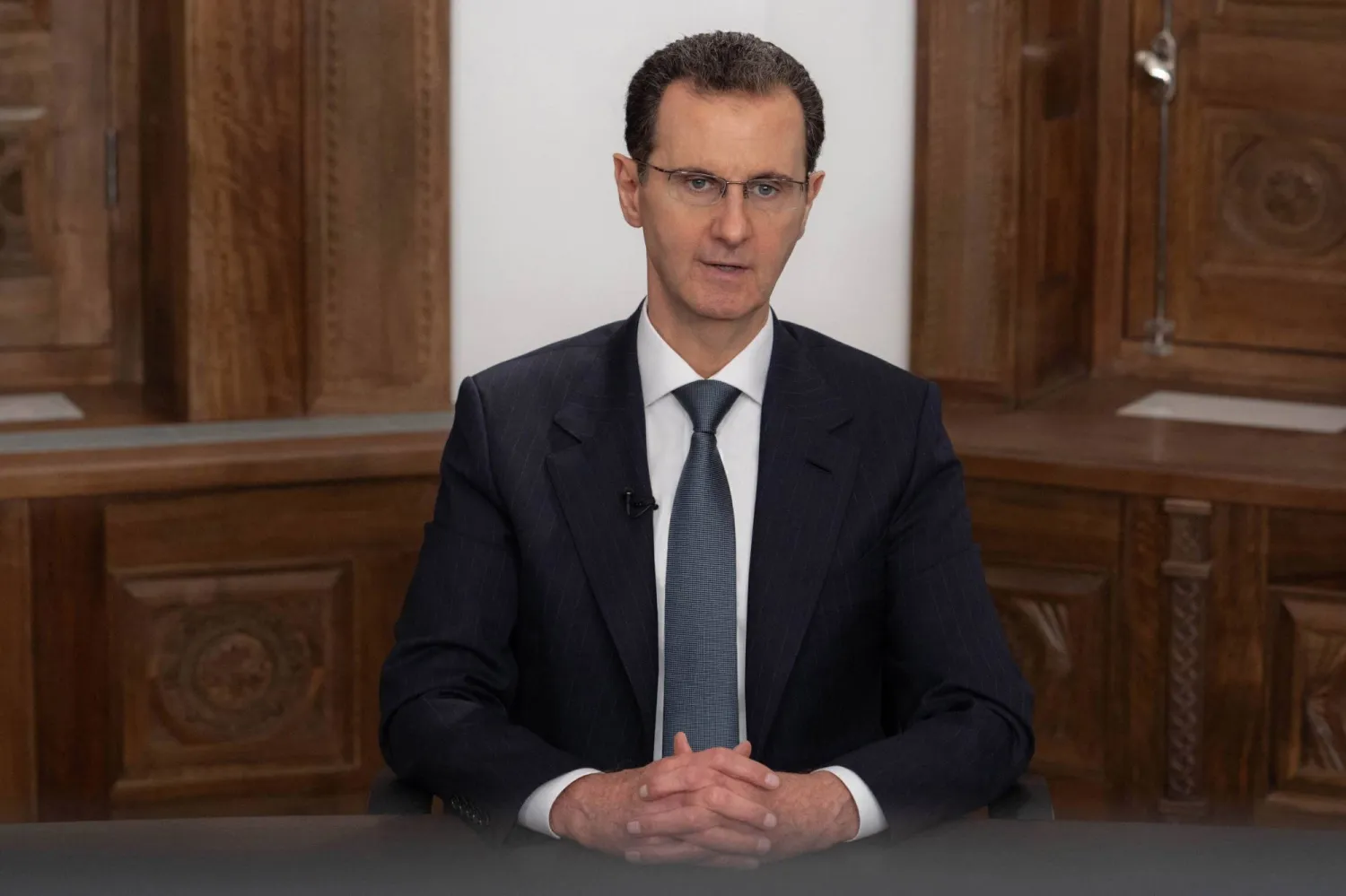

Arrest Warrant Issued for Assad Ahead of Sharaa’s Visit to Moscow

16 February 2023, Syria, Damascus: A photo released by the official Syrian Arab news agency (SANA) on 16 February shows then Syrian President Bashar al-Assad delivering a televised speech. (SANA/dpa)
TT

Arrest Warrant Issued for Assad Ahead of Sharaa’s Visit to Moscow

16 February 2023, Syria, Damascus: A photo released by the official Syrian Arab news agency (SANA) on 16 February shows then Syrian President Bashar al-Assad delivering a televised speech. (SANA/dpa)

As anticipation grows over Syrian interim President Ahmed al-Sharaa’s visit to Moscow next month to attend the Arab-Russian summit, Damascus has officially launched legal proceedings against ousted Syrian president Bashar al-Assad, who has been living in Russia since the fall of his regime last December.

Tawfiq al-Ali, the seventh investigative judge in Damascus, issued an arrest warrant in absentia against Assad in connection with events that took place in Daraa in November 2011 during the civil war. The decision allows the warrant to be circulated through Interpol and pursued internationally.

In remarks to the state-run news agency SANA on Saturday, al-Ali said the warrant includes charges of premeditated murder, torture resulting in death, and unlawful deprivation of liberty.

He explained that the move stems from lawsuits filed by families of victims in Daraa, stressing that legal proceedings will continue “to hold accountable those responsible for crimes committed under the ousted regime.”

Sharaa is expected to attend the Arab-Russian Summit in mid-October at the invitation of Russian President Vladimir Putin. Deputy

Prime Minister Alexander Novak, who visited Damascus two weeks ago at the head of a large delegation, said Moscow attaches “great importance to the president’s visit,” describing it as the opening of a “new chapter in relations with Syria.”

So far, Russia has not responded positively to Damascus’s request for Assad’s extradition, a matter that was raised during Deputy Foreign Minister Mikhail Bogdanov’s visit to the Syrian capital earlier this year.

Moscow-based researcher Mahmoud Hamza downplayed the likelihood that Assad’s prosecution would disrupt the new stage in bilateral relations.

Speaking to Asharq Al-Awsat, he described Assad’s extradition as a Syrian demand essential for justice, noting that the arrest warrant “came at the right time.”

He predicted that Moscow would refrain from issuing a negative reaction, saying Putin “will not hand over Bashar al-Assad,” but will nonetheless take the matter into account.

Hamza added that the case “will not die; it may simply be postponed, or unconventional solutions may emerge later.”

The warrant was “crucial for establishing the rights of Syrians in court, as well as for its political significance,” he added.

He urged Damascus to extend the case to relevant international organizations, arguing that Assad “committed crimes against Syria and its people.”

He also revealed that Russian officials, in private conversations, “do not defend Assad but insist that they accepted him and his family on humanitarian grounds.”

Political analyst Bassam Suleiman, who is close to the Syrian government, told Asharq Al-Awsat that Damascus remains determined to “advance the path of transitional justice and prosecute criminals, foremost among them Assad.”

Russia bears a “historic responsibility” in repairing ties between the two peoples, he said, acknowledging the importance of cultural, social, and economic bonds.

“This positive history was tarnished,” Suleiman said. “Russia must now correct this, and realize that the man it is sheltering is the greatest criminal sought by Syrians.”



Sudan Farms Lie Barren as El Nino Leaves Nile Banks Dry

A photograph shows the exposed riverbed of the Blue Nile in Khartoum on July 27, 2026. (AFP)
TT

Sudan Farms Lie Barren as El Nino Leaves Nile Banks Dry

A photograph shows the exposed riverbed of the Blue Nile in Khartoum on July 27, 2026. (AFP)

Along the bone-dry riverbanks of the Nile in Sudan, farmers struggle to pull water to their crops. Others gather to pray for rainfall over cracked earth.

Across the country, farmland that could feed the world's largest hunger crisis many times over lies fallow, as weary farmers once again find themselves in the crosshairs of faraway destruction.

First came war between the country's army and rival paramilitaries, which since April 2023 has killed more than 200,000 people and pushed nearly 20 million into crisis levels of hunger.

Then a more distant conflict, between Iran and the United States, crippled fuel and fertilizer supply through the Strait of Hormuz, causing costs to soar.

And now the powerful El Nino climate pattern strengthening in the Pacific Ocean, which impacts winds and rains across the world, has delayed crucial rains and led water levels in the life-giving Nile to drop precipitously.

Just south of the capital Khartoum, farmer Al-Tigani Fadlallah points to an island that shouldn't be there.

"The water usually covers it by July, but you can see it even now," he told AFP this month, seeing in the sunbaked sandbank a bad omen for his parched crops.

Through the length of Sudan, from the northern fields near Egypt, along the Nile river to the Ethiopian border, farmers told AFP reporters the water they need is not rising from the riverbanks nor falling from the sky.

The UN's food and agriculture organization says the season "is unfolding under heightened climate risk, driven by El Nino conditions" including delayed and below average rains, and long and frequent dry spells.

Farmers say it is one of the hardest seasons in recent memory, but climate research shows it will not be the last.

- Pray for rain -

Climate and hydrology scientist Elfatih Eltahir, at the Massachusetts Institute of Technology, has studied the link between El Nino and the Nile for thirty years.

His research has shown El Nino is closely associated with low Nile flow and, when it begins in late spring, as it did this year, brings a high probability of drought in southeastern Sudan and northwestern Ethiopia, where the Blue Nile originates.

Water levels at the reservoir behind Ethiopia's massive Grand Renaissance dam on the Blue Nile, which contributes the majority of water feeding the Nile river, was six meters lower this July compared to the same month last year, according to data from Germany's University of Tubingen.

A Sudanese farmer ploughs agricultural land in Gedaref State, eastern Sudan, on July 18, 2026. (AFP)

But Eltahir warns "more transparency and cooperation" are also needed between Ethiopia, Egypt and Sudan over Addis Ababa's management of the reservoir, especially as climate change brings more extreme floods and droughts.

This summer, the Blue Nile basin has already seen as little as half of its usual rainfall, according to UC Santa Barbara's Climate Hazards Center, and regional forecasts predict below average rainfall for the rest of the rainy season.

Farmers in Gedaref state on the Ethiopian border, where the bulk of Sudan's staple crops such as sorghum and sesame are planted, are already feeling it.

When August rolled in and their usually-verdant fields were still a dull brown, frustrated farmers gathered behind local imams for rain-invoking prayers.

"We need these rains for our crops and our livestock, and they're late," local farmer Abdelmajid Hussein told AFP after a prayer.

Agriculture minister Ismat Qurashi told AFP farmers are being told to choose drought-resistant crops and to delay planting.

Moussa Yaacoub, 75, has planted sesame for decades, including three wartime growing seasons each harder than the last.

Now, standing sentinel over the cracked earth, he wonders if he will make it through the next, with his land now costing him "four times as much to plant".

- Can't catch a break -

Downstream, in Sudan's other breadbasket state Al-Jazira, Hassan Ahmed stares out at the farm that has been in his family for 100 years.

When Ahmed returned to it last year, after the army recaptured Al-Jazira from the Rapid Support Forces, he found it had been ransacked by looting paramilitaries, and his trees stood wilting in the sun.

He and his sons got to work bringing it back to life, but this year have struggled anew.

"I'm 63 and I have never seen the Nile this low in August," he told AFP. "By now we should have taken our water pump out because the flood had drenched the soil several meters in."

Buffeted by a perfect storm -- low water, soaring costs and a crippled market -- many farmers have abandoned their lands, at a time when 65 percent of Sudan's vast arable land is already out of commission.

Some farmers, hopeful at the start of the season, "planted their crops but then left them to die because it just wasn't worth the harvest," young farmer Mohamed al-Tijani told AFP near Khartoum.

Sudan imports all of its fuel and most of its fertilizer, costs for which have multiplied by up to five this year as a result of war in the Middle East.

Veteran farmer Ahmed Othman is one of many who know he won't break even in the market, already devastated with most of the country out of work.

"But at least I can say I'm working at all," he told AFP, back bent from decades of toiling in the fields.


Arab Parliament Speaker Condemns Israeli Settlement Plan in West Bank

Arab Parliament logo
TT

Arab Parliament Speaker Condemns Israeli Settlement Plan in West Bank

Arab Parliament logo

Arab Parliament Speaker Mohammed Al-Yamahi strongly condemned Israel’s plan to implement the expansionist settlement project in the E1 area of the occupied West Bank and rejected the remarks made by Israel’s security minister calling for the killing of dozens of Palestinians in the Gaza Strip, the Saudi Press Agency reported on Friday.

He stressed that proceeding with the project despite international warnings defies international law and relevant international resolutions.

He called on the international community, the UN Security Council, parliaments, and international organizations to take concrete measures to halt settlement and annexation activities, hold those responsible for incitement accountable, and work toward achieving peace, which begins with ending the occupation and enabling the Palestinian people to exercise their legitimate rights.


Syria Requests to Join Anti-chemical Weapons Partnership

The logo of the Organization for the Prohibition of Chemical Weapons (OPCW) is seen during a special session in the Hague, Netherlands June 26, 2018. REUTERS/Yves Herman Purchase Licensing Rights
TT

Syria Requests to Join Anti-chemical Weapons Partnership

The logo of the Organization for the Prohibition of Chemical Weapons (OPCW) is seen during a special session in the Hague, Netherlands June 26, 2018. REUTERS/Yves Herman Purchase Licensing Rights

Syria on Friday said it had requested to join the International Partnership Against Impunity for the Use of Chemical Weapons on the anniversary of a 2013 chemical attack on a suburb of the capital Damascus.

In a joint statement with France commemorating the attack during former leader Bashar al-Assad's rule on opposition-held areas, Syria announced its bid to join the partnership of dozens of countries, launched by Paris in January 2018.

France welcomed the step as "a clear demonstration of Syria's commitment to strengthening accountability and justice and combating impunity" following its more than decade-long civil war.

Damascus and Paris also said they "commemorate the victims, extend their deepest sympathies and solidarity to their families, and reaffirm their joint commitment to supporting efforts to uncover the truth, ensure justice, and hold those responsible for these crimes accountable".

In August 2013, the Syrian army under Assad was accused of using chemical weapons to target areas then under the opposition’s control.

According to US intelligence and rights groups, more than 1,400 men, women and children died as a result.

With Syria at the height of its civil war, the Assad government denied responsibility, but agreed to hand over its chemical arsenal in order to avert US strikes.

Assad went on to remain in power for more than a decade, only to be ousted in 2024 by opposition forces, headed by now President Ahmed al-Sharaa.

Survivors of the attacks, including medics, at the time risked their lives by posting dozens of videos online, and spoke to journalists including AFP reporters about the horror they had witnessed.

The footage showed dozens of corpses, many of them children, outstretched on the ground.

Other images showed unconscious children, people foaming at the mouth and doctors trying to help them breathe.

The scenes provoked revulsion and condemnation around the globe.

- 'Painful chapter' -

A United Nations report later said there was clear evidence sarin gas had been used.

Syria agreed to join the Organization for the Prohibition of Chemical Weapons (OPCW) and disclose and hand over its toxic stockpile under Russian and US pressure, averting the threat of strikes by Washington and its allies.

But that was not the last of the chemical attacks: the OPCW went on to blame Assad's forces for others later in the civil war.

Marking 13 years since the attack, Syrian Foreign Minister Asaad al-Shaibani called it "one of the most painful chapters in Syria's history".

"Tomorrow, the Syrian Arab Republic begins a new phase in dealing with the legacy of these weapons. We have initiated the necessary technical and logistical procedures for their disposal, in cooperation with our international partners," he added, also vowing to pursue those involved in the attack.

Several Syrian officers linked to the attack have been arrested since Assad's fall.

Syria's civil war began in 2011, with a brutal crackdown on dissent that yielded an armed rebellion. More than half a million people ended up being killed, with millions more forced into exile.

The OPCW reinstated Syria last month, five years after taking the unprecedented step of stripping it of its voting rights.