


Rock Samples Show Moon’s Farside Interior Is Cooler than the Nearside

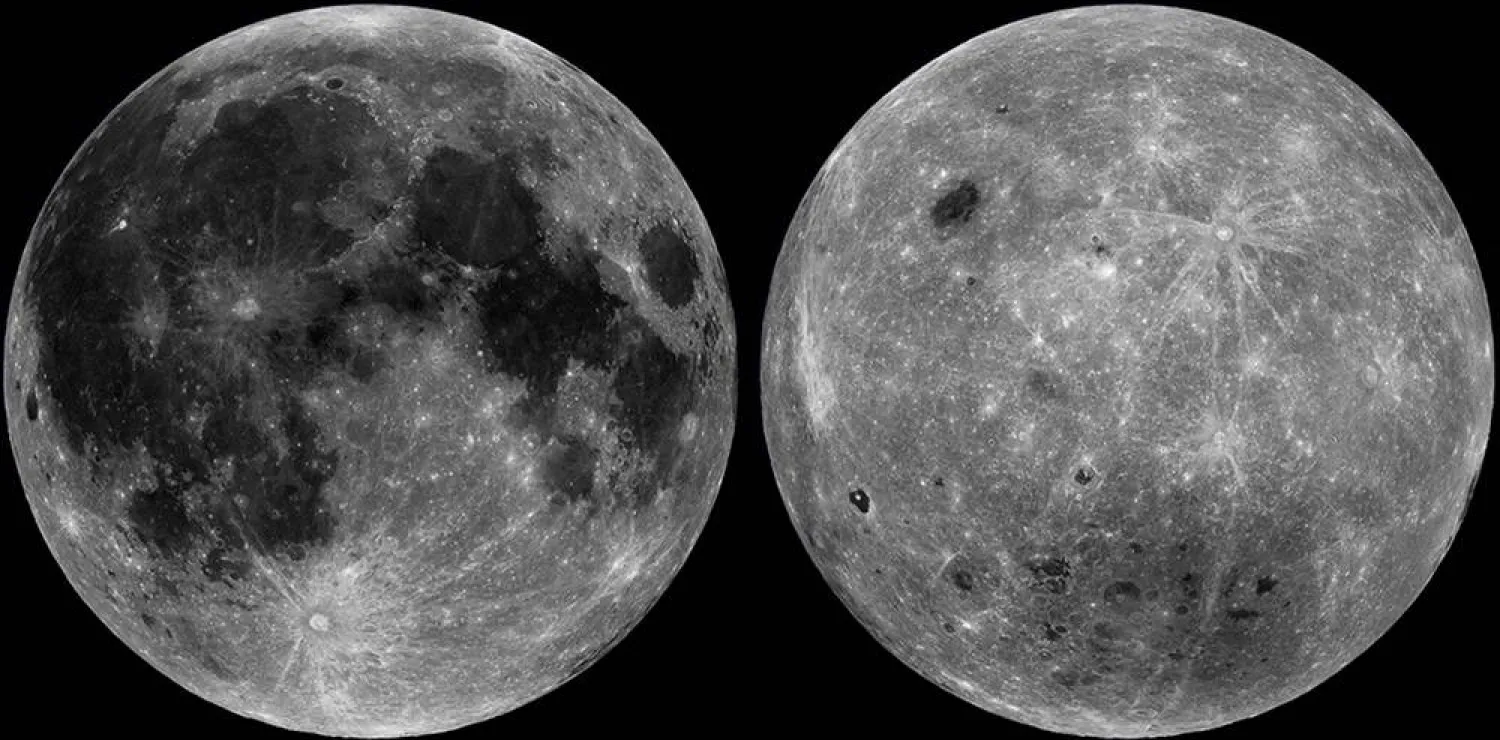
Views of the moon's nearside, left, and farside, right, put together from observations made by NASA's Lunar Reconnaissance Orbiter, are seen in this photograph provided on September 30, 2025. (NASA/JPL-Caltech/Handout via Reuters)
TT

Rock Samples Show Moon’s Farside Interior Is Cooler than the Nearside

Views of the moon's nearside, left, and farside, right, put together from observations made by NASA's Lunar Reconnaissance Orbiter, are seen in this photograph provided on September 30, 2025. (NASA/JPL-Caltech/Handout via Reuters)

The moon is sometimes called "two-faced" because the surface of its side perpetually facing away from Earth looks so different than its side always facing our planet. And the differences run deeper than that, as shown by an analysis of rock and soil retrieved in 2024 by China's Chang'e-6 robotic lunar spacecraft.

Scientists said the chemical makeup of the minerals in the material obtained from a location on the moon's farside showed it formed from lava within the lunar mantle about 60 miles (100 km) under the surface some 2.8 billion years ago, crystallizing at a temperature of about 2,000 degrees Fahrenheit (1,100 degrees Celsius). They compared that to data on previously studied samples of rock that crystallized in the nearside mantle.

It turns out that the Chang'e-6 sample, the only one ever gotten from the farside, formed in the lunar interior at a temperature about 180 degrees Fahrenheit (100 degrees Celsius) cooler than the 33 samples previously retrieved from the nearside during NASA Apollo missions and by a Chinese spacecraft in 2020. The researchers said they believe this difference between the two sides persists to this day.

"Our results demonstrate the existence of thermal asymmetry between the nearside and farside mantle," said geoscientist Yang Li of University College London and Peking University, who led the study published in the journal Nature Geoscience.

"This takes us one step closer toward understanding the dichotomy of the moon. Specifically, the moon has a dramatic difference for the two sides at its surface, such as volcanism, crust thickness and topography," Li added.

The farside possesses a thicker crust - the outermost layer of the planet - and is more mountainous and cratered. It appears that this side was less volcanic in the past than the nearside, so it has fewer dark patches of basalt, a type of rock formed from lava long ago. The surface of the nearside is smoother and mostly covered in dark volcanic plains.

The moon, like Earth, formed about 4.5 billion years ago. Volcanism on the moon, Earth and other planetary bodies involves the eruption of molten rock from the mantle - the layer just under the crust - onto the surface. The Chang'e-6 landing site in the South Pole-Aitken Basin, an impact crater, is an area with the thinnest crust on the moon, helpful for finding evidence concerning volcanism.

Chang'e-6 used a scoop and drill to obtain material after arriving on the lunar surface in June 2024, then returned it to Earth, landing in the Chinese region of Inner Mongolia.

Because of Earth's gravitational pull, the moon always shows the same side to our planet - tidally locked, in scientific terms. But the differences in temperature in the interior may not have anything to do with this.

The researchers hypothesize that the interior of the moon's farside may be cooler than the nearside as a result of having a smaller amount of elements such as uranium, thorium and potassium that release heat due to radioactive decay.

Some scientists have hypothesized that this uneven distribution of such elements within the moon may have been caused when a massive asteroid or some other celestial body smashed into the farside early in lunar history. This could have disturbed the moon's interior and shifted denser material containing more heat-producing elements to the lunar nearside.

There are also hypotheses that the moon early on may have smashed into and merged with a second, smaller moon orbiting Earth. As a result, its current internal differences would reflect the thermal differences between the two moonlets before they collided.

"Understanding the origin of this lunar dichotomy is essential for reconstructing the moon's formation history, thermal evolution and crustal development, and may have implications for understanding the origin and evolution of other planets," Li said.



London Boasts 12 of Top 100 Cinemas in the World

The Castle has been voted among the best in the world (The Castle Cinema)
TT

London Boasts 12 of Top 100 Cinemas in the World

The Castle has been voted among the best in the world (The Castle Cinema)

The cinema might feel like a relic to some – a moment from before films were available at the press of a button at home – but those interested in cinemas never turn their back on an afternoon spent sitting in complete darkness with total strangers in front of a booming big screen.

According to METRO, London is a city that can officially boast 12 of the top 100 cinemas in the world.

Time Out recently released its ranking of the greatest cinemas on the planet, with the TCL Chinese Theater in Los Angeles – host to more red carpet premieres for major blockbusters than anywhere outside London’s Leicester Square – taking the top spot.

Elsewhere on the list were some spectacularly unusual venues: the world’s biggest cinema screen in Leonberg, Germany, a small town with a population of just 49,000; a Hungarian cinema housed inside a former temple; a Berlin theater complete with its own nuclear bunker; and a Spanish Baroque picture house that even starred in the Oscar-winning film Milk.

But no city can claim more entries than London, whose best performer came in fourth place.

The BFI Southbank was named the capital’s top cinema, with £4 tickets for 16–25 year olds, the UK’s largest LGBTQ+ film festival, and a constant stream of panels and talks featuring some of the biggest names in film.

Other London venues that made the cut include Picturehouse Central, a seven-screen complex just off Piccadilly Circus, and Curzon Soho only a few meters down the road.

The Castle Cinema, tucked away on Chatsworth Road in the heart of east London, came in at number 82.

By afternoon, the same familiar faces are tapping away on laptops, before the evening crowd rolls in for a blockbuster, a streamed theater show they couldn’t get tickets for – even if they could afford the £100 price tag – or a niche arthouse film you’d struggle to find anywhere else.

If The Castle is backing a film, that’s usually recommendation enough.

The cinema’s distinctive charm is always enough to lure away from the temptation of anywhere else – even Time Out’s supposed best cinema in London – and rearrange the day if needed to catch a film in one of its two screens.

Screen One is the larger of the two, but what it boasts in size it matches in cosiness. Each customer sinks deep into their own armchair, perhaps with one of the best cocktails in east London in hand (often on offer) or a hot chocolate and a slice of homemade cake from the bar.

In Screen Two, however, the back two rows are made up of sofas which, if you’re lucky, you can often get one to yourself.

Independent cinemas are in desperate need of regular customers, but more often than not they struggle to compete with the low prices of soulless multiplex chains like Vue or Odeon.

At The Castle, though, a spectator rarely spends more than £3 on a ticket. Midweek, members can bring a friend for free before 5pm from Tuesday to Friday – and membership costs just £35 a year, or £17.50 for students, NHS staff and those on lower incomes.

Generosity and kindness sit at the heart of the cinema too. Anyone can leave a few pounds behind the bar so that someone else – someone who might need the comfort of a film but can’t afford a ticket – can still walk in and take a seat.

In an age of endless streaming and algorithm-driven recommendations, The Castle feels quietly radical. It’s not just a place to watch films – it’s a place to belong.

And while the world’s most famous cinemas might have bigger screens, grander foyers or red-carpet premieres, none of them have ever made the spectator feels quite as at home or impressed as much as a £3 seat on Chatsworth Road.


Prince William Shares a Post Remembering His Late Mother Princess Diana on UK Mother’s Day

The prince, 43, posted a photo showing Diana with a 2-year-old William in a field of flowers that was taken at the family’s main home at Highgrove, Gloucestershire, in 1984. (Kensington Royal/X)
TT

Prince William Shares a Post Remembering His Late Mother Princess Diana on UK Mother’s Day

The prince, 43, posted a photo showing Diana with a 2-year-old William in a field of flowers that was taken at the family’s main home at Highgrove, Gloucestershire, in 1984. (Kensington Royal/X)

Prince William said Sunday he remembers his late mother Princess Diana “today and every day” as he shared a photo of them together on social media to mark Mother's Day in the UK.

“Remembering my mother, today and every day. Thinking of all those who are remembering someone they love today. Happy Mother’s Day,” the royal wrote on Instagram, signing off with “W.”

The prince, 43, posted a photo showing Diana with a 2-year-old William in a field of flowers that was taken at the family’s main home at Highgrove, Gloucestershire, in 1984.

Diana was killed in a car crash in Paris in August 1997, when William was 15 and his brother Prince Harry was 12. She was 36.

The royal family also posted other photos on social media to mark Mothering Sunday, which is celebrated in the UK on the fourth Sunday of Lent.

They included a black-and-white photo from 1953 of the late Queen Elizabeth II sitting on a garden bench with King Charles III and his sister Anne, the Princess Royal — both still young children at the time — at Balmoral in Scotland.


Australian Government Deploys Military to Assist Flood-Hit Northern Territory

 Australian Prime Minister Anthony Albanese addresses a press conference at Parliament House in Canberra, Australia, Tuesday, March 10, 2026. (Mick Tsikas/AAP Image via AP)
Australian Prime Minister Anthony Albanese addresses a press conference at Parliament House in Canberra, Australia, Tuesday, March 10, 2026. (Mick Tsikas/AAP Image via AP)
TT

Australian Government Deploys Military to Assist Flood-Hit Northern Territory

 Australian Prime Minister Anthony Albanese addresses a press conference at Parliament House in Canberra, Australia, Tuesday, March 10, 2026. (Mick Tsikas/AAP Image via AP)
Australian Prime Minister Anthony Albanese addresses a press conference at Parliament House in Canberra, Australia, Tuesday, March 10, 2026. (Mick Tsikas/AAP Image via AP)

Australia's Prime Minister Anthony Albanese said on Sunday that troops would be deployed to help communities hit by a days-long flood emergency in the country's north.

Albanese said the center-left government had approved deployment of Australian Defense Force personnel to ‌help communities around the ‌flood-hit Northern Territory ‌town ⁠of Katherine, about 264km (164 ⁠miles) south of territory capital Darwin.

"To everyone doing it tough right now, know we are with you through the response and through the ⁠recovery," Albanese said on social ‌media ‌platform X.

Emergency Services Minister Kristy McBain ‌said in televised remarks that ‌the troops would be deployed for up to 14 days.

Authorities, grappling with floods sparked by ‌heavy rain in the Northern Territory and neighboring Queensland ⁠state, ⁠said this week they recovered two bodies in a search for two Chinese backpackers who went missing in floods in Queensland's Gympie region.

Climate change is causing heavy short-term rainfall events to become more intense in Australia, the country’s science agency has previously said.