


New Study Adds to the Possibility of Favorable Conditions for Life at Saturn’s Moon Enceladus 

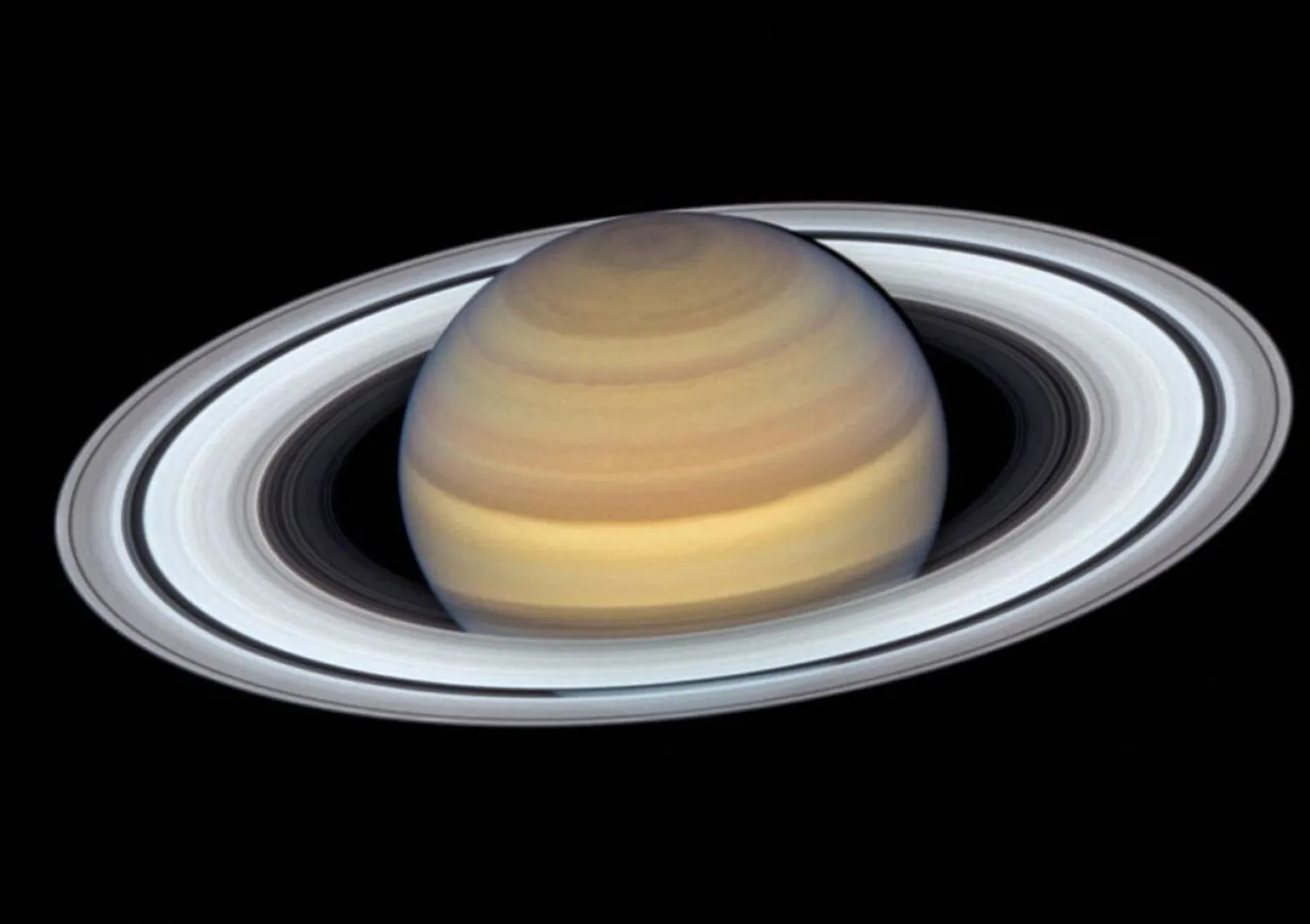
Saturn's rings are seen as viewed by NASA's Cassini spacecraft, which obtained the images that comprise this mosaic at a distance of approximately 450,000 miles (725,000 km) from Saturn on April 25, 2007. (Reuters-NASA/JPL-Caltech/Space Science)
TT

New Study Adds to the Possibility of Favorable Conditions for Life at Saturn’s Moon Enceladus 

Saturn's rings are seen as viewed by NASA's Cassini spacecraft, which obtained the images that comprise this mosaic at a distance of approximately 450,000 miles (725,000 km) from Saturn on April 25, 2007. (Reuters-NASA/JPL-Caltech/Space Science)

Scientists have uncovered new types of organics in icy geysers spouting from Saturn’s moon Enceladus, bolstering the likelihood that the ocean world may harbor conditions suitable for life.

Their findings, reported Wednesday, are based on observations made by NASA’s Cassini spacecraft in 2008 during a close and fast flyby of Enceladus. The small moon, one of 274 orbiting Saturn, has long been considered a prime candidate in the search for life beyond Earth because of its hidden ocean and plumes of water erupting from cracks near its south pole.

While Enceladus may be habitable, no one is suggesting that life exists.

“Being habitable and being inhabited are two very different things. We believe that Enceladus is habitable, but we do not know if life is indeed present,” said the University of Washington's Fabian Klenner, who took part in the study.

An international team decided to launch a fresh analysis of tiny grains of ice encountered as Cassini flew through the moon's geysers. The grains were young compared with the much older geyser particles that ended up in one of Saturn’s outermost rings.

These new grains collided with Cassini’s cosmic dust analyzer at 40,000 mph (64,800 kph), faster than the old ones. The increased speed provided a clearer view of the chemical compounds present, the scientists noted.

Organic molecules already had been spotted in the old geyser grains, but their age raised questions as to whether they had been altered over the years by space radiation.

Scientists found some of the same molecules in the fresh grains, confirming they came from the moon’s underground sea, as well as new chemical compounds. The findings were published in Nature Astronomy.

An ice-encapsulated water world barely 310 miles (500 kilometers) across with a rocky core, Enceladus is suspected of having hydrothermal vents on its ocean floor, quite possibly like those in the Arctic. The moon's jets of water vapor and frozen particles can stretch thousands of miles (kilometers) into space.

“We are confident that these molecules originate from the subsurface ocean of Enceladus, enhancing its habitability potential,” the Free University of Berlin’s Nozair Khawaja, the lead author, said in an email.

The scientists favor new missions to further explore Enceladus. Launched in 1997, Cassini is long gone; the spacecraft was deliberately plunged into Saturn in 2017 following its joint mission by NASA, the European Space Agency and the Italian Space Agency.

“Having a variety of organic compounds on an extraterrestrial water world is simply phenomenal,” Klenner said in an email.

The European Space Agency is in the early planning stages of a mission to land on Enceladus decades from now. China also has proposed a landing mission.

NASA has a spacecraft en route to another enticing target to hunt for the ingredients of life: Jupiter's moon Europa. The Europa Clipper is expected to begin orbiting Jupiter in 2030 with dozens of Europa flybys. ESA also has a spacecraft, Juice, that's headed to Jupiter to explore Europa and two other icy moons that could hold buried oceans.

Underground oceans on moons “are perhaps the best candidates for the emergence of extraterrestrial life in our solar system. This work only confirms the need for further studies,” said University of Kent physics professor Nigel Mason, who was not involved in the latest findings.



US Astronaut to Take her 3-year-old's Cuddly Rabbit Into Space

FILE PHOTO: An evening launch of a SpaceX Falcon 9 rocket carrying 20 Starlink V2 Mini satellites, from Space Launch Complex at Vandenberg Space Force Base is seen over the Pacific Ocean from Encinitas, California, US, June 23, 2024. REUTERS/Mike Blake/File Photo
TT

US Astronaut to Take her 3-year-old's Cuddly Rabbit Into Space

FILE PHOTO: An evening launch of a SpaceX Falcon 9 rocket carrying 20 Starlink V2 Mini satellites, from Space Launch Complex at Vandenberg Space Force Base is seen over the Pacific Ocean from Encinitas, California, US, June 23, 2024. REUTERS/Mike Blake/File Photo

When the next mission to the International Space Station blasts off from Florida next week, a special keepsake will be hitching a ride: a small stuffed rabbit.

American astronaut and mother, Jessica Meir, one of the four-member crew, revealed Sunday that she'll take with her the cuddly toy that belongs to her three-year-old daughter.

It's customary for astronauts to go to the ISS, which orbits 250 miles (400 kilometers) above Earth, to take small personal items to keep close during their months-long stint in space.

"I do have a small stuffed rabbit that belongs to my three-year-old daughter, and she actually has two of these because one was given as a gift," Meir, 48, told an online news conference.

"So one will stay down here with her, and one will be there with us, having adventures all the time, so that we'll keep sending those photos back and forth to my family," AFP quoted her as saying.

US space agency NASA says SpaceX Crew-12 will lift off on a SpaceX Falcon 9 rocket from Cape Canaveral in Florida to the orbiting scientific laboratory early Wednesday.

The mission will be replacing Crew-11, which returned to Earth in January, a month earlier than planned, during the first medical evacuation in the space station's history.

Meir, a marine biologist and physiologist, served as flight engineer on a 2019-2020 expedition to the space station and participated in the first all-female spacewalks.

Since then, she's given birth to her daughter. She reflected Sunday on the challenges of being a parent and what is due to be an eight-month separation from her child.

"It does make it a lot difficult in preparing to leave and thinking about being away from her for that long, especially when she's so young, it's really a large chunk of her life," Meir said.

"But I hope that one day, she will really realize that this absence was a meaningful one, because it was an adventure that she got to share into and that she'll have memories about, and hopefully it will inspire her and other people around the world," Meir added.

When the astronauts finally get on board the ISS, they will be one of the last crews to live on board the football field-sized space station.

Continuously inhabited for the last quarter century, the aging ISS is scheduled to be pushed into Earth's orbit before crashing into an isolated spot in the Pacific Ocean in 2030.

The other Crew-12 astronauts are Jack Hathaway of NASA, European Space Agency astronaut Sophie Adenot, and Russian cosmonaut Andrey Fedyaev.


iRead Marathon Records over 6.5 Million Pages Read

Participants agreed that the number of pages read was not merely a numerical milestone - SPA
TT

iRead Marathon Records over 6.5 Million Pages Read

Participants agreed that the number of pages read was not merely a numerical milestone - SPA

The fifth edition of the iRead Marathon achieved a remarkable milestone, surpassing 6.5 million pages read over three consecutive days, in a cultural setting that reaffirmed reading as a collective practice with impact beyond the moment.

Hosted at the Library of the King Abdulaziz Center for World Culture (Ithra) and held in parallel with 52 libraries across 13 Arab countries, including digital libraries participating for the first time, the marathon reflected the transformation of libraries into open, inclusive spaces that transcend physical boundaries and accommodate diverse readers and formats.

Participants agreed that the number of pages read was not merely a numerical milestone, but a reflection of growing engagement and a deepening belief in reading as a daily, shared activity accessible to all, free from elitism or narrow specialization.

Pages were read in multiple languages and formats, united by a common conviction that reading remains a powerful way to build genuine connections and foster knowledge-based bonds across geographically distant yet intellectually aligned communities, SPA reported.

The marathon also underscored its humanitarian and environmental dimension, as every 100 pages read is linked to the planting of one tree, translating this edition’s outcome into a pledge of more than 65,000 trees. This simple equation connects knowledge with sustainability, turning reading into a tangible, real-world contribution.

The involvement of digital libraries marked a notable development, expanding access, strengthening engagement, and reinforcing the library’s ability to adapt to technological change without compromising its cultural role. Integrating print and digital reading added a contemporary dimension to the marathon while preserving its core spirit of gathering around the book.

With the conclusion of the iRead Marathon, the experience proved to be more than a temporary event, becoming a cultural moment that raised fundamental questions about reading’s role in shaping awareness and the capacity of cultural initiatives to create lasting impact. Three days confirmed that reading, when practiced collectively, can serve as a meeting point and the start of a longer cultural journey.


Imam Turki bin Abdullah Royal Reserve Launches Fifth Beekeeping Season

Jazan’s Annual Honey Festival - File Photo/SPA
TT

Imam Turki bin Abdullah Royal Reserve Launches Fifth Beekeeping Season

Jazan’s Annual Honey Festival - File Photo/SPA

The Imam Turki bin Abdullah Royal Nature Reserve Development Authority launched the fifth annual beekeeping season for 2026 as part of its programs to empower the local community and regulate beekeeping activities within the reserve.

The launch aligns with the authority's objectives of biodiversity conservation, the promotion of sustainable environmental practices, and the generation of economic returns for beekeepers, SPA reported.

The authority explained that this year’s beekeeping season comprises three main periods associated with spring flowers, acacia, and Sidr, with the start date of each period serving as the official deadline for submitting participation applications.

The authority encouraged all interested beekeepers to review the season details and attend the scheduled virtual meetings to ensure organized participation in accordance with the approved regulations and the specified dates for each season.