


Egypt Working to Convince Hamas to Accept Trump Plan, Says Foreign Minister

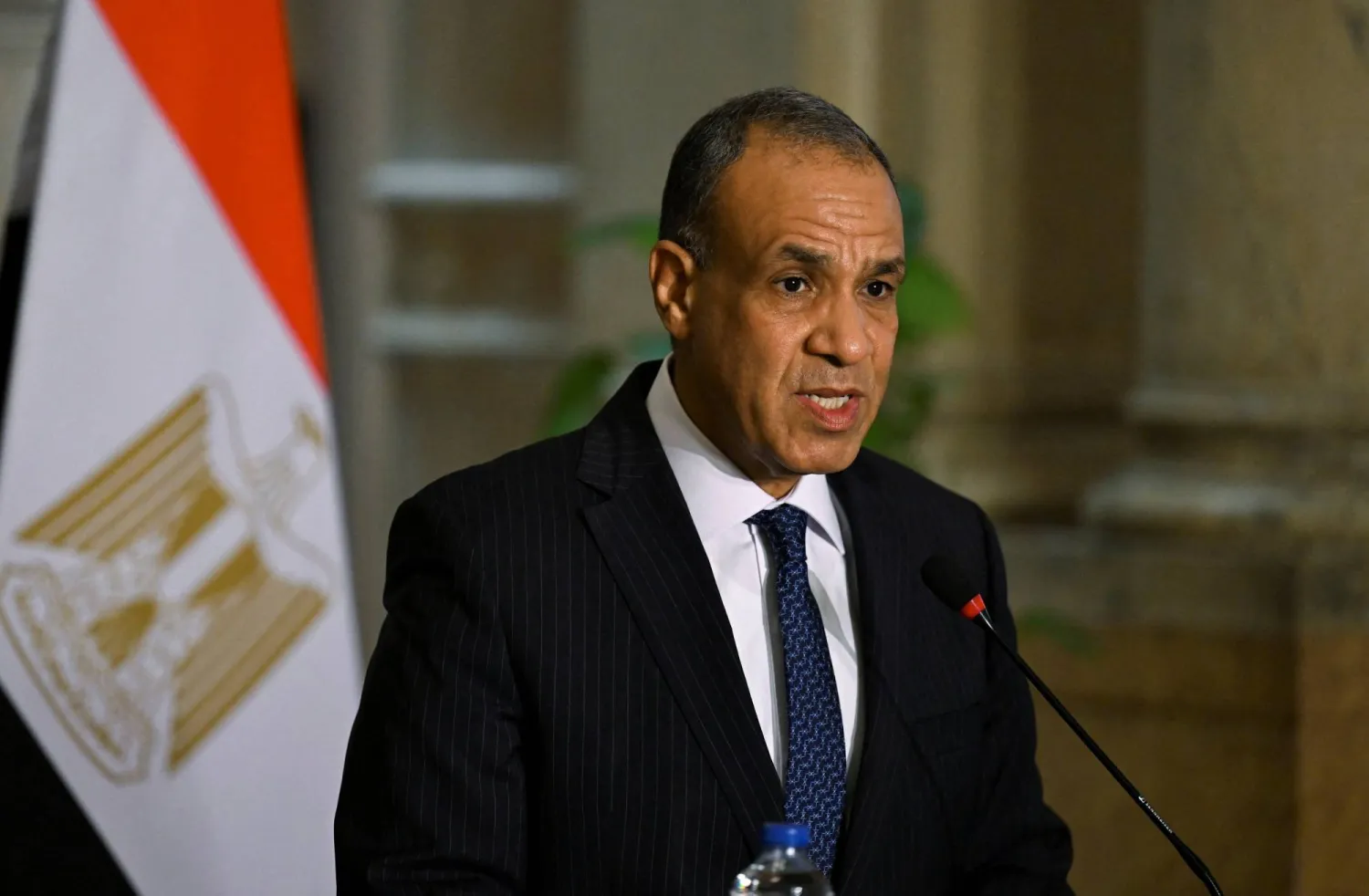
Egyptian Foreign Minister Badr Abdelatty speaks during a press conference with Philippe Lazzarini, Commissioner-General of the United Nations Relief and Works Agency for Palestine Refugees in the Near East (UNRWA) (not pictured), in Cairo, Egypt September 6, 2025. REUTERS/Mohamed Abd El Ghany
TT

Egypt Working to Convince Hamas to Accept Trump Plan, Says Foreign Minister

Egyptian Foreign Minister Badr Abdelatty speaks during a press conference with Philippe Lazzarini, Commissioner-General of the United Nations Relief and Works Agency for Palestine Refugees in the Near East (UNRWA) (not pictured), in Cairo, Egypt September 6, 2025. REUTERS/Mohamed Abd El Ghany

Egypt's foreign minister said on Thursday that Cairo was working with Qatar and Türkiye to convince Hamas to accept US President Donald Trump's plan to end a nearly two-year-old war in Gaza, and warned the conflict would escalate if the militant group refused.

Speaking at the French Institute of International Relations in Paris, Badr Abdelatty said it was clear that Hamas had to disarm and that Israel should not be given an excuse to carry on with its offensive in Gaza.

"Let's not give any excuse for one party to use Hamas as a pretext for this mad daily killings of civilians. What's happening is far beyond the seventh of October," he said, referring to the group's 2023 attack on Israel, in which 1,200 people were killed and more than 200 people taken hostage, according to Israeli tallies.

Israel's offensive has killed over 66,000 people in Gaza, Palestinian health authorities say.

"It is beyond revenge. This is ethnic cleansing and genocide in motion. So enough is enough," Abdelatty said.

The White House unveiled earlier this week a 20-point document that called for an immediate ceasefire, an exchange of hostages held by Hamas for Palestinian prisoners held by Israel, a staged Israeli withdrawal from Gaza, Hamas disarmament and a transitional government led by an international body.

On Tuesday, Trump gave Hamas three to four days to agree to the plan.

Egypt is a key mediator in efforts to end the Gaza war and Abdelatty said Cairo was coordinating with Qatar and Türkiye to convince Hamas to respond positively to the plan, but he remained very cautious.

"If Hamas refuse, you know, then it would be very difficult. And of course, we will have more escalation. So that's why we are exerting our intensive efforts in order to make this plan applicable and to get the approval of Hamas,” he said. Abdelatty said while he was broadly supportive of Trump's proposal for Gaza, more talks were needed on it.

"There are a lot of holes that need to be filled, we need more discussions on how to implement it, especially on two important issues - governance and security arrangements," he said. "We are supportive of the Trump plan and the vision to end war and need to move forward."

When asked whether he feared the Trump plan could lead to forced displacement of Palestinians, he said Egypt would not accept that.

"Displacement will not happen, it will not happen because displacement means the end of the Palestinian cause," he said. "We will not allow this to happen under any circumstances."


Israel Says Killed Four Militants Exiting Tunnel in Gaza’s Rafah

Boys walk past the rubble of destroyed buildings in the Jabalia camp for Palestinian refugees in the northern Gaza Strip on February 8, 2026. (AFP)
TT

Israel Says Killed Four Militants Exiting Tunnel in Gaza’s Rafah

Boys walk past the rubble of destroyed buildings in the Jabalia camp for Palestinian refugees in the northern Gaza Strip on February 8, 2026. (AFP)

Israel's military said it killed four suspected militants who attacked its troops as the armed men emerged from a tunnel in southern Gaza on Monday, calling the group's actions a "blatant violation" of the ceasefire.

Despite a US-brokered truce entering its second phase last month, violence has continued in the Gaza Strip, with Israel and Hamas accusing each other of breaching the agreement.

"A short while ago, four armed terrorists exited an underground tunnel shaft and fired towards soldiers in the Rafah area in the southern Gaza Strip.... Following identification, the troops eliminated the terrorists," the military said in a statement.

It said none of its troops had been injured in the attack, which it called a "blatant violation of the ceasefire agreement" between Israel and Hamas.

Israeli troops "are continuing to operate in the area to locate and eliminate all the terrorists within the underground tunnel route", the military added.

Gaza health officials have said Israeli air strikes last Wednesday killed 24 people, with Israel's military saying the attacks were in response to one of its officers being wounded by enemy gunfire.

That wave of strikes came after Israel partly reopened the Rafah border crossing between Gaza and Egypt on February 2, the only gateway to the Palestinian territory that does not pass through Israel.

Israeli forces seized control of the crossing in May 2024 during the war with Hamas, and it had remained largely closed since.

Around 180 Palestinians have left the Gaza Strip since Rafah's limited reopening, according to officials in the territory.

Israel has so far restricted passage to patients and their accompanying relatives.

The second phase of the Gaza ceasefire foresees a demilitarization of the territory -- including the disarmament of Hamas -- along with a gradual withdrawal of Israeli forces.

Hamas has repeatedly said that disarmament is a red line, although it has indicated it could consider handing over its weapons to a future Palestinian governing authority.

Israeli officials say Hamas still has around 20,000 fighters and about 60,000 Kalashnikovs in Gaza.

A Palestinian technocratic committee has been set up with a goal of taking over day-to-day governance in the strip, but it remains unclear whether, or how, it will address the issue of demilitarization.


Building Collapse in Lebanon's Tripoli Kills 13, Search for Missing Continues

Rescue workers and residents search for survivors in the rubble of a building that collapsed in the northern city of Tripoli, Lebanon, Sunday, Feb. 8, 2026. (AP Photo)
TT

Building Collapse in Lebanon's Tripoli Kills 13, Search for Missing Continues

Rescue workers and residents search for survivors in the rubble of a building that collapsed in the northern city of Tripoli, Lebanon, Sunday, Feb. 8, 2026. (AP Photo)

The death toll from the collapse of a residential building in the Lebanese city of Tripoli rose to 13, as rescue teams continued to search for missing people beneath the rubble, Lebanon's National News ‌Agency reported ‌on Monday. 

Rescue ‌workers ⁠in the ‌northern city's Bab al-Tabbaneh neighborhood have also assisted nine survivors, while the search continued for others still believed to be trapped under the ⁠debris, NNA said. 

Officials said on ‌Sunday that two ‍adjoining ‍buildings had collapsed. 

Abdel Hamid Karameh, ‍head of Tripoli's municipal council, said he could not confirm how many people remained missing. Earlier, the head of Lebanon's civil defense rescue ⁠service said the two buildings were home to 22 residents, reported Reuters. 

A number of aging residential buildings have collapsed in Tripoli, Lebanon's second-largest city, in recent weeks, highlighting deteriorating infrastructure and years of neglect, state media reported, ‌citing municipal officials. 


Salam Concludes Visit to South Lebanon: Region Must Return to State Authority

Lebanon's Prime Minister Nawaf Salam (L) holds bouquets of flower as he stands next to the mayor of the heavily-damaged southern village of Kfar Shouba, near the border with Israel, during his visit on February 8, 2026. (AFP)
TT

Salam Concludes Visit to South Lebanon: Region Must Return to State Authority

Lebanon's Prime Minister Nawaf Salam (L) holds bouquets of flower as he stands next to the mayor of the heavily-damaged southern village of Kfar Shouba, near the border with Israel, during his visit on February 8, 2026. (AFP)

Lebanese Prime Minister Nawaf Salam vowed on Sunday to work on rebuilding infrastructure in southern villages that were destroyed by Israel during its last war with Hezbollah.

On the second day of a tour of the South, he declared: “We want the region to return to the authority of the state.”

He was warmly received by the locals as he toured a number of border villages that were destroyed by Israel during the conflict. His visit included Kfar Kila, Marjeyoun, Kfar Shouba and Kfar Hamam. He kicked off his tour on Saturday by visiting Tyre and Bint Jbeil.

The visit went above the differences between the government and Hezbollah, which has long held sway over the South. Throughout the tour, Salam was greeted by representatives of the “Shiite duo” of Hezbollah and its ally the Amal movement, as well as MPs from the Change bloc and others opposed to Hezbollah.

In Kfar Kila, the locals raised a banner in welcome of the PM, also offering him flowers and an olive branch. The town was the worst hit during the war with Israel, which destroyed nearly 90 percent of its buildings and its forces regularly carrying out incursions there.

Salam said the town was “suffering more than others because of the daily violations and its close proximity to the border.”

He added that its residents cannot return to their homes without the reconstruction of its infrastructure, which should kick off “within the coming weeks.”

“Our visit underlines that the state and all of its agencies stand by the ruined border villages,” he stressed.

“The government will continue to make Israel commit” to the ceasefire agreement, he vowed. “This does not mean that we will wait until its full withdrawal from occupied areas before working on rehabilitating infrastructure.”

Amal MP Ali Hassan Khalil noted that the people cannot return to their town because it has been razed to the ground by Israel and is still coming under its attacks.

In Marjeyoun, Salam said the “state has long been absent from the South. Today, however, the army has been deployed and we want it to remain so that it can carry out its duties.”

“The state is not limited to the army, but includes laws, institutions, social welfare and services,” he went on to say.

Reconstruction in Marjeyoun will cover roads and electricity and water infrastructure. The process will take months, he revealed, adding: “The state is serious about restoring its authority.”

“We want this region to return to the fold of the state.”

MP Elias Jarade said the government “must regain the trust of the southerners. This begins with the state embracing and defending its people,” and protecting Lebanon’s sovereignty.

MP Firas Hamdan said the PM’s visit reflects his keenness on relations with the South.

Ali Murad, a candidate who ran against Hezbollah and Amal in Marjeyoun, said the warm welcome accorded to Salam demonstrates that the “state needs the South as much as the people of the South need the state.”

“We will always count on the state,” he vowed.

Hezbollah MP Hussein Jishi welcomed Salam’s visit, hoping “it would bolster the southerners’ trust in the state.”

Kataeb leader MP Sami Gemayel remarked that the warm welcome accorded to the PM proves that the people of the South “want the state and its sovereignty. They want legitimate institutions that impose their authority throughout Lebanon, without exception.”
